Towards a consistent perturbation theory at finite temperature
Published 12 Jun 2026 in hep-ph, hep-lat, hep-th, and nucl-th | (2606.14863v1)
Abstract: The standard approach to perturbation theory for finite-temperature quantum field theories has several issues, including the appearance of ill-defined on-shell contributions in the real-time formulation, and infrared diverges in massless theories. Earlier studies indicate that these issues all stem from the inconsistent thermal generalisation of the Gell-Mann-Low relation, which forms the foundation of perturbation theory in vacuum. This inconsistency arises from the use of free scattering states in the relation, which are known not to exist in interacting thermal theories. In this work, we propose a generalisation of the Gell-Mann-Low relation for scalar theories based on non-perturbative spectral insights, namely that finite-temperature scattering states can be described by damped but stable particle-like excitations, so-called thermoparticles. The perturbative expansion of this generalised relation gives rise to contributions with exactly the same topology as the standard finite-temperature approach, except that now the propagators appearing in this expansion are not those of a free field but of thermoparticles, which depend on the dynamics of the theory. We demonstrate that thermoparticle perturbation theory resolves the known problems of the standard approach. Furthermore, by comparing imaginary-time calculations at two-loop level with numerical lattice simulations of two-point correlation functions in massive $φ{4}$ theory, we explicitly show that this framework gives rise to precise predictions, as in the vacuum case, in stark contrast to the standard approach.
The paper's main contribution is the formulation of thermoparticle perturbation theory (TPPT) that replaces free-particle states to eliminate pinch singularities and regulate infrared divergences.
It validates TPPT through lattice QFT tests in massive φ⁴ theory, achieving pointwise agreement with data within 1% across various temperatures.
The framework provides a consistent, physically meaningful basis for thermal quantum field theories, with promising extensions to fermionic and gauge models.
Consistent Perturbation Theory at Finite Temperature via Thermoparticles
Introduction and Motivation
The paper "Towards a consistent perturbation theory at finite temperature" (2606.14863) presents a rigorous reconsideration of perturbation theory (PT) for quantum field theories (QFTs) at finite temperature, targeting long-standing inconsistencies when extending vacuum-based approaches to thermal environments. The conventional methodology, built on the Gell-Mann–Low (GML) relation with free asymptotic states, fails at nonzero temperature due to the absence of legitimate free-particle states in an interacting thermal medium. This foundational flaw induces critical issues: ill-defined on-shell contributions (pinch singularities), unmanageable infrared (IR) divergences in massless theories, and severe degradation in series convergence—even for massive models.
The central contribution of the paper is the construction of a perturbative expansion based not on free-particle states but on "thermoparticles"—broadened, dynamically damped, yet stable excitations, as required by fundamental theorems in thermal QFT. This framework—thermoparticle perturbation theory (TPPT)—both structurally and numerically remedies the inconsistencies of the canonical approach, as substantiated by precise lattice QFT tests in the context of massive ϕ4 theory.
Limitations of the Standard Finite-Temperature Perturbative Approach
The naive extension of the GML relation to finite T involves taking thermal instead of vacuum expectation values, structurally maintaining the expansion in terms of free-field asymptotic states. In the real-time Schwinger-Keldysh formalism, this results in a class of thermal propagators with explicit on-shell δ-function terms and pole structures analogous to the vacuum, modulated by Bose-Einstein occupation numbers. Problems quickly arise:
On-shell singularities: At any nontrivial (i.e., higher-loop) order, products like δ(p2−m2)2 appear, which are mathematically undefined. Although these pinch singularities algebraically cancel when summing all diagrams for physical observables, each diagram individually is ill-defined, necessitating artificial regularization.
Infrared divergences: In massless theories, lines with Matsubara frequency zero lead to integrals that diverge as ∣p∣→0. Various resummation and effective theory techniques (e.g., hard thermal loops, screened PT, 2PI formalism) have only partial success—branch point singularities remain and analytic control is lost beyond low orders.
Poor convergence: Even in massive theories and at weak coupling, the convergence of perturbative expansions collapses as T increases, in stark contrast to the well-behaved vacuum case.
Theoretical inconsistency: The Narnhofer–Requardt–Thirring (NRT) theorem rigorously demonstrates that, at T>0 and with interactions, no nontrivial S-matrix can be built from free-particle asymptotic states. Free propagators are thus forbidden as the basis for consistent thermal PT.
Thermoparticles: The Correct Asymptotic Degrees of Freedom
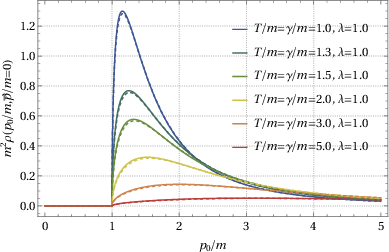
Non-perturbative axiomatic studies have established that, at finite T, the long-time, large-distance excitations are not free particles but "thermoparticles": states characterized by a spectral function ρ(p0,p) broadened from a sharp mass shell p2=m2 to a distribution governed by a temperature- and dynamics-dependent damping kernel. The thermoparticle two-point function includes an exponential spatial damping factor, encoding information about interactions and the thermal bath.
Key properties of thermoparticles:
The spectral function exhibits a mass threshold, T0, reflecting the lowest excitation energy cost.
The spatial correlator decays exponentially with a damping scale that depends on T1 and the coupling.
The approach is consistent with the NRT theorem: thermoparticles do not possess purely real dispersion relations and, crucially, are not free.
This framework is supported empirically by lattice studies in scalar and QCD-like theories, where the measured spectral and correlation functions are always broadened as predicted by the thermoparticle ansatz.
Consistent Finite-Temperature Perturbation Theory: The Thermoparticle Framework
The paper proposes a generalization of the GML relation with asymptotic fields taken to be the operators creating thermoparticle states. The perturbative expansion proceeds as in standard QFT, but the "propagators" appearing in internal lines are those of thermoparticles rather than free fields. Consequently, the Feynman diagram topology is preserved, but all singularities are regulated by physical (dynamical, temperature-dependent) broadening—not ad hoc procedures.
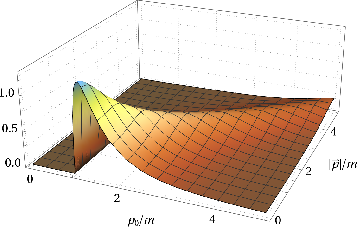
Figure 1: Leading order (solid) and one-loop (dashed) TPPT spectral functions at T2 for various T3 and T4, showing intrinsic broadening absent from the T5-function structure of standard PT.
Advantages include:
Elimination of on-shell singularities: The broadening of the propagator removes the sharp mass shell, so products of spectral functions in loop diagrams are always well-defined distributions.
Infrared finiteness: The thermoparticle propagator, by virtue of the momentum-space damping kernel, regulates zero-mode divergences even in the massless limit. No artificial resummation is required; the IR structure is physically screened.
No new UV divergences: The UV structure of the TPPT diagrams is identical to vacuum PT; standard renormalization suffices.
Physical interpretation: All regularization and analytic continuation is a reflection of the true thermal dynamics rather than a mathematical artifact.
Lattice Validation of Thermoparticle Perturbation Theory
To validate TPPT, the authors use high-precision lattice simulations of massive T6 theory. They compute two-point correlators and compare with both the standard perturbative predictions and those from TPPT, tuning only the damping parameter T7—which corresponds to the spatial broadening scale—by matching the spatial correlation function.
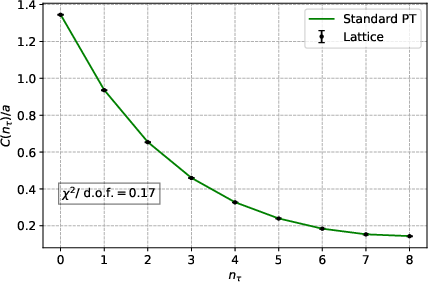
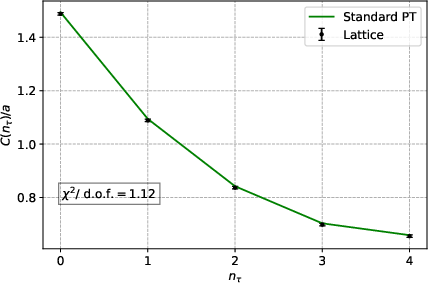
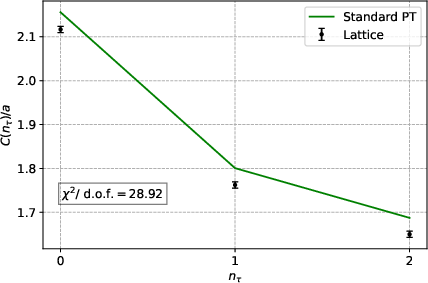
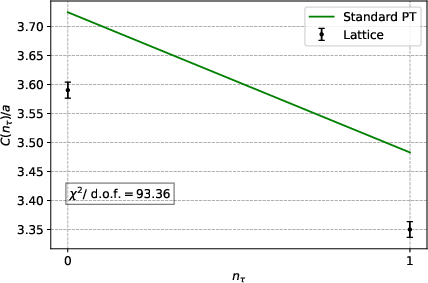
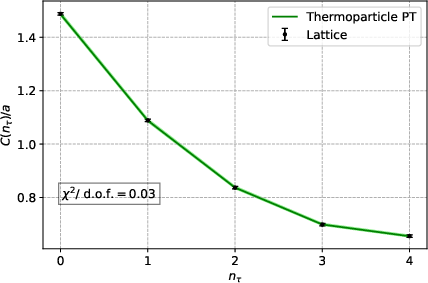
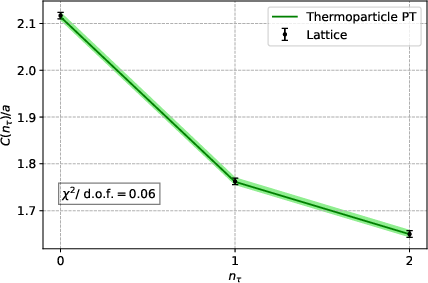
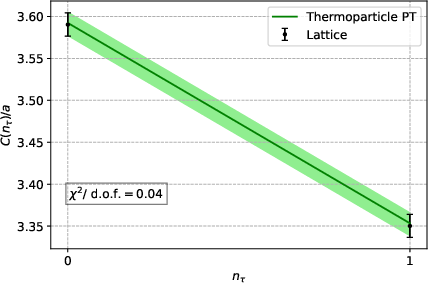
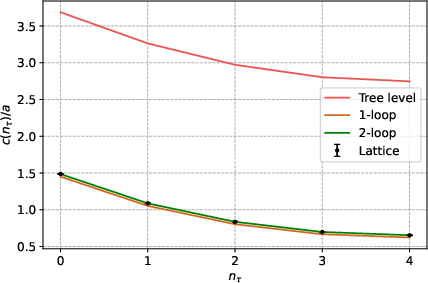
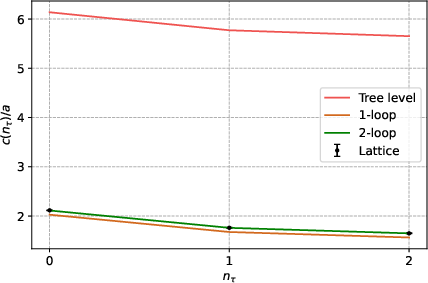
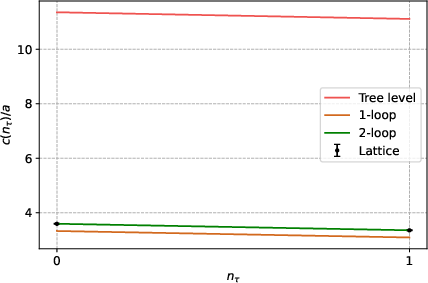
Parametric results: Tuning T8 to describe the spatial correlator, the TPPT predictions for the temporal correlator match the lattice data pointwise (within 1%) across all considered points, at two-loop order. In contrast, standard PT predictions rapidly diverge from the data as soon as T9 increases beyond the vacuum regime.
Figure 2: Two-loop standard PT predictions for the temporal correlator (lines) versus δ0 lattice data (points). Disagreement grows with δ1.
Figure 3: Two-loop TPPT predictions for the temporal correlator, with δ2 fixed from the spatial channel, accurately track the lattice data for all δ3.
Figure 4: Successive TPPT predictions (tree-level, one-loop, two-loop) converge asymptotically to the lattice data, demonstrating controlled behavior analogous to the vacuum case.
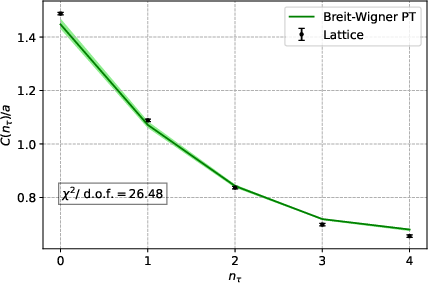
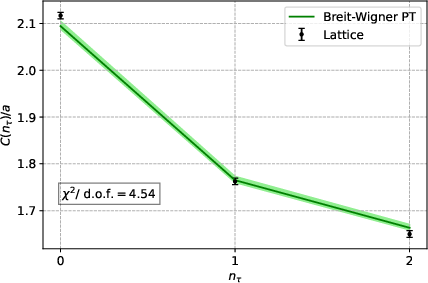
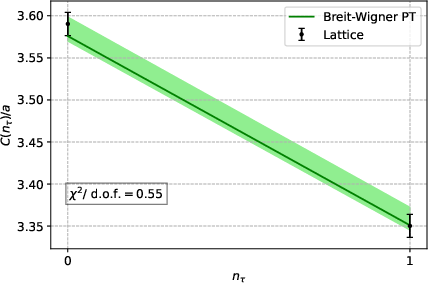
The robustness of the approach is further tested by substituting Breit-Wigner-like propagators (i.e., standard resonance ansatz with Lorentzian width) for the thermoparticle form. While these can be tuned to partially fit spatial correlators, predictions for the temporal channel become systematically worse, especially at low temperature, clarifying the necessity of the specific thermoparticle structure.
Figure 5: Two-loop Breit-Wigner PT predictions for the temporal correlator, adjusted to fit the spatial correlator, exhibit worse agreement with the data compared to TPPT.
Implications and Future Directions
This framework has significant consequences. For QFTs at finite δ4, PT should always be constructed on the basis of medium-modified, non-free excitations; otherwise, it is structurally inconsistent and unreliable beyond the δ5 regime. The TPPT approach provides a prescription that is fully renormalizable, operationally practical, and demonstrably predictive when tested against lattice computations.
Given the non-perturbative complexity of determining the thermoparticle damping kernel in general, this work opens new directions for future research:
Extension to fermionic and gauge theories (e.g., QED, QCD), where evidence for thermoparticle structure is already mounting (2606.14863, 2207.14718);
Analytical determination of the kernels in non-integrable systems;
Exploration of thermodynamic quantities and transport coefficients within the TPPT formalism;
Application to theories near phase transitions, where medium effects are maximally pronounced.
Conclusion
The thermoparticle formalism systematically resolves foundational and technical inconsistencies inherent to standard finite-temperature PT. By grounding the asymptotic structure of the perturbative expansion in the true thermal eigenmodes of the system, all calculations become structurally and physically meaningful. The lattice tests in massive scalar theory empirically confirm both the necessity and sufficiency of this approach for producing quantitatively reliable predictions. The implications are expected to be far-reaching for both formal field theory and phenomenological applications at nonzero δ6.
References
The technical presentation, methodology, and results discussed here are found in "Towards a consistent perturbation theory at finite temperature" (2606.14863) and references therein.
“Emergent Mind helps me see which AI papers have caught fire online.”
Philip
Creator, AI Explained on YouTube
Sign up for free to explore the frontiers of research
Discover trending papers, chat with arXiv, and track the latest research shaping the future of science and technology.Discover trending papers, chat with arXiv, and more.