- The paper proves that every unit-length arc is enclosed by a congruent copy of Wetzel’s 30–60–90 triangle through rigorous computer-assisted methods.
- The authors employ interval arithmetic and second-order cone programming to certify that the minimal chain length exceeds 1.0048, permitting a scaled reduction of the triangle’s area.
- The study advances geometric transversal theory by establishing a new convex cover with an area of 0.260956, thereby improving upon the previous best candidate.
Wetzel's 30∘–60∘–90∘ Triangle Covers All Unit Arcs: A Computer-Assisted Resolution
Introduction and Context
Covering plane curves of fixed length by small convex sets is central to geometric transversal theory and combinatorial geometry, notably manifesting in the Moser worm problem and Wetzel’s fits-and-covers program. Specifically, the problem addressed is: what is the smallest convex set that contains a congruent copy of every unit-length arc in the plane? Decades ago, Wetzel conjectured that two candidates— the 30∘ unit sector and a specific 30∘–60∘–90∘ triangle constructed by appending a square of side $1/3$ on its hypotenuse—cover this class.
While the sector case was previously settled, this paper ("Wetzel's 30-60-90 Triangle Covers Unit Arcs" (2606.14625)) rigorously resolves the triangle conjecture via a computer-assisted method, furnishing independently checkable interval certificates and leveraging advances in convex geometry, support-line theory, and modern convex optimization.
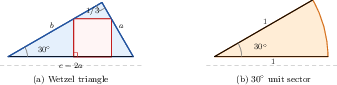
Figure 1: The two Wetzel candidates: (a) the 30∘–60∘–60∘0 triangle with inscribed 60∘1 square; (b) the 60∘2 unit sector.
Problem Formulation and Main Result
Let 60∘3 denote the 60∘4–60∘5–60∘6 triangle, with side 60∘7, 60∘8, and hypotenuse 60∘9. The area of 90∘0 is approximately 90∘1. The core theorem is:
Every plane unit arc is contained in a congruent copy of 90∘2.
A critical numerical strengthening follows: the minimum certified lower bound on chain length over all obstructions is 90∘3, allowing a homothetic shrink of 90∘4 by 90∘5 to area 90∘6, thereby producing a strictly smaller convex cover than the 90∘7 sector, which has area 90∘8.
Reduction Framework and Structural Analysis
The proof pipeline comprises a sequence of structural reductions:
- Arc Reduction: The Wetzel–Wichiramala theorem enables restriction to simple polygonal arcs.
- Support-Line and 90∘9-Property: The 30∘0-property yields a key contact configuration—every simple arc admits two parallel supports (30∘1, 30∘2) contacting the lower and upper extremes at 30∘3 and decomposing the arc accordingly.
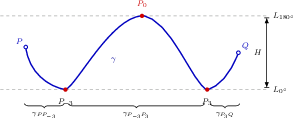
Figure 2: The 30∘4-property: horizontal supports 30∘5/30∘6 touch 30∘7 at 30∘8.
- Witness and Skeleton Construction: A finite vocabulary of contact points at prescribed angles is selected, organizing the arc's structure via a normal-fan skeleton supporting finite case analysis.
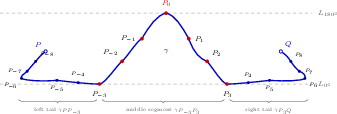
Figure 3: Index map: contacts 30∘9 and auxiliary contacts including inner and tail roles.
- Canonical Orientations of 30∘0: The possible placements of 30∘1 with respect to arcs are enumerated via a fixed system of canonical orientations, each enforced by the geometric configuration.
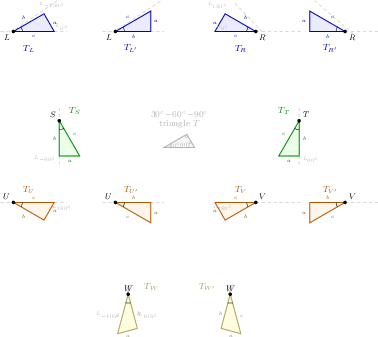
Figure 4: The twelve canonical orientations of 30∘2—floor, wall, ceiling, and wedge groupings.
Canonical Placements and Escape Predicate
In each canonical orientation, the short side of 30∘3 is positioned such that escaping the "wedge" defined by the triangle triggers an escape predicate: 30∘4, where 30∘5 is the anchor and 30∘6 the direction normal to the short side.
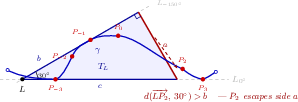
Figure 5: Escape predicate for 30∘7 orientation: arc must escape strictly beyond the short side.
For any hypothesized arc not covered by 30∘8, an escape inequality is forced in each placement, translating the overall problem into a finite system of affine and conic constraints.
Exhaustive Case Analysis and Constraint System
The structured case tree results from the possible roles (inner or tail) of 30∘9 and 60∘0 support contacts, yielding three principal cases:
- Case 1: Both 60∘1 contacts inner—leading to narrow shoulders.
- Case 2: One inner, one outer—an asymmetric situation.
- Case 3: Both 60∘2 contacts on the tails—wide tails branch.
All parameter/placement alternatives are controlled via support-contact ordering enforced by planarity and the normal-fan structure.
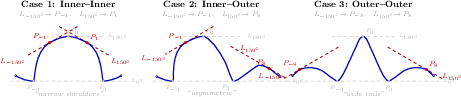
Figure 6: Geometric distinction between three main cases: inner/outer 60∘3 contacts affect arc-tail geometry.
This combinatorially exhaustive analysis produces twelve "terminal" representative models and 60∘4 auxiliary raw-order branches, for a total of 60∘5 second-order cone programs (SOCPs), each corresponding to a particular affine/contact configuration.
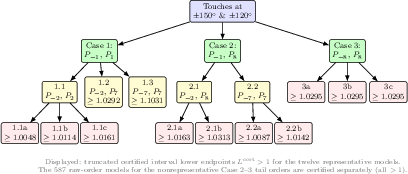
Figure 7: The branching case tree showing the finite case analysis structure.
Computer-Assisted Validation: Convex Optimization and Certificate Scheme
For each case, the minimal possible polygonal chain (lower bound for arc length) compatible with all incidence and escape constraints is computed via SOCP. Each model's minimum is validated by a robust dual certificate, with all constraints checked using interval arithmetic and verified singular-value floors, fully eliminating floating-point error sensitivity.
Key numerical results:
- Smallest certified lower endpoint is 60∘6 (Subcase 1.1a).
- All 60∘7 SOCPs yield certified optima exceeding 60∘8, with the weakest (most critical) raw-order endpoint 60∘9.
Terminal configurations and the associated forced predicate incidences are visually instantiated (Figure 8), showcasing geometric chains incompatible with a unit arc.
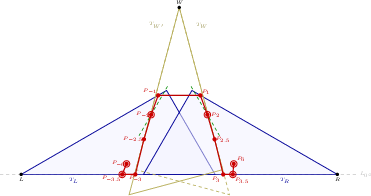
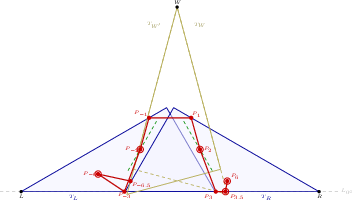
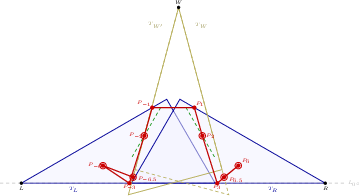
Figure 8: Example certified configurations for Subcase 1.1—floor, wedge, wall placements all unable to fit a unit arc congruent with 90∘0.
Implications and Certified Scaling
By scaling 90∘1 down by 90∘2, every escape and incidence constraint is strictly satisfied, so the rescaled triangle remains a universal cover for unit arcs. This produces a new best bound in the convex Wetzel-program setting—a triangle of area 90∘3 serves as a universal convex cover for unit arcs, strictly improving upon the previous 90∘4 sector.
Theoretical and Algorithmic Insights
The proof validates the efficacy of:
- Support-based combinatorics: Normal-fan order and planarity enforce strict limits on possible arc placements.
- Computational convex geometry: Modern SOCP, when coupled with sound interval verification, handles nontrivial geometric finite enumeration with full certification.
- Certified models: The pipeline demonstrates that machine-checked, interval-validated certificates yield concise, reproducible, and audit-ready proofs in geometric transversals, setting a precedent for future work in computational geometry and convex covering.
Future Directions
This resolution closes Wetzel’s triangle conjecture and establishes a novel area threshold within convex universal covers for unit arcs. The analytical framework and certificate infrastructure deployed here should generalize to broader classes of geometric covering problems. Open questions pertain to possible further reductions in cover area (potentially through more intricate convex shapes or through alternate polygonal configurations), as well as generalization to closed curves, higher-order transversals, or higher-dimensional analogues.
Conclusion
Every unit arc in the plane is contained within a congruent copy of the 90∘5–90∘6–90∘7 triangle described by Wetzel, with a rigorous, interval-certified computational margin. By leveraging geometry, convex optimization, and computer-aided verification, the result strengthens the program of finding minimal convex covers for unit arcs, establishes new area benchmarks, and validates the integration of rigorous computation into classical geometric extremal problems (2606.14625).