- The paper presents an actuator-agnostic impedance MPC framework that integrates algebraic feedforward and Kalman-based disturbance estimation for offset-free, high-precision dexterous hand control.
- It achieves milliradian-scale tracking accuracy and robust constraint enforcement through high-frequency (500 Hz) QP optimizations and predictive receding horizon control.
- Experimental benchmarks demonstrate significant improvements over classical impedance methods, ensuring safety and precision under diverse mechanical constraints.
Impedance MPC with Disturbance Estimation for Dexterous Hand Control
Introduction and Motivation
Dexterous robotic manipulation requires controllers that simultaneously deliver high-precision trajectory tracking and enforce compliance for safe contact, particularly when interacting with objects and humans. These objectives are inherently antagonistic for fixed-gain impedance-control architectures, which cannot simultaneously achieve high stiffness for accuracy and compliance for safety. The paper "Impedance MPC with Disturbance Estimation for Dexterous Hand Control" (2606.14606) presents an actuator-agnostic Impedance Model Predictive Control (MPC) framework that extends the offset-free, constant-Ad architecture first developed for physical human–robot interaction to the domain of dexterous tendon-driven fingers. The method leverages algebraic feedforward, augmented Kalman-based disturbance estimation, and efficient receding-horizon QP solves at 500 Hz, all while directly embedding mechanical and safety constraints in the control loop.
Architecture and Methodology
The proposed control pipeline is fundamentally platform-agnostic. The key operation is an algebraic feedforward that collapses the transmission physics (hydraulic, cable, pneumatic, twisted-string, series-elastic) to an effective, configuration-independent double integrator via identification of two parameters: effective joint inertia and damping. For example, in hydraulics, piston areas and mechanism geometry facilitate this reduction, yielding a scalar double-integrator as the residual plant for the MPC (Section 3). Substitutions for alternative tendon architectures are explicitly tabulated, demonstrating the controller’s extensibility.
Offset-Free Impedance MPC and Constraint Integration
Over this reduced system, the controller employs an offset-free Impedance MPC, leveraging a two-layer architecture:
- Feedforward cancellation removes the known transmission dynamics, isolating the error dynamics and uncertainty into a lumped disturbance.
- MPC Layer optimizes corrective input torques under receding-horizon predictions, with the state augmented by an integrated disturbance estimated via a steady-state Kalman filter from joint encoders alone.
Critically, all platform limitations—actuation bounds, jerk constraints, contact force per ISO/TS 15066, and, for hydraulics, cavitation and seal pressures—are formulated as hard or softly relaxed QP constraints. Consequently, any actuator’s physical limits are enforced at every optimization step, ensuring recursive feasibility and safety without post-hoc saturation.
Disturbance Estimation and Offset Rejection
An augmented Kalman observer on the encoder-derived position and velocity cancels steady-state errors induced by unknown but constant disturbances, ensuring zero position deviation under contact. Optional instrumentation (e.g., cylinder pressure for hydraulics) can be used to reduce estimator convergence time, but the offset-free guarantee is retained with only encoders. The estimator observes the disturbance as a random walk, enabling suppression of persistent torques and unmodeled effects.
Theoretical Guarantees and Implementation
Inheritance of stability, recursive feasibility, and input-to-state-stability properties from the reference architecture is ensured by preserving the required assumptions: bounded error in feedforward cancellation, positive-definite cost, convex (or soft-relaxed) constraints, and stabilizable double-integrator residual dynamics. The constant Ad structure permits all prediction matrices and the QP cost inverse to be precomputed offline, yielding sub-millisecond online control even at 500 Hz rates.
Single-Finger Hydraulic Benchmarks
In a suite of seven-controller benchmarks, the 500 Hz Kalman-augmented Impedance MPC achieves sub-milliradian errors: 0.5 mrad RMS, 0.1 mrad steady-state, and 6.6 mrad peak under a 1.5 Nm contact. This tracks a 183× reduction in RMS and 1500× in steady-state error compared to classical impedance control, in addition to a 23× improvement in peak deflection.
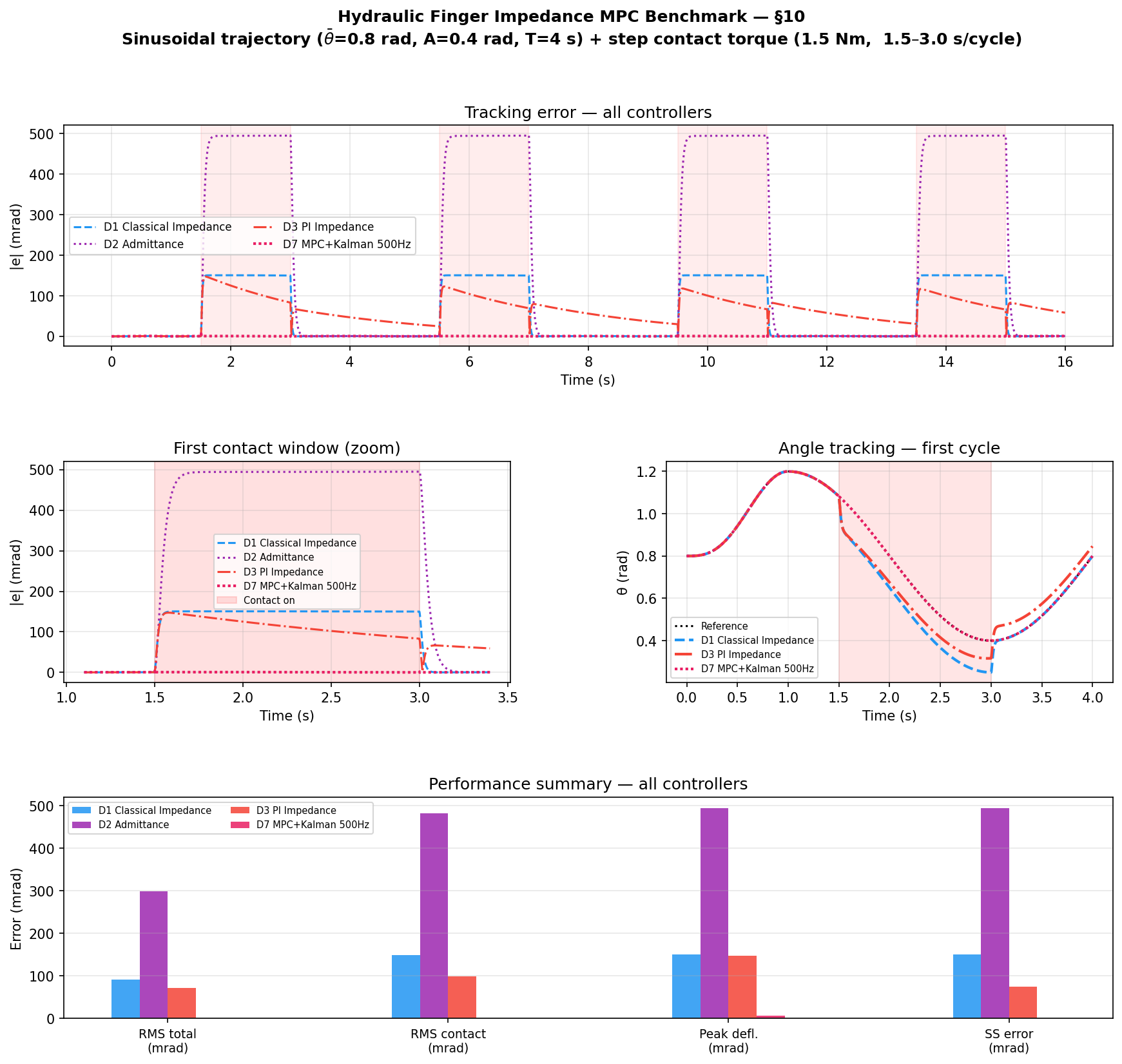
Figure 1: Sinusoidal tracking under cyclic 1.5 Nm step contact torque: the 500 Hz Kalman MPC’s error is indistinguishable from zero at this scale, easily outperforming the classical baselines.
Classical impedance is fundamentally limited in offset rejection (e∞=τext/Kd); admittance and PI impedance suffer from excessive yielding or slow integral windup and cross-contact windup, respectively. The no-Kalman MPC (predictive only) benefits from higher achievable stiffness as update rate increases—18 Nm/rad at 100 Hz to 323 Nm/rad at 500 Hz, outperforming the classic controller—but only the Kalman-augmented variant cancels steady-state error, as established by independent closed-loop gain/pole analyses.
A demanding sequential waypoint-tracking benchmark reveals that at 500 Hz, both non-estimator and estimator variants of MPC keep contact-onset/release transients and steady-state errors within a strict 15 mrad window at every waypoint. In contrast, at 100 Hz, all approaches fail on either steady-state, onset, or release transients.
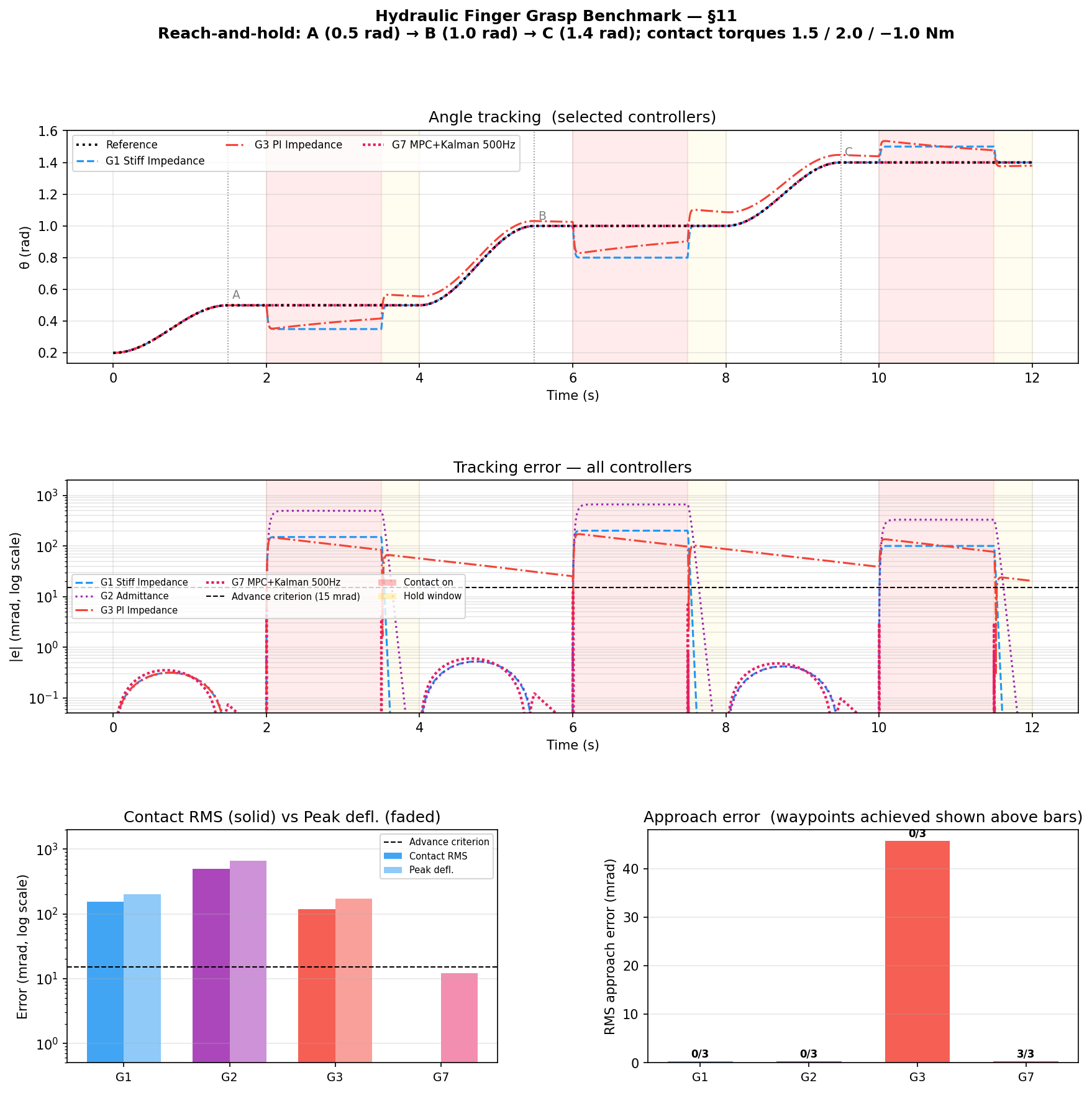
Figure 2: Precision reach-and-hold benchmark: only the 500 Hz Kalman MPC passes all advance criteria, achieving zero steady-state error.
For this high-bandwidth platform and tuning, fast receding-horizon control is strictly necessary for milliradian-class precision and contact resilience.
Multi-Finger Generalization: 16-DOF LEAP Hand Simulation
The architecture directly generalizes to high-DOF hands by running independent per-joint QPs, using per-joint mass and input bounds from the physical model. However, direct per-joint Kalman estimation of disturbances fails on the coupled thumb due to inertia variation, non-diagonal coupling, and unresolved self-contact reactions. These are systematically diagnosed and resolved via (i) online gain scheduling of thumb dynamics, (ii) block-structured disturbance estimation to capture coupling, and (iii) contact-aware gating of integration to prevent windup under kinematic constraint forces.
A 2.5 N disturbance applied to the power grasp is rejected within 0.7 s, with the hand settling to correct contact equilibria and bounded post-release jitter.
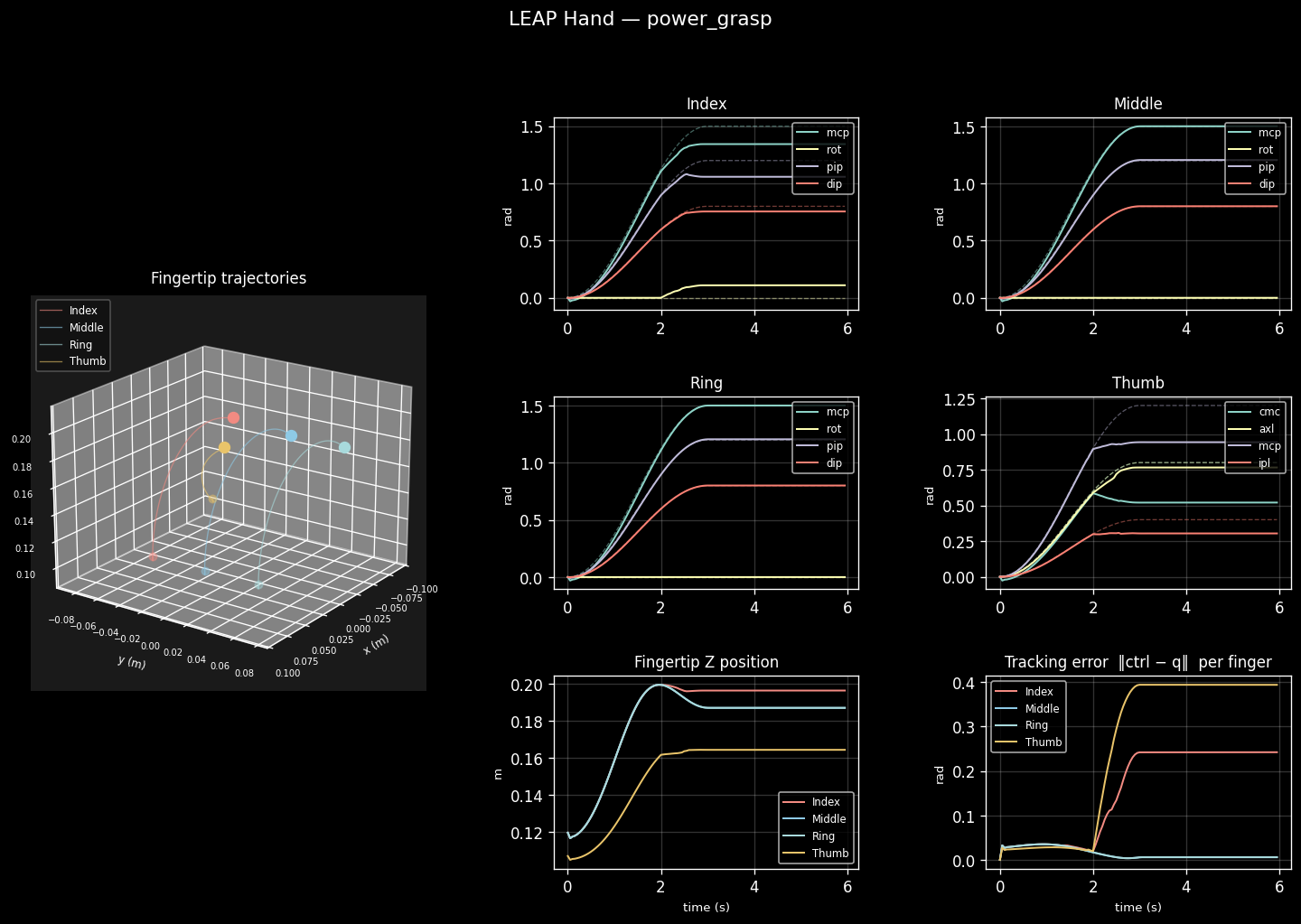
Figure 3: Power-grasp dashboard for the 16-DOF LEAP Hand: per-joint tracking, contact equilibria, and rejection of a 2.5 N disturbance during grasp hold.
Despite intentionally soft per-joint impedance for compliance, sub-20 mrad transients are achieved within 500–700 ms hold phases, and the robust constraint embedding ensures safe, predictable force closure throughout.
Implications and Future Perspectives
The actuator-independent MPC architecture represents a shift away from custom, platform-specific gain programming towards a formal, assumption-preserving template for high-bandwidth, precision-compliant manipulation. By reducing diverse tendon transmissions to a uniformly controlled double-integrator, and embedding structured constraint satisfaction and disturbance rejection, this approach enables controller portability across robotic hand platforms and actuator technologies, with efficient scaling to many-DOF hands. The precision and safety enforced under hard environmental constraints, without force or torque sensing, address long-standing open challenges identified in the manipulation literature.
Theoretical implications include reinforcing the criticality of high update rates when offset-free behavior and sharp contact transitions are required, as well as the limits of classical integral augmentation under sequential or multi-contact regimes. Practically, the hand-invariant MPC design enables deployment on both simulated and real-world platforms, currently validated up to a 16-DOF anthropomorphic hand.
Future work will involve experimental validation on hydraulic hardware, extension of the control model to regimes involving fluid compressibility (requiring augmented-state prediction), further refinement of the contact-aware estimation modules, and integration with learned policy architectures for grasp and object-class-conditioned impedance scheduling.
Conclusion
The paper delivers a rigorous, actuator-agnostic impedance MPC methodology that achieves milliradian-scale, offset-free precision in tendon-driven dexterous manipulation under contact. Strong empirical results on both single-finger and multi-finger hands support the bold claim that high-frequency receding-horizon control, combined with encoder-based disturbance estimation and direct constraint embedding, is necessary and sufficient for precise, safe manipulation beyond the limits of fixed-gain classical impedance. The work substantially advances high-reliability, platform-portable dexterous hand control and underlines the unavoidability of high update rates and estimator integration for next-generation safe robotic manipulation.

