- The paper presents a Redfield master equation approach that interpolates between local and global models with fidelity >0.999.
- Simulations using HOPS capture strong-coupling and non-Markovian effects, revealing universal low-temperature efficiency and interaction-tuned power output.
- Interaction-induced rectification yields diode-like heat flow and generates steady-state entanglement, highlighting potential for quantum thermal devices.
On-site Interactions and Non-Markovian Effects in Quantum Thermal Machines
Introduction and Model Architecture
This work investigates the role of on-site interactions and non-Markovian bath effects in a minimal quantum thermal machine: a two-site bosonic junction coupled to two thermal reservoirs. The central objectives are to elucidate how interactions influence steady-state transport, efficiency, rectification, and entanglement, and to rigorously benchmark different reduced dynamical descriptions that interpolate between Markovian local and global master equations.
The model consists of two bosonic sites with on-site interaction U, coupled by a tunneling amplitude g and each coupled to its own bath at temperatures Th and Tc by rates κh and κc, respectively. An optional external drive couples the two sites at frequency E. The bosonic statistics interpolate between a harmonic oscillator limit (U=0) and a qubit/spin limit (U→∞), providing a versatile platform Figure 1.
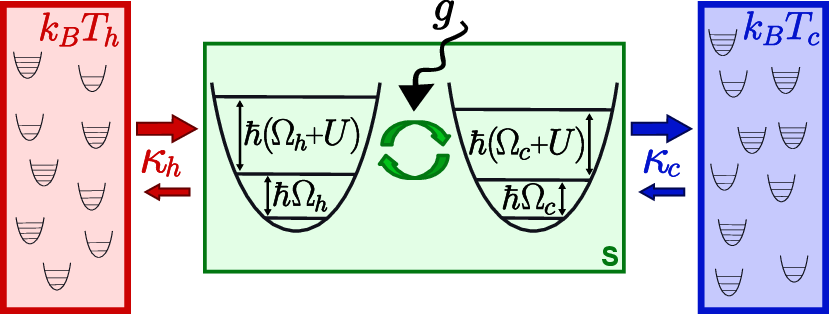
Figure 1: Schematic of the two-site quantum junction with tunable on-site interactions U and coupling parameters, enabling thermal machine operation via power generation from reservoir temperature differences.
Master Equations and Numerical Framework
The steady state and transport properties in the weak-coupling regime are analyzed using three master equation frameworks:
- Redfield Master Equation (RME): Retains the full non-secular structure, thus interpolates between the local (LME) and global (GME) limits and remains accurate across broad regimes of parameters. RME enables inclusion of non-Markovian and coherence effects not captured in the secular GME.
- Local Master Equation (LME): Treats each site–bath coupling independently, omitting intersite coherences and leading to thermodynamic inconsistencies in strong-coupling regimes.
- Global Master Equation (GME): Imposes the secular approximation and is appropriate at strong internal coupling, ensuring complete positivity but neglecting critical non-secular terms in many regimes.
Numerically exact solutions are obtained via (i) integration of the full Heisenberg equations for the quadratic, non-interacting limit, and (ii) the Hierarchy of Pure States (HOPS) pure-state stochastic methodology for arbitrary interaction strength and system–bath coupling, extending the simulation capacity to non-Markovian and strongly interacting regimes.
Figure 2 demonstrates that the RME not only interpolates between LME and GME in steady-state populations, but achieves superior quantitative agreement with exact solutions (fidelity g0) across a wide parameter range.
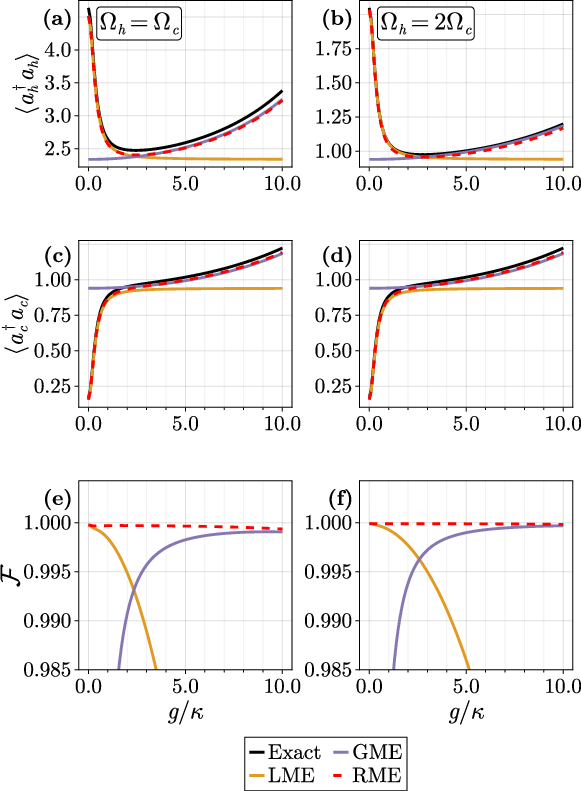
Figure 2: Steady-state populations and state fidelities for LME, GME, RME, and the exact method; RME unifies both limits and remains accurate in intermediate regimes.
Figure 3 visualizes the RME-exact method fidelity as a function of coupling and tunneling, further supporting the robustness of RME for weak to moderate dissipation strengths.
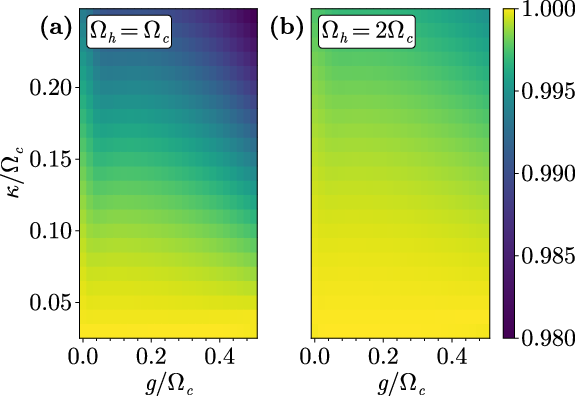
Figure 3: Steady-state fidelity between RME and the exact bath-integrated solution, confirming RME reliability up to moderate system–bath coupling strengths.
The paper explores how the on-site interaction g1 shapes continuous engine operation at both low and high temperatures, analyzing power output, heat currents, and efficiency. At low g2, the constitutive relation between g3 and g4 becomes independent of g5 upon appropriate rescaling, indicating a universal-like efficiency robustness.
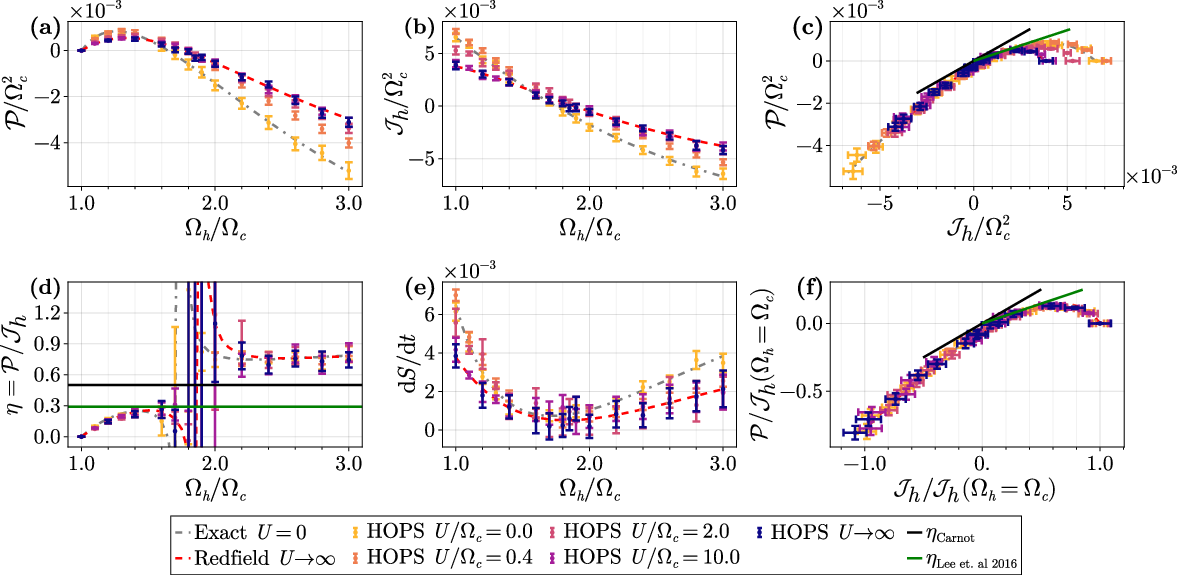
Figure 4: Low-temperature power, heat current, and efficiency. “Universal” efficiency scaling and insensitivity to g6 is evident across regimes.
At high g7, universality is broken: efficiency at maximum power becomes sensitive to g8, and higher g9 permits performance tuning via nonlinear spectral restructuring Figure 5. Notably, for Th0, results analytically connect to known universal values for two-qubit machines [lee_efficiency_2016].
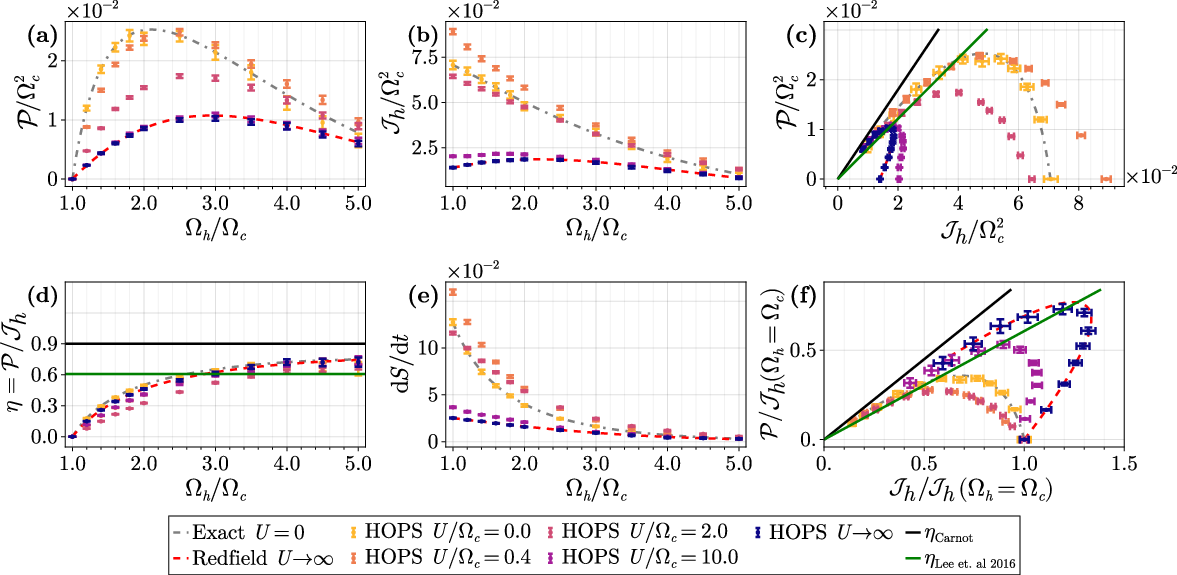
Figure 5: High-temperature regime showing interaction-dependent deviations in rescaled power–current characteristics and efficiency.
Rectification and Directional Heat Transport
When the bath couplings are asymmetric (Th1), the system acts as a quantum rectifier, with heat current magnitude depending on the direction of temperature bias. The degree of rectification is quantified via Th2 Figure 6. Rectification is negligible for Th3 but increases sharply with Th4, reaching saturation above Th5 and enabling fully diode-like response in the deeply interacting (qubit) regime.
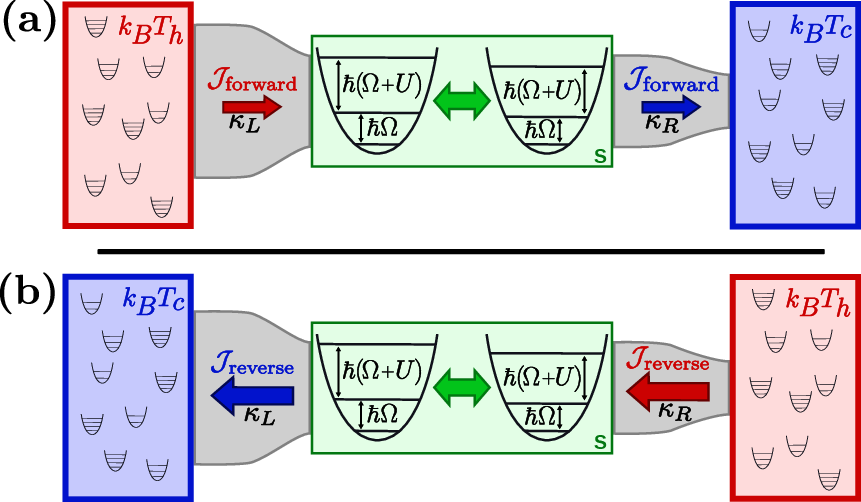
Figure 7: Definitions of forward/reverse heat currents under bath asymmetry for rectification analysis.
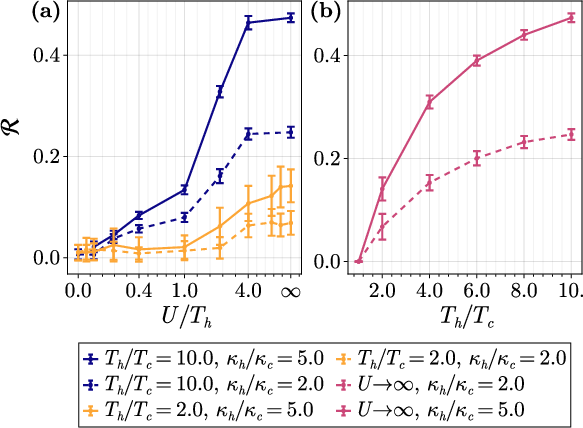
Figure 6: Rectification ratio Th6 as a function of Th7 and bath asymmetry, demonstrating strong non-reciprocity induced by interactions and bath coupling asymmetry.
Entanglement Generation
The study further reveals that interaction-induced nonlinearity, in combination with coupling asymmetry and favorable temperature gradients, leads to nonzero steady-state entanglement (log-negativity Th8) between the junction sites Figure 8. No operational regime supporting steady-state entanglement was found for the noninteracting limit (Th9), highlighting the necessity of nonlinear interactions for entanglement in this thermal context.
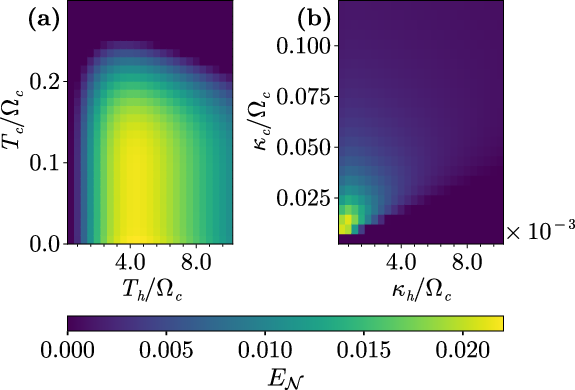
Figure 8: Steady-state log-negativity Tc0 as a function of temperatures and coupling asymmetries for the qubit regime, clarifying parameter domains supporting entanglement.
Non-Markovian Reservoir Effects and Spectrum
Engineering of the bath spectral density, e.g., altering the cutoff frequency or system-reservoir coupling, enables control over the transport spectrum and power output Figure 9. For moderate Tc1, heat current increases substantially with spectral width due to interaction-induced laddering of transition frequencies (see perturbative analysis in the paper).
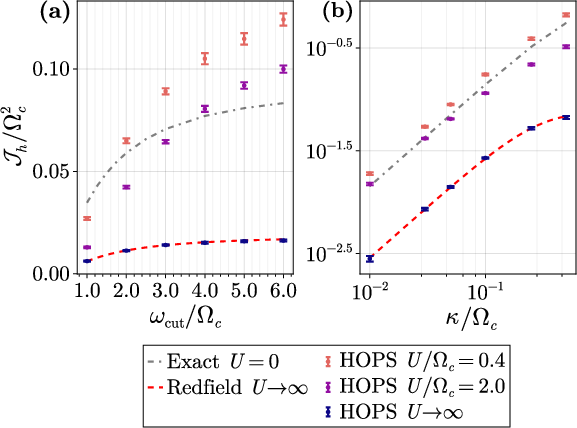
Figure 9: Heat current variation with bath spectral cutoff and system-bath coupling, revealing the nontrivial impact of interaction-induced spectral structures.
Momentum-resolved current spectra Figure 10 display splitting and broadening of resonance features in direct correspondence to the spectral structure induced by Tc2, with maximal asymmetry and broadening in the strong-interaction regime.
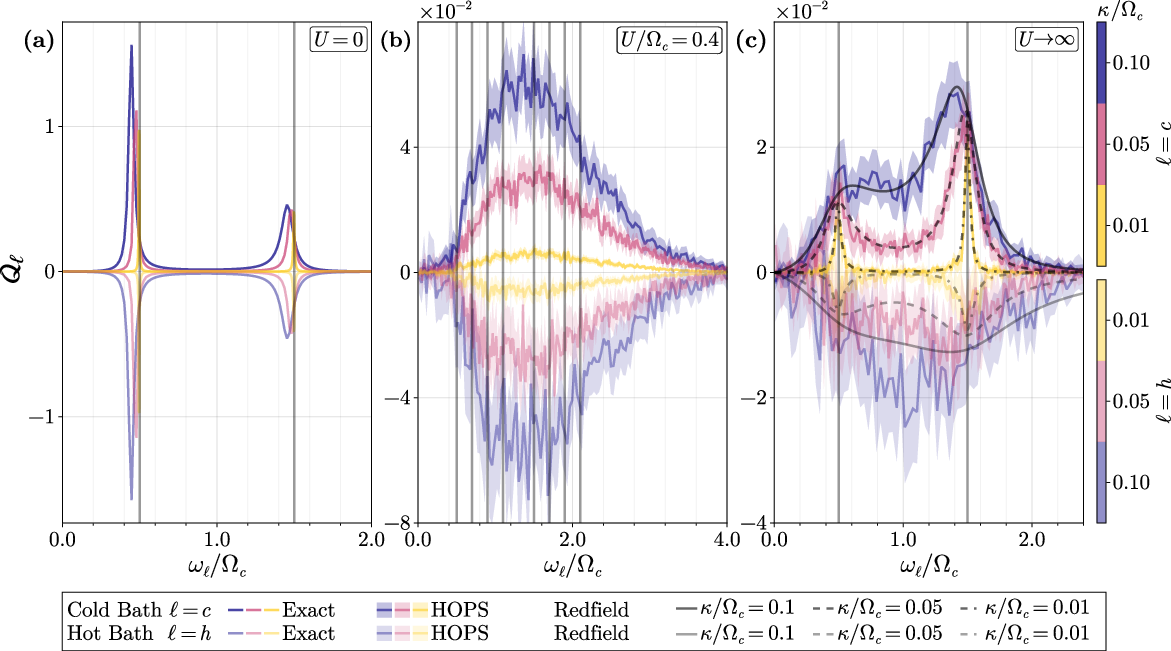
Figure 10: Momentum-resolved particle current spectra for varying Tc3 and dissipation, displaying interaction-induced spectral splitting and broadening.
Implications and Future Directions
The results clarify the role of nonlinearities and non-Markovianity for quantum transport and thermal machine behavior:
- Thermodynamic Robustness: Universal-like engine efficiency and power resilience to local interactions at low temperature has significant implications for the robustness of nanoscale or bosonic working fluids.
- Rectification and Functional Devices: The realization of pronounced non-reciprocal heat flow and heat diodes by interaction tuning provides a route to implementing quantum logical elements and heat management devices purely by harnessing quantum statistics and system-bath asymmetry, with relevance for heat-based logic and thermal information processing [poulsen_heat-based_2024].
- Steady-State Quantum Correlations: Demonstrated entanglement generation in the nonequilibrium steady state of a continuous engine via interactions, without additional coherently engineered couplings, provides foundational understanding for autonomous quantum information protocols leveraging heat currents.
- Beyond Weak Coupling: Use of HOPS enables exploration of strong-coupling, non-Markovian effects beyond standard master equation approaches, capturing significant physical features inaccessible to simpler Lindbladian or secular-reduced models.
Future directions include extension to larger networks (quantum thermal transistors), integration of local dissipation or dephasing for transport engineering [Damanet2019], incorporation of strong-coupling corrections [PhysRevB.107.195117], and further study of experimental realizations with continuous monitoring and backaction [Ferreira2024, Uchino2018].
Conclusion
This paper provides a rigorous and numerically exact analysis of the interplay between on-site interactions, non-Markovian baths, and quantum transport in a minimal continuous thermal machine. The Redfield formulation, combined with stochastic trajectory techniques, enables accurate prediction and interpretation of nonequilibrium properties across operational regimes. The work advances the theoretical understanding of quantum thermodynamic devices and delineates new routes for engineering quantum heat diodes and entangled steady states in mesoscopic systems (2606.14593).