- The paper presents the first lattice determination of vector resonance mass, width, and effective coupling in two-flavored Sp(4) gauge theories.
- It employs Lüscher’s finite-volume formalism with variational analysis using EVP and GEVP methods to extract scattering phase shifts and resonance parameters.
- The results provide actionable insights for tuning composite Higgs and SIMP dark matter models by demonstrating control over near-threshold vector resonances.
Resonant Scattering in Two-Flavored Sp(4) Lattice Gauge Theories
Introduction and Motivation
The study investigates the nonperturbative dynamics of two-flavored Sp(4) gauge theories with Wilson-Dirac fermions in the fundamental representation. This theory is of special interest as a UV completion for composite Higgs models (CHM) and as a minimal scenario for Strongly Interacting Massive Particle (SIMP) dark matter based on a pseudo-real gauge group. The work aims to elucidate the properties of the lightest vector resonances, including their mass spectrum, coupling to pseudo-Nambu-Goldstone bosons (PNGBs), width, and their role in the phenomenology of extensions of the Standard Model, particularly for collider and cosmological constraints.
In seeking to advance both collider phenomenology and the theoretical understanding of dark matter, this study delivers the first ab initio lattice determination of vector resonance properties, such as mass and width, and their effective coupling to PNGBs within Sp(4), Nf=2 theory. The results are directly applicable to the tuning and viability of composite Higgs and SIMP dark matter models, particularly regarding the phenomenological relevance of near-threshold vector resonances in the dark sector.
Lattice Setup, Ensembles, and Operator Basis
The work utilizes the standard Wilson gauge and Wilson fermion action, simulating a substantial range of lattice volumes and spacings. The study constructs a comprehensive operator basis for the variational analysis, including both single-meson and two-PNGB states projected into the relevant irreducible representations of the cubic group and its little groups for moving frames. This is essential for implementing Lüscher’s method in finite-volume lattice calculations of two-particle scattering.
The correlation matrices for the variational analysis are constructed from all nontrivial Wick contractions appropriate for the relevant operator basis:
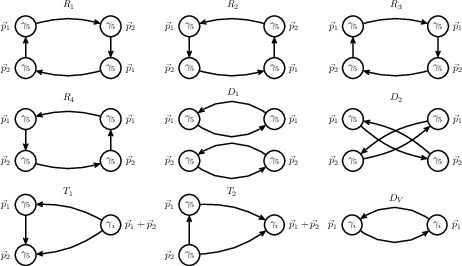
Figure 1: Wick diagrams contributing to the correlation matrix elements, encapsulating all necessary contractions for the variational extraction of energy levels in the PNGB-vector scattering channel.
The broad lattice parameter scan, combined with operator smearing and high-statistics ensemble generation, enables a robust study of both stable and resonant regimes across the phase space accessible to simulations.
Single-Meson Spectroscopy and Continuum Extrapolation
A global update of the meson spectrum, including mass and decay constant determination for both PNGBs and higher-mass flavoured mesons, is achieved via two-point function analysis and nonperturbative continuum extrapolation. The dimensionless ratios and continuum limits are obtained using fit forms inspired by NLO Wilson ChPT, with careful treatment of discretization and mass effects.
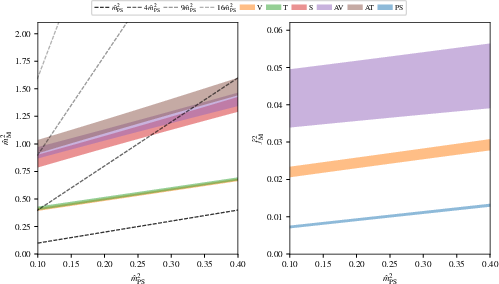
Figure 2: Continuum extrapolation results for vector and tensor meson masses and decay constants, as functions of the PNGB mass squared, highlighting the parameter region near the two-PNGB decay threshold.
Key findings:
- The lightest vector multiplet (analogue of the QCD ρ) is systematically mapped as a function of the fermion mass.
- The vector mass can be dialed close to the two-PNGB decay threshold by tuning the input fermion mass, a feature critical for realizations of strong self-interacting dark matter.
Lüscher's Method for Scattering and Resonance Extraction
The core of the analysis utilizes Lüscher’s finite-volume formalism, adapted to this non-QCD theory, for the extraction of infinite-volume scattering parameters. The work generalizes operator and contraction strategies for the Sp(4) global symmetry structure and establishes robust methodology for applying the variational method to the vector–two-PNGB sector.
The energy levels are extracted through both standard eigenvalue problem (EVP) and generalized EVP (GEVP) formulations, with systematic comparisons:

Figure 3: Variational analysis comparing EVP and GEVP extraction for representative ensembles, demonstrating stability and systematics in the extraction of the two lowest-lying states in the vector channel.
Energy spectra as functions of lattice volume and moving frame momenta reveal the transition from stable vector mesons (below threshold) to resonances (above threshold), with clear evidence for both bound state and resonant behavior when the relevant mass ratios are tuned.
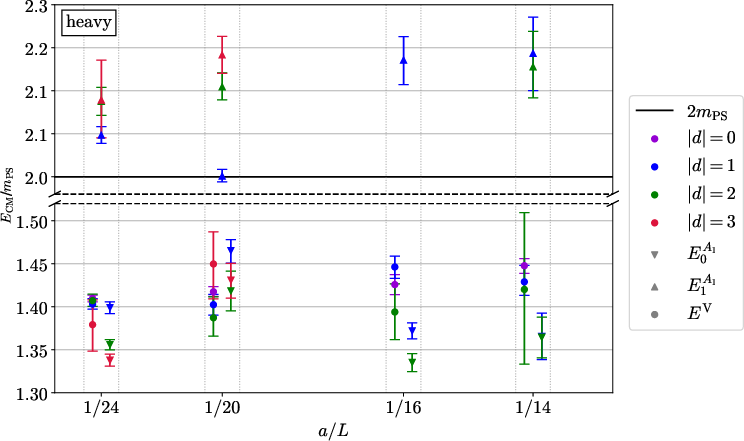
Figure 4: Finite-volume energy levels in the spin-1, 10 channel for "heavy" ensembles, showing the separation of single-meson and two-PNGB scattering states relative to threshold.
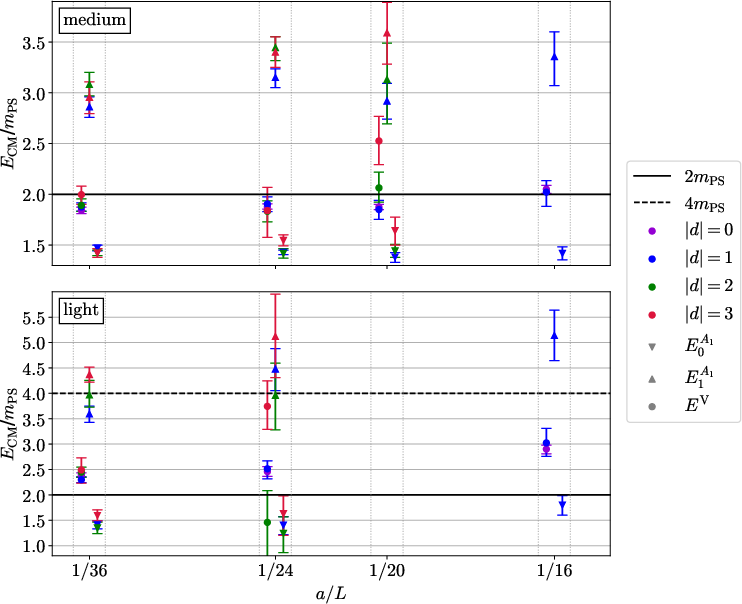
Figure 5: Finite-volume energy levels for "light" and "medium" ensembles, illustrating the appearance of sub-threshold bound states and near-threshold resonances as the fermion mass decreases.
Phase Shift Analysis and Resonance Properties
Extraction of the P-wave (vector channel) scattering phase shift proceeds via the finite-volume quantization condition, with multiple representations and total momenta analyzed. For masses below threshold, a nontrivial, attractive scattering length is found, indicative of a bound state, whereas for lighter fermions a resonant enhancement consistent with a Breit–Wigner shape is observed.
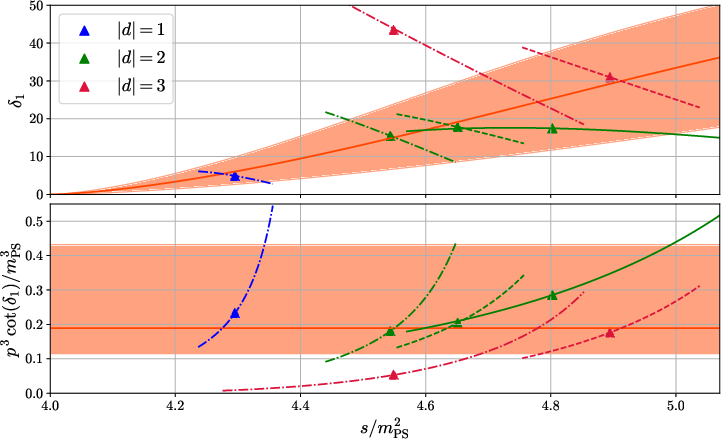
Figure 6: P-wave scattering phase shift and effective range expansion in "heavy" ensembles, evidencing an attractive interaction dominated by a negative scattering length.
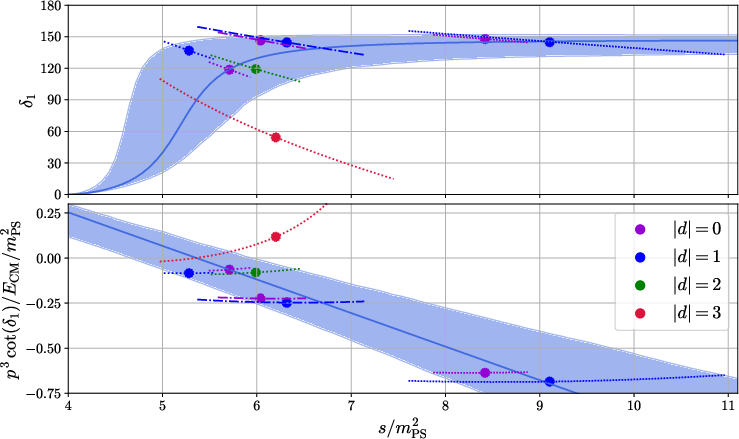
Figure 7: Phase shift and Breit–Wigner parameterization for "light" ensembles, with linear behavior indicative of resonant dynamics and a well-defined coupling gV′PP and resonance mass.
Key extracted numbers include mV′/mPNGB=2.31−0.10+0.18 and Sp(4)0 (in units set by the PNGB mass). These results are strongly relevant for model-building, providing input for effective field theory matching and guiding experimental searches for composite states.
Implications for SIMP Dark Matter and Phenomenological Applications
The potential relevance for SIMP dark matter is twofold: (1) a tunable vector resonance enables strong, velocity-dependent self-interactions close to the galactic escape velocity relevant for small-scale structure, and (2) the demonstrated control over resonance parameters makes the theory a predictive testing ground for strongly interacting hidden sectors.
The cross-sections computed from lattice phase shifts for both the scalar (Sp(4)1) and vector (Sp(4)2) channels reveal that near-threshold vector resonances permit large enhancements in dark sector self-interaction cross-sections in the astrophysically most relevant region:
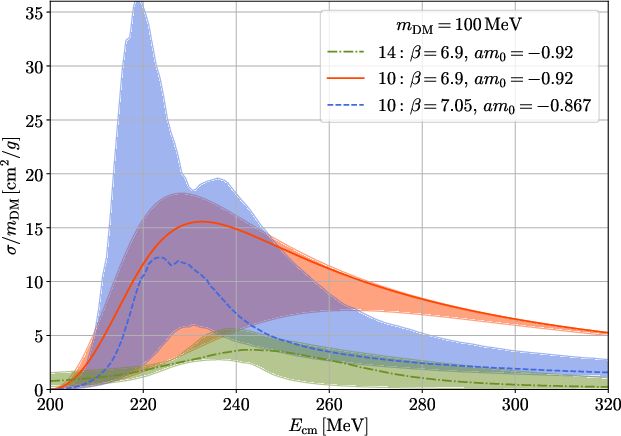
Figure 8: Comparison of cross-sections for scalar and vector channels; the strong enhancement in the Sp(4)3 (Sp(4)4-wave) channel near resonance exemplifies the possible phenomenological impact for dark matter models.
These findings enable systematic placement of composite Higgs and dark matter models in the space of viable phenomenology, particularly for those scenarios where the Sp(4)5-wave resonance can be tuned close to the two-body threshold.
Methodological Advances and Future Directions
The study sets a new standard for combining high-statistics lattice simulations, operator science for non-QCD symmetries, and resonance extraction methods in strongly coupled gauge theories relevant for new physics. The methodology is extensible to broader classes of theories with enlarged cosets, multiple irreducible representations, and multi-particle operators. The approach provides a blueprint for future studies, especially for three-body interactions relevant for Sp(4)6 SIMP dynamics and for coupling to Standard Model fields in CHM completions.
Conclusion
This paper achieves a comprehensive lattice characterization of the vector resonance sector in two-flavored Sp(4)7 gauge theory, combining precision single-meson spectroscopy with a robust variational, finite-volume, and phase shift analysis. The extraction of resonance mass, width, and couplings from first principles opens new avenues for quantitative model-building in composite Higgs and dark matter physics, enabling direct contact between lattice results and phenomenological constraints in cosmology and collider experiments. The demonstrated ability to dial vector resonances near threshold and to compute associated couplings establishes the theory as a benchmark for strongly coupled extensions of the Standard Model.

