- The paper establishes genuine tripartite entanglement in neutrinos by classifying them as W states using a three-flavor wave-packet formalism and SLOCC invariants.
- It quantitatively tracks the evolution of entanglement measures—concurrence, tangle, and negativity—with propagation distance, energy, and CP phases.
- The study shows how wave-packet induced decoherence modulates oscillation-driven quantum correlations, highlighting prospects for probing CP violation.
Tripartite Entanglement in Oscillating and Decohering Neutrinos
Introduction
Tripartite quantum entanglement is an essential facet of many-body quantum systems, and its characterization provides insight into quantum information transport and decoherence mechanisms. This paper, "Tripartite entanglement of oscillating and decohering neutrinos" (2606.14454), presents a full three-flavor analysis of neutrino oscillations in the wave-packet formalism, demonstrating genuine tripartite entanglement in neutrino systems and establishing their classification into the W state class. It further examines how entanglement measures—concurrence, tangle, negativity, and monogamy inequalities—evolve with propagation distance, energy, and under decoherence due to wave-packet separation, highlighting how non-zero CP phases modulate these correlations.
The study leverages the wave-packet description of neutrinos, wherein flavor states are superpositions of mass eigenstates with Gaussian momentum distributions. The finite width induces decoherence over large L/E regimes due to differential packet separation, rendering the system mixed rather than pure.
Flavor states are mapped onto a three-qubit occupation number basis, and entanglement classes are defined using SLOCC invariants. The neutrino system can realize product, biseparable, or genuinely tripartite entangled states. The W class, characterized by non-zero three-π negativity and zero three-tangle, is particularly relevant for mode-entangled single-neutrino dynamics.
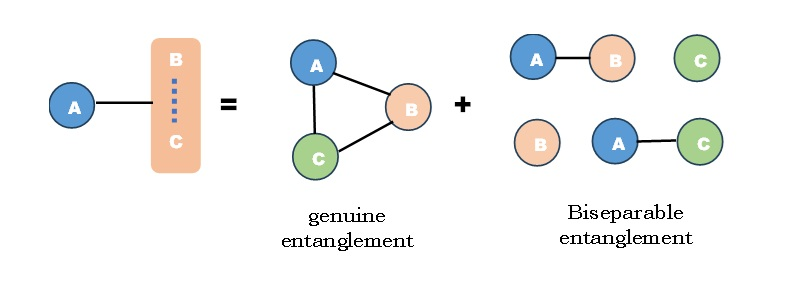
Figure 1: Possible realizations of three-qubit entanglement: Product, biseparable, and genuine tripartite—W and GHZ—states.
Quantitative Entanglement Measures
The analysis introduces concurrency, tangle, and negativity as fundamental bipartite entanglement measures. For mixed states, negativity is defined via the PPT criterion, and monogamy of entanglement is probed through the Coffman-Kundu-Wootters (CKW) inequality. Crucially, the three-πeμτ negativity serves as the appropriate quantifier for genuine tripartite entanglement in W-class states, surpassing the limitations of tangle-based measures for this system.
The density matrix formalism allows explicit computation of these measures as functions of baseline, energy, and CP phase, using NuFIT 6.0 and PDG oscillation parameters.
Dynamics of Entanglement and Decoherence Effects
Entanglement generation is directly linked to the onset of oscillation and superposition among flavors. For small propagation distances or high energies, entanglement measures are negligible due to the initial product state. As L increases, oscillation drives rapid growth and oscillatory behavior in tangle, negativity, and concurrence.
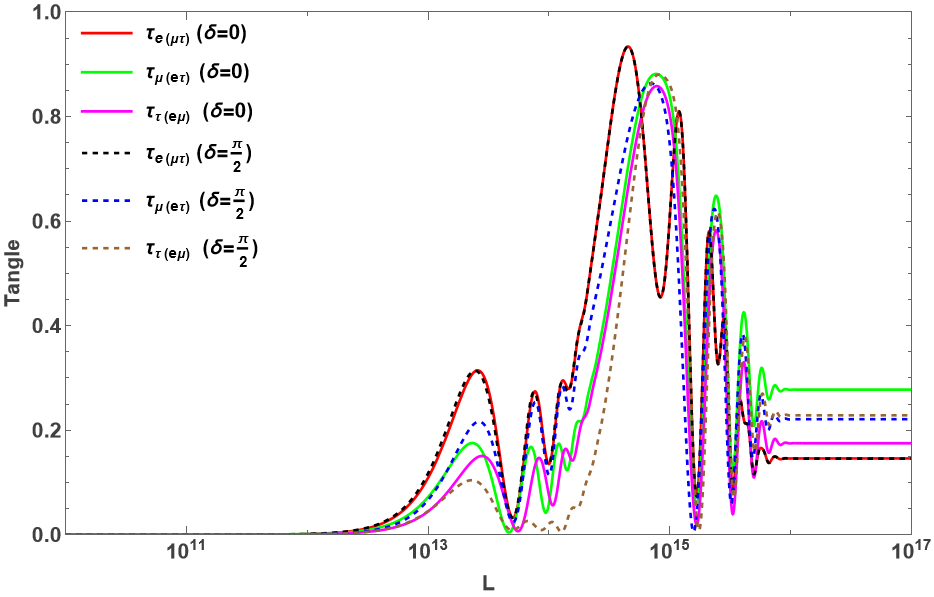
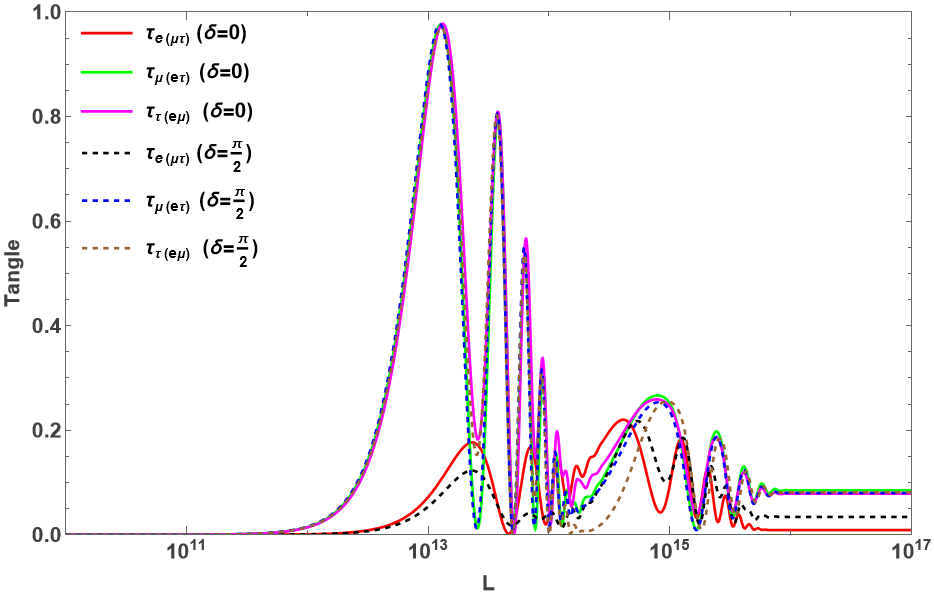
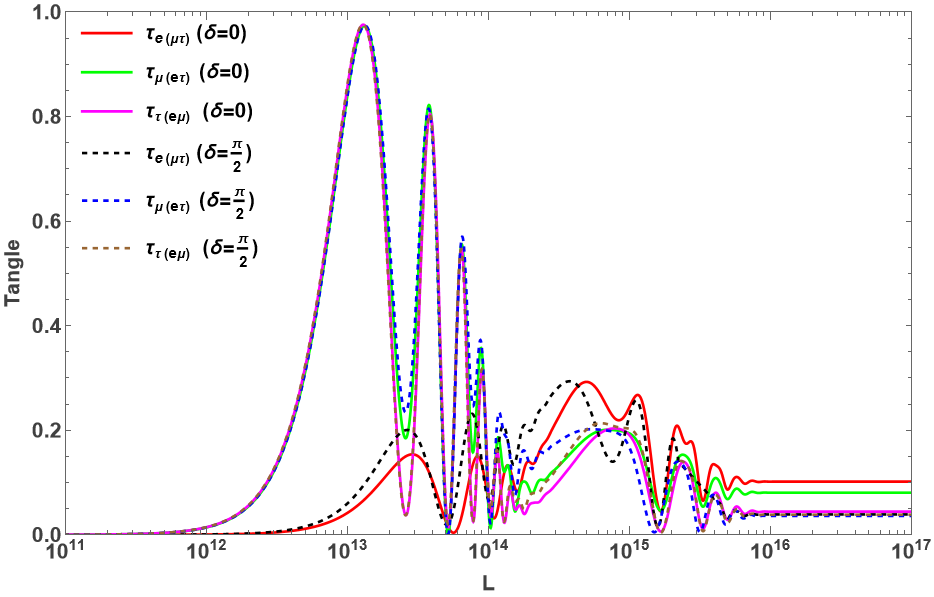
Figure 2: Distribution of bipartite entanglement (tangle) versus distance for νe, νμ, and ντ initial states at E=10 GeV.
In the decoherence regime (large L/E), wave-packet separation induces damping of oscillatory features, causing all measures to converge to non-zero constants. Wave-packet induced decoherence is irreversible; the system does not return to a pure product state. Notably, the tangle and concurrence measures saturate the CKW inequality, and their residuals vanish, confirming the W-class nature.
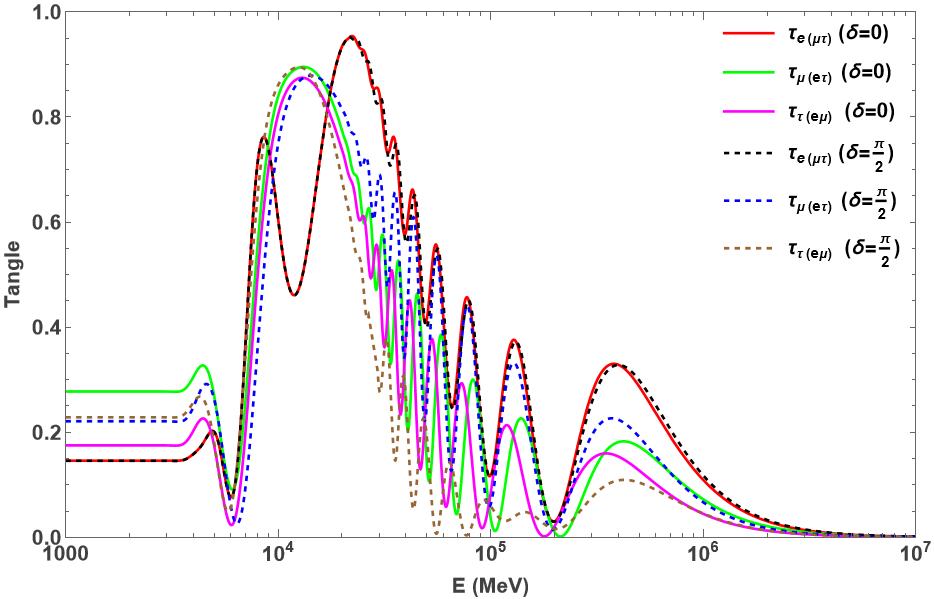
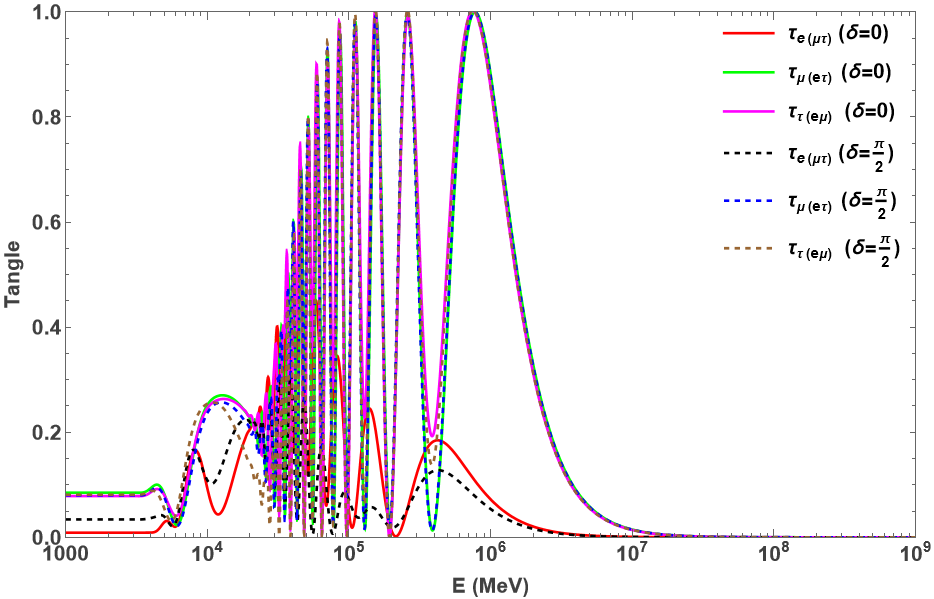
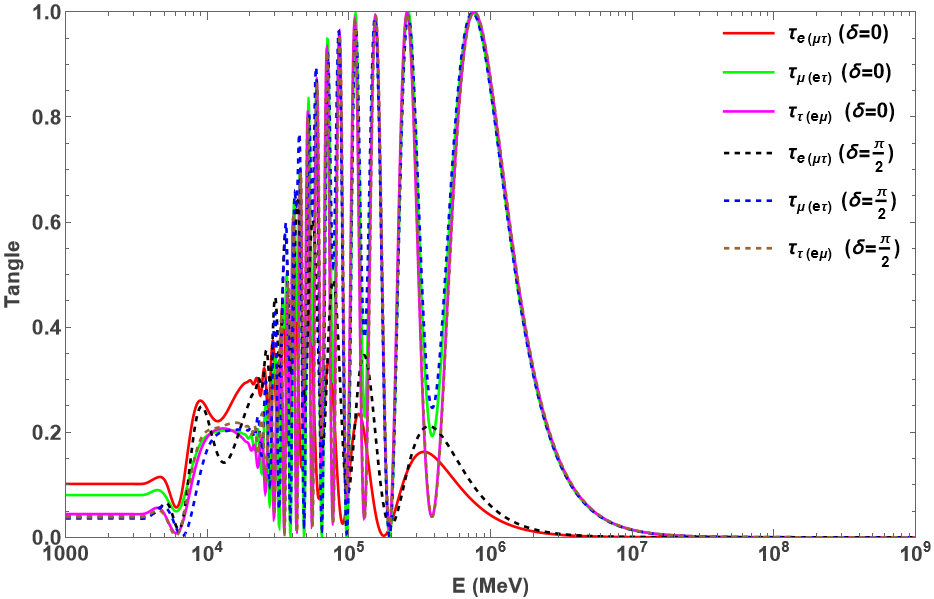
Figure 3: Bipartite tangle versus energy at L=1015 meters, demonstrating suppression at high energies and decoherence plateau at low energies.
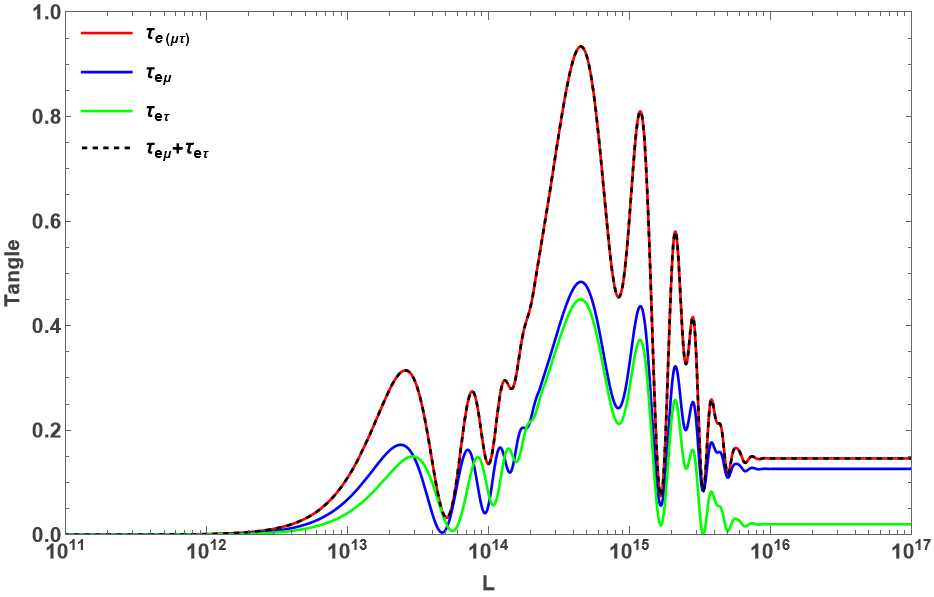
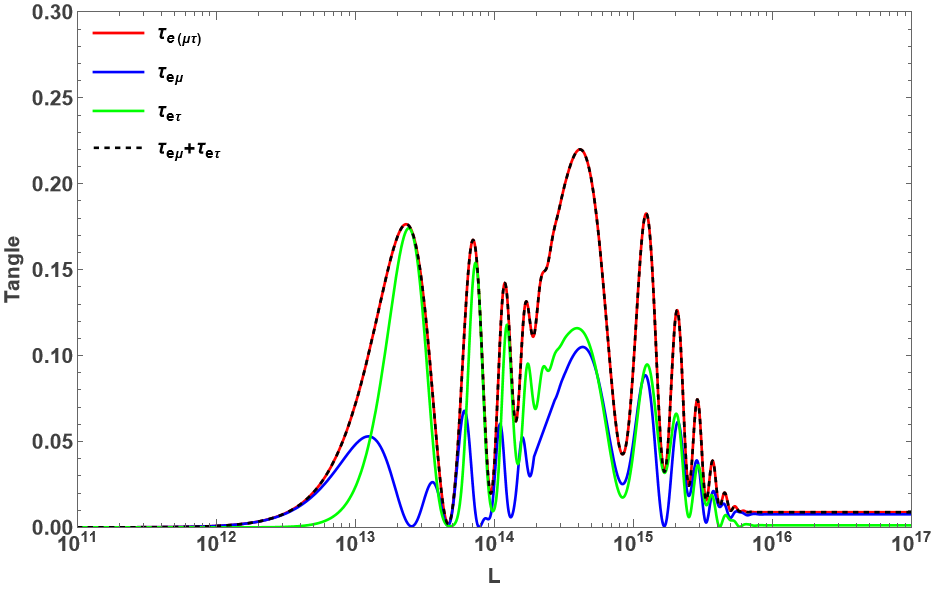
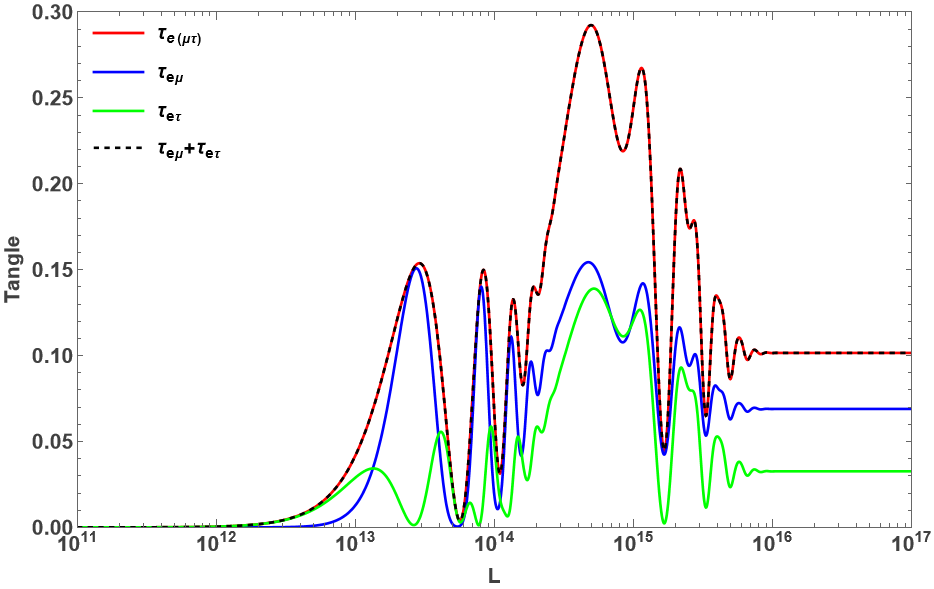
Figure 4: Test of CKW inequality in terms of tangles; saturation confirms vanishing residual entanglement and W-state structure.
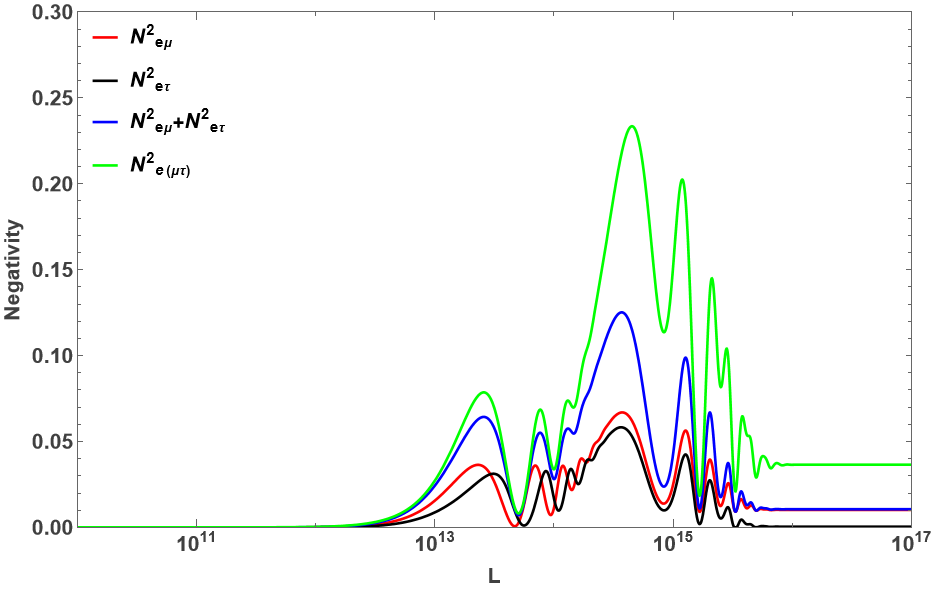
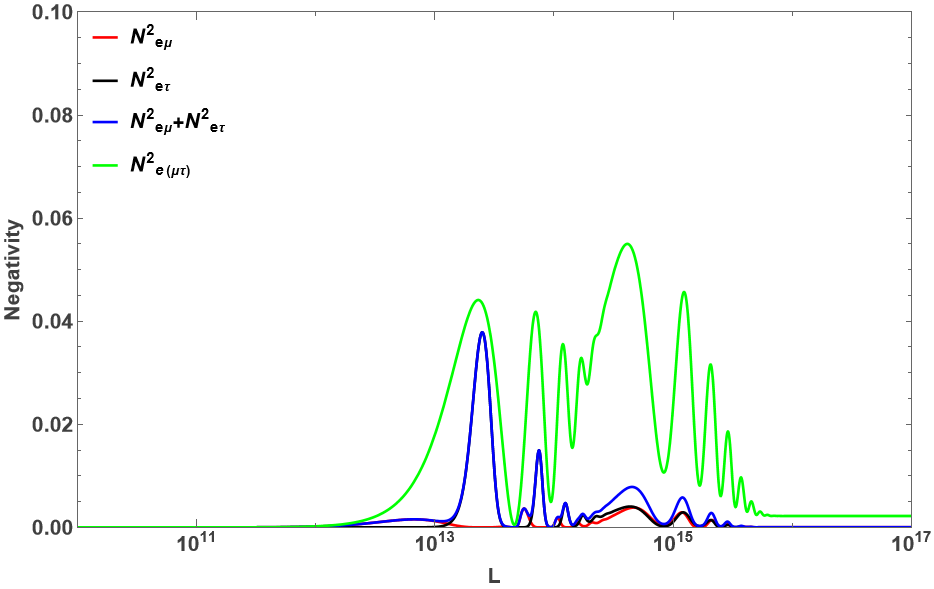
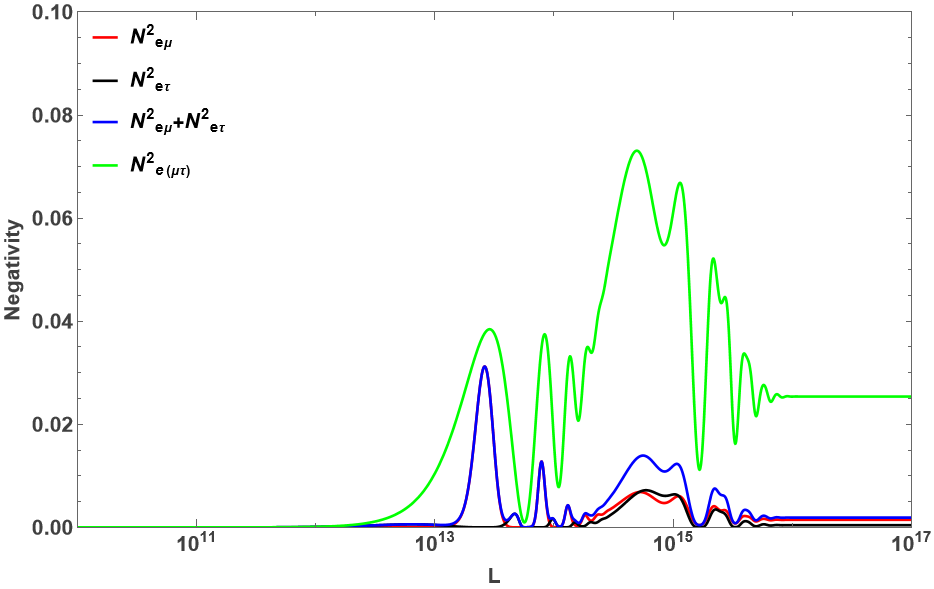
Figure 5: Test of CKW inequality in terms of negativity; inequality is not saturated, allowing for genuine tripartite entanglement.
Three-π0 negativity remains positive throughout and is unambiguously non-zero in the decoherence limit, confirming persistent tripartite entanglement across ultra-long baselines—even for astrophysical neutrinos spanning π1 meters.
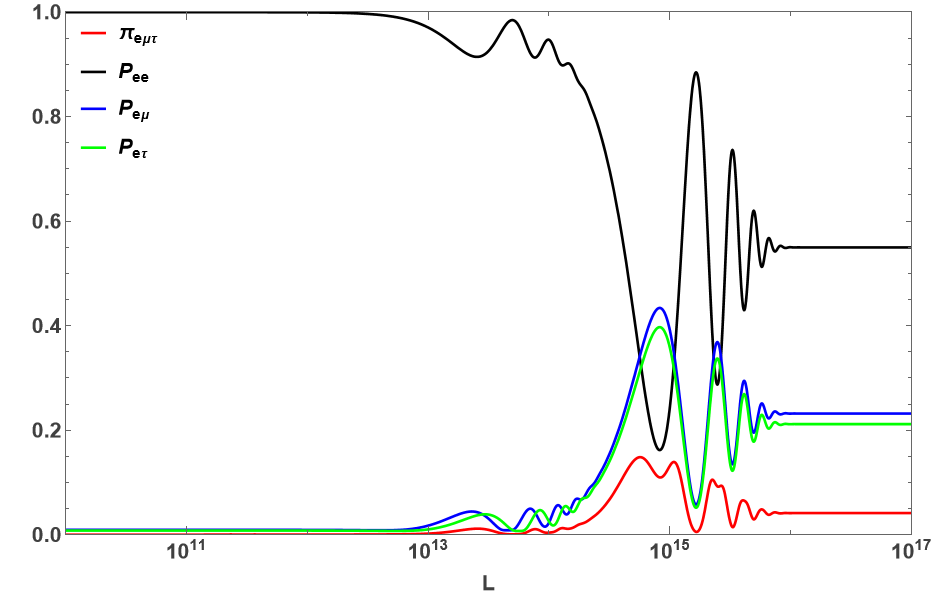
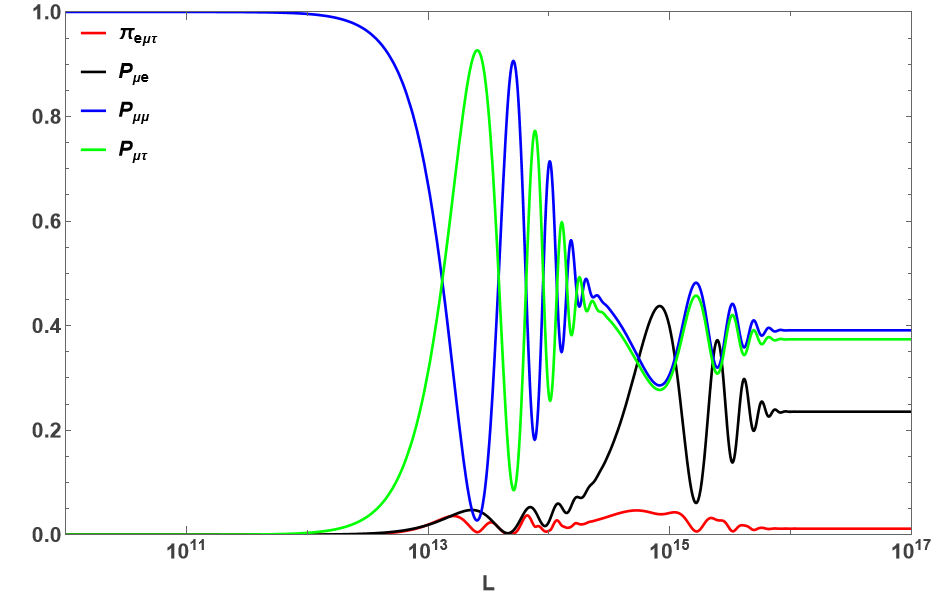
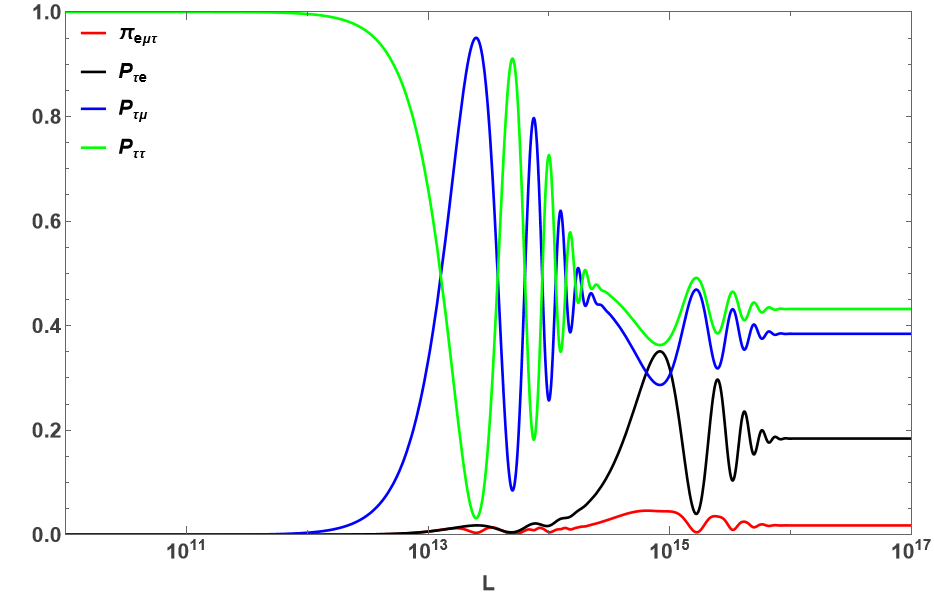
Figure 6: Genuine tripartite entanglement (π2) compared to transition probabilities; entanglement persists and correlates with oscillation physics.
CP Phase Dependence
Including non-vanishing Dirac CP phases in the PMNS matrix modifies interference patterns and thus alters the oscillatory structure of entanglement measures, introducing phase shifts and amplitude modulations in concurrence, tangle, and negativity. Sensitivity to CP phase underscores the potential for entanglement-based probes of CP violation in neutrino oscillations.
Implications and Outlook
The identification of genuine tripartite mode entanglement in neutrino oscillations, robust to decoherence and propagating over cosmological distances, advances the fundamental understanding of quantum field theory and quantum information exchange in particle physics. Practically, it qualifies neutrinos as unique macroscopic quantum probes for both quantum-to-classical transition studies and potential quantum gravity effects. The sensitivity of entanglement measures to CP phase offers prospects for entanglement-based diagnostics in neutrino oscillation experiments.
Future directions include extending the formalism to matter effects, non-standard interactions, and explicit wave-packet reconstruction from astrophysical neutrino data, as well as exploiting multipartite entanglement for quantum information protocols in high-energy physics contexts.
Conclusion
This paper rigorously establishes tripartite entanglement in oscillating neutrinos within a three-flavor wave-packet approach, demonstrates persistent genuine entanglement despite decoherence, and classifies neutrino systems into the W state class. The findings imply the survival of quantum entanglement over astronomical scales, underpinning the quantum coherence of neutrino systems and their suitability as probes of fundamental quantum mechanisms. The sensitivity to CP violation and decoherence transitions signals a broad avenue for future interdisciplinary research at the interface of quantum information science and high-energy particle physics.

