- The paper introduces SmoQyElPhQMC.jl which implements near-linear scaling QMC techniques using hybrid Monte Carlo and exact Fourier acceleration for electron–phonon systems.
- It demonstrates significant performance improvements over traditional DQMC, accurately capturing order parameters and spectral features in benchmark Holstein and oSSH models.
- Its innovative preconditioning, block matrix approaches, and stochastic measurement methods enable precise and scalable studies of complex electron–phonon interactions.
SmoQyElPhQMC.jl: Efficient and Scalable Quantum Monte Carlo for Electron-Phonon Models
Introduction and Context
The SmoQyElPhQMC.jl package represents a significant advancement in large-scale quantum Monte Carlo (QMC) simulations of electron-phonon (e-ph) coupled models. Built atop the SmoQyDQMC.jl framework, it implements a suite of algorithmic optimizations that enable near-linear scaling in both system size N and inverse temperature β, targeting a broad class of uncorrelated e-ph Hamiltonians. The software leverages hybrid Monte Carlo (HMC) strategies, exact Fourier acceleration (EFA), advanced preconditioning, and stochastic measurement techniques for efficient simulation, incorporating flexible support for generic tight-binding models, various phonon branches, long-range and nonlinear e-ph couplings, disorder, and dynamic carrier density control.
This development addresses a prominent computational bottleneck in existing QMC schemes for e-ph systems. Traditional DQMC-based approaches, while robust and widely adopted, exhibit cubic or worse scaling with system size—rendering them prohibitive in the adiabatic regime or for large N and β relevant to real materials. SmoQyElPhQMC.jl instead enables operability at unprecedented scale, accuracy, and model generality.
Supported Models and Hamiltonian Structure
The code supports an extensive variety of e-ph coupled Hamiltonians, formulated as
H^=U^+V^+K^
where U^ describes phononic (harmonic, anharmonic, and dispersive) terms; V^ includes the electron on-site potential and diagonal e-ph couplings (e.g., Holstein/Fröhlich types), and K^ contains the electronic hopping (including phonon-modulated SSH/Peierls-like terms).
The package enables:
- Arbitrary lattice geometry and basis dimension,
- Momentum-dependent, long-range, and nonlinear e-ph interactions,
- Multiple phonon branches with independent microscopic coupling,
- Low-energy (optical/acoustic) phonons and anharmonic lattice potentials,
- Chemical potential feedback for fixed carrier density,
- Full spatial disorder support,
- Specialized observable measurement infrastructure.
Algorithmic Innovations
At its core, SmoQyElPhQMC.jl utilizes HMC—specifically, the EFA-HQMC method—for global phonon updates, effectively sampling the high-dimensional continuous phonon field with low autocorrelation and enabling ergodic exploration. The key algorithmic contributions are as follows:
- Checkerboard Exponential (MSCHK) Approximation: Sparse exponentiation of the kinetic term preserves scalability for arbitrary hopping range and generic SSH couplings while introducing only O(Δτ2) systematic error.
- Fermion Determinant as Pseudofermion Integral: The costliest operation in DQMC (evaluating ∣detM∣2) is recast as a complex Gaussian integral over pseudofermion fields, transforming the bottleneck into an iterative linear solve amenable to preconditioning and parallelization.
- Block Structure and Preconditioning: The package replaces the conventional small-matrix representation with a block-sparse (β0) matrix for efficient storage and matrix-vector operations, using a preconditioner inspired by the adiabatic limit and implemented via the Kernel Polynomial Method (KPM) for optimal conditioning of the conjugate gradient (CG) solver.
- Ergodicity Enhancements: Reflection and swap updates are implemented to overcome topological barriers and ergodicity breaking, crucial for reliable sampling especially in models with discrete symmetry breaking.
- Stochastic Measurements: All Green's function and correlation observables are computed via stochastic estimators with β1 random (phase) vectors, ensuring unbiased results at β2 cost, with autocorrelation further reduced by FFT-based translational averaging.
These features result in a robust toolkit for nonperturbative, sign-problem-free simulation of large e-ph Hamiltonians across the full range of physically relevant parameters.
Numerical Benchmarks and Physical Results
Benchmark calculations focus on the square lattice Holstein and optical SSH (oSSH) models at half-filling in the adiabatic regime (β3), chosen for their direct relevance to charge/bond-order instabilities in low-dimensional electron-lattice systems.
Simulations quantitatively capture:
- The onset and scaling of charge density wave (CDW) and bond order wave (BOW) order parameters,
- Near-linear runtime scaling in both system size and inverse temperature, with only a weak residual dependence due to CG iteration counts,
- High acceptance rates (β4) for HMC trajectories,
- Accurate spectral functions β5, with robust signature of long-range order and spectral weight redistribution due to e-ph coupling.
The following figures illustrate these findings:
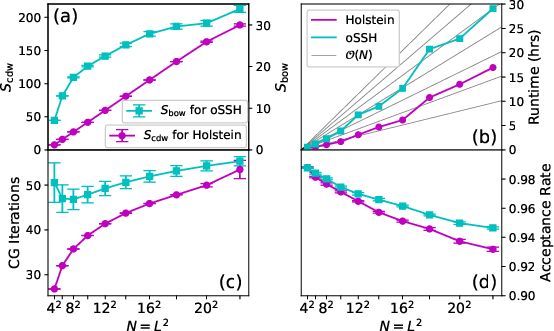
Figure 1: System-size scaling of structure factors, runtime, CG iterations per solve, and HMC acceptance rates for Holstein and oSSH models at β6.
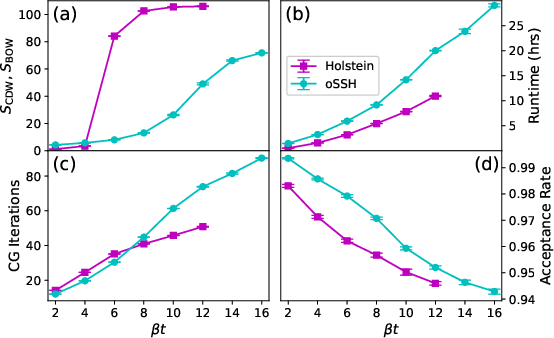
Figure 2: Inverse-temperature scaling of structure factors, runtime, CG iterations, and HMC acceptance for β7 simulations.
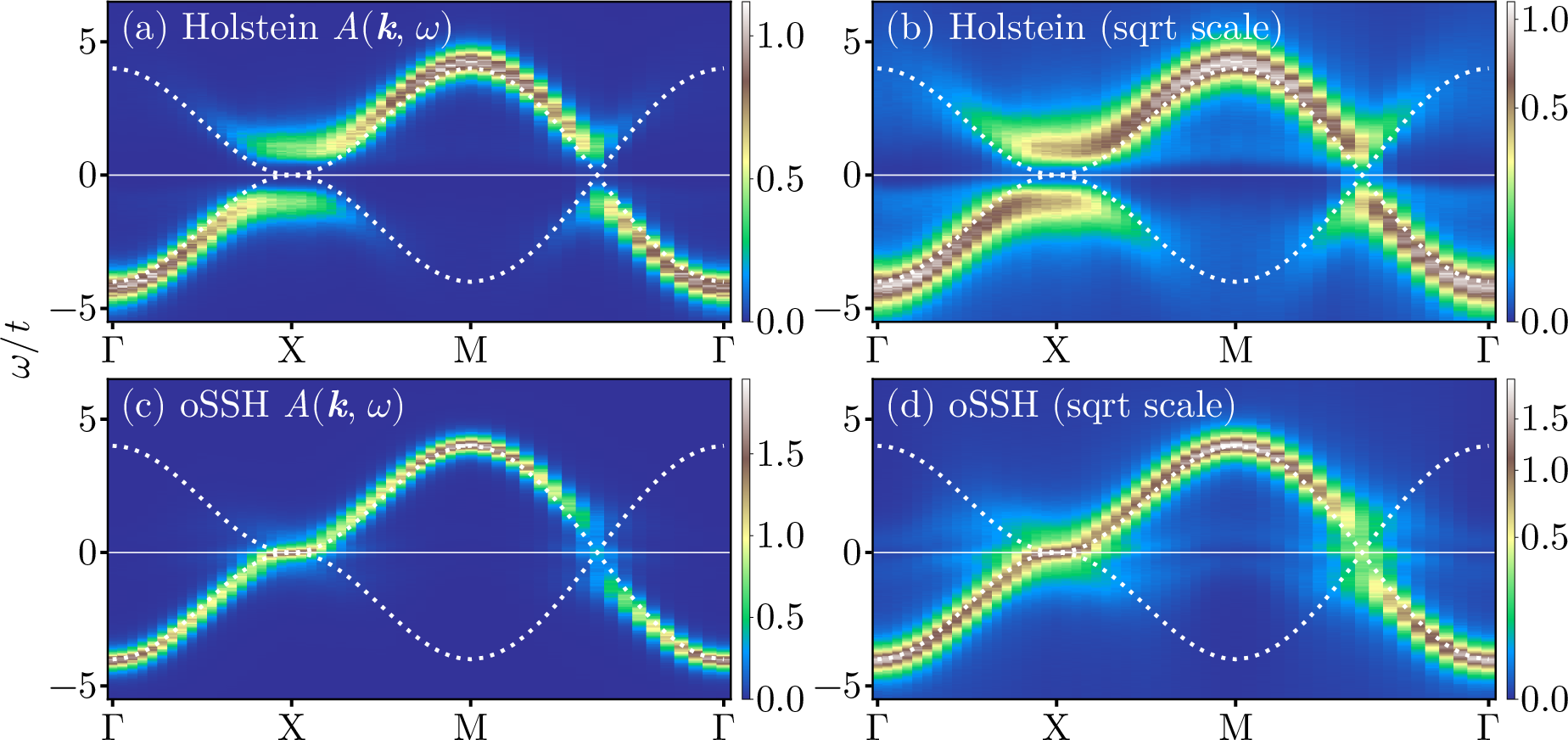
Figure 3: Single-particle electron spectral function β8 for β9 lattices at N0, highlighting CDW gap formation (Holstein) and BOW-driven band renormalization (oSSH).
Statistical precision is achieved via long simulation runs and extensive averaging, while analytic continuation is performed with the DEAC algorithm, enabling precise extraction of low-energy spectral features relevant to experimental observables.
Implications, Comparisons, and Future Directions
Algorithmically, SmoQyElPhQMC.jl extends the current state of large-scale e-ph QMC by delivering the following practical advantages over legacy DQMC or pure HMC workflows:
- Orders-of-magnitude larger accessible lattice sizes,
- Adiabatic (N1) and strong-coupling regimes at finite doping,
- Efficient measurement infrastructure for momentum-resolved and real-space observables.
Theoretically, this package allows controlled studies of emergent phenomena in correlated electron-lattice systems, such as:
- Nature and criticality of CDW/BOW transitions in 2D,
- Nontrivial competition/coexistence between various symmetry-breaking ground states,
- Effects of dispersive phonons, nonlinearity, and disorder,
- Band structure renormalization and polaron formation at the thermodynamic limit.
Broader impacts are anticipated in:
- Materials theory, enabling direct model-based comparison to ARPES, RIXS, and transport experiments in quantum materials,
- Algorithmic development, as the preconditioning and pseudofermion integration strategies can be generalized to other finite-temperature lattice field theories (including gauge fields and multi-flavor Hubbard models) [Feng2025Scalable],
- Interoperability within the Julia quantum simulation ecosystem and extensibility to hybrid workflows (e.g., combining with machine-learning-accelerated Markov chain proposals [Albergo2021Flowbased]) and improved analytic continuation methods [Neuhaus2024SmoQyDEACjl].
Critical avenues for further research include:
- Systematic extension to correlated models with electron-electron interactions,
- Generalization of preconditioning, with potential use of Lanczos-based methods for further acceleration [Chen2024Lanczos],
- Automated tuning of HMC/EFA integrator parameters and deeper study of ergodicity solutions (radial update, sector crossing techniques) [Ostmeyer2025Exponential, Temmen2025Fully],
- Integration with high-level domain-specific libraries for automated model construction and experiment-theory comparison.
Conclusion
SmoQyElPhQMC.jl represents state-of-the-art methodology for QMC simulations of large-scale, uncorrelated e-ph Hamiltonians. Its innovative combination of HMC, exact Fourier acceleration, KPM preconditioning, and stochastic measurement infrastructure delivers near-linear scaling, high efficiency, model flexibility, and accurate physical observables—paving the way for systematic exploration of electron-lattice coupling in realistic materials contexts.
References
- "Fast and scalable quantum Monte Carlo simulations of electron-phonon models" [Cohen-Stead2022Fast]
- "SmoQyDQMC.jl: A flexible implementation of determinant quantum Monte Carlo for Hubbard and electron-phonon interactions" [Cohen-Stead2024SmoQyDQMCjl]
- "A hybrid Monte Carlo study of bond-stretching electron–phonon interactions and charge order in BaBiON2" [Cohen-Stead2023Hybrid]
- "Charge order in the kagome lattice Holstein model: a hybrid Monte Carlo study" [Bradley2023Charge]
- "The Lanczos algorithm for matrix functions: a handbook for scientists" [Chen2024Lanczos]
- "Flow-based sampling for fermionic lattice field theories" [Albergo2021Flowbased]
- "SmoQyDEAC.jl: A differential evolution package for the analytic continuation of imaginary time correlation functions" [Neuhaus2024SmoQyDEACjl]
Additional relevant references provided in the main paper.

