- The paper proposes a shift from theoretical global optima to robust optima by emphasizing uncertainty quantification for industrial reliability.
- It demonstrates the integration of computational models, empirical experiments, and machine learning techniques to accelerate materials discovery.
- The study outlines hybrid quantum-classical workflows and infrastructure strategies that bridge the gap between theoretical advances and real-world manufacturing constraints.
The Future of Computing in Addressing Materials Science Challenges
Introduction
"The Future of Computing for Materials Science Challenges" (2606.14387) articulates a comprehensive perspective on the present and future role of computation in materials discovery. Drawing upon perspectives across academia, industry, and national laboratories, the paper diagnoses central obstacles in translating theoretical advances to industrial deployment and provides a roadmap for integrating empirical, computational, data-driven, and quantum paradigms. The discussion is balanced between technical rigor, organizational realities, and the evolving demands of sustainability and manufacturability. Key themes include the paradigm shift from seeking theoretical global optima to emphasizing robust optima for industrial reliability, the essential coupling of disparate research paradigms, and the centrality of uncertainty quantification and standards in data management. The paper’s focus on actionable integration across communities and methodologies distinguishes it in the discourse on accelerating materials innovation.
Bridging Theory and Industrial Realities
The paper foregrounds the persistent gap between theoretical materials discovery and practical deployment. Simulations expand the design space but often overlook real-world constraints, such as processing variability, supply chain dependencies, microstructural evolution, and lifecycle considerations. The authors argue that robust optima—material solutions with high tolerance to variability—should supplant the pursuit of theoretical global optima as central objectives in workflow design. This shift is visually typified in the trade-off between sharp and flat optima, the latter preferred for their resilience against real-world perturbations.
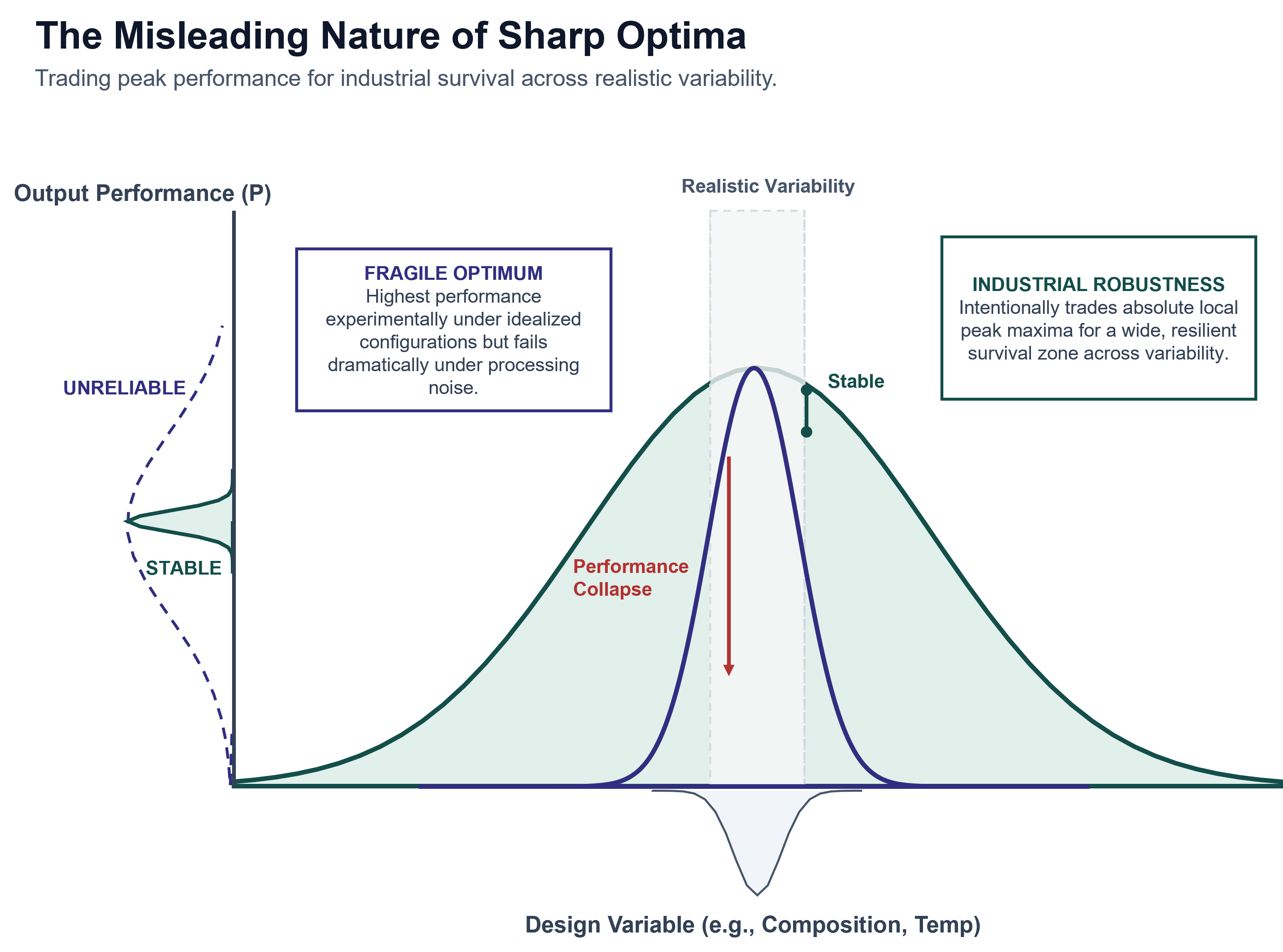
Figure 1: Trade-off between performance and robustness in materials design, highlighting the value of flatter, robust optimum regions over sharp, fragile maxima.
The workflow implication is the early and explicit inclusion of manufacturability, durability, environmental, regulatory, and supply constraints in computational screening, rather than their assignment as late-stage “filters.” This paradigm shift demands tighter coupling of experimental feedback, processing knowledge, and uncertainty quantification throughout design cycles.
Integration of Scientific Paradigms
A central argument is that empirical, theoretical, computational, and data-driven paradigms are not sequential, but dynamically interacting modes that, when properly integrated, accelerate insight and reduce wasted cycles. The empirical paradigm uncovers phenomena inaccessible to theoretical simplification; computational models expand accessible structures but often lack complete physical context; data-driven methods reveal trends across large, heterogeneous datasets, but require curated data and rigorous physical constraints to avoid spurious correlations.
The paper posits that the most potent advances occur when these paradigms interoperate in tightly-coupled workflows where experiments target model uncertainties, computations inform experiment design, and machine learning leverages both simulation and empirical data. High-throughput experimentation, active learning, and closed-loop systems are highlighted as emerging pillars of this integrated approach, facilitating rapid hypothesis testing and decision-making in early-stage discovery.
Computational Advances and Multiscale, Uncertainty-Aware Workflows
Density functional theory (DFT) retains a foundational role for many systems, but its known limitations with strongly correlated materials and complex interfaces necessitate escalating methodologies (e.g., advanced functionals, many-body techniques) and a culture of methodological diversity. The paper spotlights advances in multiscale modeling, hybrid QM/MM methods, and the rise of machine-learned interatomic potentials that accelerate high-throughput computation while demanding robust uncertainty propagation across couplings.
A noteworthy claim is the shift in emphasis from raw numerical accuracy to the impact of computational approaches on decision making under uncertainty. Models are increasingly evaluated by their ability to produce actionable uncertainty intervals and to clarify decision-critical mechanisms, not simply their accuracy on controlled benchmarks. Facilities-scale computing infrastructures and code modernization are crucial enablers of broader access, reproducibility, and community benchmarking.
Artificial Intelligence, Machine Learning, and Data Stewardship
AI and ML are most transformative when used not for passive property prediction but for actively guiding experiment design, identifying trends across modalities, and informing triage in resource-constrained programs. Explicit attention to data curation, adherence to FAIR principles, tracking provenance, and providing uncertainty annotations is essential for the reliability and utility of ML-driven insights. The text argues that interpretability, physical priors, and constraint-driven learning are mandatory for ML models to achieve adoption in settings governed by safety, regulatory, and process-lifecycle constraints.
Integration with laboratory automation further accelerates discovery, as feedback from model-informed experiments increases the efficiency of both data generation and hypothesis refutation. Generative models and active learning are forecasted to reshape candidate generation, especially as mechanisms for dynamic labeling and simulation-guided curation are improved.
The Role of Physical Experimentation
Experiments are characterized as the final arbiters of material behavior, with particular value arising from interrogation—not merely confirmation—of model predictions. Strategic experiment design, leveraging active learning to resolve model degeneracies and targeting slow, rare, or microstructure-dominated phenomena, is emphasized. Advanced characterization and the collaborative culture in national facilities are essential for providing the high-quality, uncertainty-annotated data required by next-generation computational and ML models.
Quantum Computing: Opportunity and Realism
Quantum computing is positioned as a necessary tool for addressing electronic structure problems characterized by strong correlation, multireference states, or nonperturbative dynamics—regimes where all classical solvers fail or produce poorly-defined uncertainty. The paper is explicit that, despite progress, most industrially significant problems will require fault-tolerant devices at meaningful scale. Hybrid workflows—classical-quantum embeddings using reduced observables—are presented as the pragmatic path for near-to-medium term relevance, avoiding “quantum advantage” hype and focusing on quantum relevance for properties that impact industrial gating decisions.
Integration of Quantum and Classical Approaches
The long-term landscape is defined by hybrid quantum-classical workflows, featuring strategic system partitioning to direct quantum resources to critical bottlenecks, automated selection of quantum-amenable regions, and iterative coupling of observables. Integration is guided by the requirement to impact actionable decision points, with rigorous uncertainty management at workflow interfaces. ML-driven orchestration and reproducible, standards-based infrastructures will be foundational for scaling such workflows beyond specialized demonstrations.
Community, Infrastructure, and Future Directions
The authors highlight the necessity of transdisciplinary teams and enduring research infrastructure as prerequisites for sustained progress. Shared language, standards, data models, and governance for data stewardship and attribution are required to enable knowledge to move efficiently across teams and institutions. Training future researchers to operate across paradigm boundaries is as essential as establishing physical or computational infrastructure.
Responsibility for sustainability, resource efficiency, and societal constraints on materials innovation must migrate from after-the-fact filters to embedded elements of discovery, enforced through multi-objective optimization frameworks and early-stage modeling. As the field matures, the value of knowledge preservation, benchmarking on industrially realistic problems, and disciplined data capture—including uncertainty and provenance—will eclipse the impact of isolated algorithmic advances.
Conclusion
This paper crystallizes a vision for materials science in which technical, organizational, and cultural innovations are mutually reinforcing. Robust materials design will be realized not via isolated leaps in computational or laboratory techniques, but through the honest, reproducible integration of empirical, theoretical, computational, data-driven, and quantum paradigms, supported by durable community standards and infrastructures. The pivot from seeking not just new materials but deployable, robust materials—ones that thrive in complex operational conditions—reflects a maturation of the field. The success of this integrative approach will depend as much on continued investment in shared infrastructure, training, and open data practices as on technical achievements in quantum hardware or algorithmic sophistication. The implications are that future breakthroughs, especially those required for sustainability and industrial relevance, will be the product of culture and coordination as much as computation.
References: