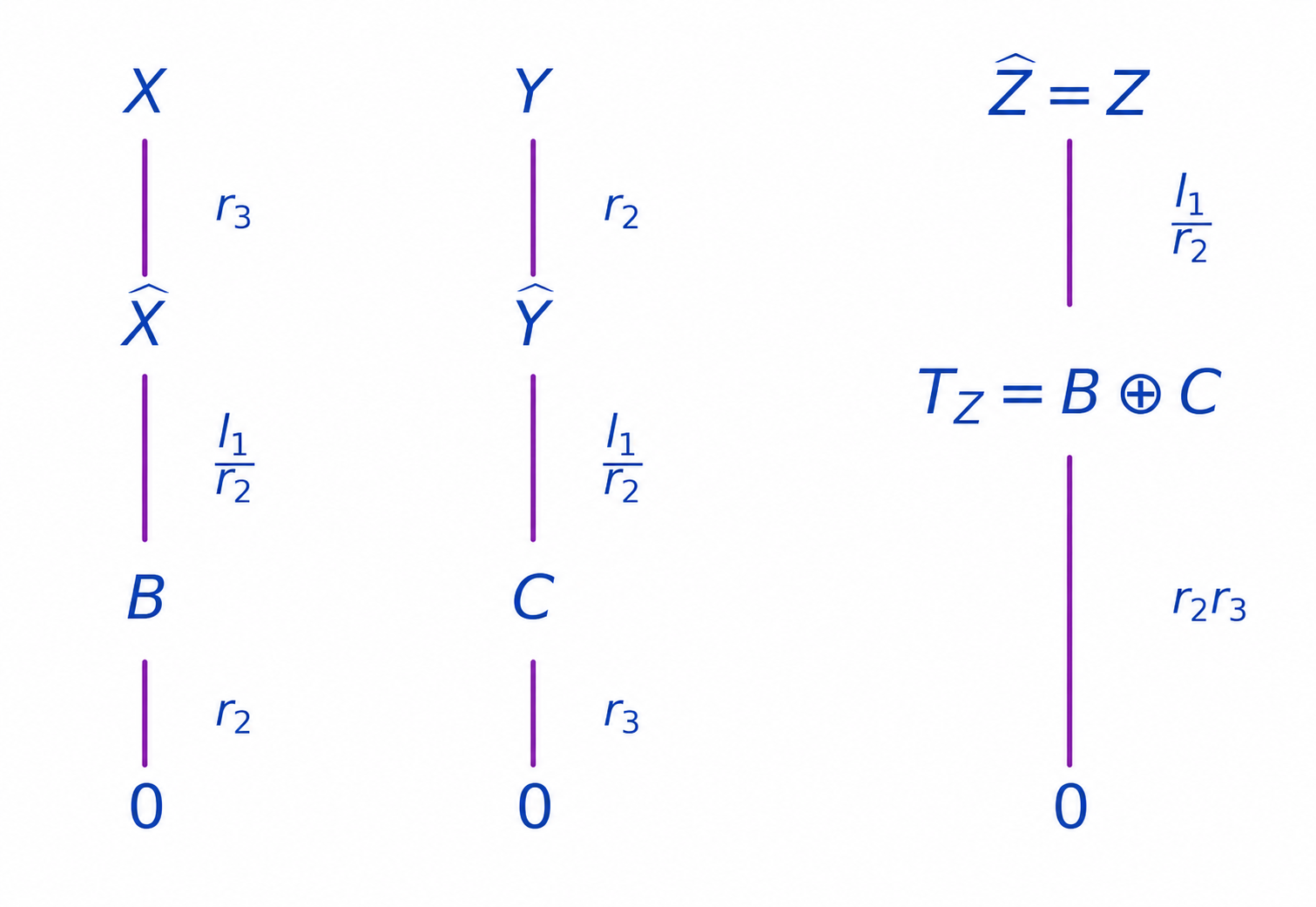
- The paper establishes that a common transversal exists for three equal-order subgroups, except when a specific 2-adic obstruction due to cyclic Sylow 2-subgroups occurs.
- It employs combinatorial bijections and subgroup reduction techniques to generalize classical matching theorems, addressing transversal existence in both algebraic and geometric settings.
- The results provide actionable criteria for constructing fundamental domains in full-rank lattices, linking the theory to practical problems like the measurable Steinhaus tiling problem.
Three Subgroup Common Transversals in Abelian Groups: A Technical Summary
Introduction and Motivation
The paper "Three subgroup common transversal in abelian groups" (2606.14319) resolves a longstanding combinatorial and geometric problem involving coset representatives (common transversals) for three equal-order subgroups of a finite abelian group. This characterizes the existence or non-existence of common transversals, directly generalizing the classical Hall Marriage Theorem for the n=3 case and answering a question raised by Kolountzakis in 1997 [kol97].
A transversal, or fundamental domain, for a subgroup H⊆G is a set of representatives—one from each coset. The central question is: Given three subgroups X,Y,Z of the same index in G, when does a subset E⊆G exist such that E is a transversal for all three?
The results are further translated to the theory of full-rank lattices in Rd, establishing criteria for the existence of a common fundamental domain for three lattices of equal volume and discrete sum, with direct implications for the measurable Steinhaus tiling problem.
Main Results and Theorem
The authors provide a complete characterization: The obstruction to the existence of a common transversal is a purely 2-adic structural phenomenon. Specifically, the only circumstance where three subgroups X,Y,Z fail to share a common transversal is when, after factoring out their intersection, the Sylow $2$-subgroups of X,Y,Z are non-trivial, cyclic, pairwise disjoint, and together their direct sums reconstruct the entire Sylow H⊆G0-subgroup of H⊆G1, i.e.:
H⊆G2
where H⊆G3, and H⊆G4 denotes the Sylow H⊆G5-subgroup.
Key Corollary: If the index of the subgroups is odd, a common transversal always exists.
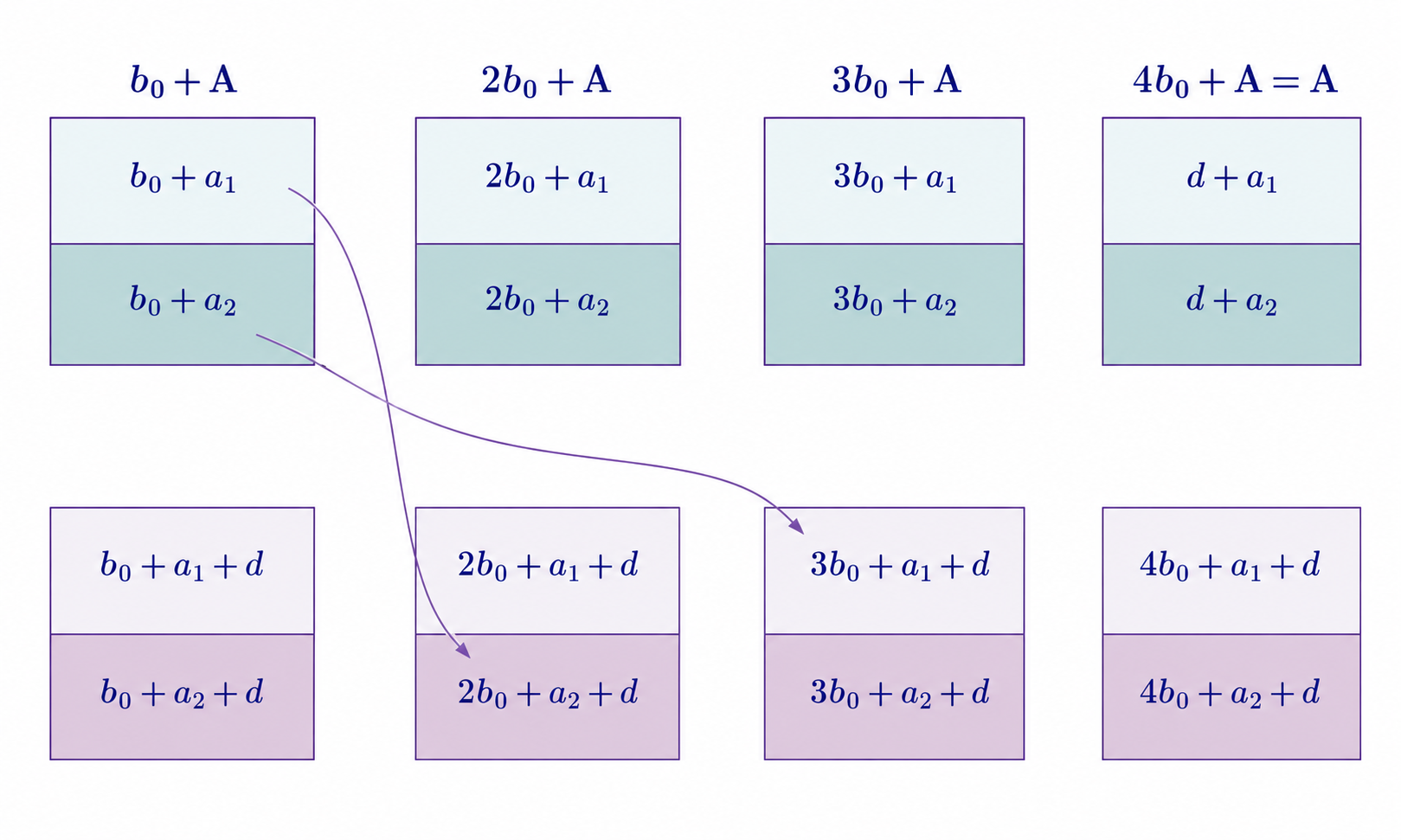
Figure 1: The function H⊆G6 matches the elements of each coset of H⊆G7, demonstrating transversal construction in a finite abelian group.
Methodology and Combinatorial Machinery
The proof framework systematically reduces the problem to perfect matching in finite abelian groups using combinatorial tools:
The authors further clarify the role of Sylow subgroups, showing that the existence of common transversals in the original group is equivalent to existence in each Sylow subgroup for all prime divisors of the group order.
Geometric Translation: Lattices in H⊆G9
The group-theoretic results yield immediate, strong conclusions for lattice tiling problems in X,Y,Z0: Three full-rank lattices of equal volume and discrete sum admit a common fundamental domain unless their quotient groups exhibit the 2-adic obstruction described above. If a fundamental domain exists, it can be constructed explicitly as a finite union of polytopes.
This solves the X,Y,Z1 case of Kolountzakis's open question, containing implications for both bounded and Lebesgue measurable fundamental domains, and ties into the measurable Steinhaus problem [KW98], [Jackson].
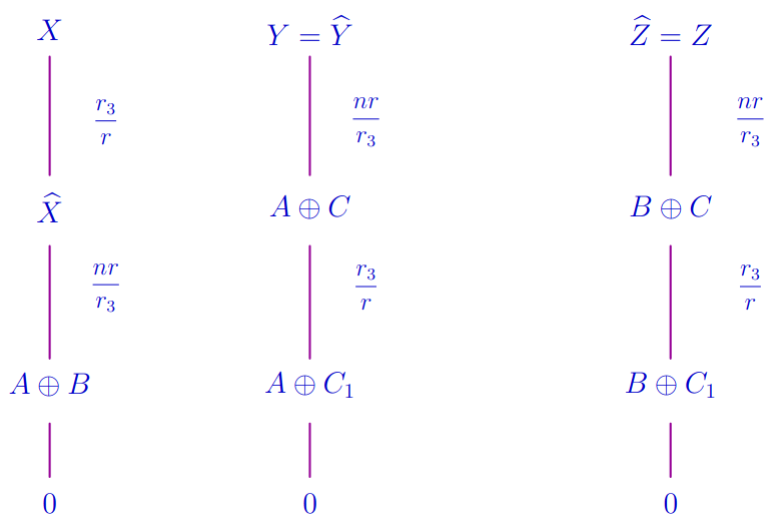
Figure 3: X,Y,Z2 along with their involved subgroups, illustrating higher-dimensional lattice analogues.
Examples and Counterexamples
Detailed examples are provided to illustrate both cases: configurations of full-rank lattices in X,Y,Z3 where no common fundamental domain exists, constructed to satisfy the critical 2-adic obstruction. For instance, selecting X,Y,Z4 so that their Sylow X,Y,Z5-components are cyclic and their intersections and sum reconstruct the group as in the main theorem.
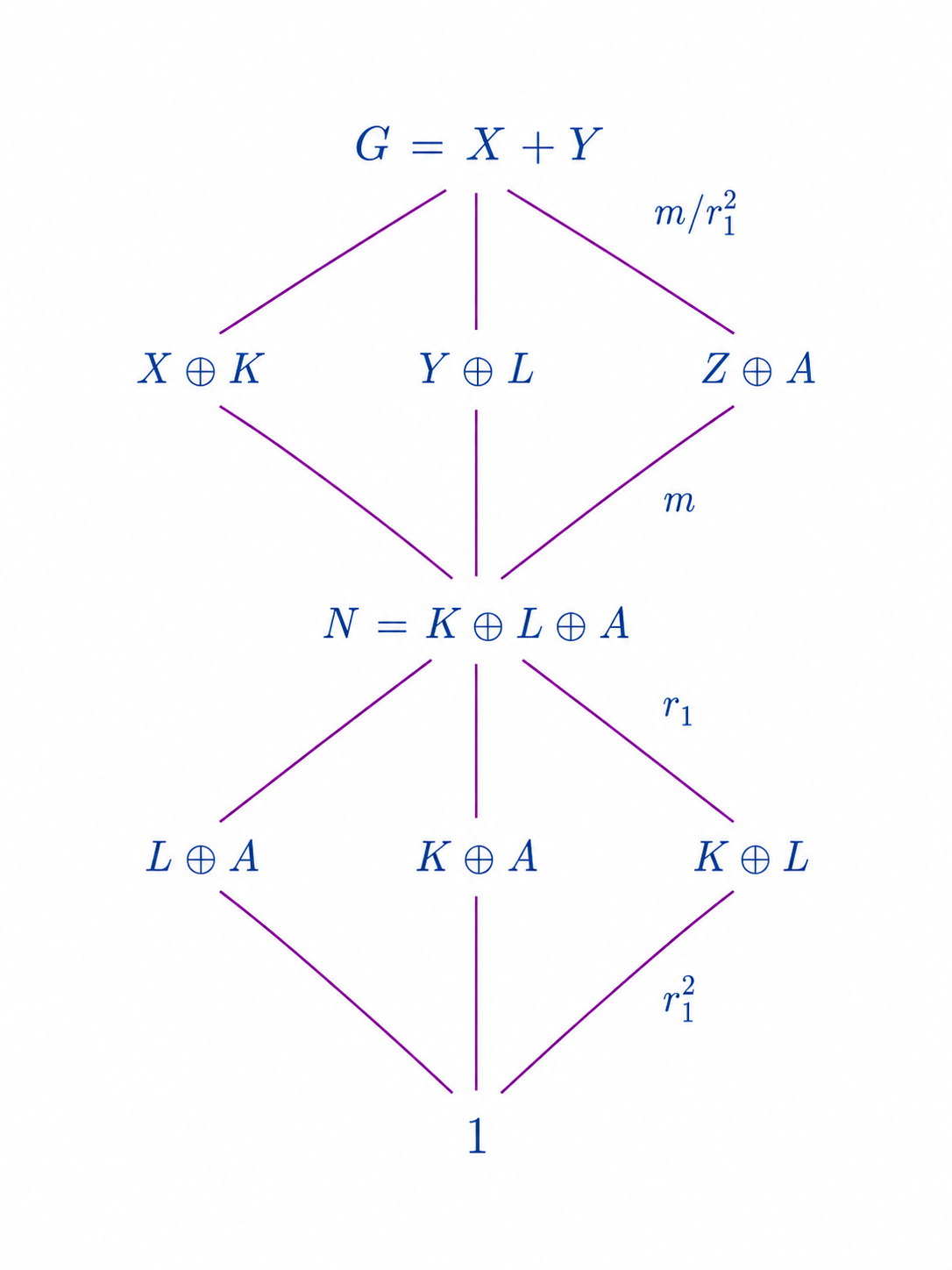
Figure 4: The groups involved in this case, demonstrating a configuration with a 2-adic obstruction.
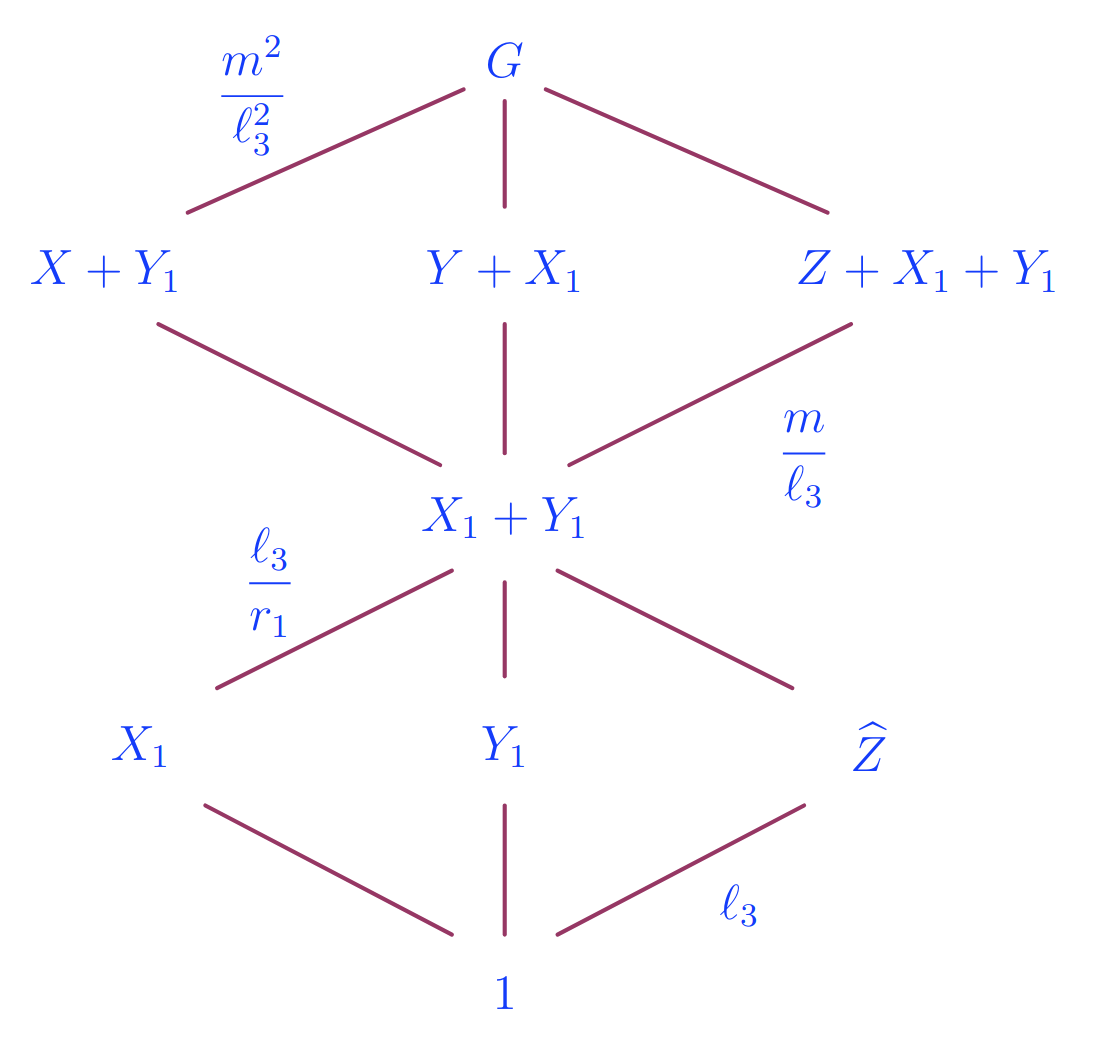
Figure 5: The groups involved in this case, showing a scenario permitting a common transversal.
Numerical Results and Strong Claims
Numerical Strength: The results provide a complete characterization; for three equal-order subgroups of a finite abelian group, either a common transversal always exists except in the explicit 2-adic obstruction, or it does not exist due to this obstruction. For odd indices, existence is guaranteed.
Contradictory Claims: Previous partial results suggested possible further obstructions, but the authors confirm that the only obstruction is the one linked to cyclic Sylow X,Y,Z6-subgroup structure. All other non-cyclic cases permit common transversals.
Implications and Future Directions
Theoretical Implications
These results cement the combinatorial underpinnings of transversal existence, connecting group-theoretic phenomena to geometric tiling and matching problems. The explicit characterization enables systematic investigation of multi-subgroup transversal problems and extends to more complex settings, such as higher X,Y,Z7 and other group classes.
The reduction to Sylow subgroup structure hints at broad applicability in understanding group actions, tiling, and combinatorial designs, potentially advancing Latin square theory and orthogonal arrangements [Evans2018].
Practical Implications
For lattice tiling and discrete geometry, the characterization delivers concrete criteria for constructing polytopal fundamental domains in multi-lattice settings, with immediate relevance for signal processing, crystallography, and coding theory.
Speculation on AI and Combinatorics
The reduction of existence questions to purely structural group-theoretic invariants offers strategies for automated reasoning in group-based combinatorial designs. Future AI systems dealing with algebraic combinatorics may leverage these structural decompositions for efficient transversal and tiling verification.
Conclusion
The paper delivers a definitive answer to the existence of common transversals for three equal-order subgroups of finite abelian groups, tracing the obstruction to the configuration of cyclic Sylow X,Y,Z8-subgroups. This result generalizes classical matching theorems, solves the X,Y,Z9 case for lattices in G0, and provides explicit constructions and counterexamples. The characterization is both algebraic and geometric, enabling future work in both domains.