- The paper demonstrates that intrinsic particle chirality initiates fluidization by producing a finite viscosity at zero shear.
- The methodology integrates a Lennard-Jones framework with pairwise transverse forces to model nonlinear shear-thinning and thinning-by-spinning behavior.
- Results reveal scaling laws and emergent layered structures when chirality opposes shear, offering insights into designing tunable active materials.
Shear Rheology and Thinning-by-Spinning in Dense Chiral Fluids
Introduction
The study "Thinning-by-spinning: shear rheology of dense chiral fluids" (2606.14311) addresses the rheological response of two-dimensional chiral fluids composed of self-spinning particles subjected to external shear. By introducing pairwise transverse (odd) forces into a Lennard-Jones framework, the investigation isolates the interplay between externally imposed shear and intrinsic particle chirality, elucidating how these ingredients shape fluidization, structural organization, and the nonlinear rheology of dense chiral suspensions.
Model and Simulation Framework
The system consists of N=4096 spherical particles in two dimensions, interacting via Lennard-Jones potential augmented with pairwise transverse forces parameterized by a dimensionless spinning rate Ω. The sign of Ω determines whether the particle’s intrinsic rotation aligns or opposes the imposed shear vorticity. Simulations are conducted over a broad range of densities and temperatures, spanning solid and liquid phases, with rheology probed via standard measurement of stress and structural order.
Chirality, Shear, and Hexatic Order
Chirality acts as an intrinsic source of both stress and fluctuations, affecting phase behavior and melting processes. In equilibrium, the system exhibits solid, hexatic, and liquid phases, but the introduction of spinning promotes the proliferation of defects and local rearrangements, fundamentally destabilizing hexatic order even in the absence of external driving. These effects are directly visualized through local projections of the hexatic order parameter ψ6(ri) for various shear rates and chiralities:
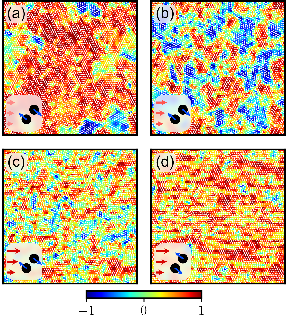
Figure 1: Projection of the local hexatic order parameter ψ6(ri) for ρ=0.7, kBT=0.35, at multiple shear rates and chirality, illustrating the fragmentation of hexatic order and the emergence of string-like structures when chirality opposes imposed shear.
At high shear and for Ω<0 (chirality opposing shear vorticity), the system self-organizes into string-like, layered domains—a marked structural transition compared to the moderate fragmentation seen when chirality and shear cooperate.
Shear Rheology and Thinning-by-Spinning
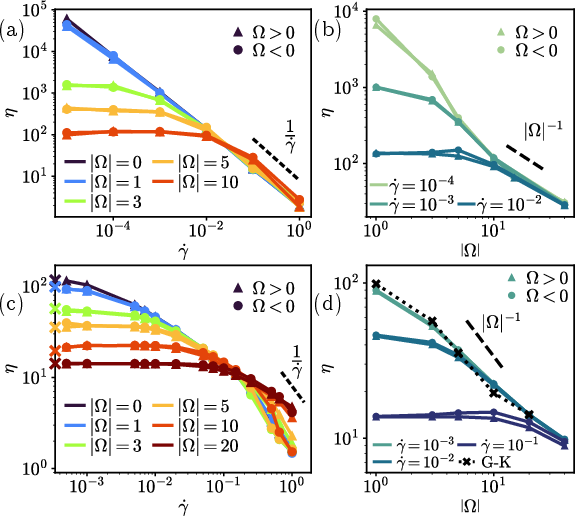
Quantitative rheological measurements reveal two main regimes:
The data support scaling laws compatible with mode-coupling theory predictions: Ω2 for strong driving, and a comparable scaling for chirality, Ω3, indicating effective stress contributions from both sources.
The non-equilibrium enhancement of fluctuations and transport is well captured by an effective temperature, Ω4, defined via violation of the FDT. This effective temperature grows with increasing activity, and, once incorporated into a generalized Green-Kubo formula, quantitatively reconciles the macroscopic viscosity with equilibrium-like stress autocorrelation measurements.
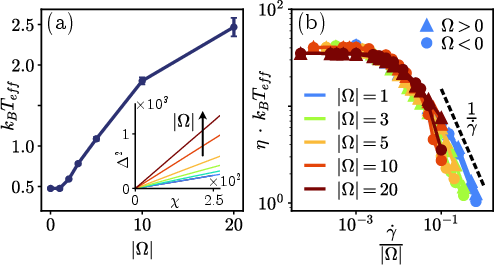
Figure 3: (a) Effective temperature as a function of chiral activity; (b) Collapse of flow curves rescaled by Ω5 and Ω6, corroborating the analogy between spin-activity and thermal/kinematic forcing.
These results substantiate the interpretation of chirality as a source of "thermalization" at the macroscale, validating extensions of equilibrium approaches to active chiral matter in the linear response regime.
Handedness, Asymmetry, and Layered Flow Transitions
At large shear and strong chirality, the detailed handedness of the driving becomes critical. When chirality and imposed flow are antagonistic, the system exhibits a sharp transition to layered, string-like structures facilitating flow and stress relaxation via channel formation. State diagrams constructed via local hexatic order and pair correlations demarcate the boundaries of these regimes:
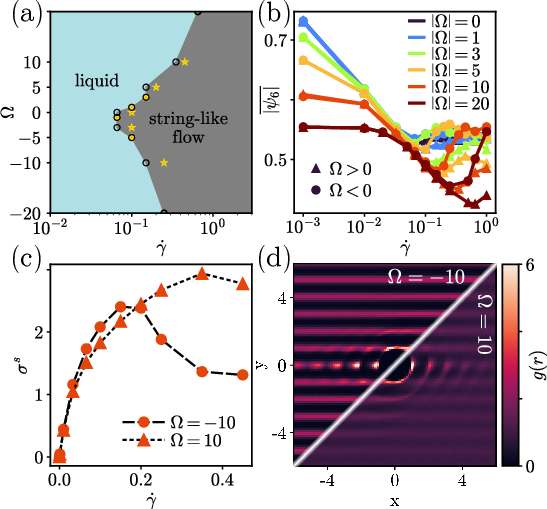
Figure 4: Phase diagram showing the onset of layering, the behavior of hexatic order, measured off-diagonal stress as a function of Ω7 for Ω8, and corresponding pair correlation functions that highlight the emergence of quasi-1D structures for Ω9.
The bifurcation of stress and structural order at high drive underscores the nontrivial interplay between intrinsic and extrinsic chiralities, leading to mechanical responses and flow organizations not accessible in achiral or equilibrium fluids.
Implications and Future Directions
This research positions chirality as a generic route to fluidization and nonlinear rheology in dense particle systems, revealing both scaling analogies to classical shear-thinning and qualitatively new phenomena arising from the non-commutativity of imposed and intrinsic torques. The implications are significant for engineering tunable active materials and understanding odd mechanical metamaterials, where transverse interactions play central roles.
Further study could explore the universality of thinning-by-spinning across dimensionality and interaction types, finite-size or confinement effects, coupling to hydrodynamic or frictional environments, and the impact of spatiotemporal heterogeneity in activity. Theoretical extensions incorporating higher-order stress and response functions, as well as experimental realization with chiral colloidal or granular systems, would deepen the connection between microscopic mechanisms and macroscopic transport.
Conclusion
The study provides a comprehensive account of the nonlinear rheology of dense chiral fluids, elucidating how spinning at the microscale parametrically tunes viscosity, structural order, and transport via effective temperature and competition with external driving. The identification of thinning-by-spinning and emergent layered states highlights unique mechanical responses in chiral suspensions, establishing a framework for future exploration of active and odd matter in soft condensed phases.