- The paper introduces ChronoID, which infuses explicit temporal signals into semantic ID learning to capture evolving user intent in recommender systems.
- It rigorously compares fusion strategies and quantization architectures, showing that relative time embeddings with parallel quantization yield up to 40% HR improvements.
- The study establishes a time-aware benchmark framework, demonstrating practical benefits in challenging scenarios like cold-start and emerging item recommendation.
ChronoID: Explicit Temporal Signal Integration for Semantic IDs in Generative Recommendation
Modern generative recommendation systems increasingly leverage discrete semantic IDs (SIDs) derived through vector quantization of item embeddings, enabling end-to-end modeling for retrieval, ranking, and diversification. However, current generative recommender approaches are fundamentally time-agnostic at the semantic abstraction level: while temporal cues can influence data selection (via session construction) or optimization (via order and positional encoding), the learned SIDs remain static, conflating temporally distinct interactions into identical semantic representations. This temporal stationarity assumption is misaligned with the dynamics of real-world recommenders, where user intent and item meaning evolve through time.
ChronoID directly addresses this gap by systematically evaluating where and how explicit temporal signals should enter the SID learning pipeline for generative recommendation. The approach establishes a unified framework and benchmark to analyze how temporal embedding strategies, fusion architectures, and quantization mechanisms interact to infuse time-awareness into SIDs.
ChronoID Framework: Three Orthogonal Design Dimensions
ChronoID parameterizes the design space of time-aware SID learning along three key axes: time embedding formulation, fusion strategy, and quantization architecture.
ChronoID explores three principal architectural variants:
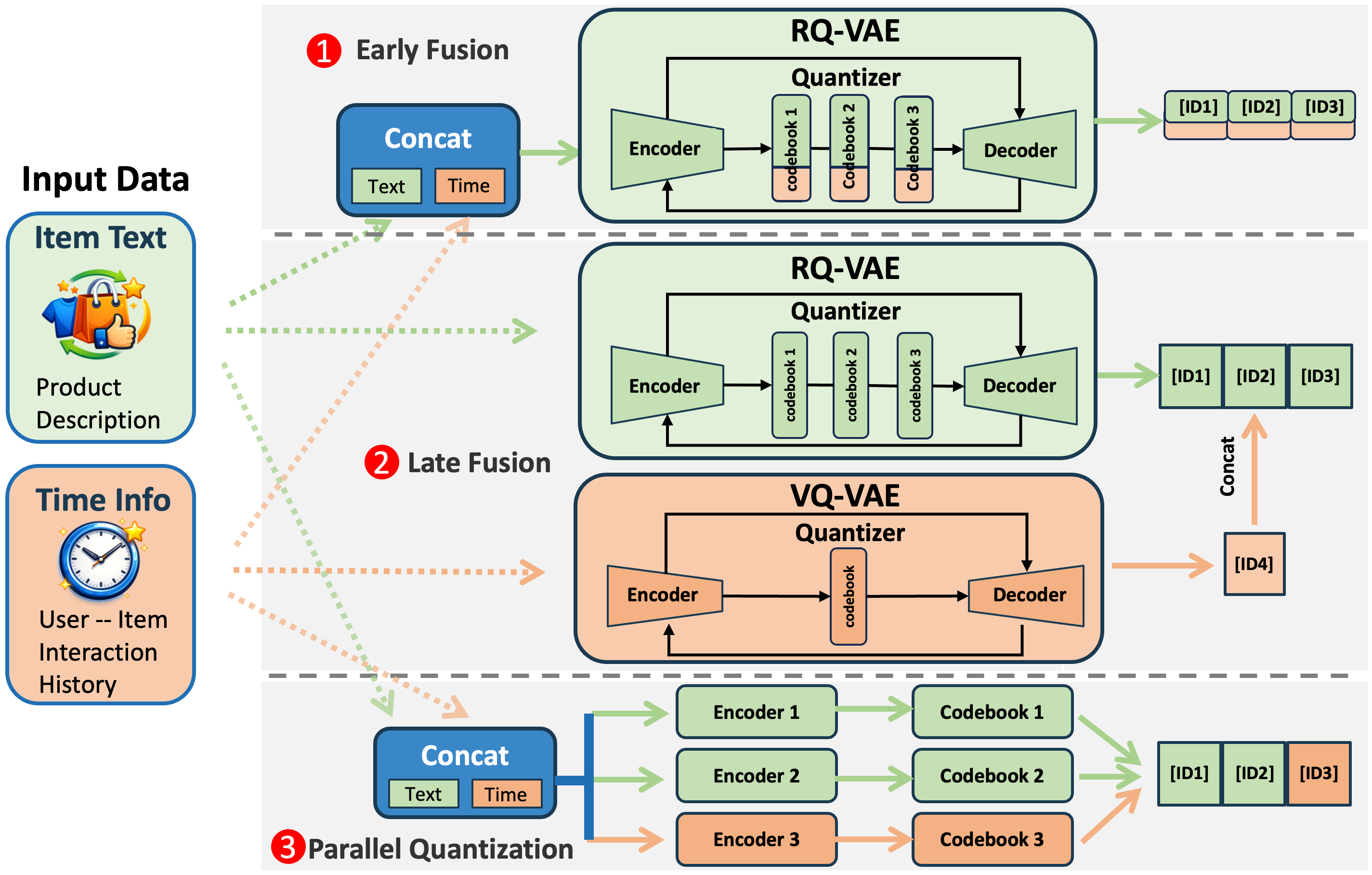
Figure 1: Three architectural variants of ChronoID: (a) Early Fusion of modalities before quantization, (b) Late Fusion via independent quantizers, (c) Parallel Quantization with decoupled codebooks.
Time Embedding: Absolute vs. Relative
ChronoID constructs time embeddings for each interaction using either:
- Absolute Time: Direct encoding of the event's UNIX timestamp, as in standard positional encodings. This captures global seasonality and calendar effects.
- Relative Time: Encoding the time interval since the preceding interaction, focusing on the rhythm and recency of sequential behavior, thus providing more localized, robust temporal semantics.
The empirical results establish that relative time provides more effective temporal grounding for SID learning, as it aligns better with user behavioral patterns and mitigates issues of distribution shift affecting absolute timestamps.
Fusion Strategy: Early vs. Late Fusion
- Early Fusion: Item and time embeddings are concatenated prior to quantization, and the fused vector is discretized with a single quantizer.
- Late Fusion: Item and time embeddings are separately quantized with distinct codebooks, and their discrete SIDs are then concatenated.
Late fusion consistently outperforms early fusion in empirical analysis. The superiority is attributed to late fusion's capacity to respect the heterogeneity of semantic (textual) and temporal feature spaces, preventing mutual interference during quantization and preserving the full expressivity of both modalities.
Quantization Architecture: Residual vs. Parallel
- Residual Quantization: Hierarchical quantization (RQ-VAE), where each codebook layer refines the residual from the previous, models coarse-to-fine aspects of the embedding.
- Parallel Quantization: Multiple independent codebooks discretize different perspectives or facets of the fused embedding concurrently, well-suited for modalities without explicit hierarchy—such as semantic and temporal signals.
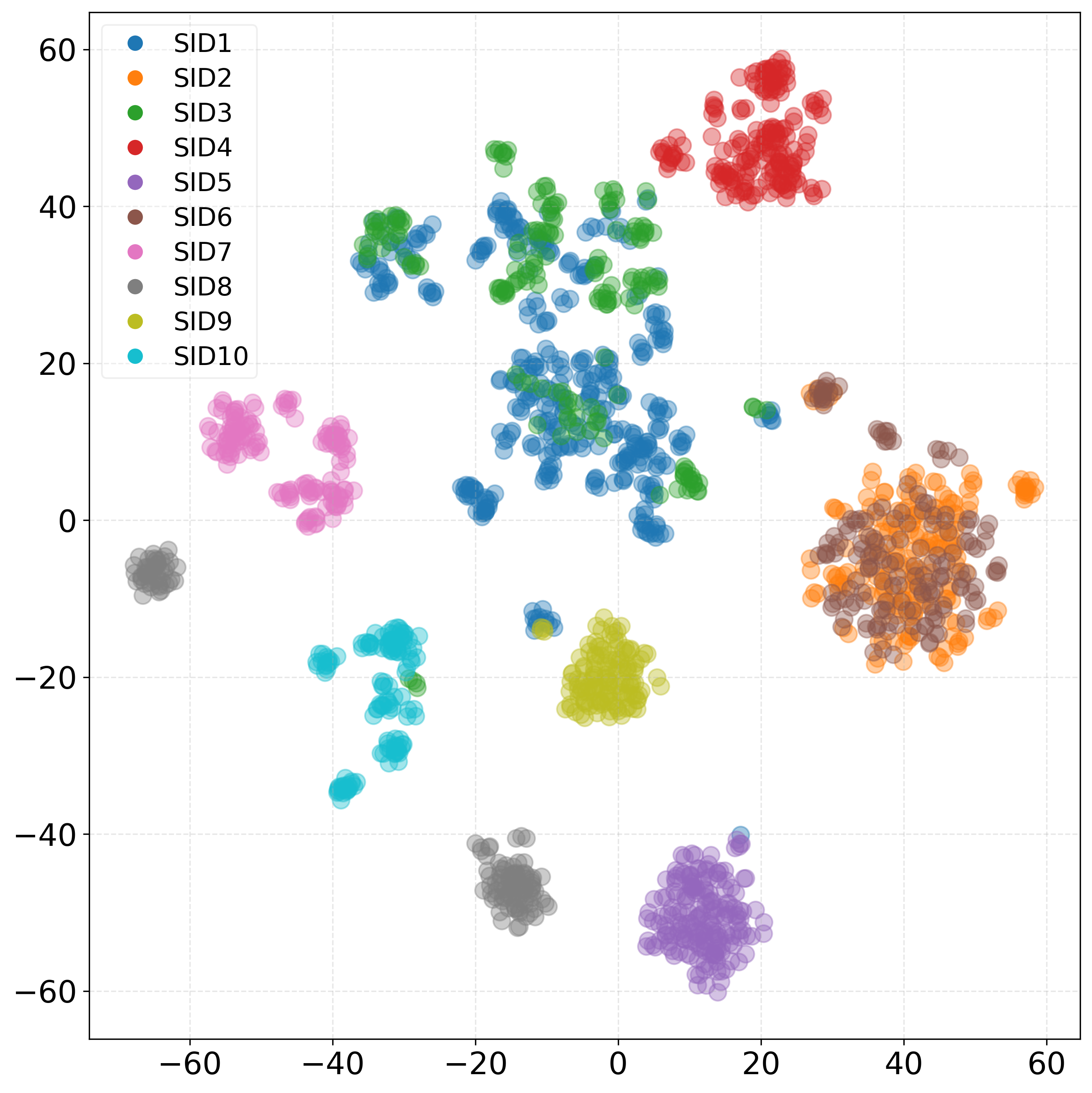
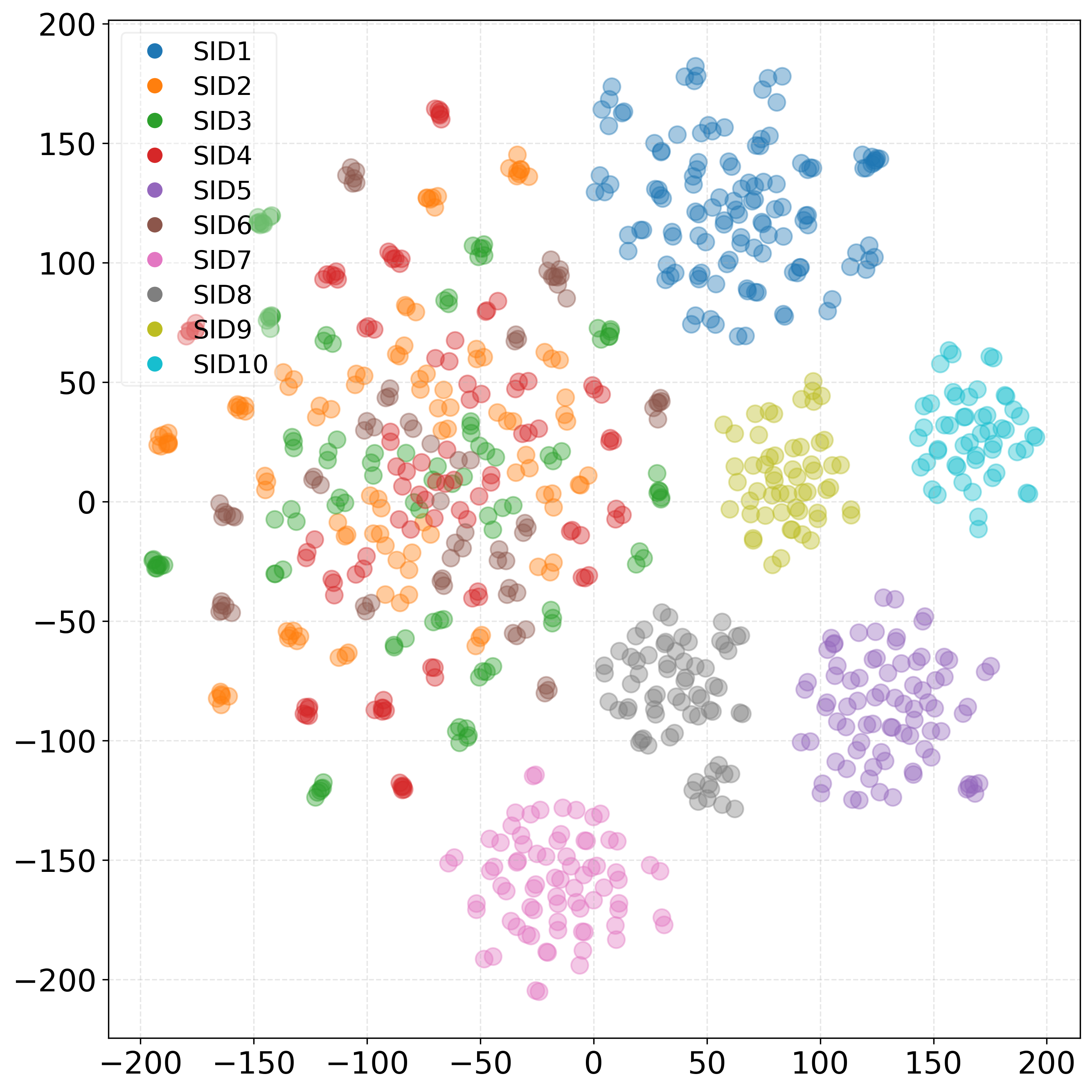
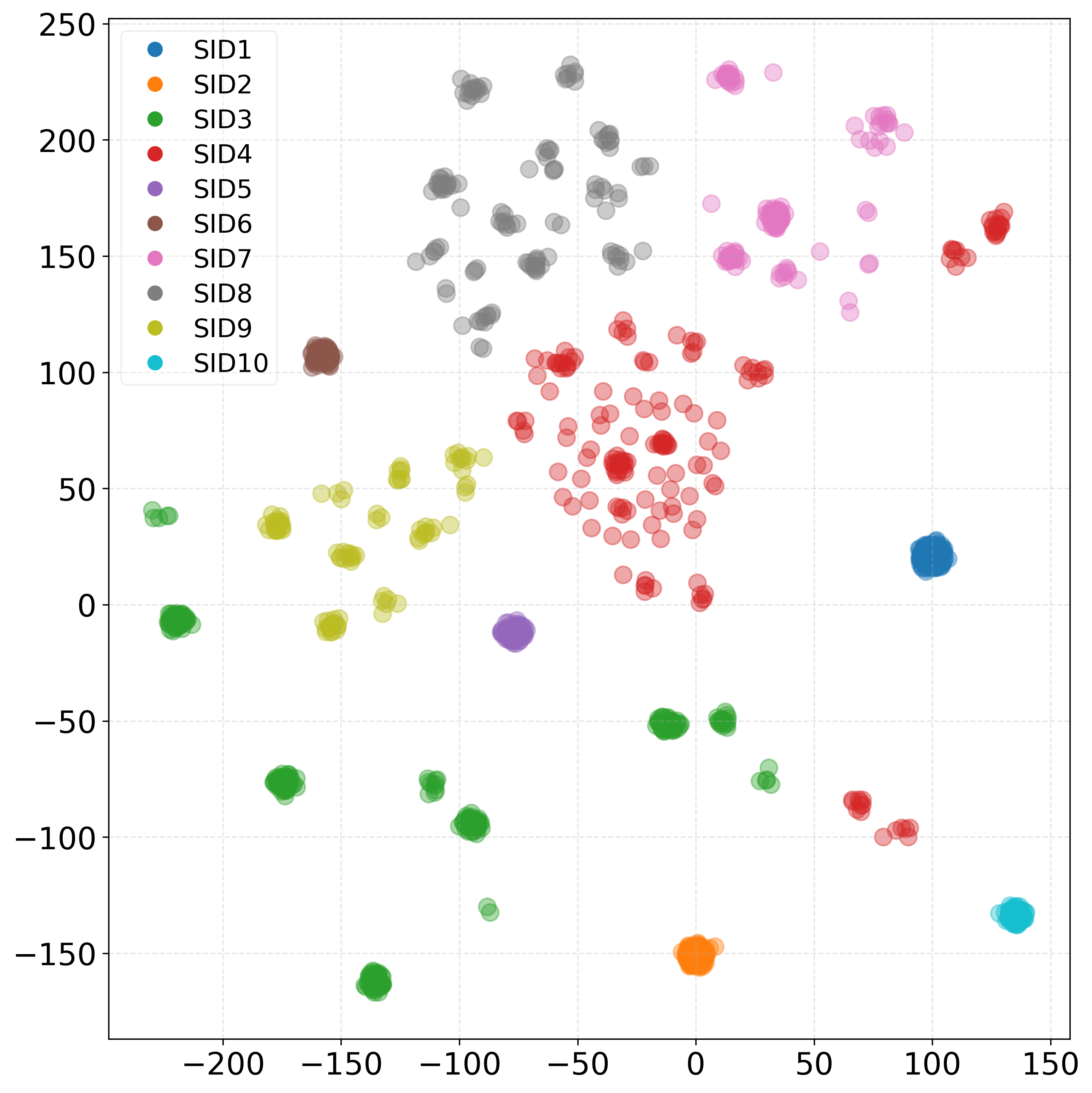
Figure 2: Parallel quantization utilizes independent codebooks to capture decoupled semantic and temporal facets.
Empirical evidence indicates that parallel quantization, particularly when combined with relative time encoding, produces the most discriminative and informative SIDs for generative recommendation.
Experimental Framework and Benchmark Construction
A major contribution is the introduction of a rigorously time-aware benchmark protocol. ChronoID implements strict temporal partitioning: codebook training, supervised fine-tuning, and test splits are segmented by a global cutoff timestamp to rigorously exclude future information leakage at all stages. This setting provides a more faithful evaluation of time-sensitive recommendation scenarios.
ChronoID is evaluated on three domains (Amazon Industrial, Amazon Office, and Mercari) against strong discriminative (e.g., SASRec, HSTU) and contemporary generative baselines (e.g., MiniOneRec, ActionPiece, TokenRec). The evaluation utilizes top-K (HR@K, NDCG@K) metrics following standard leave-one-out protocols.
Major Findings and Numerical Highlights
- ChronoID with parallel quantization and relative time embeddings yields up to 40% relative improvement in HR@3 over the best strong generative baselines on Amazon Office (8.42% vs. 6.01%), and over 36% improvement on Amazon Industrial (12.60% vs. 9.26%).
- Relative time embedding consistently outperforms absolute timestamp, with effect sizes exceeding 40% in some settings (e.g., early fusion with residual quantization, Industrial HR@3: 10.62 vs. 7.44).
- Late fusion is empirically superior to early fusion. Variants using more complex fusion (e.g., MLP or cross-attention) do not yield further gains, confirming that simple late fusion suffices.
- Parallel quantization decisively outperforms residual quantization in aligning multimodal representations, yielding more compact and discriminative SID clusters as visualized by t-SNE.
Visual Analysis of Learned Embeddings
t-SNE projections reveal that SIDs learned with relative time and parallel quantization form tight, well-separated clusters, indicating disentanglement and higher-quality semantics. In contrast, absolute timestamp and residual quantization result in more diffuse, overlapping clusters, reflecting lower discriminative capacity.
(Figure 1), (Figure 2)
Key Ablations
- ID Length vs. Semantics: Merely increasing SID capacity (by adding codebooks) without modeling temporal semantics does not improve, and may even degrade, recommendation performance.
- Necessity of Temporal Signals: Removing or zero-padding temporal features results in significant degradation. The drop is more severe with out-of-distribution (zero) signals, which confound sequence models.
- High-Level Time Features: Explicit inclusion of calendar-based features (weekends, holidays, seasons) adds negligible or inconsistent performance, indicating that fine-grained temporal embeddings suffice for Sid learning.
- Hyperparameter Sensitivity: ChronoID is most effective with moderate time embedding size (d=768) and $3$ codebooks, balancing capacity and noise.
Theoretical and Practical Implications
Theoretically, ChronoID demonstrates that temporal context must be accounted for at the level of discrete representation learning, not solely through chronological order or session-based heuristics. This refutes the implicit stationarity assumption in prior semantic ID methods and highlights the independence of temporal and semantic abstraction.
Practically, explicit time-aware SID learning improves the adaptability and topicality of recommender systems, directly benefiting cold-start and emerging item scenarios. The time-aware benchmark enables future studies on continual learning and adaptive codebook evolution without retraining from scratch, aligning with realistic production settings.
Outlook for Future Developments
Future research can extend ChronoID via:
- Adaptive or continual SID codebook updates as new items and interaction modalities evolve post-cutoff.
- Exploration in multi-domain and cross-domain generative recommendations, leveraging time-aware SIDs for transfer learning.
- Integration with more granular, user-centric temporal features (e.g., circadian, context-aware cues) to further individualize recommendation sequences.
Conclusion
ChronoID introduces a comprehensive framework and benchmark for learning and evaluating time-aware semantic IDs in generative recommender systems. By rigorously elucidating the interplay between temporal encoding, fusion strategies, and quantization mechanisms, it establishes the necessity and utility of infusing explicit temporal signals into the semantic abstraction layer. The approach offers significant empirical improvements over time-agnostic baselines and sets a foundation for the next generation of temporally adaptive, generative recommendation models.

