- The paper introduces CORD-SLS, a framework that combines GPU-parallel differentiable simulation with robust MPC for real-time, certified deformable manipulation.
- It employs contact smoothing and surrogate gradients to achieve up to 700× faster forward simulation and 2000× faster Jacobian computation than previous models.
- Certified safety is ensured through calibrated uncertainty bounds and output-feedback SLS, as demonstrated by 100% safety rates in hardware validations.
Manipulating deformable objects, such as ropes and cloth, presents significant challenges due to high-dimensional nonlinear dynamics, intermittent contact, and uncertainty in perception and control. Existing techniques either sacrifice robustness for tractability or lack efficiently exploitable gradients for planning contact-rich manipulation. The paper introduces CORD-SLS—a framework that integrates a GPU-parallel differentiable simulator featuring contact smoothing, GPU-accelerated output-feedback robust Model Predictive Control (MPC) via System Level Synthesis (SLS), and calibrated uncertainty bounds for certified safety, targeting real-time, robust manipulation of ropes and cloth (2606.14188).
The core simulator models nodal systems for ropes and cloth via an implicit time-stepping scheme, capturing elastic energy and constraint forces through holonomic and contact constraints. The contact dynamics are convexified using Anitescu’s relaxation, enabling efficient gradient computation and improved contact discovery. Crucially, gradient vanishing near contact transitions is mitigated by surrogate gradients: constraint stiffness is smoothed, and complementarity conditions are relaxed, providing informative gradients without physically inaccurate rollouts.
The simulator is implemented in JAX, leveraging GPU acceleration for both forward simulation and analytical gradient computation via implicit differentiation. Benchmarks demonstrate up to 700× speedup in forward simulation and 2000× acceleration in Jacobian computation compared to prior differentiable models, with only a modest loss in simulation fidelity.
GPU-Parallel Robust Output Feedback Control via SLS
The planning layer extends GPU-SLS from state feedback to causal output-feedback, synthesizing controllers that robustly stabilize manipulation trajectories under bounded process and perception disturbance. The SLS formulation computes reachable tubes for the closed-loop system, tightening constraints so trajectories remain inside safety sets. The observer design employs parallel associative scans—enabling millisecond-rate robust controller synthesis in dimensions previously inaccessible via CPU-bound SLS.
Output-feedback robust MPC is demonstrated to maintain all rollouts within robust tubes, certifying robustness to both dynamical and measurement uncertainty.
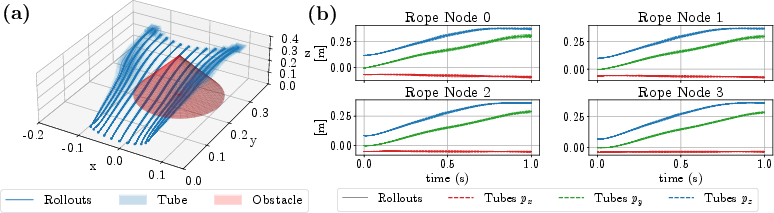
Figure 1: Robust tubes and rollouts for rope manipulation task; all rollouts are contained, evidencing closed-loop robustness.
Perception Pipeline and Uncertainty Calibration
The hardware system leverages a perception pipeline combining semantic segmentation (SAM3), skeletonization, and high-rate keypoint tracking (TAPNext++), fused with RGB-D to reconstruct rope and cloth states. To certify safety given perception uncertainty, the framework uses conformal prediction (CP) to empirically calibrate worst-case measurement-error bounds, inflating reachable tubes and guaranteeing high-probability containment of true object state.
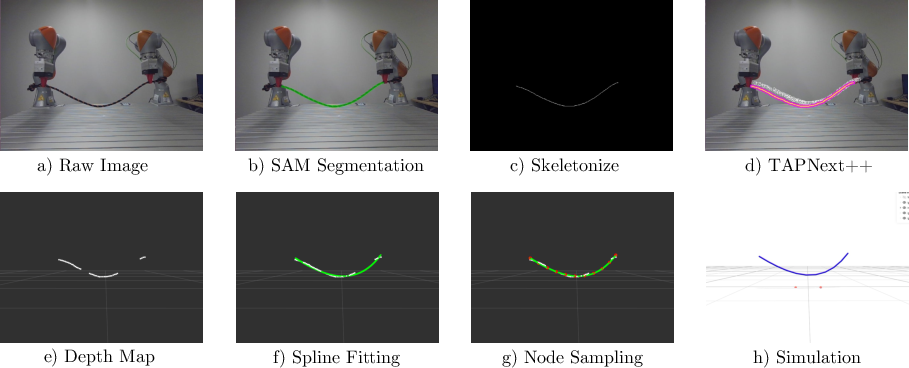
Figure 2: Rope perception pipeline—RGB processing, segmentation, skeletonization, keypoint tracking, depth association, spline fitting, state reconstruction.
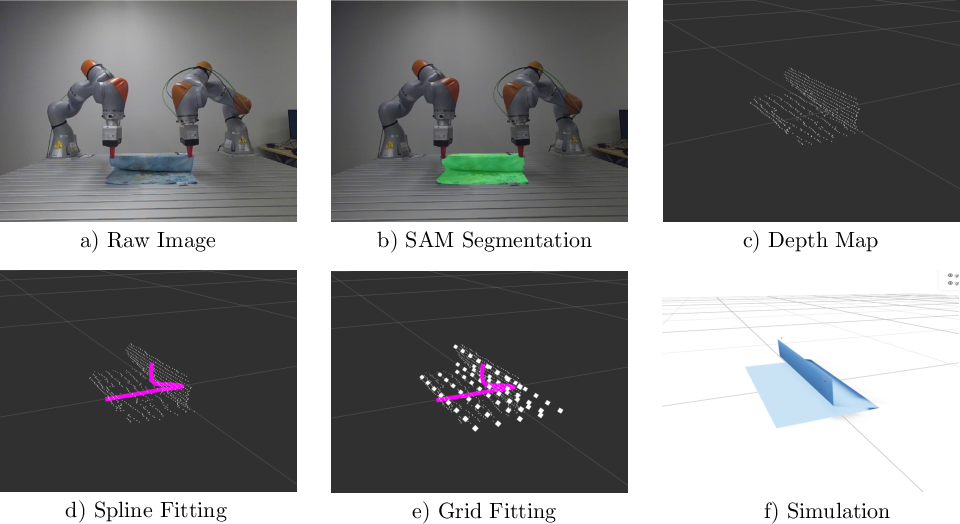
Figure 3: Cloth perception pipeline—segmentation, depth projection, boundary extraction, occlusion handling, grid fitting, state representation.
Model-Based RL Acceleration
CORD-SLS’s differentiable simulator facilitates model-based RL policy training via Analytical Policy Gradients (APG), allowing direct differentiation through contact transitions. Empirical comparisons indicate APG converges to optimal policies up to 46% faster than PPO due to more informative, lower-variance gradients.
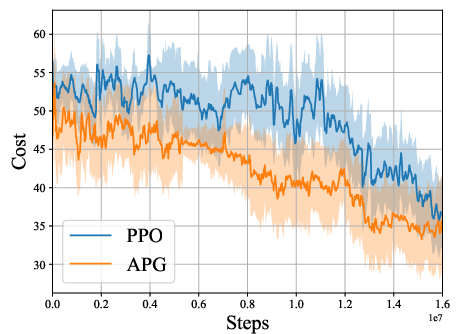
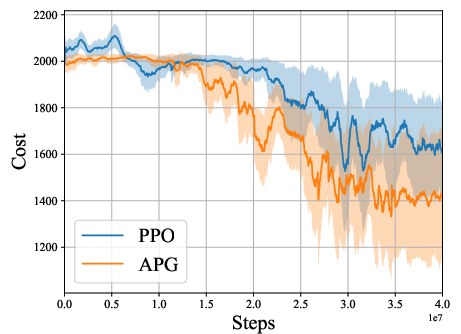
Figure 4: RL convergence comparison—APG reaches optimal policy in fewer steps than PPO for lift rope and drag rope tasks.
Empirical Results and Hardware Validation
Benchmark tasks include rope lifting, rope dragging with obstacle avoidance, and cloth folding/flattening, across simulation and hardware. CORD-SLS achieves:
- 100% safety rates and lower goal errors than baselines in rope lift, drag, and cloth tasks
- Millisecond planning rates for up to 300-DoF systems
- Orders-of-magnitude reduction in dynamics evaluations versus MPPI and PPO
In hardware demonstrations, manipulators robustly achieve constrained rope manipulation and cloth folding, with robust tubes computed by CORD-SLS maintaining state containment throughout execution.
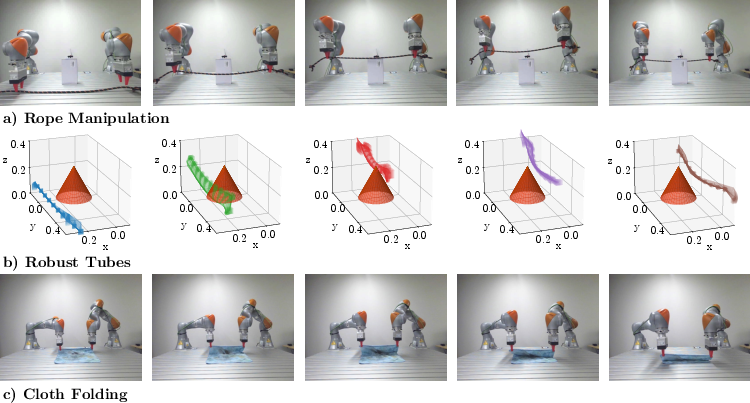
Figure 5: Hardware results—(a) Rope lift and obstacle navigation; (b) Robust tubes visualized for rope manipulation; (c) Extension to cloth folding.
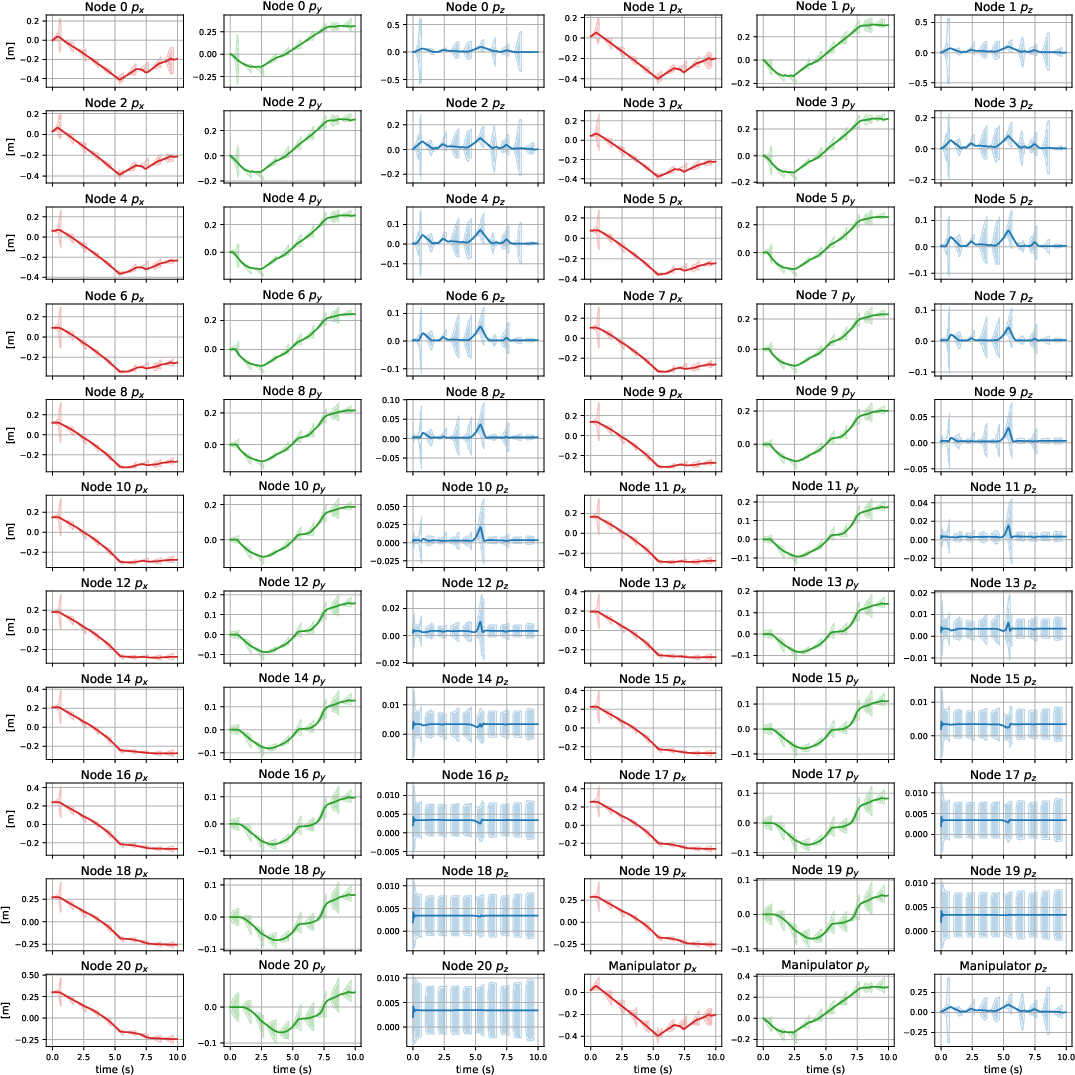
Figure 6: Forward reachable tubes for drag rope task (all 66 states), visualizing closed-loop safety under disturbance.
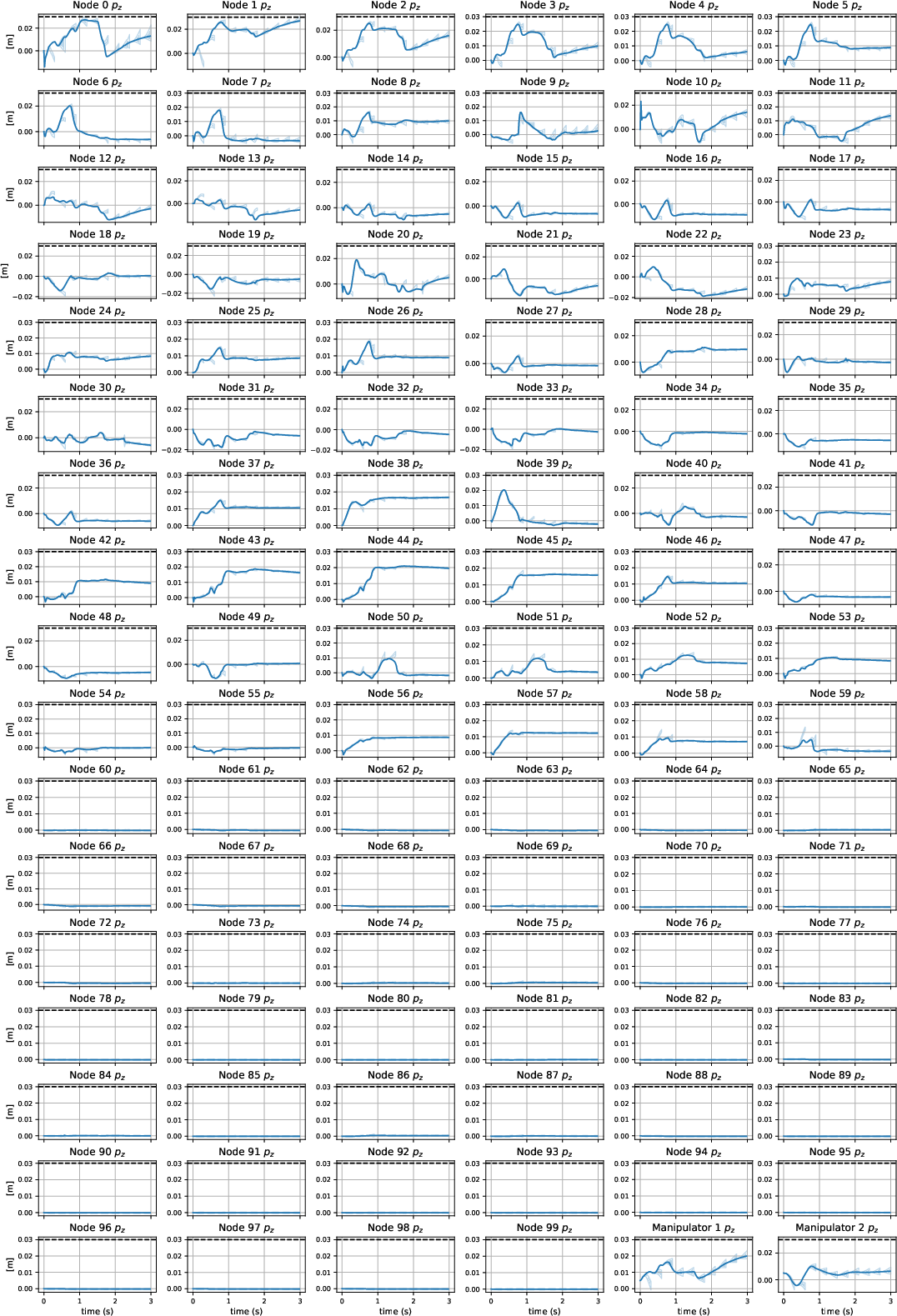
Figure 7: Forward reachable tubes for fold cloth task (z-coordinates), visualizing robust constraint satisfaction.
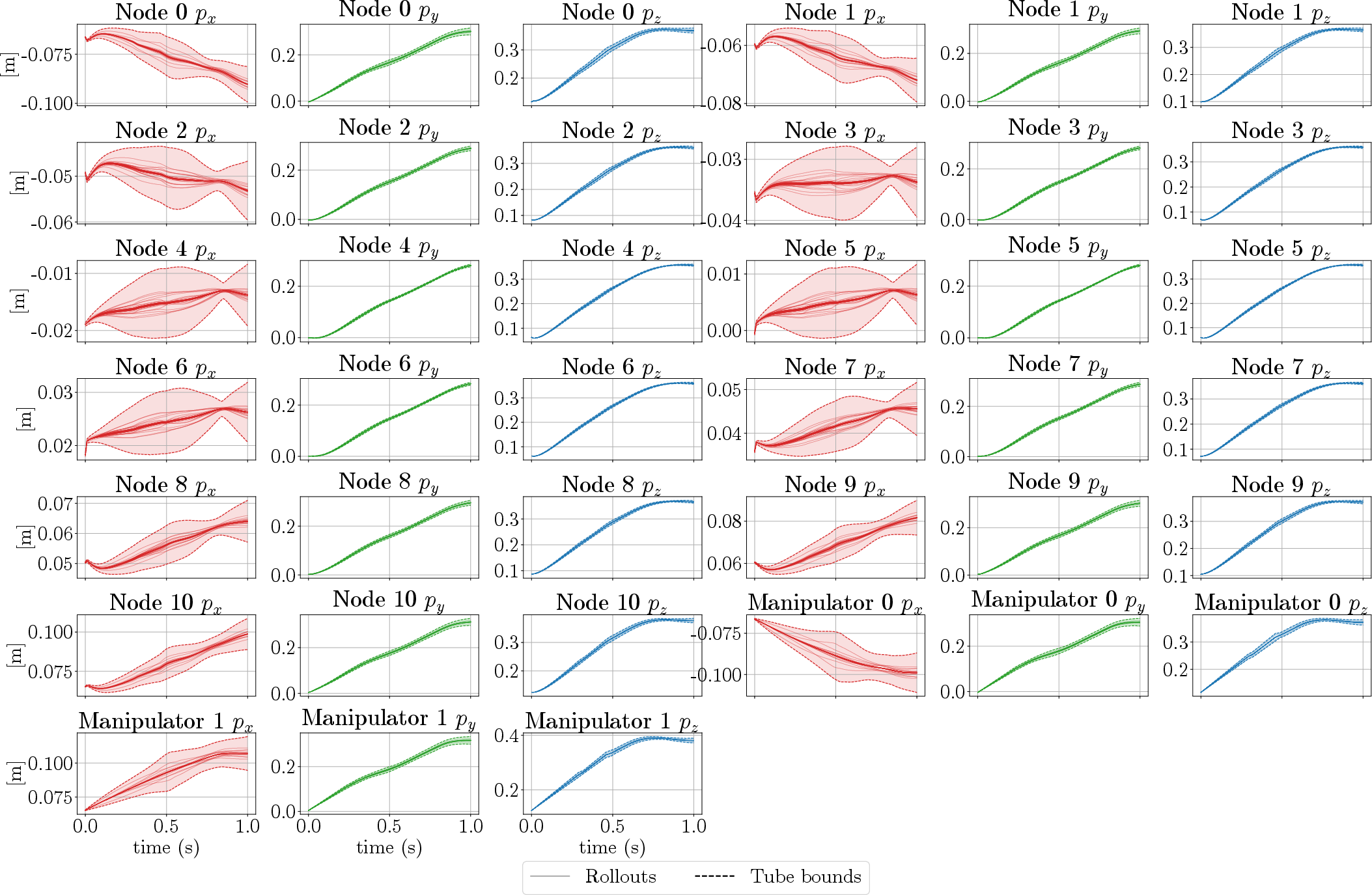
Figure 8: Forward reachable tubes for output-feedback rope manipulation (x, y, z dimensions), evidencing high-dimensional robust tube containment.
Implications and Future Directions
CORD-SLS provides a principled integration of differentiable simulation, robust control synthesis, and uncertainty quantification for deformable manipulation. Its real-time performance enables deployment in safety-critical robotic manipulation contexts, with direct applicability to logistics, domestic automation, and surgical environments. The formal robustness guarantees (via SLS and CP) set a practical foundation for increasingly autonomous manipulation under realistic perception and model error.
Future avenues include scalable memory-efficient SLS for very-high-dimensional systems, learned perception models for occluded or complex topologies, recursive feasibility for robust MPC, and potential extension to general dynamic contact-rich manipulation beyond quasi-static scenarios.
Conclusion
CORD-SLS addresses key gaps in robust, real-time deformable object manipulation by combining GPU-parallel differentiable simulation, robust SLS-based output-feedback control, calibrated uncertainty bounds, and accelerated RL via analytical gradients. Empirical evidence across simulation and hardware demonstrates superior safety, efficiency, and task success compared to established baselines. The modular architecture enables certified manipulation for ropes and cloth, underscoring both practical and theoretical progress in robot manipulation under uncertainty.