- The paper introduces a robust, hardware-in-the-loop dataset that captures realistic acoustic scenarios to evaluate hearing instrument algorithms.
- It details a comprehensive experimental setup including room reverberation control, dome configurations, and precise calibration for objective evaluation.
- Key quantitative analyses, such as SER >12 dB and DRR measurements, validate the dataset's fidelity for feedback cancellation and leakage analysis.
HIDVAS: A Comprehensive Dataset for Hearing Instrument Algorithm Evaluation and Training
Introduction and Motivation
The "HIDVAS: A Hearing Instrument Dataset in Various Acoustical Scenarios for Algorithm Evaluation and Training" (2606.14175) presents a multidimensional dataset designed to facilitate objective evaluation and data-driven algorithm development in the domain of hearing instruments. Unlike simulated datasets, the use of carefully recorded, hardware-in-the-loop data ensures faithful representation of real-world acoustic scenarios, capturing the complexities of room acoustics, transducer nonlinearities, and device-specific characteristics. HIDVAS addresses major limitations of existing datasets by supporting a combinatorically rich set of conditions: multiple room reverberation times, open/semi-open/closed dome configurations, a range of source material (speech, noise, music), and a complete microphone/loudspeaker topology.
Experimental Apparatus and Recording Scenarios
HIDVAS leverages two specialized audio laboratories, namely the SONORA Audio Laboratory (SAL) and ExpORL Audio Laboratory (EAL) at KU Leuven, each offering variable reverberation properties and controllable acoustic environments. The SAL provides a relatively long reverberation baseline (T=1.48 s), while the EAL allows adjustment across T∈{0.09,0.47,0.73} s by deploying curtain-based absorption.
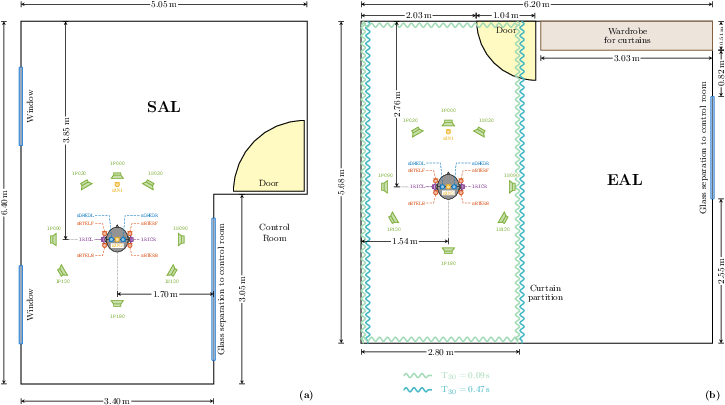
Figure 1: Floor plans of the SAL and EAL rooms showing loudspeaker and microphone positions, as well as curtain layout for variable reverberation.
The core measurement assembly comprises:
- A Cortex MK II dummy head, equipped with microphones at both the eardrums and behind-the-ear (BTE) positions.
- Pairwise mounted receiver-in-canal (RIC) hearing instrument loudspeakers with interchangeable domes (open, semi-open, closed, and no-RIC).
- Eight external Genelec loudspeakers arrayed on a 1 m radius circle to simulate diverse spatial scenarios.
- Two external microphones: one near the reference source (for assisted listening device simulation) and one above the dummy head.
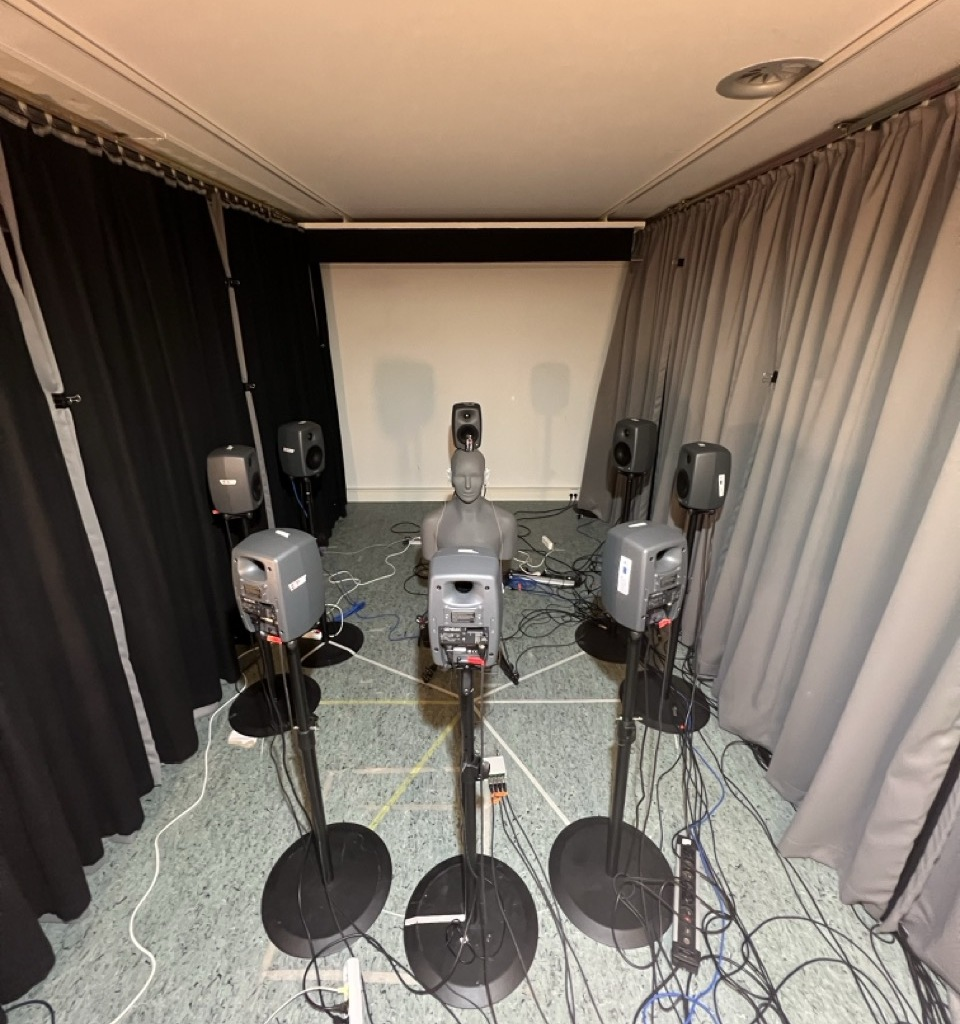
Figure 2: Photograph of setup in EAL (T=0.47 s), demonstrating physical arrangement and curtain-based reverberation control.
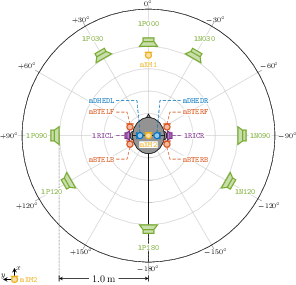
Figure 3: Schematic plan view of microphone and loudspeaker configuration with coordinate system and naming conventions.
Various acoustic source materials are included, spanning male/female speech (in both English and Flemish), speech-shaped noise, and four musical instrument classes, ensuring the dataset’s breadth across application targets.
Signal Acquisition and Audio Equipment Chain
All signals are digitized at 48 kHz, 16 bit, with robust synchronization controlled via an RME Digiface interface. The audio chain supports simultaneous high-fidelity capture from all microphone channels, with stimulus playback routed to both external loudspeakers and in-canal RIC drivers.
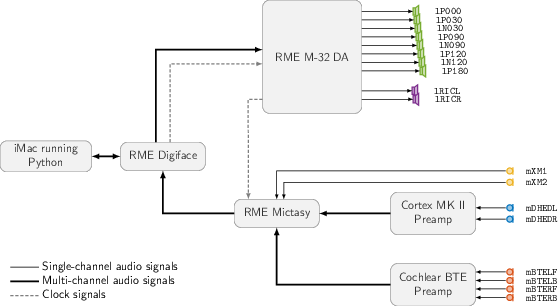
Figure 4: Recording chain schematic, detailing connections between the iMac controller, RME interface, preamps, DACs, and all transducers.
A rigorous gain calibration protocol equalizes level response across both microphones and loudspeakers. Calibration exploits diffuse and direct sound field measurements—ensuring that relative microphone gains match under a diffuse field with ±1.5 dB tolerance, and loudspeaker outputs are normalized for matched SPL at the central grid. Latency is consistently compensated such that time alignment between impulse responses (IRs) and direct audio recordings is maintained.

Figure 5: Power distribution across reverberant tails, confirming loudspeaker gain equalization in the diffuse field.
Dataset Structure and Recording Procedure
The HIDVAS dataset encompasses:
- Swept-sine IRs for every loudspeaker-microphone pair, supporting reproducible system identification.
- Direct waveform recordings for all source material, repeated for each dome, room condition, and loudspeaker.
Impulse responses employ an exponential sine sweep protocol with added silence buffers to prevent intersweep and interfile interference and to ensure deconvolution fidelity.
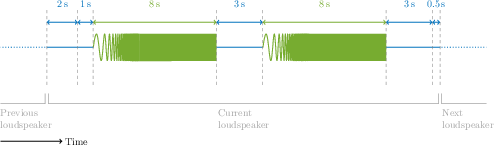
Figure 6: Timing structure for exponential sine sweeps, illustrating placement of silences for interference avoidance and latency compensation.
The final dataset comprises over 15,000 individual files, totaling >156 hours of raw signal data and >50 GB of storage. This scale underscores the richness and combinatorial depth of HIDVAS, exceeding the scope of most previous publicly available datasets.
Quantitative Analysis and Model Validation
To validate acoustic fidelity, the reverberation time (T30) is analyzed across octave bands and all room configurations. The system’s IR model is further validated by comparing the Signal-to-Error Ratio (SER) and Linear-to-Distortion Ratio (LDR) between recorded audio and the corresponding source audio convolved with the measured IRs.
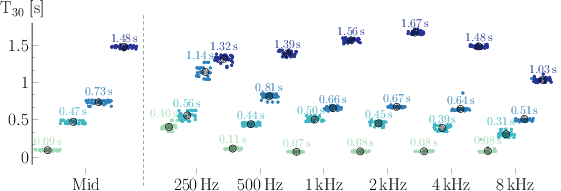
Figure 7: Reverberation time estimates per room and octave, confirming distinct and consistent acoustic conditions.
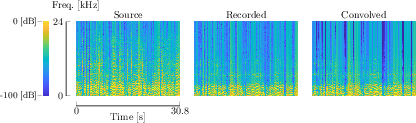
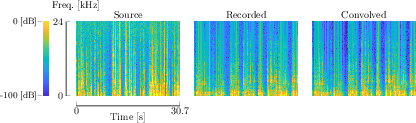
Figure 8: Spectrograms of source audio, direct recording, and IR-convolved signal, demonstrating close spectral correspondence and realistic reverberant smearing.

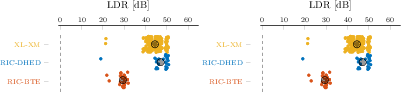
Figure 9: SER and LDR for key loudspeaker-microphone pairs reveal SER >12 dB, indicating strong modeling accuracy between IRs and direct recordings.
These results confirm both consistency across repeated measurements and the adequacy of the linear IR model for subsequent algorithmic evaluation.
Example Use Cases and Scenario Evaluation
Feedback Path Analysis
The influence of dome type and room acoustics on feedback magnitude between RIC loudspeakers and ipsilateral BTE microphones is characterized. Closed domes significantly attenuate feedback (>7 dB drop), whereas open and semi-open domes have near-identical, higher feedback sensitivity. Reverberation time has a negligible effect due to the short spatial distance and strong localization of the feedback path.
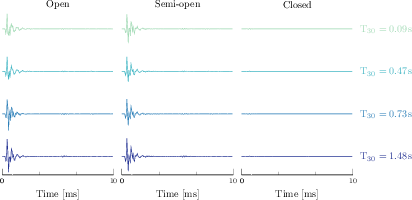
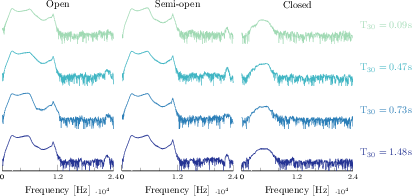
Figure 10: Magnitude and spectrum of ipsilateral feedback paths by dome and reverberation time, illustrating strong attenuation for closed domes and insensitivity to room T.
Assisted Listening Device Scenario
The direct-to-reverberant ratio (DRR) is quantified for external microphones positioned near the source versus BTE microphones. The external (proximal) microphone maintains a substantially higher DRR, with the DRR difference increasing as reverberation time grows, affirming the advantage of remote microphones or assisted listening streaming in challenging acoustic conditions.
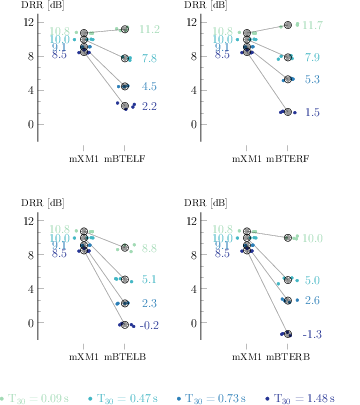
Figure 11: DRR measurements for BTE and external microphones show substantial benefit for near-source pickup, especially at long T.
Dome-Based Leakage Analysis
Leakage of external sound to the eardrum is analyzed as a function of dome occlusion. Both open and semi-open domes exhibit minimal attenuation of leakage (within a few dB of no dome), whereas closed domes attenuate external leakage by >30 dB, indicating effective occlusion for unprocessed ambient sound.

Figure 12: Power ratio of eardrum recordings for each dome versus open ear. Closed domes block external sound leakage by over 30 dB; open and semi-open configurations are ineffective in this regard.
Implications and Future Directions
HIDVAS enables robust evaluation for both classic and deep learning signal processing algorithms under highly controlled yet ecologically valid conditions. The simultaneous availability of IRs and real recordings supports both model-based and data-driven research, including end-to-end learning systems attuned to hardware non-idealities. The systematic inclusion of dome types, room reverberation, and multiple pickup locations addresses realistic fitting scenarios for hearing instruments, facilitating investigations into feedback cancellation, dereverberation, beamforming, signal enhancement, adaptive occlusion, and more.
Potential future extensions include multi-talker mixtures, additional acoustic environments, inclusion of dynamic scenarios (e.g., moving sources or head tracking), and leveraging the data for generative modeling of hearing instrument signal paths. HIDVAS’ design philosophy of maximizing ecological and device realism sets a high benchmark for future datasets in this domain.
Conclusion
HIDVAS (2606.14175) constitutes a rigorously engineered dataset for algorithm benchmarking and training in hearing instrument signal processing. Its comprehensive hardware-in-the-loop capture, combined with comprehensive scenario coverage, grants researchers a unique resource to advance state-of-the-art in both conventional and data-driven algorithm design. The public availability of both data and code further amplifies its value for reproducible research and robust comparative studies.