- The paper introduces a modified collision model that shows how persistent system-environment correlations lead to non-Markovian dynamics.
- Key analytical and numerical methods, including BLP measures and CP-divisibility witnesses, quantify transitions between distinct dynamical regimes.
- Closed-form expressions and reset map analyses demonstrate practical implications for quantum technologies, such as error correction and reservoir engineering.
Collision Models for Open Quantum Systems with Finite Quantum Environments
Introduction
This paper interrogates the dynamical structure of open quantum systems where the system qubit undergoes repeated interactions with the same environmental qubit, with an interposed CPTP reservoir action between collisions. Unlike traditional collision models that assume a thermodynamic environment composed of an infinite sequence of ancillas, this finite-environment scenario allows for persistent system-environment (S–E) correlations, thereby introducing non-trivial memory effects. The theoretical motivation arises from advances in quantum technology, where the ability to engineer both system and environmental degrees of freedom makes the environment a finite, controllable quantum object rather than a passive, infinitely large bath.
Standard and Modified Collision Model Frameworks
The standard collision model compartmentalizes the environment as a stream of independent ancillae, each prepared identically, interacting with the system once via a fixed unitary and subsequently discarded. This ensures Markovian dynamics due to immediate correlation erasure after every collision.
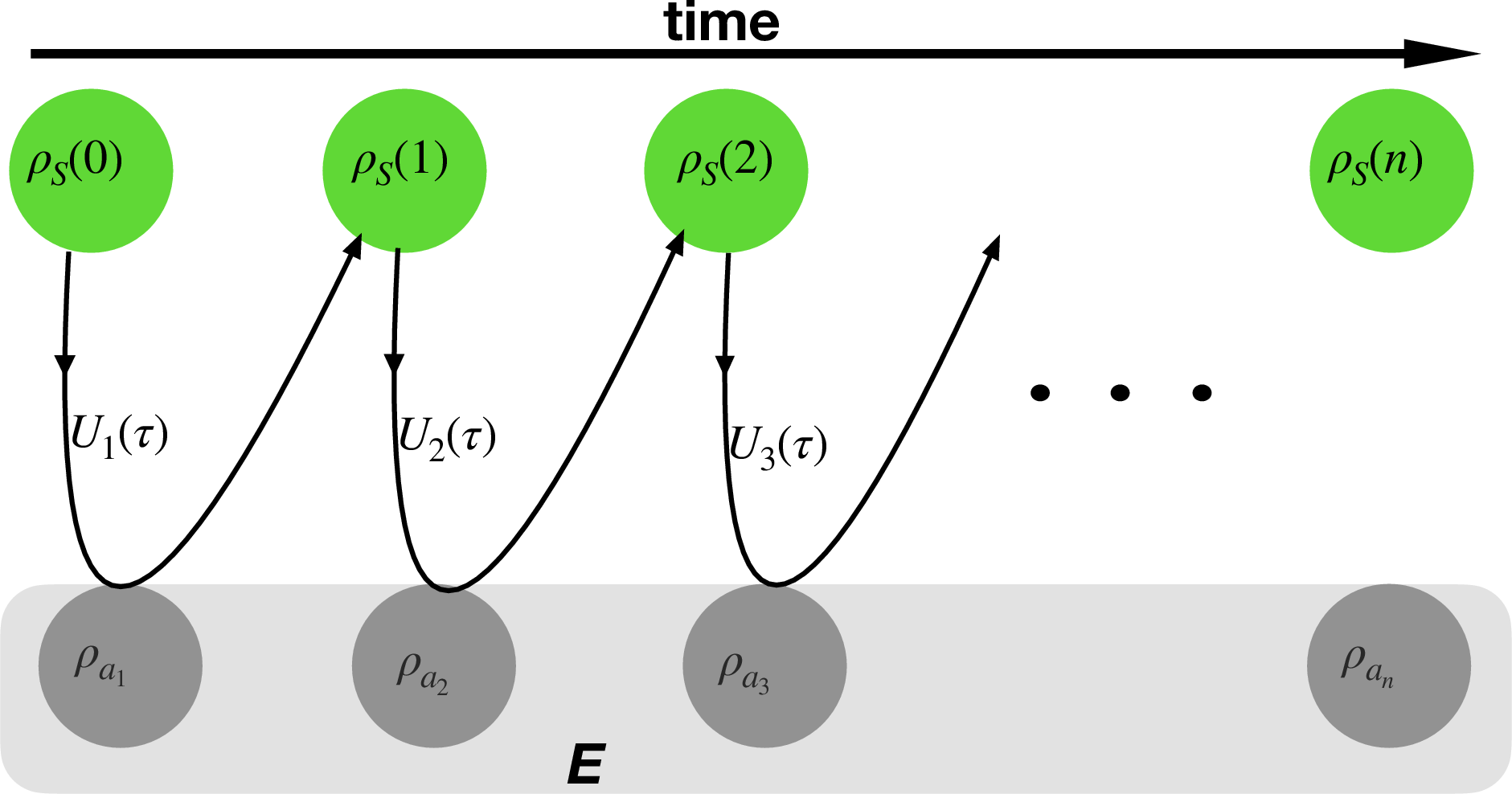
Figure 1: Schematic of the standard collision model. The environment E is partitioned into independent ancillae ai, each interacting with S via Ui.
The modified collision model replaces this environmental sequence with a single environment qubit E, interacting repeatedly with the system S, while a reservoir-induced CPTP map acts on E between collisions. Thus, S–E correlations persist and accumulate, and the reduced dynamics of S becomes history-dependent.
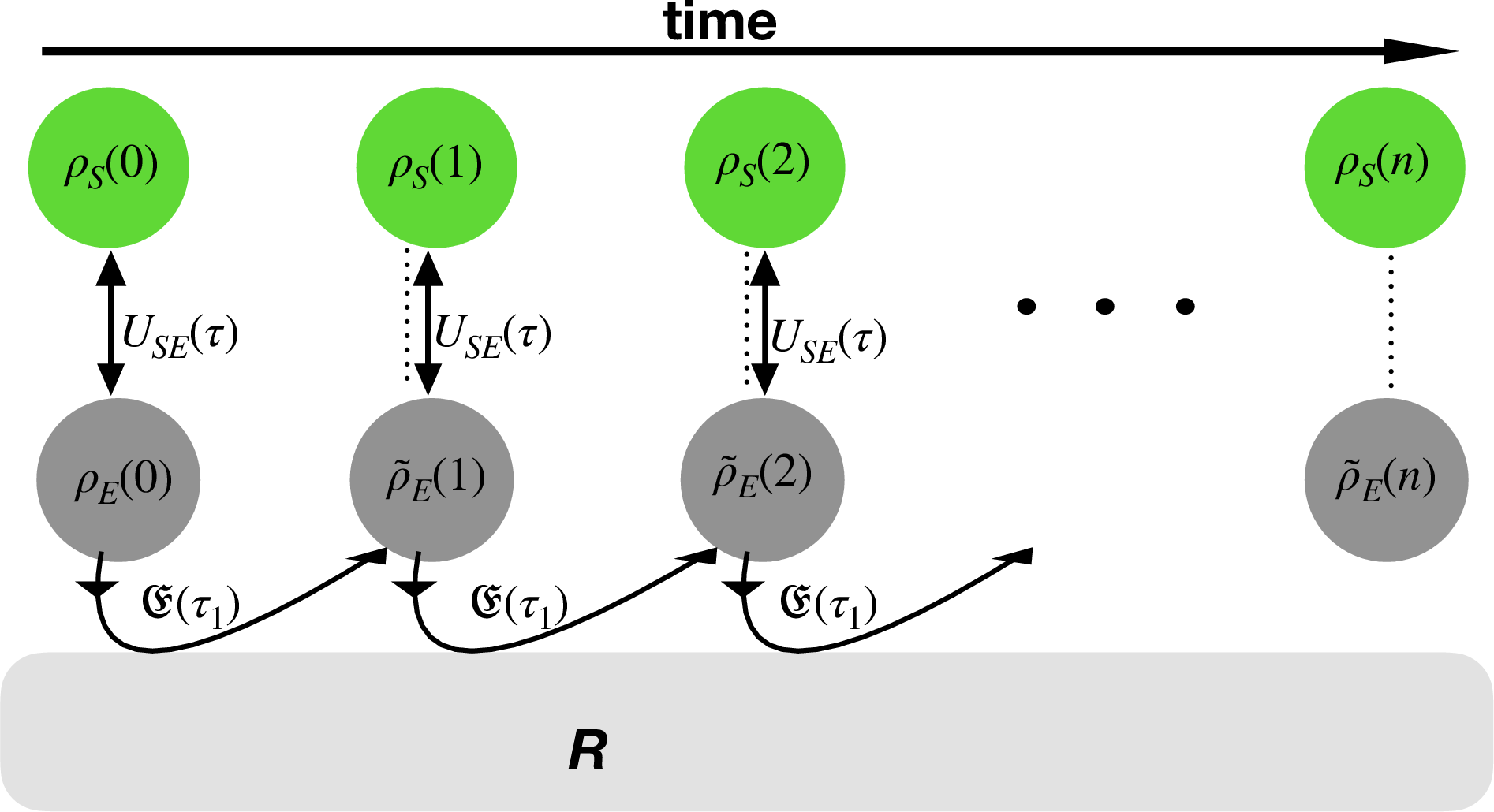
Figure 2: Schematic of the modified collision model, where S repeatedly interacts with E; reservoir CPTP maps act between collisions, retaining S–E correlations.
Quantification of Non-Markovianity and Divisibility
Memory effects are quantified via two primary measures: the trace-distance-based BLP (Breuer–Laine–Piilo) measure and a Choi-matrix CP-divisibility witness. The BLP measure detects backflow of information from E to S, and thus non-Markovianity, using changes in trace distance between pairs of system states; any increase indicates non-Markovianity.
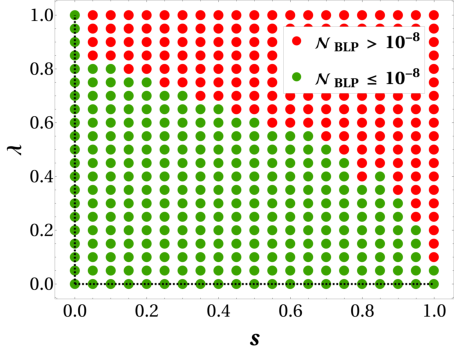
Figure 3: BLP non-Markovianity measure N as a function of model parameters, demarcating Markovian and non-Markovian zones.
The divisibility witness further refines characterization, distinguishing CP-divisible (Markovian), CP-indivisible but P-divisible, and non-P-divisible regimes, leveraging negative eigenvalues in the Choi representation of intermediate dynamical maps.
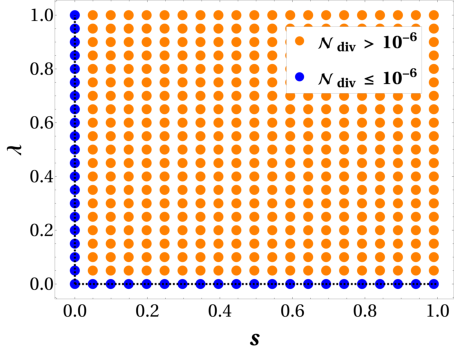
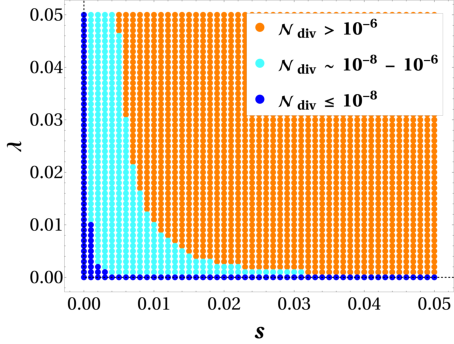
Figure 4: Divisibility measure N reveals CP-indivisible yet P-divisible domains, highlighting subtleties beyond BLP detection.
Uniqueness of the Reset Map and Emergence of Dynamical Regimes
It is rigorously established that only a complete environmental reset—independent of interaction specifics—can fully suppress S–E correlations. Partial resets correspond to a CPTP map that contracts the environment's Bloch sphere by a parameterizable strength, yielding a continuous interpolation between full non-Markovianity (no reset) and Markovian semi-group dynamics (complete reset). This is proven using algebraic constraints on the action of general maps upon the environmental correlation subspace, showing that any partial contraction leaves residual correlations except in the trivial full-reset limit.
Partial reset maps, such as generalized depolarizing channels (uniform contraction) or amplitude-damping channels (anisotropic contraction), generate three distinct dynamical regimes:
The boundaries between these regimes are elucidated numerically, showing explicit phase transitions as a function of interaction strength and reservoir contraction.
For resonant excitation-exchange interactions—HSE=α(σ1S⊗σ1E+σ2S⊗σ2E)—exact closed-form expressions for the system's Bloch dynamics are derived, facilitating analytic and numerical investigation of memory effects within the partial-reset framework. For generalized depolarizing (GD) channels, the reduced map ES(n) becomes a convex combination of the CP-divisible semi-group and a coherent (non-reset) component, with weights determined by reservoir strength.
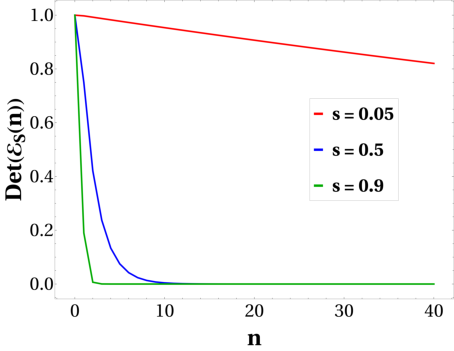
Figure 6: Determinant of dynamical map E illustrates contraction of accessible state space and reveals rapid loss of invertibility in strong-memory regimes.
For generalized amplitude-damping (GAD) channels, anisotropic contraction rates result in accelerated volume loss in the system's accessible state space; longitudinal directions are suppressed twice as fast as transverse ones.
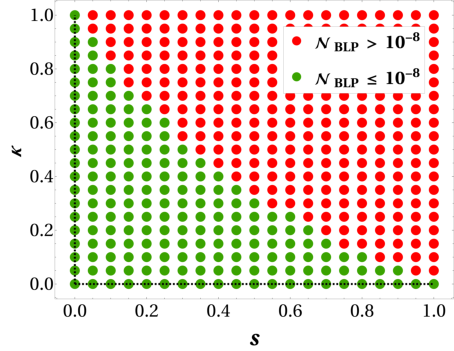
Figure 7: BLP non-Markovianity measure N for GAD contraction, showing enlarged non-Markovian domain and sensitivity to anisotropy.
Numerically, the BLP measure and divisibility witnesses are computed across parameter ranges, confirming that CP-indivisibility persists in all partial-reset cases except exact limits of zero interaction or vanishing reservoir retention. The onset and extent of intermediate regimes depends quantitatively on interaction strength and environmental contraction anisotropy, generalizing the Markov/non-Markov boundary.
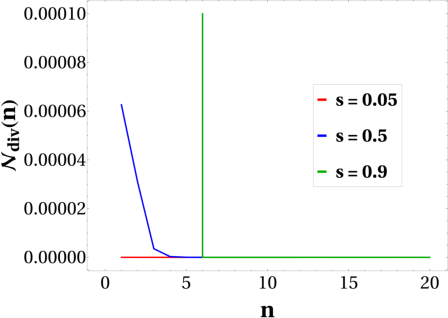
Figure 8: Step-wise CP witness N as a function of collision number; non-monotonic decay evidences persistent history dependence.
Implications, Practical Deployment, and Future Directions
The results provide a constructive framework for understanding how engineered environments generate or suppress memory effects in open quantum systems. Practical implementations in quantum technologies using controlled reservoirs—such as superconducting circuit QED, spin qubits in silicon, or cavity QED—can exploit partial resets to dial-in desired Markovianity, with implications for quantum information processing and error correction. The analytic tools for explicit map construction and divisibility assessment are directly extendable to higher-dimensional environments, multi-level systems, and multi-time processes, relevant for quantum thermodynamics and driven, out-of-equilibrium scenarios.
Theoretical extensions may address strong-coupling limits, environmentally-mediated feedback protocols, and non-equilibrium reservoir engineering. The finite-size origin of irreducible CP-indivisibility—a result of residual correlation retention by a finite environment—suggests that even arbitrarily strong relaxation cannot fully restore Markovianity unless the environment is infinite-dimensional. This result challenges the universality of master equation descriptions and mandates a more nuanced approach in system–environment modeling where finite memory and correlation recurrence are unavoidable.
Conclusion
This paper rigorously characterizes the open-system dynamics arising from repeated system–environment interactions under reservoir-induced partial resets, establishing the unique role of the full reset map and detailing the transitions between Markovian and non-Markovian, CP-divisible and CP-indivisible regimes (2606.14163). Closed-form dynamical maps are derived, and strong numerical evidence is provided for the existence and boundaries of distinct regimes. The framework links standard noise channels and finite quantum environments, providing practical and theoretical insights for the manipulation of memory in open quantum systems. Extensions to larger quantum systems and structured reservoirs promise further advances in quantum control and decoherence management.