- The paper introduces a Neyman-orthogonal score estimator that enables valid causal treatment effect inference in high-dimensional proportional hazards models.
- It employs cross-fitting and regularization techniques to mitigate bias from high-dimensional nuisance estimators and ensure robust estimation.
- Simulation studies and a real-data analysis confirm the method’s ability to achieve root-n asymptotic normality and reliable confidence interval coverage.
Neyman-Orthogonal Causal Inference Under High-Dimensional Proportional Hazards: A Technical Overview
Introduction and Problem Setup
The development of valid statistical inference for treatment effects in survival analysis remains a central challenge, particularly in high-dimensional settings rife with confounding. The Cox proportional hazards model is the mainstay for analyzing censored time-to-event data, but when the dimensionality of covariates rivals or exceeds the sample size, regularization is essential, yet induces bias that compromises valid inference. Conventional plug-in or naively debiased estimators are insufficient in this regime due to the slow convergence of high-dimensional nuisance estimators.
The "HSCI: Neyman-Orthogonal Causal Inference under High-Dimensional Proportional Hazards" paper (2606.14132) proposes the HSCI framework to surmount these hurdles by providing jointly valid inference for the (low-dimensional) causal treatment effect and (potentially high-dimensional) covariate effects under a sparse high-dimensional Cox model and high-dimensional propensity score model. The approach leverages a Neyman near-orthogonal score construction and cross-fitting to eliminate the detrimental impact (to first order) of high-dimensional nuisance estimation errors.
Neyman-Orthogonal Score and Methodology
The high-dimensional survival treatment effect model posits:
λT(t∣D,Z)=λ0(t)exp{Dθ0+Z⊤β0}
P(D=1∣Z)=1+exp{Z⊤γ0}exp{Z⊤γ0}
for baseline hazard λ0, treatment effect θ0, high-dimensional coefficient vectors β0 (Cox regression) and γ0 (propensity score).
Estimation of θ0 in this context is complicated by the need to control for high-dimensional confounding and to correct for regularization bias. The HSCI approach builds a moment equation for θ0 that is (nearly) orthogonal to the high-dimensional nuisance parameters, thereby attaining Neyman orthogonality as in Chernozhukov et al. (2018)—crucial for debiased estimation. The main estimation step solves:
Φn(θ,η):=l˙θ(θ,β)−μ⊤l˙β(θ,β)=0,
where η=(β⊤,μ⊤)⊤, P(D=1∣Z)=1+exp{Z⊤γ0}exp{Z⊤γ0}0 is the Cox partial likelihood score, and the vector P(D=1∣Z)=1+exp{Z⊤γ0}exp{Z⊤γ0}1 is calibrated to neutralize the gradient’s sensitivity to P(D=1∣Z)=1+exp{Z⊤γ0}exp{Z⊤γ0}2. This orthogonalization is constructed using covariance blocks of the score, approximated by their population analogs via the propensity score model (see Lemma 1).
To address overfitting in complex machine learning models for nuisance components, the procedure employs cross-fitting: partitioning the sample, training nuisance estimators on one fold, and constructing orthogonal scores on held-out data. Two approaches for aggregation—averaging solutions and solving a pooled moment—are described.
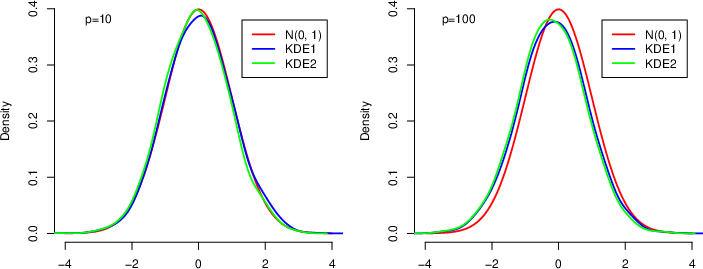
Figure 1: The empirical distributions of P(D=1∣Z)=1+exp{Z⊤γ0}exp{Z⊤γ0}3 and P(D=1∣Z)=1+exp{Z⊤γ0}exp{Z⊤γ0}4 over simulations, illustrating empirical normality and consistent scaling in both moderate and high dimensions.
For high-dimensional covariates, the methodology deploys the Lasso for initial estimation and a CLIME-style estimator for the precision matrix needed in debiased inference on covariate effects. The overall procedure enjoys rate double-robustness: valid inference requires that the product of convergence rates for Cox and propensity score nuisance estimators is sufficiently fast, relaxing the demands on any individual component as long as the other is well-estimated.
Asymptotic Theory
Under standard sparsity, compatibility, and overlap conditions, the authors rigorously derive:
- Root-n asymptotic normality for the treatment effect estimator P(D=1∣Z)=1+exp{Z⊤γ0}exp{Z⊤γ0}5 and low-dimensional linear functionals of P(D=1∣Z)=1+exp{Z⊤γ0}exp{Z⊤γ0}6.
- Consistent plug-in variance estimation via a sandwich formula based on empirical data.
- Coverage guarantees for confidence intervals even with high-dimensional confounding and possible propensity model misspecification, under rate double-robustness (see Theorem 1 and 2).
The technical contribution includes a detailed Taylor expansion and error control of the orthogonalized estimation equation, exploiting martingale properties of counting-process data and uniform concentration for empirical risk-set terms. The population moments leveraged for orthogonality are efficiently approximated using the sample and the estimated (or possibly misspecified) propensity model.
Numerical and Empirical Evaluation
The methodology is validated in a suite of simulations with both moderate and high-dimensional covariate sets (P(D=1∣Z)=1+exp{Z⊤γ0}exp{Z⊤γ0}7 up to 100) and varying censoring proportions. The empirical distribution of the normalized estimator (after variance correction) closely tracks the standard normal, and confidence intervals maintain nominal coverage even when the propensity score model is severely misspecified. Comparisons against the standard Cox-Lasso estimator demonstrate that the naive approach is substantially biased, whereas the HSCI approach controls bias and coverage.
Real Data Illustration
The methodology is further demonstrated on a diffuse large-B-cell lymphoma (DLBCL) dataset, assessing the effect of molecular subgroups on survival, controlling for thousands of gene expression features (via principal components for dimension reduction). The cross-fitted Neyman-orthogonal Cox estimator gives a significantly negative log-hazard difference, consistent with the observed Kaplan–Meier separation:
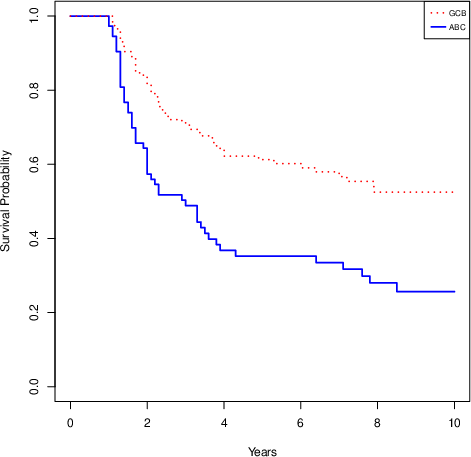
Figure 2: The Kaplan–Meier curves for germinal-center B-cell-like (GCB) and activated B-cell-like (ABC) subgroups, showing the survival advantage for GCB in DLBCL.
The proposed methodology offers both point estimation and valid confidence intervals for the effect of interest even in the ultra-high-dimensional regime.
Implications and Outlook
From a theoretical perspective, HSCI advances the literature by providing—under Cox's semi-parametric survival model—a principled, orthogonalization-based estimator which achieves valid root-n inference when confronted with high-dimensional confounding, regularization bias, and potentially misspecified treatment models. The framework incorporates cross-fitting and double machine learning ideas into the counting-process structure of right-censored survival data, which is substantially more intricate than iid settings.
Practically, HSCI directly enables individual-level causal effect estimation in high-dimensional biomedical and social science studies, supporting interpretable inference even when classical semiparametric efficiency approaches are intractable. The results demonstrate robustness to violations of the working propensity score model, provided the product of nuisance estimation rates is sufficiently small—a result that is especially impactful in modern applications involving flexible machine learning tools for nuisance regression.
Future Research
Open theoretical and practical directions include: extension to more complex survival models (e.g., nonproportional hazards, nonlinear effects), adaptation to machine learning–based nuisance estimators without explicit sparsity, and generalization to longitudinal or dynamic treatment effect settings (e.g., time-varying covariates/interventions), where martingale and risk-set structures become even more nuanced.
Conclusion
The HSCI framework achieves valid and robust inference for causal treatment effects in high-dimensional survival analysis, overcoming the challenge of bias from regularization and high-dimensional nuisance estimation. Its theoretical, simulation, and real-data analyses collectively confirm that Neyman orthogonality, paired with cross-fitting and machine learning, yields substantial improvements in the rigor and interpretability of survival causal inference.
References
- "HSCI: Neyman-Orthogonal Causal Inference under High-Dimensional Proportional Hazards" (2606.14132)
- Chernozhukov, V. et al., "Double/debiased machine learning for treatment and structural parameters" (Chernozhukov et al., 2017)
- Yu, Y., Bradic, J., Samworth, R. "Confidence intervals for high-dimensional Cox models" (2021).
- Huang, J. et al. "Oracle inequalities for the Lasso in the Cox model". (2013)
- van der Vaart, A.W., Wellner, J.A., "Weak convergence and empirical processes" (1996).