- The paper demonstrates that advanced MLIPs, particularly MACE, significantly outperform NequIP in accurately capturing energies, forces, and structural features.
- The paper uses AIMD-generated melt–quench data to benchmark RDF and S(q) trends, providing detailed insights into the molten state of Li₂CO₃.
- The paper reveals temperature-dependent Li⁺ transport, with a shift from anisotropic, correlated motion at lower temperatures to isotropic diffusion at higher temperatures.
Probing Structure and Ionic Transport in Molten Lithium Carbonate: A Technical Analysis
Overview and Motivation
Molten alkali carbonates, and particularly Li₂CO₃, are pivotal in high-temperature energy systems like molten carbonate fuel cells (MCFC), electrochemical carbon capture technologies, and as components of the solid–electrolyte interphase (SEI) in Li-ion batteries. Despite their widespread application, first-principles-level insight into their atomistic structure and ionic transport mechanisms, especially in the molten phase, remains an unresolved challenge due to expensive ab initio molecular dynamics (AIMD) and the inability of classical force fields to capture complex many-body and polarization effects. This work addresses these challenges by systematically benchmarking advanced equivariant machine-learned interatomic potentials (MLIPs)—specifically, MACE (Multi Atomic Cluster Expansion) and NequIP (Neural Equivariant Interatomic Potential)—trained on AIMD melt–quench data and using them for large-scale, long-time molecular dynamics simulations. The investigation targets accurate characterization of both structural features and Li⁺ transport regimes, emphasizing the concerted, correlated nature of ionic dynamics and its temperature dependence in molten Li₂CO₃.
Methodological Framework
A sophisticated dataset generation and model development workflow is employed, incorporating AIMD trajectories at 1500 K and 1250 K to sample realistic molten configurations, which serve as the training corpus for both NequIP and MACE Figure 1.
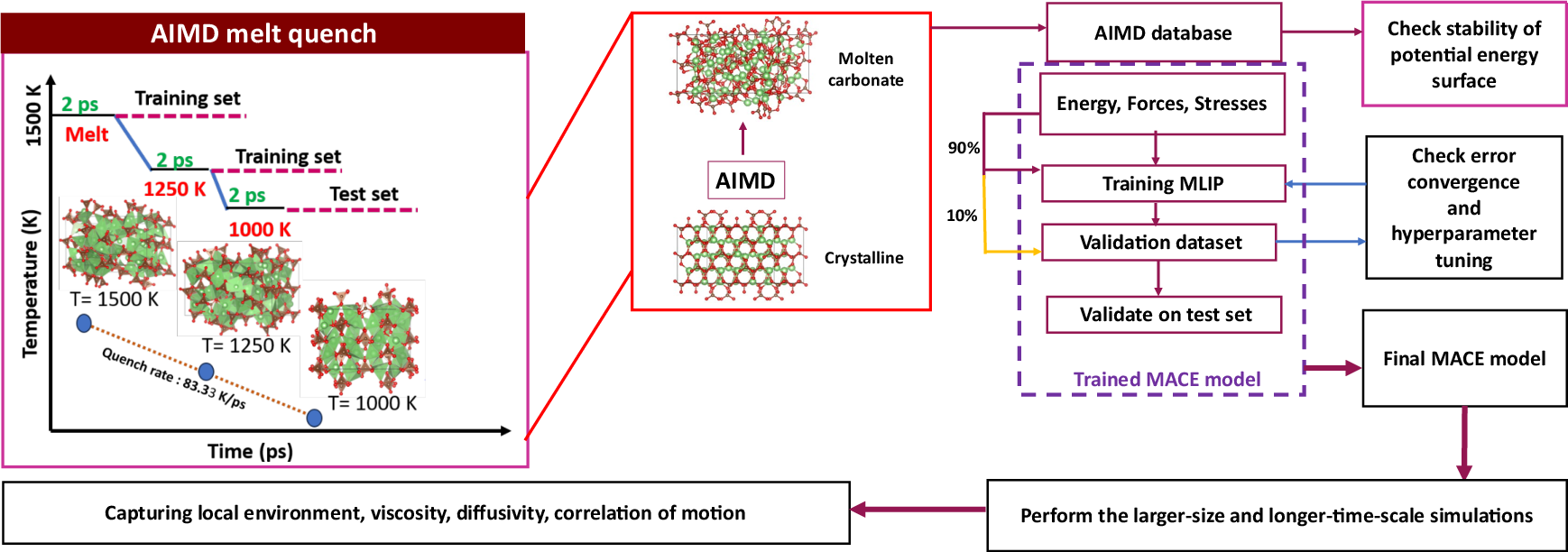
Figure 1: Workflow for dataset generation and MLIP training (for MACE); AIMD melt-quench simulations generate configurations for MLIP training and hyperparameter optimization, followed by validation and deployment in production MD.
Both models are directly compared against independent test datasets (equilibrated molten phases at 1000 K and mechanically strained crystalline configurations). The models use E(3)-equivariance with message passing (set to Lmax=1 for parsimony in benchmarking), and performance is evaluated via mean absolute errors (MAE) for total energies and forces. Structural analyses leverage extensive computation of RDFs, S(q), and comparison to both AIMD and experimental data, while transport analyses utilize extended MD runs to evaluate viscosity, mean-squared displacements (MSD), Li⁺ self-diffusivity, and correlation-sensitive quantities like the Haven’s ratio (HR).
Benchmarking and Model Selection
The MACE model demonstrably outperforms NequIP in both accuracy and transferability. On test sets at 1000 K, MACE achieves MAEs of 0.2 meV/atom (energy) and 0.17 meV/Å (force), substantially lower than NequIP (2.6 meV/atom and 18.1 meV/Å, respectively). The superiority of MACE extends to strained crystalline configurations. Importantly, MACE achieves competitive accuracy with just two message-passing layers, highlighting architecture efficiency. Although MACE is computationally slower than NequIP (approximately 5–10×), the accuracy gains permit reliable simulations at larger scales and longer timescales, justifying its use for production simulations in this study.
Structural Characterization: Local and Medium-Range Order
Detailed RDF analyses reveal that upon melting and increasing temperature, Li₂CO₃ loses its long-range crystalline order, as manifest in the broadening and lowering of all RDF peaks except for the C–O pair, whose first peak remains dominant and sharp Figure 2.
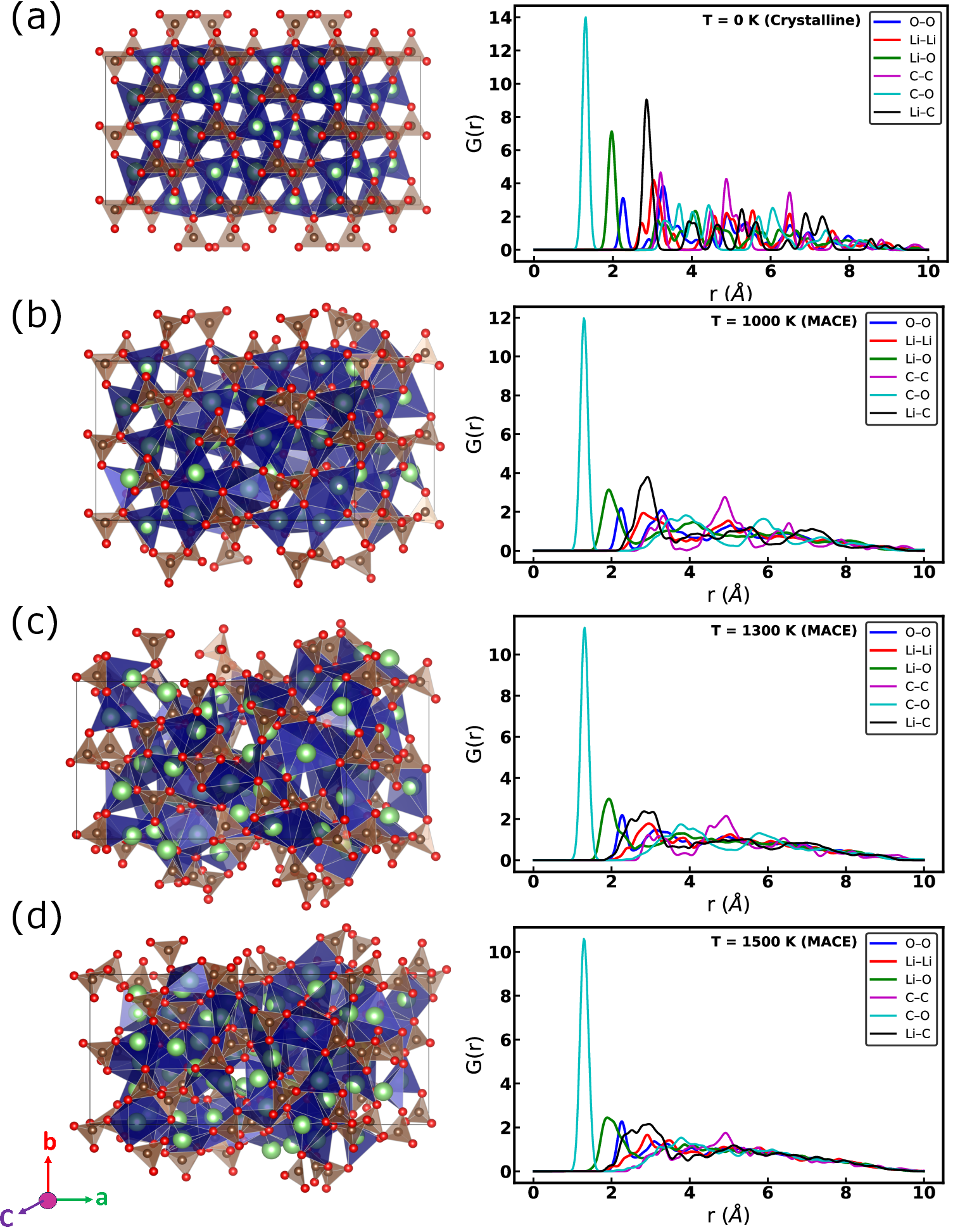
Figure 2: Representative atomic configurations and corresponding RDFs of Li₂CO₃ at different temperatures; melting is characterized by loss of long-range order and persistent local carbonate structure.
This observation highlights the robust covalent nature of carbonate groups, with thermal disorder and orientational randomness dominating above the melting point. Broadening of Li–O, Li–C, and C–C peaks further reinforces the liberation of Li⁺ and carbonate mobility, while C–O resilience is pivotal for sustained chemical identity in the melt. The MACE model faithfully reproduces these RDF trends and matches literature DeepMD-based results for key pair correlation functions.
The S(q) analysis at 1500 K demonstrates close alignment between MACE and AIMD, with all principal features and peak intensities accurately captured Figure 3. MACE predictions also show excellent agreement with experimental S(q) at near-melting temperatures, with only minor deviations at high scattering vectors.
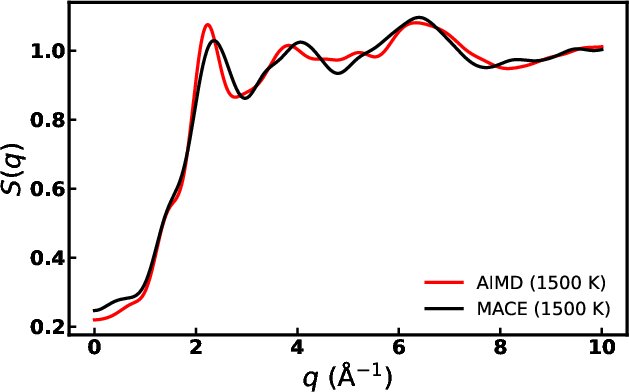
Figure 3: Static structure factor S(q) for molten Li₂CO₃ at 1500 K from AIMD (red) and MACE (black); near-complete overlap of the curves indicates high structural fidelity of the MACE model.
These results validate the model’s capacity for simulating both local and intermediate-range order in realistic, scalable molten systems.
Transport Properties: Viscosity, Diffusivity, and Ionic Correlations
Shear viscosity computed from MACE molecular dynamics aligns quantitatively with experimental measurements, outperforming both DeepMD and classical force field approaches Figure 4.
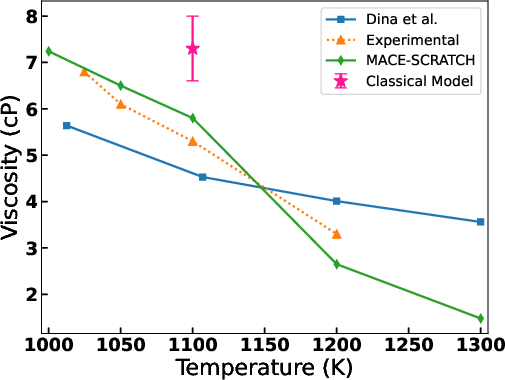
Figure 4: Viscosity of Li₂CO₃ as a function of temperature; MACE predictions (green) closely follow experimental values (orange), while DeepMD (blue) and classical (pink) models deviate.
The temperature dependence of Li⁺ mean-squared displacement (MSD) directly yields self-diffusivities exhibiting Arrhenius behavior with an extracted activation energy Ea=1.287 eV Figure 5, matching prior simulations and relevant literature values. Notably, the diffusion mechanism transitions with temperature: at 1000 K, directional anisotropy in Li⁺ MSD is pronounced (with a preference along the crystallographic c-axis), whereas at 1400 K, diffusion is isotropic.
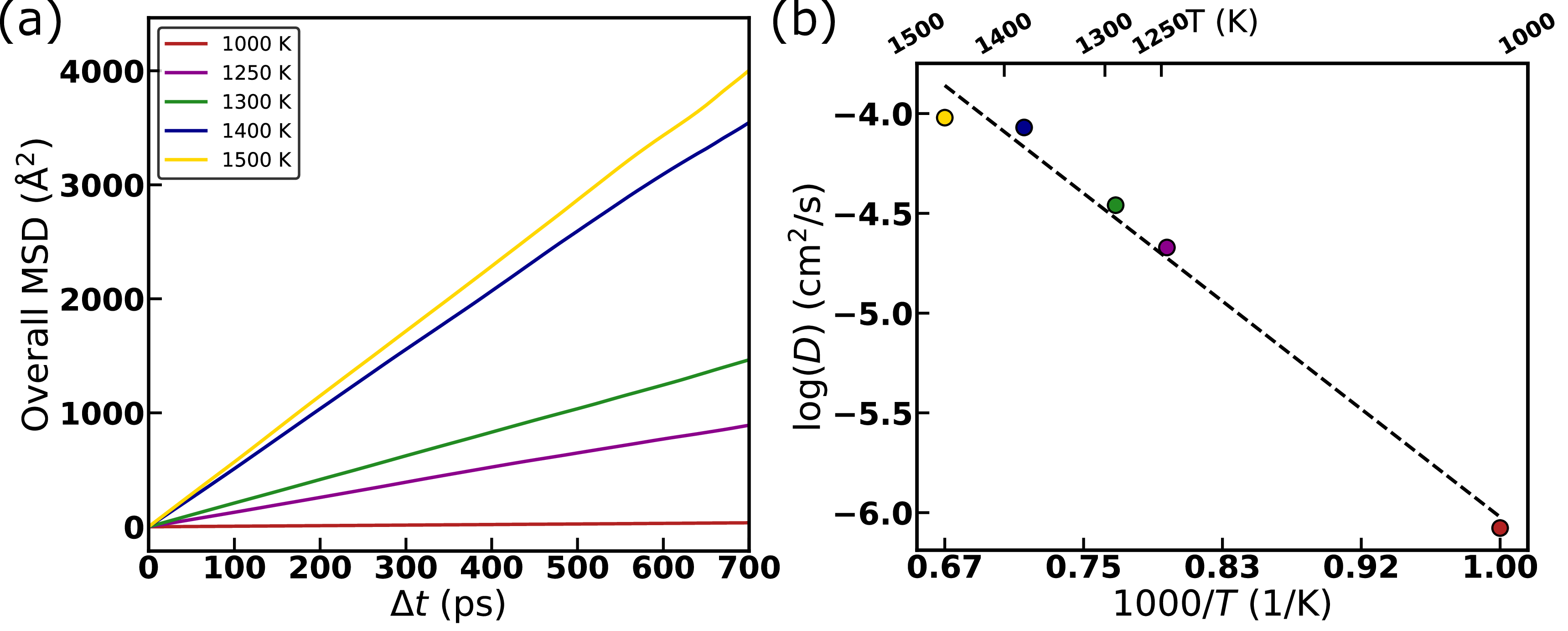
Figure 5: (a) MSD versus Δt from long MACE-MD runs at multiple temperatures; (b) Arrhenius plot of diffusion coefficient, yielding Ea=1.287 eV with strong correlation.
A critical finding is that the Haven’s ratio S(q)0, quantifying the deviation from uncorrelated Nernst–Einstein behavior, remains substantially below unity (0.20–0.40) across the studied temperatures. This indicates strong many-body correlations and concerted mechanisms dominate Li⁺ transport, especially at lower temperatures—a departure from independent random-walk diffusion.
Visualization of representative Li⁺ trajectories further substantiates this: at 1400 K, Li⁺ ions exhibit continuous migration, whereas at 1000 K, transient trapping within carbonate cages leads to localized, oscillatory motion before escape Figure 6.
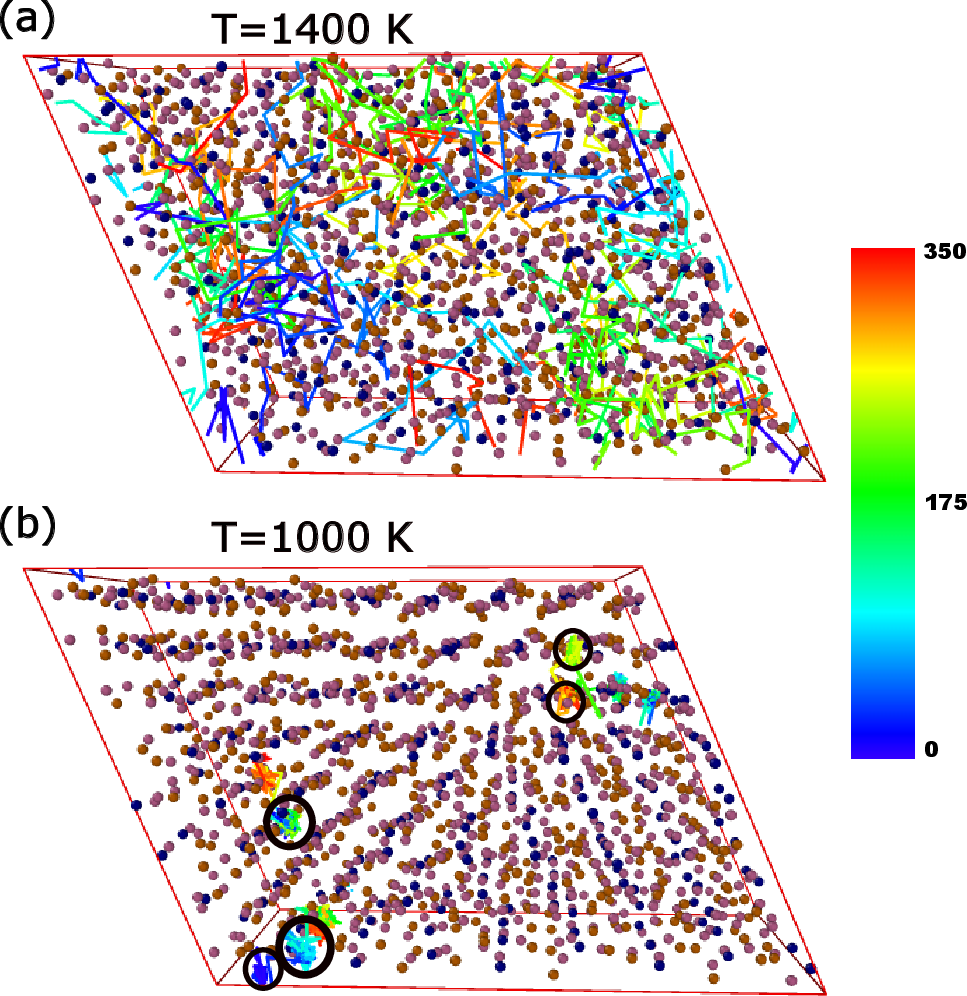
Figure 6: Unwrapped Li⁺ trajectories at 1400 K (left, continuous migration) and 1000 K (right, transient trapping and anisotropic, concerted jumps).
Oxygen-centered Voronoi analyses show that at lower temperatures, persistent local cage topologies along the preferred transport direction underlie the anisotropy and concerted motion, facilitating correlated ionic hops.
Implications, Theoretical Impact, and Future Directions
The explicit demonstration that Li⁺ transport in molten Li₂CO₃ is fundamentally collective—rather than manifesting as independent hopping—challenges simplified transport models commonly used for molten salts. The highly temperature-sensitive crossover from anisotropic, correlated motion to isotropic, less-correlated diffusion provides a mechanistic basis for the design of optimized molten carbonate electrolytes. For MCFCs and related devices, understanding these correlations is critical for tailoring system performance by modulating operating temperature, composition, and microstructure.
From a methodological standpoint, this work affirms the necessity of using equivariant, message-passing graph neural network MLIPs, such as MACE, for accurately capturing both energetic and dynamical properties in complex ionic systems. The demonstrated scalability and near-DFT accuracy of such models open new prospects for simulating emergent phenomena in large, chemically reactive, or disordered molten and liquid-phase systems—of direct relevance to battery SEIs, solid-state electrolytes, and high-temperature electrochemical technologies.
Looking forward, combining such MLIPs with multi-species and multi-phase environments (e.g., MCFC ternary mixtures, liquid–solid interfaces) and extending analysis to longer timescales or more extreme conditions (elevated pressure, fast cycling scenarios) could yield generalized models for predictive electrolyte design. Additionally, integrating these approaches with on-the-fly active learning and automated model selection could further accelerate the exploration of compositional and operational design spaces for advanced energy materials.
Conclusion
This work provides a comprehensive, atomistically faithful evaluation of both structure and Li⁺ transport in molten Li₂CO₃. By leveraging MACE, an equivariant message-passing MLIP, the study establishes superior accuracy for energies, forces, structural metrics, and transport properties, validated against AIMD and experiment. The findings unequivocally show that Li⁺ transport is governed by strong correlations and concerted dynamics, with a temperature-driven transition between anisotropic and isotropic diffusion regimes. These mechanistic insights, and the scalable, transferable MLIP framework, lay the foundation for rational molten salt electrolyte engineering and signify a substantial methodological advancement for the simulation of complex ionic liquids and melts.

