Extreme-Scale Atomistic Simulation of Real-Temperature Magnetic Skyrmion Dynamics by Coupled Spin-Lattice Modeling
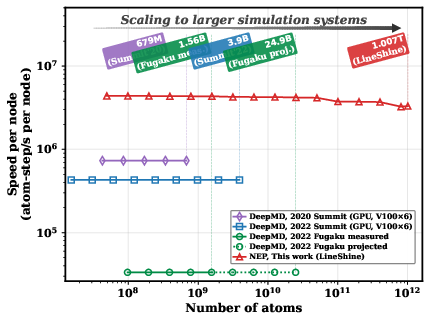
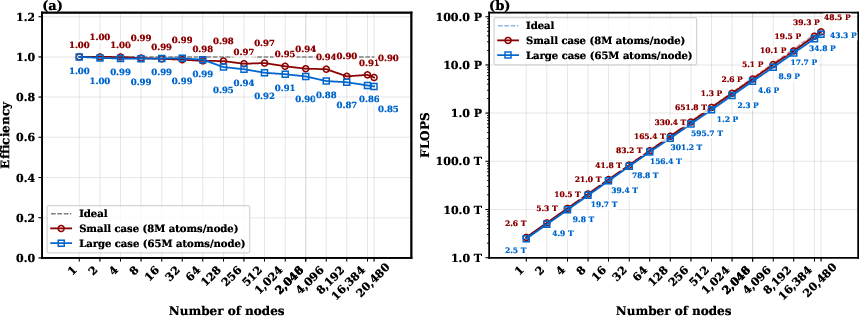
Abstract: Real-temperature topological magnetic dynamics in functional materials is governed by coupled lattice and spin evolution, yet remains inaccessible to predictive simulation at device-relevant scales. As a flagship example, thermally driven helix-to-skyrmion transformation in FeGe requires atomistic resolution, explicit lattice motion, and micrometer-scale domains to resolve device-scale topological texture formation. We combine a spin-constrained density-functional-theory-trained neuro-evolution potential with a structure-preserving spin-lattice integrator within one machine-learned framework. Architecture-specific optimizations, kernel fusion, SVE2 vectorization, and NUMA-aware data layout deliver a seven orders-of-magnitude speedup over prior spin-aware methods. Deployed on LineShine exascale supercomputer, the full application scales to 12.45 million CPU cores with 89.7% weak-scaling efficiency, enabling simulations of 1.34 trillion atoms and an equal number of spins while reaching 48.5 PFLOPS in double precision. The simulations directly resolve real-temperature skyrmion nucleation and reorganization at previously inaccessible scales, establishing a new regime for predictive simulation of coupled spin-lattice topological magnetic dynamics.
Paper Prompts
Sign up for free to create and run prompts on this paper using GPT-5.
Top Community Prompts
Explain it Like I'm 14
Extreme-Scale Atomistic Simulation of Real-Temperature Magnetic Skyrmion Dynamics — Explained Simply
What this paper is about (big picture)
This paper shows how scientists used a massive supercomputer and a smart physics–plus–machine‑learning model to watch tiny magnetic “whirls” called skyrmions form and move inside a real material (FeGe) at realistic temperatures. These skyrmions are promising for future low‑power memory and computing devices, but they’re hard to simulate correctly because you have to track both:
- where each atom sits and shakes (the lattice), and
- how each tiny magnetic arrow at an atom points and changes (the spin).
The team built a new way to simulate both together, fast and accurately, at a size big enough to match actual device dimensions.
What questions the researchers asked
In simple terms, they wanted to know:
- Can we realistically simulate how a magnetic material shifts from a “helix” pattern (spins twisting like a spring) to a skyrmion pattern (spins swirling like tiny whirlpools) at real temperatures?
- Can we do this at the huge sizes and time spans that real devices need—without oversimplifying the physics?
- Can we make these simulations fast enough to handle trillions of atoms and spins?
How they did it (methods, with analogies)
Think of a material as a giant 3D crowd:
- Each person is an atom that can wiggle (lattice).
- Each person also holds a tiny compass that can point in different directions (spin).
To predict what the crowd will do, the team combined three ideas:
- A “learned rulebook” for forces and magnetism
- They trained a machine‑learning model (called NEP‑SPIN) using quantum‑level calculations (density functional theory) to learn how atoms push/pull each other and how their “compasses” twist and tug.
- Analogy: Instead of doing extremely slow full quantum math every time, they trained a super‑smart shortcut that acts like a fast, well‑trained referee who knows the rules.
- A physics‑respecting simulator for both atoms and spins
- They used a special time‑stepping method (an integrator) that keeps the simulation stable and faithful to real physics over long runs, updating positions and magnetic directions together.
- Analogy: It’s like using a smooth camera stabilizer so the video of the crowd stays clear and accurate even during long, fast action.
- Supercomputer “kitchen re‑organization” for speed
- They rewrote and rearranged the code so it fits how the computer chips work best (vector instructions, memory layout, fusing steps together, and careful scheduling across many cores).
- Analogy: They redesigned the kitchen so cooks don’t bump into each other—ingredients are placed just right, tools are grouped, and steps are combined—so the meal (the simulation) is made much faster without messing up the recipe (the physics).
Key technical ideas translated:
- “Spin–lattice dynamics”: Updating atom positions and tiny magnetic compass directions at the same time.
- “Machine‑learning potential”: A fast, trained model that predicts energy, forces, and magnetic torques based on local environments.
- “Skyrmion” vs “helix”: A skyrmion is a tiny magnetic swirl; a helix is a spiral-like twist. FeGe naturally shows both.
- “DMI” and “exchange”: Competing tendencies in magnetism—some interactions like spins to line up, others prefer them to twist; the balance sets the size of spirals and whirls.
What they found and why it matters
Main results:
- They simulated an enormous system: 1.34 trillion atoms and 1.34 trillion spins at once.
- They ran it on 12.45 million CPU cores and reached 48.5 PFLOPS (that’s 48.5 quadrillion math operations per second) in double precision.
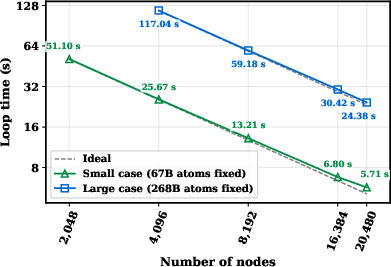
- The code scaled efficiently (about 90% weak‑scaling efficiency at full machine size), meaning adding more computers kept making it faster almost ideally.
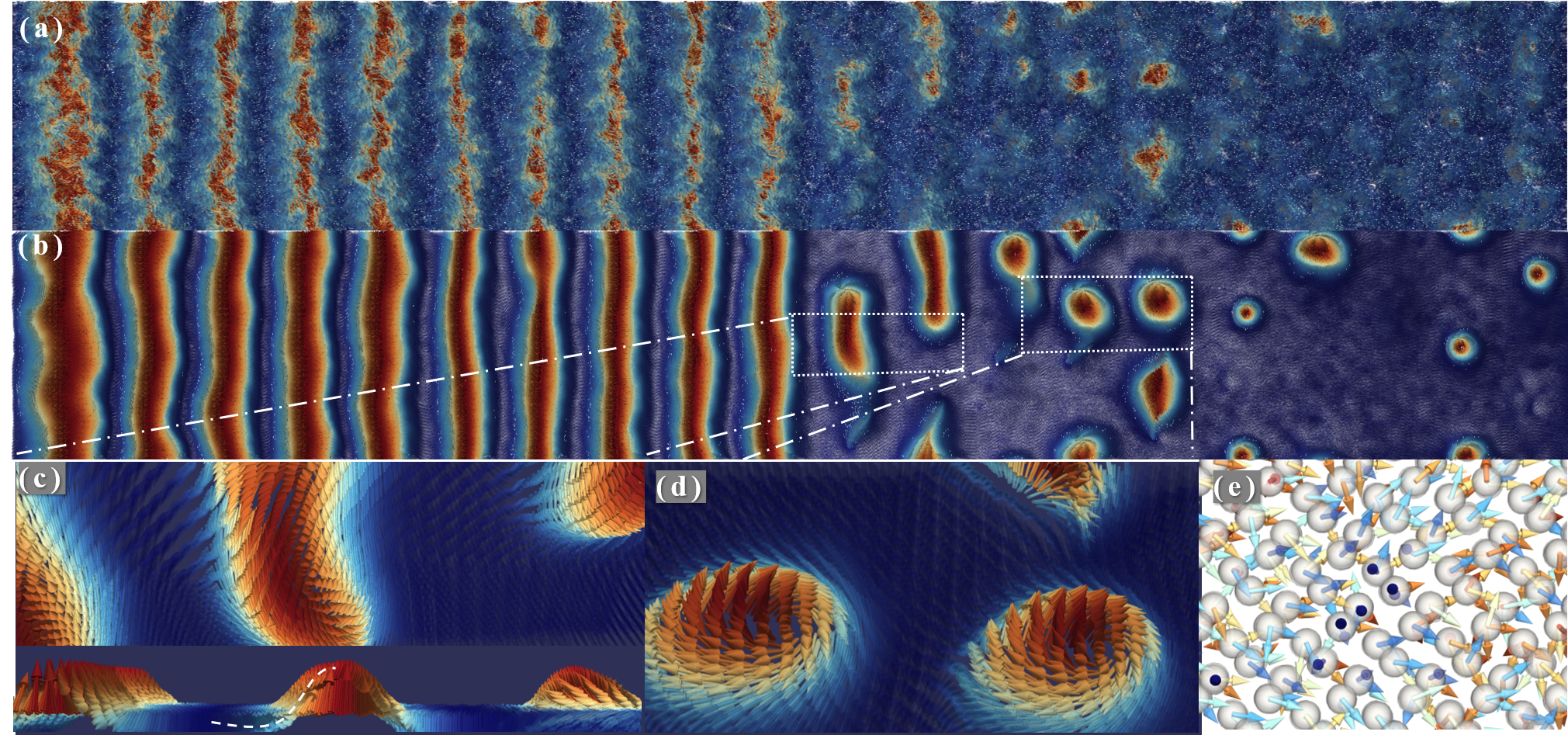
- Most importantly, they directly watched, at atom‑by‑atom detail and real temperatures, how skyrmions nucleate (start), grow, and reorganize from an initial helical state in FeGe, inside a sample big enough to reflect realistic device sizes (micrometers).
Why this is important:
- Before, simulations were either small (missing real‑world behaviors), oversimplified (ignoring real temperature effects or freezing the atoms), or too slow.
- This work shows we can now model the true, coupled dance of atoms and spins at the right size and temperature, which is crucial for designing future skyrmion‑based memory and logic devices that could be faster and use less energy.
What this could lead to (impact and implications)
- Better device design: Engineers can virtually prototype materials and conditions (temperature, magnetic fields, geometry) to control skyrmions and make stable, low‑power memory bits.
- Faster discovery: The same “learn the physics + scale it up” recipe can be applied to other complex materials where structure and magnetism interact (and beyond—like batteries, spintronics, or multiferroics).
- New science at new scales: Seeing skyrmion behavior across micrometers and nanoseconds reveals pathways and bottlenecks in forming and moving these magnetic textures—knowledge that experiments alone can’t easily provide.
In short: The team built a fast, accurate, and gigantic simulation tool that finally lets us watch, in realistic detail, how magnetic whirls (skyrmions) appear and evolve in real materials. This is a big step toward practical skyrmion‑based technologies.
Knowledge Gaps
Knowledge gaps, limitations, and open questions
Below is a focused list of what remains missing, uncertain, or unexplored, as concrete directions for future work.
- Long-range magnetostatics omitted: The potential and kernels are strictly local; it is unclear whether demagnetization (dipolar) fields—crucial for domain patterns and skyrmion size—are included. Quantify errors from neglecting long-range dipoles and integrate FFT/Ewald-based dipolar solvers or learned long-range corrections.
- Spin-bearing species assumption: The model assigns one local magnetic moment to every atom; in FeGe, Ge is essentially nonmagnetic. Quantify the learned Ge moments from DFT data, assess the impact on J/D, helix pitch, and skyrmion properties, and compare against a Fe-only spin sublattice formulation.
- DFT training fidelity and coverage: Details of SOC treatment (required for DMI), exchange–correlation functional, k-point/energy convergence, and finite-temperature electronic effects are not specified. Provide a breakdown of how accurately J, D, anisotropy, and their T/strain dependence are reproduced, with uncertainty bounds.
- Dataset scope and robustness: The training set composition (temperatures, fields, strains, phonon distortions, defects, surfaces, interfaces) and OOD robustness are not described. Curate and release a diverse dataset, adopt active learning, and stress-test transferability to unseen pathways.
- Validation beyond helix pitch: Experimental benchmarking is limited. Systematically validate skyrmion radius, lattice spacing, areal density, phase boundaries in the B–T plane, nucleation/annihilation barriers, and lifetimes against Lorentz TEM, SANS, and magnetometry.
- Placeholder accuracy metrics: The comparison table reports placeholder RMSE values pending final validation. Publish finalized accuracy metrics on independent test sets and error decompositions (energy/force/torque) with confidence intervals.
- Mechanistic insights missing: The work demonstrates formation/reorganization qualitatively but does not quantify nucleation pathways, critical nucleus size, topological charge density evolution, Bloch-point dynamics, or defect-assisted mechanisms. Develop automated, in-situ analytics for these quantities at scale.
- Spin–lattice energy exchange calibration: The model claims explicit energy exchange and longitudinal spin fluctuations, but the damping constants, thermostat schemes, and equilibration times are unspecified. Calibrate Gilbert/LLB parameters and validate energy flow and relaxation rates vs ultrafast pump–probe experiments.
- Timescale reach: Device-relevant stability and lifetimes can span microseconds–milliseconds; simulations emphasize atom count and throughput but not achieved physical time. Explore multi-time-step, rare-event sampling, or accelerated dynamics to extend timescales.
- Boundary conditions and geometry: Bulk periodic setups may miss thin-film/interface effects critical to devices. Incorporate free surfaces, finite thickness, patterned edges, and realistic demag fields; map thickness and geometry dependence of skyrmion stability.
- Current-driven physics absent: No spin-transfer/spin–orbit torques, electron transport, or Joule heating are modeled. Add conduction-electron degrees (e.g., s–d model) or effective torque terms and validate current-driven motion, Hall angle, and depinning.
- Magnetoelastic coupling quantification: While coupled dynamics are included, the quantitative modulation of J, D, and anisotropy by strain/phonons and their consequences for skyrmion energetics and mobility are not analyzed. Compute strain derivatives and skyrmion–strain interaction energies.
- Numerical integrator properties: Timestep limits, error control, long-time invariants, and stability under strong coupling are not reported. Benchmark symplecticity, drift, and compare explicit vs self-consistent midpoint and multirate/adaptive schemes.
- Long-range exchange (RKKY-like) effects: Local cutoffs may miss oscillatory or extended exchange in itinerant magnets. Assess the need for hybrid local–long-range exchange models or extended descriptors.
- Phase diagram completeness: Only a narrow T/B protocol (including a gradient) is shown. Construct full equilibrium and metastable B–T phase diagrams (with/without gradients), including hysteresis, for direct comparison with experiments.
- Defects and disorder: Device-scale pinning and transport depend on vacancies, impurities, grain boundaries, and roughness. Incorporate realistic defect ensembles and quantify pinning potentials, creep, and depinning currents/fields.
- 3D topology and particles: Hopfions, skyrmion strings, Bloch points are mentioned but not studied. Characterize their creation/annihilation, elastic properties, and interactions in 3D.
- Portability and reproducibility: The implementation is highly specialized to Arm SVE2/SME and NUMA layout. Evaluate performance/accuracy on x86 and GPUs, document portability gaps, and release code, training data, and containerized workflows.
- Mixed precision opportunities: Only FP64 is used. Identify safe mixed-precision pathways (e.g., FP32 descriptor + FP64 torque accumulation) that preserve torque accuracy and topology while improving throughput/energy efficiency.
- Load balance at scale: Claims of minimal imbalance are not quantified. Measure and mitigate imbalance from heterogeneous neighbor counts and evolving textures (dynamic domain decomposition, work stealing).
- I/O, in-situ analysis, and fault tolerance: Strategies for computing/streaming topological metrics at 1012 scale, scalable checkpointing, and resilience are not detailed. Develop reduced-order outputs and fault-tolerant in-situ analytics.
- Hyperparameter sensitivity: Cutoff radii, basis orders, and network sizes may affect J/D and torque fidelity. Perform sensitivity analyses and provide guidelines for selecting descriptor/inference hyperparameters.
- Generalization to other hosts: Extend and validate NEP-SPIN on diverse skyrmion materials (B20 variants, multilayers with interfacial DMI, Heuslers), including multicomponent chemistry and temperature-dependent anisotropy.
- Uncertainty quantification: No UQ is provided for emergent observables. Use ensemble/Bayesian models or conformal prediction to quantify confidence in phase boundaries, sizes, and lifetimes.
- External field protocols: The study uses a magnetic-field gradient; most experiments use uniform fields. Compare gradient vs uniform-field outcomes and their implications for nucleation and device operation.
- Near-Tc critical dynamics: Validity of classical local-moment dynamics near Tc (strong longitudinal fluctuations, critical slowing down) is untested. Benchmark against neutron scattering and susceptibilities; consider quantum or stochastic extensions if needed.
Practical Applications
Immediate Applications
Below are practical use cases that can be deployed now or with modest adaptation, drawing on the paper’s methods (NEP-SPIN machine-learned spin–lattice potential, structure-preserving integrator, and exascale-optimized implementation in LAMMPS) and findings (predictive, real-temperature skyrmion dynamics at device-relevant scales).
- Predictive prototyping of skyrmion devices (nucleation, stability, and motion)
- Sectors: electronics/semiconductors (spintronics), research labs
- What it enables: rapid evaluation of device geometries, thermal/field protocols, pinning sites, and edge effects to achieve robust skyrmion nucleation/annihilation at near-room temperature (e.g., FeGe and analogous chiral magnets)
- Tools/products/workflows: NEP-SPIN models integrated into LAMMPS; parameter sweeps of geometry, temperature, and field; automated analysis of skyrmion number and size distributions
- Assumptions/dependencies: trained NEP-SPIN for the specific material system (DFT data quality critical); cluster access for 106–108 atom runs; experimental calibration of J/D ratio and anisotropies
- Process-guided thin-film and heterostructure engineering
- Sectors: materials manufacturing, foundries, metrology
- What it enables: simulate strain, thickness, interfaces, and patterning to reduce trial-and-error in deposition/etching steps that affect skyrmion size and stability
- Tools/products/workflows: device-scale LAMMPS runs using NEP-SPIN with realistic boundary conditions; coupling to continuum elasticity inputs from TCAD/FEA tools
- Assumptions/dependencies: transferability of trained potential to thin-film environments; access to moderate HPC resources
- Interpretation and planning of magnetic imaging experiments
- Sectors: academia, R&D centers (Lorentz TEM, MFM, NV centers)
- What it enables: synthetic images from simulated textures for experiment–theory alignment and experimental protocol design
- Tools/products/workflows: pipeline from spin configurations to synthetic contrasts; comparisons vs. TEM/MFM; parameter inference for experimental conditions
- Assumptions/dependencies: image forward models and calibration; realistic thermal and defect distributions
- Screening of chiral magnets and doped variants
- Sectors: materials discovery, specialty alloys
- What it enables: high-throughput evaluation of J/D balance, helix pitch, skyrmion windows vs. strain, doping, and temperature
- Tools/products/workflows: constrained-DFT data generation → NEP-SPIN training → device-scale MD runs → stability maps
- Assumptions/dependencies: DFT coverage of relevant spin/lattice configurations; retraining for new chemistries
- Defect and reliability modeling for skyrmion devices
- Sectors: reliability engineering, quality assurance
- What it enables: quantify effects of dislocations, grain boundaries, voids, and edge roughness on skyrmion pinning, annihilation, and drift
- Tools/products/workflows: defect introduction workflows in LAMMPS; analysis of pinning energies and failure rates across thermal cycles
- Assumptions/dependencies: accurate defect energetics in training data; realistic defect densities
- Multiscale model calibration (atomistic → micromagnetics)
- Sectors: software, academia
- What it enables: derive coarse-grained parameters (exchange, DMI, anisotropy, damping, thermal noise) from atomistic simulations to improve micromagnetic models
- Tools/products/workflows: atomistic-to-continuum parameter extraction, uncertainty quantification; improved micromagnetic solvers for large-area devices
- Assumptions/dependencies: rigorous mapping methodology; sensitivity analysis to training-set biases
- Training data generation for fast ML surrogates
- Sectors: software, EDA for spintronics
- What it enables: curate datasets from atomistic spin–lattice MD for training lightweight surrogates for design exploration or control
- Tools/products/workflows: automated data pipelines (configurations, energies, torques); surrogate validation against NEP-SPIN predictions
- Assumptions/dependencies: coverage of relevant states and transitions; model generalization
- HPC performance engineering patterns for neighbor-list codes
- Sectors: HPC software (molecular dynamics, CFD/DEM), hardware vendors
- What it enables: immediate speedups in neighbor-list-driven codes via kernel fusion, vectorization, NUMA-aware layouts, and predicated dispatch, transferable beyond magnetism
- Tools/products/workflows: code templates and intrinsics (SVE2/SME), NUMA placement guides, fused-kernel patterns; contributions to LAMMPS and similar frameworks
- Assumptions/dependencies: availability of SVE2/SME (or equivalent) on target CPUs; effort to port patterns to x86/Power or GPUs
- Extensible LAMMPS module and integrator for coupled spin–lattice dynamics
- Sectors: academia, open-source software ecosystems
- What it enables: deployable building blocks for spin–lattice MD with energy-, force-, and torque-consistent updates; reproducible pipelines
- Tools/products/workflows: NEP-SPIN plugin, structure-preserving integrator, example input decks and trained FeGe model
- Assumptions/dependencies: community packaging and maintenance; documentation and training materials
- Curriculum and visualization for magnetism education
- Sectors: education, outreach
- What it enables: hands-on labs to visualize helices, skyrmions, and thermal effects; building intuition for topological textures
- Tools/products/workflows: downscaled runs on departmental clusters; visualization notebooks; pre-configured tutorial data
- Assumptions/dependencies: simplified models and access to modest compute
- Benchmarking and standardization for spin–lattice workloads
- Sectors: HPC centers, vendors, benchmarking bodies
- What it enables: adoption of atom-step/s and FLOPS metrics for magnetic workloads; fair comparisons across architectures
- Tools/products/workflows: public benchmark cases (e.g., FeGe helix-to-skyrmion), scripts for performance counters
- Assumptions/dependencies: community consensus on benchmark definitions
- Policy case for CPU-based exascale investments
- Sectors: public policy, funding agencies, national computing facilities
- What it enables: evidence-based advocacy linking national materials priorities (low-power electronics) to CPU-exascale ROI
- Tools/products/workflows: performance and scaling data; application narratives for grant and procurement processes
- Assumptions/dependencies: continuity of public funding; access policies allowing academic/industrial collaboration
Long-Term Applications
These opportunities require further research, broader material coverage, scaling, integration with manufacturing, or new infrastructure.
- Commercial skyrmion memory (MRAM/racetrack) and logic
- Sectors: semiconductors, consumer electronics, data centers
- What it enables: low-power, high-density nonvolatile memory and logic blocks engineered with predictive atomistic design
- Tools/products/workflows: end-to-end TCAD for spintronics integrating atomistic-to-micromagnetic modeling; design kits for EDA
- Assumptions/dependencies: materials that stabilize skyrmions at room temperature with CMOS-compatible process flows; fab ecosystem readiness
- Neuromorphic and probabilistic computing with skyrmions
- Sectors: AI hardware, edge computing
- What it enables: device concepts leveraging skyrmion nonlinearity, stochasticity, and topology for energy-efficient compute
- Tools/products/workflows: co-design frameworks linking device physics to network-level performance; training of device-aware ML models
- Assumptions/dependencies: robust device-to-device reproducibility; integration with existing compute stacks
- Reconfigurable RF/magnonic components and oscillators
- Sectors: telecommunications (5G/6G), RF front-ends
- What it enables: tunable microwave oscillators, filters, and phase shifters using skyrmion dynamics and spin–orbit torques
- Tools/products/workflows: coupled spin–lattice–spintronics simulations (current/voltage drive); packaging and thermal management studies
- Assumptions/dependencies: high-Q operation, thermal stability, and CMOS-compatible integration
- Energy-efficient storage and computing for data centers
- Sectors: cloud infrastructure, hyperscalers
- What it enables: substantial power reductions by replacing or augmenting SRAM/DRAM/Flash with skyrmion-based nonvolatile elements
- Tools/products/workflows: device-to-system performance models parameterized by atomistic simulations; reliability and lifetime modeling
- Assumptions/dependencies: endurance and retention at scale; standardized interfaces; cost competitiveness
- Real-time digital twins for magnetic devices in operation
- Sectors: industrial IoT, predictive maintenance
- What it enables: in-situ monitoring and control of skyrmion devices via fast surrogates trained on atomistic data; feedback control for nucleation/motion
- Tools/products/workflows: sensor fusion, online inference using reduced-order/ML models; edge/cloud deployment
- Assumptions/dependencies: robust surrogates with uncertainty quantification; low-latency integration with control hardware
- Autonomous materials acceleration platforms for magnetic textures
- Sectors: materials platforms, national labs
- What it enables: closed-loop workflows combining DFT → NEP-SPIN → exascale MD → experimental validation → retraining
- Tools/products/workflows: active learning across scales, automated data management, Bayesian optimization for composition/strain processing
- Assumptions/dependencies: scalable DFT pipelines for spin-constrained data; FAIR data standards; lab automation
- Cross-material expansion to multiferroics, ferroelectrics, and quantum materials
- Sectors: advanced materials, sensors, actuators
- What it enables: coupled order-parameter simulations (spin–lattice–polarization) for emergent functional devices
- Tools/products/workflows: generalized MLIPs capturing multiple coupled degrees of freedom; new integrators preserving structure
- Assumptions/dependencies: richer DFT datasets with explicit SOC and polarization; integrator extensions
- Radiation-tolerant magnetic materials for fusion and space
- Sectors: energy (fusion), aerospace
- What it enables: prediction of irradiation-induced defect–spin interactions and their impact on magnetic performance
- Tools/products/workflows: spin–lattice MD with defect cascades; lifetime and degradation models
- Assumptions/dependencies: validated radiation damage models; mixed-chemistry NEP-SPIN training data
- Standardized spintronic TCAD toolchain
- Sectors: EDA, design services
- What it enables: consolidated workflows from materials to circuits for skyrmion-based devices, enabling broader industry uptake
- Tools/products/workflows: interoperable formats (atomistic/micromagnetic/compact models), APIs into circuit simulators
- Assumptions/dependencies: pre-competitive collaboration for standards; IP frameworks
- HPC–hardware co-design for particle/neighbor workloads
- Sectors: CPU/GPU vendors, supercomputing centers
- What it enables: ISA and microarchitecture features (predication, gather/scatter, matrix engines) tuned for MD-like kernels; software stacks exploiting them
- Tools/products/workflows: benchmark suites and kernels distilled from NEP-SPIN; compiler support for vector-length-agnostic intrinsics
- Assumptions/dependencies: long hardware design cycles; broad software ecosystem support
- Exascale-as-a-service for extreme-scale materials simulation
- Sectors: cloud/HPC services, industrial R&D
- What it enables: on-demand access to large-scale spin–lattice simulations without owning hardware
- Tools/products/workflows: containerized NEP-SPIN/LAMMPS stacks; job orchestration and data lifecycle management
- Assumptions/dependencies: scheduling policies and cost models; data transfer and security
- Consumer and IoT devices with skyrmion components
- Sectors: mobile, wearables, automotive
- What it enables: longer battery life and nonvolatile logic/memory in sensors and edge devices
- Tools/products/workflows: reliability and environmental testing informed by atomistic simulations; product qualification flows
- Assumptions/dependencies: mass manufacturing, cost, and durability under real-world conditions
Cross-cutting assumptions and dependencies
- Access to high-quality, spin-constrained DFT datasets and retraining workflows for each material/chemistry of interest.
- Portability of performance optimizations: current implementation targets Arm SVE2/SME; GPU/x86 ports or alternative optimizations may be needed for broad deployment.
- Validation against experimental observables (e.g., helix pitch, skyrmion size vs. T/B/strain) to ensure predictive accuracy.
- HPC resource availability: trillion-atom runs need national-scale systems; however, many R&D tasks are feasible at smaller scales on institutional clusters.
- Integration costs and IP/licensing considerations for industrial toolchains and EDA environments.
Glossary
- Anharmonic lattice dynamics: Lattice motions that deviate from simple harmonic (spring-like) behavior, important at finite temperatures and large amplitudes. "they offer a route toward combining anharmonic lattice dynamics, complex magnetic interactions, and local spin--lattice feedback"
- Anisotropy: Direction-dependent magnetic energy that can favor certain spin orientations over others. "the competition among exchange, Dzyaloshinskii–Moriya interaction, anisotropy, and Zeeman energy"
- Armv9: An instruction set architecture generation from Arm used in modern CPUs with advanced vector/matrix extensions. "Each node contains two Armv9-based LX2 processors"
- Atomic Cluster Expansion (ACE): A systematic, physics-inspired expansion for modeling interatomic interactions (including magnetic variants). "magnetic atomic cluster expansion (ACE) variants"
- Atomistic spin dynamics: Simulation framework that evolves individual magnetic moments (spins) at the atomic scale. "Atomistic spin dynamics resolves individual moments, yet the lattice is often frozen or replaced by a thermal bath"
- BF16: Brain floating point 16-bit format, used in mixed-precision computations. "Mixed precision (FP64/FP32/BF16)"
- Chebyshev recurrence: Recursive computation of Chebyshev polynomials used here to evaluate basis functions efficiently. "Chebyshev basis recurrence"
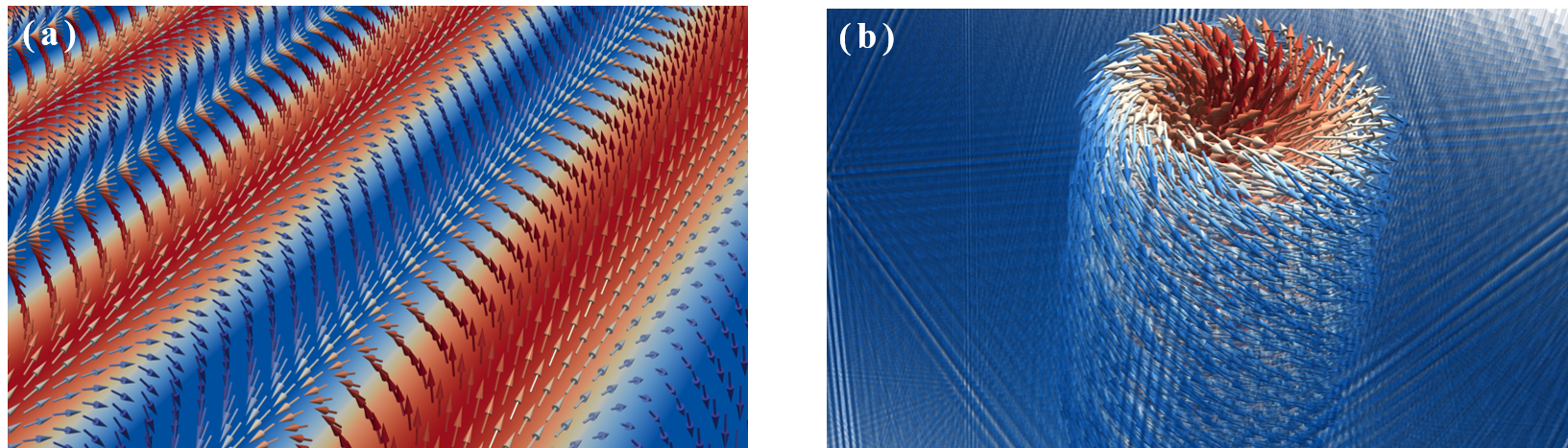
- Chiral magnet: A magnet lacking inversion symmetry where antisymmetric interactions stabilize helical/skyrmion textures. "Schematic of a magnetic helix (a) and skyrmion (b) in a chiral magnet"
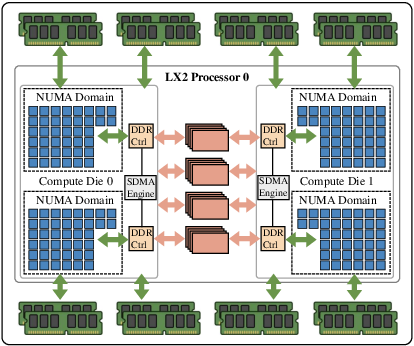
- DDR (Double Data Rate memory): Off-package system memory used alongside on-package HBM in the described nodes. "128\,GB of off-package DDR memory organized into four NUMA domains"
- DeepSPIN: A neural-network framework for spin-aware energy/torque prediction. "Yang et al.~\cite{deepspin24}"
- Density functional theory (DFT): First-principles electronic-structure method used to generate training data and constraints. "spin-constrained density functional theory data"
- DFT-parameterized spin Hamiltonians: Spin models whose parameters are derived from DFT calculations. "DFT-parameterized spin Hamiltonians"
- Dzyaloshinskii–Moriya interaction (DMI): An antisymmetric exchange interaction that favors chiral spin textures like helices and skyrmions. "the Dzyaloshinskii-Moriya interaction(D)"
- EFLOPS (ExaFLOPS): 1018 floating-point operations per second, a measure of supercomputer performance. "The entire system delivers over 2.5 \,EFLOP/s peak performance in FP64"
- Exascale supercomputer: A system capable of at least 1018 FLOPS. "LineShine exascale supercomputer"
- Fat-tree topology: A network interconnect structure that provides high bisection bandwidth via a hierarchical tree. "a dual-plane, multi-rail fat-tree topology"
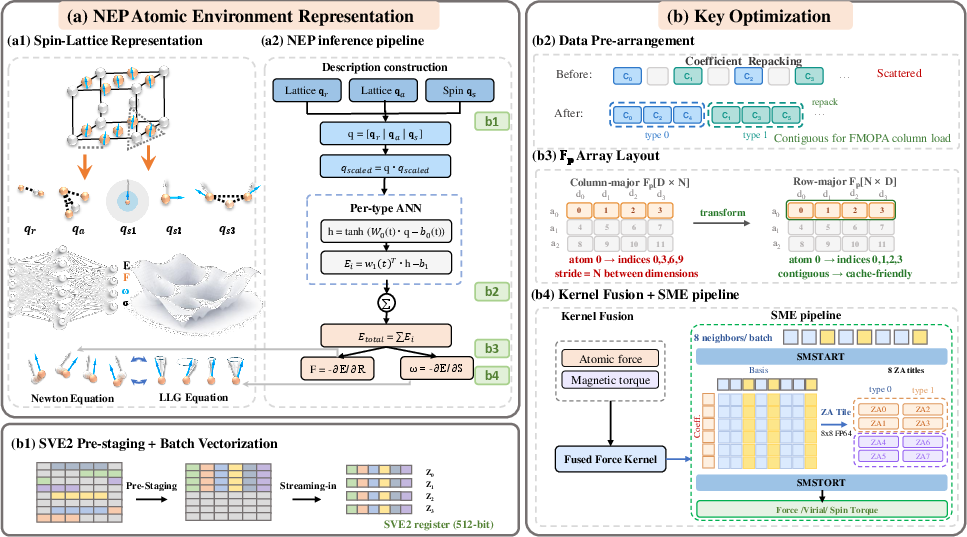
- FMOPA: An ARM SME fused matrix operation instruction used to accelerate matrix computations. "Within each FMOPA instruction"
- GEMM: General Matrix Multiply; here, implemented as outer-product operations on ARM’s matrix engine. "outer-product GEMM operations executed on the ARM SME matrix engine"
- GEMV: General Matrix-Vector multiply; denotes computation patterns that underutilize matrix units relative to GEMM. "the dominance of GEMV-like inference operations underutilizes the SME matrix units"
- Ghost atoms: Halo or ghost particles that mirror neighboring-domain atoms for force calculations across sub-domain boundaries. "the ghost-atom fraction and inter-node communication volume"
- Gordon Bell Prize: A premier HPC award recognizing outstanding achievements in high-performance computing. "Justification for the ACM Gordon Bell Prize"
- Halo exchange: Communication step to update boundary (ghost) data between neighboring sub-domains in parallel simulations. "followed by halo exchange for the next step"
- HBM (High Bandwidth Memory): On-package memory with very high bandwidth used to feed compute units efficiently. "eight on-package HBM stacks (32\,GB, 4\,TB/s aggregate bandwidth)"
- Heisenberg exchange (J): Symmetric exchange interaction that tends to align neighboring spins. "Heisenberg exchange(J)"
- Helimagnetic ordering temperature: The transition temperature at which helical magnetic order appears in a material. "its bulk critical helimagnetic ordering temperature lies close to room temperature"
- Helix pitch: The spatial period of a helical spin structure. "the helix pitch must first be reproduced quantitatively"
- Hopfion: A three-dimensional topological spin structure with nontrivial linking (Hopf) number. "skyrmion strings and more complex topological particles like hopfions"
- J/D ratio: The ratio of Heisenberg exchange (J) to DMI (D), which controls magnetic length scales. "the delicate balance between exchange and DMI (J/D)"
- LAMMPS: A widely used molecular dynamics engine used here for spin–lattice simulations. "an extreme-scale implementation of spin-lattice dynamics ... within LAMMPS"
- LineShine supercomputer: The target exascale HPC system used for the reported simulations. "LineShine exascale supercomputer"
- Longitudinal fluctuation of magnetic moment: Variations in the magnitude (not just direction) of the local magnetic moment. "including the longitudinal fluctuation of magnetic moment"
- Machine-learning interatomic potential (MLIP): A learned surrogate model predicting energies/forces (and here torques) from atomic environments. "machine-learning interatomic potential"
- Magnetic-cluster expansions: Cluster expansion techniques extended to include magnetic degrees of freedom. "spin- or magnetic-cluster expansions"
- Magnetic torque: The torque on a spin arising from effective magnetic fields or interactions, governing spin dynamics. "consistent computation of forces and magnetic torques for time integration"
- Micromagnetics: Continuum theory of magnetization dynamics at sub-micrometer scales. "Continuum micromagnetics can reach large domains"
- MMLIP (Magnetic Machine Learning Library of Interatomic Potential): A library context for the spin–lattice integrator described. "a symplectic spin-lattice dynamics integrator designed for magnetic machine learning library of interatomic potential (MMLIP)"
- Neighbor list: Data structure enumerating near neighbors within a cutoff radius used to accelerate short-range computations. "the irregular neighbor list—where each atom has a different number of valid neighbors after cutoff filtering"
- NEP (Neuro-Evolution Potential): A local-descriptor ML potential architecture emphasizing efficiency and scalability. "developed from the standard NEP"
- NEP-SPIN (NEPSPIN): An extension of NEP that incorporates spin degrees of freedom for spin–lattice modeling. "an extended spin-included neuro-evolution potential (NEP-SPIN)"
- Nonadiabatic transitions: Transitions between electronic or spin states beyond the Born–Oppenheimer approximation. "the need to follow nonadiabatic transitions among multiple electronic or spin states"
- Noncentrosymmetric chiral magnets: Magnets without inversion symmetry whose chirality leads to DMI and chiral textures. "noncentrosymmetric chiral magnets provide one of the most important platforms"
- Non-collinear magnetism: Magnetic configurations where neighboring spins are not aligned along a single common axis. "developed for non-collinear and finite-temperature settings"
- NUMA (Non-Uniform Memory Access): Memory architecture with domains where access latency/bandwidth depends on locality. "the deep 16-domain NUMA hierarchy demands careful affinity management"
- On-the-fly first-principles spin–lattice dynamics: Directly coupling DFT evaluations with spin–lattice time integration during simulation. "A more complete route is on-the-fly first-principles spin--lattice dynamics"
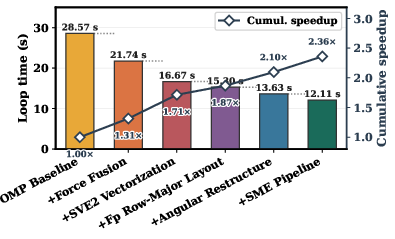
- Outer-product GEMM: A formulation of matrix multiplication accumulating rank-1 updates, suitable for certain hardware pipelines. "reformulation of the dominant coefficient inner products as outer-product GEMM operations"
- PFLOPS (PetaFLOPS): 1015 floating-point operations per second, a measure of computational throughput. "reaching 48.5 PFLOPS in double precision"
- Predictor–corrector: A two-stage time-integration scheme with an initial prediction followed by a correction step. "augment the explicit predictor-corrector update with an optional self-consistent midpoint iteration"
- Radial basis: Basis functions depending on interatomic distance used to construct local descriptors. "reuse the same radial-basis and angular-accumulation infrastructure"
- Radial cutoff: A distance threshold limiting neighbor interactions to within a fixed radius. "Because all three share the same radial cutoff"
- Rotationally invariant quantities: Descriptor components unchanged under rotations, ensuring physical symmetry. "contracting them into rotationally invariant quantities"
- Single-ion anisotropy (SIA): Anisotropy associated with individual ions, contributing to preferred spin directions. "Exchange, DMI, ANI, SIA"
- Skyrmion: A topologically nontrivial, vortex-like spin texture with particle-like properties. "Real-temperature topological magnetic dynamics ... helix-to-skyrmion transformation in FeGe"
- Skyrmion strings: Line-like extensions of skyrmions in three-dimensional magnets. "the three-dimensional nature of bulk DMI materials enables hosting of skyrmion strings"
- SME (Scalable Matrix Extension): ARM’s matrix computation engine enabling high-throughput matrix operations. "the SME three-stage pipeline"
- Spin-constrained DFT: DFT calculations performed with constraints on spin configurations to sample magnetic states. "from constrained density functional theory data of magnetic excite configurations"
- Spin–lattice dynamics: Coupled evolution of atomic positions (lattice) and spins, capturing energy exchange and feedback. "unified spin–lattice framework that treats atomic positions and local magnetic moments on an equal footing"
- Spin–orbit-mediated torque: Torques arising due to spin–orbit coupling effects, important for accurate spin dynamics. "accurate spin--lattice dynamics—particularly the spin-orbit-mediated torque terms"
- SpinGNN: A graph-neural-network-based spin–lattice modeling approach. "SpinGNN"
- SpinGNN++: An enhanced version of SpinGNN emphasizing fidelity/expressiveness. "SpinGNN++"
- Structure of Arrays (SoA): Memory layout storing each field in a separate contiguous array, improving vectorization/cache use. "packs their coordinates, distances, spins, and element types into a contiguous, alignas(64) SoA buffer"
- Surface hopping: A mixed quantum-classical method that stochastically hops between potential-energy surfaces during dynamics. "often in a surface-hopping-type framework"
- Sustained FLOPS: Measured floating-point throughput achieved by an application over time, as opposed to peak. "reaching 48.5 PFLOPS in double precision"
- Symplectic integrator: A structure-preserving time integrator that conserves geometric properties of Hamiltonian dynamics over long times. "a symplectic spin-lattice dynamics integrator"
- SVE2 (Scalable Vector Extension 2): ARM’s vector-instruction set enabling wide, predicated SIMD operations. "SVE2 vectorization"
- Time-to-solution (TtS): The total wall-clock time to complete a simulation or computation. "TtS = time-to-solution"
- Topological textures: Spin configurations characterized by nontrivial topology (e.g., skyrmions, hopfions). "device-scale topological texture formation"
- Torque-aware models: ML models that explicitly learn/predict magnetic torques in addition to energies/forces. "other torque-aware models"
- Weak scaling: Performance metric where per-node workload is held constant as the system size and number of nodes grow. "89.7\% weak-scaling efficiency"
- Weak-scaling efficiency: Ratio of single-node to multi-node time under weak-scaling conditions, indicating parallel efficiency. "89.7\% weak-scaling efficiency at full system scale"
- Zeeman energy: Energy of spins in an external magnetic field, favoring alignment with the field. "anisotropy, and Zeeman energy"
Collections
Sign up for free to add this paper to one or more collections.