- The paper shows that loss-based denoising can inadvertently amplify popularity bias by suppressing high-loss tail-item interactions.
- It introduces Popularity-Aware Denoising (PAD), a plug-in framework that dynamically adjusts weights based on item popularity to preserve informative tail signals.
- Empirical evaluations across datasets and models confirm that PAD restores diversity and enhances ranking accuracy with minimal tradeoffs.
Understanding and Mitigating the Interaction Between Recommendation Denoising and Popularity Bias
Problem Context and Motivation
This paper addresses the intersection between denoising strategies for implicit-feedback recommender systems and the prevalence of popularity bias. In implicit-feedback contexts—where clicks, purchases, or views serve as proxies for preferences—data are inherently noisy due to artifacts like mis-clicks or biased exposure. Denoising methods, especially those based on loss heuristics such as small-loss reweighting, aim to suppress unreliable or noisy data points, thereby improving model robustness. The authors highlight a significant blind spot: these methods may inadvertently exacerbate popularity bias by disproportionately suppressing genuine but hard-to-fit (high-loss) tail-item interactions, thus amplifying head–tail imbalance in recommendations.
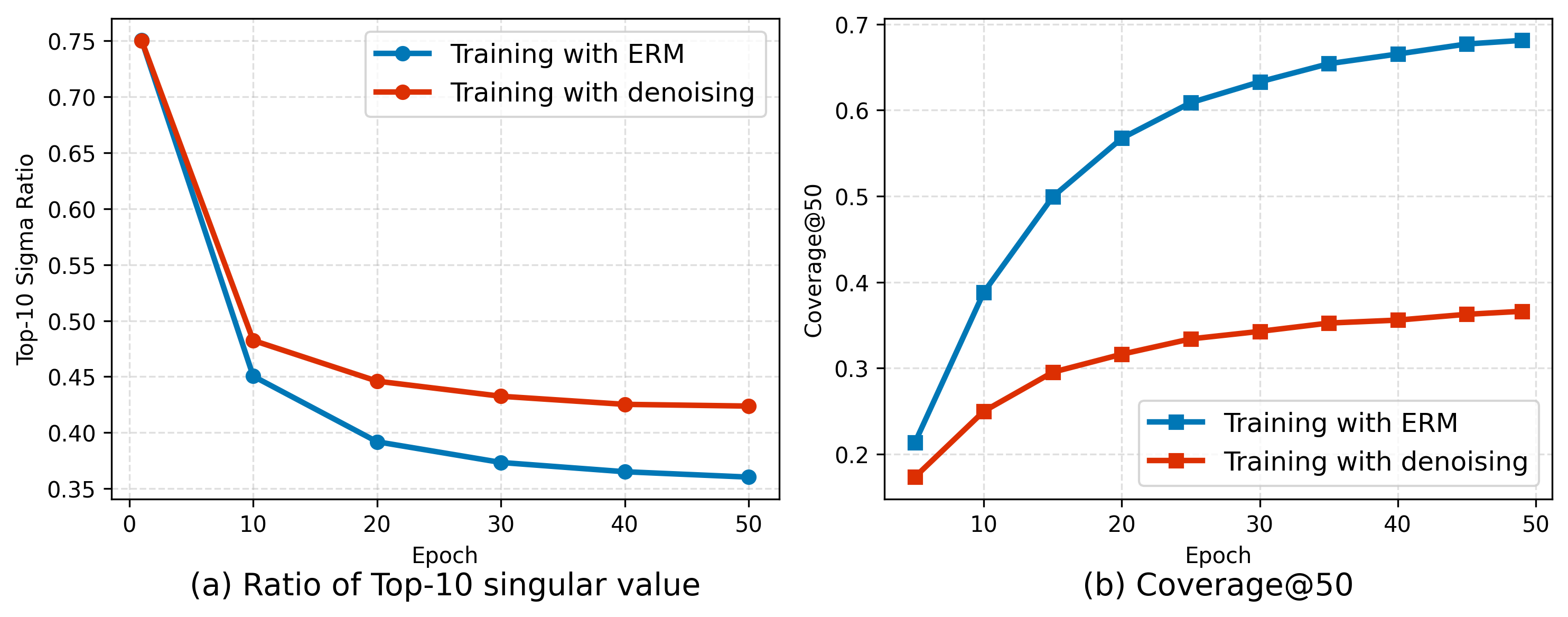
Figure 1: A motivating example of the interaction between loss-based denoising and popularity bias; denoising alters both representation concentration and recommendation coverage compared with standard ERM, motivating the conditional analysis.
Conditional Characterization of Denoising–Popularity Dynamics
The core insight is formalized via conditional analysis. The authors define the "effective head–tail signal ratio" to quantify how denoising reweights supervision between head (popular) and tail (rare) items. They prove that if tail positives have right-shifted loss distributions (i.e., higher average losses) relative to head positives—a common scenario due to sparse user-item interactions—then monotone small-loss denoising strictly increases the allocation of effective training signal to head items. This is a sufficient condition, not a universal statement, but it precisely specifies the regime wherein loss-based denoising inadvertently intensifies popularity bias.
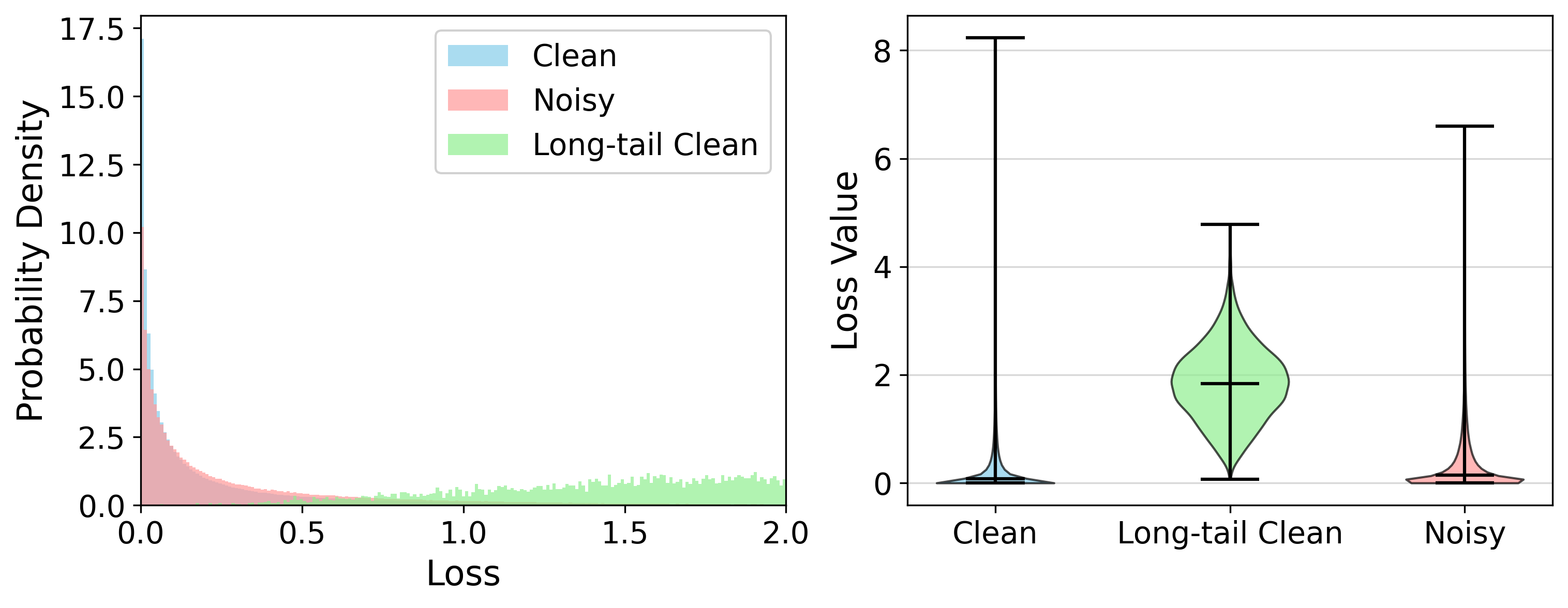
Figure 2: Distribution of losses for clean positives, clean tail positives, and noisy positives for GMF on Yelp; clean tail positives can overlap with high-loss/noisy regions, motivating conditional analysis.
The consequences are two-fold:
- Theoretical: A formal proposition shows that loss-based reweighting creates a secondary signal imbalance aligned with item popularity given the above condition.
- Empirical diagnostic: Loss distributions reveal that clean tail-item interactions are statistically likely to have higher loss, leading to their suppression under generic small-loss heuristics.
Popularity-Aware Denoising (PAD): Methodology
To mitigate this conditional failure mode, the authors propose Popularity-Aware Denoising (PAD), a plug-in framework that modulates denoising weights based on item popularity. PAD constructs the final training weight as a convex combination of the base denoising weight (e.g., small-loss reweighting) and a non-denoised reference ($1$), where the mixing coefficient is a function of normalized item popularity.
Formally,
wPAD(u,i)=(1−si)+siw(u,i)wheresi=(maxj∈Ipop(j)pop(i))η
η controls the strength of popularity-aware gating, ensuring stronger denoising on head items but more neutral weighting for tail items. This mechanism preserves hard yet informative tail-item interactions which would otherwise be down-weighted or discarded.
Theoretically, the PAD procedure is shown to strictly reduce the additional head–tail imbalance induced by base denoisers, under the sufficient conditions established earlier.
Empirical Evaluation
Datasets and Backbones
Experiments span three canonical datasets (MovieLens-100k, Amazon-Book, Yelp) and three backbone models representative of contemporary recommender architectures: GMF, NeuMF, and LightGCN.
Outcome Diversity and Popularity Bias (RQ1)
Epoch-wise tracking of diversity metrics (Gini-Div and Coverage@50) under ERM, denoising baselines, and PAD exposes clear trends. Uniform loss-based denoising often causes monotonic drops in coverage and diversity, especially on MF-style models, consistent with the theoretical framework. PAD reverses most of this loss, restoring or exceeding the baseline outcome diversity.
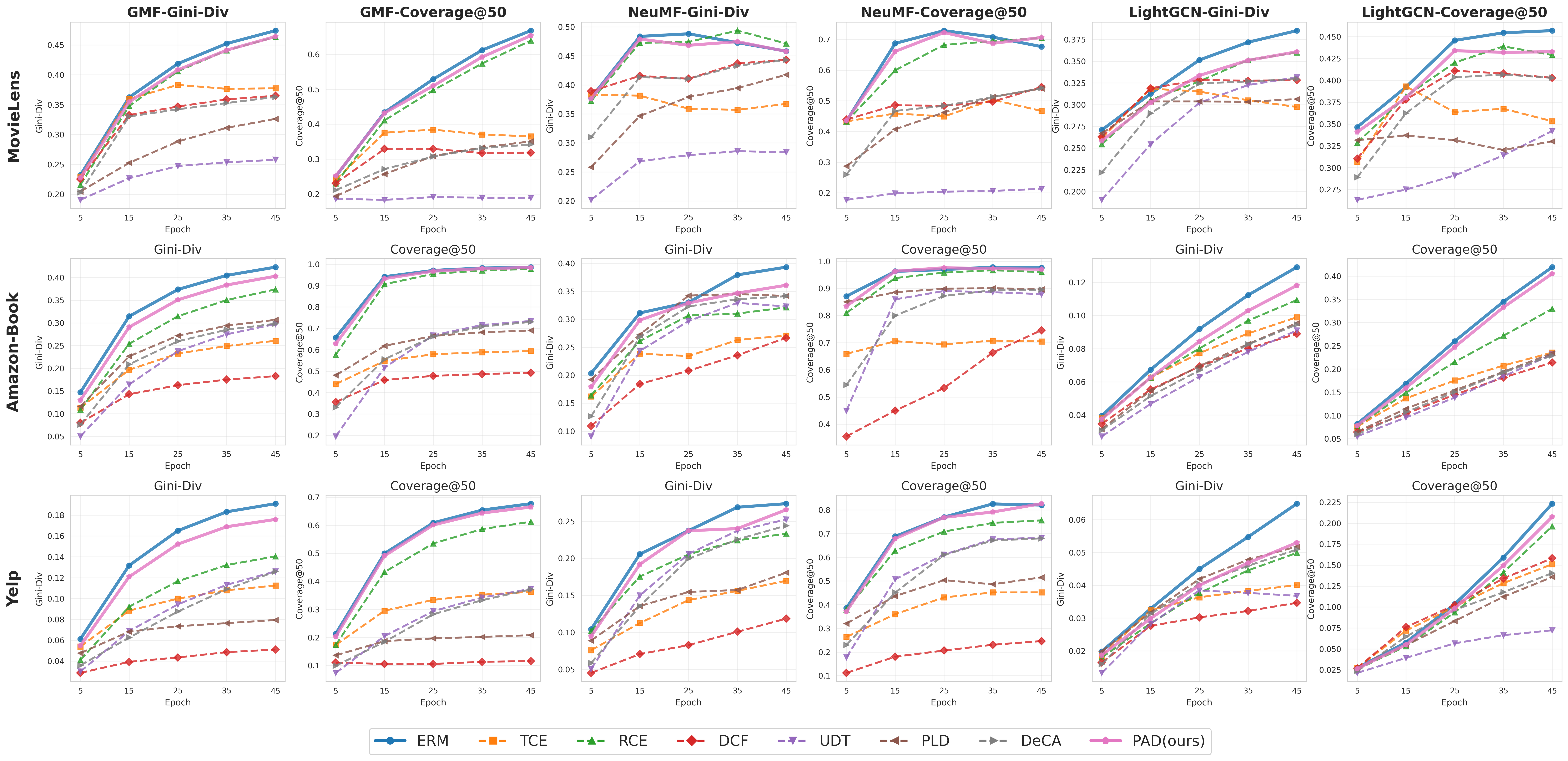
Figure 3: Epoch-wise evolution of Gini-Div and Coverage@50 under ERM, denoising baselines, and PAD across datasets and backbones.
Accuracy–Diversity Tradeoff (RQ2)
PAD consistently yields improved or best-in-class ranking accuracy (Recall@K, NDCG@K) among denoising methods, particularly on GMF and NeuMF, while also delivering superior item exposure diversity. For LightGCN, ERM remains competitive, implying that graph propagation already helps smooth sparse signals, thereby weakening the relative benefit of explicit denoising.
Hyperparameter Sensitivity and Loss Compatibility (RQ3)
A detailed grid search on PAD's hyperparameters (α,η) shows that greater popularity compensation (η) recovers diversity with minimal tradeoff in accuracy up to moderate levels of base denoising (α). This confirms PAD's role as a flexible, robust corrective mechanism.
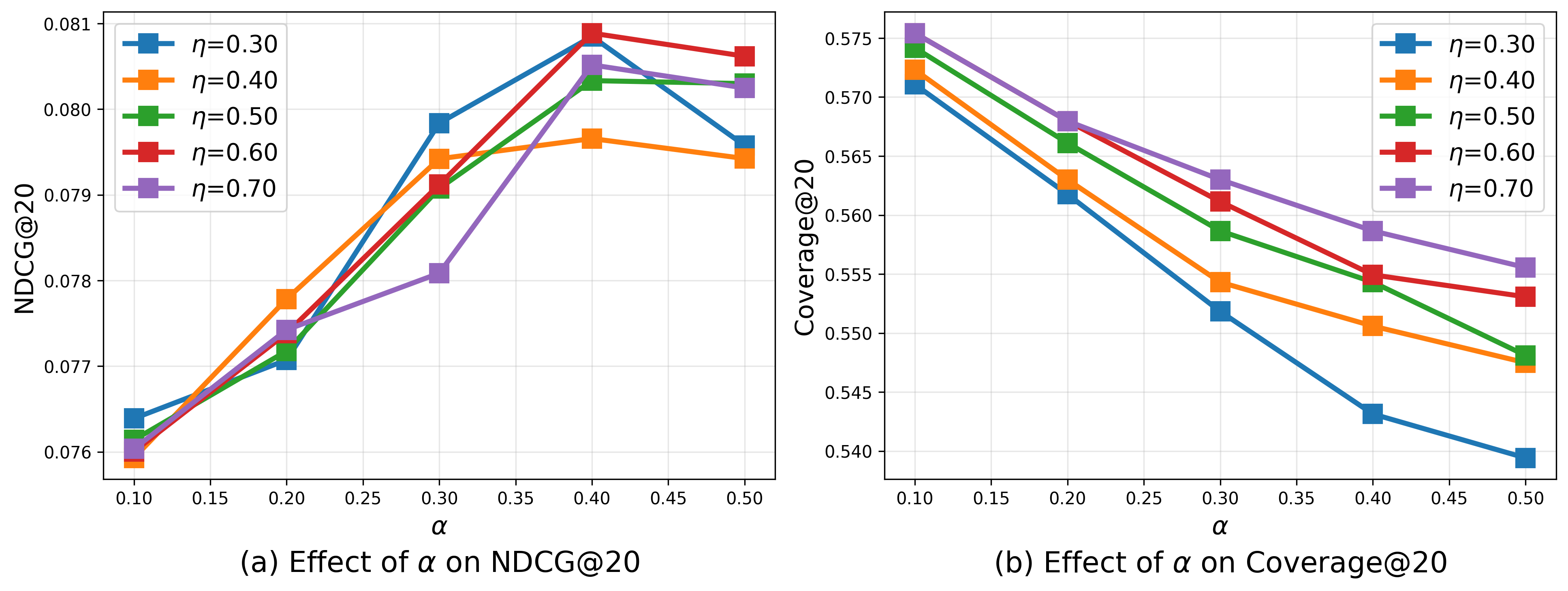
Figure 4: Sensitivity analysis of PAD's hyperparameters (α,η) on MovieLens/GMF; moderate values improve accuracy and recover coverage.
A limited investigation of pairwise (BPR) vs. pointwise (BCE) loss objectives confirms that the PAD gating mechanism is compatible beyond BCE, retaining gains in accuracy and fairness.
Implications and Future Directions
The findings have concrete implications for both theory and deployment of robust recommendation systems:
- Design of Denoisers: Uniform small-loss denoising is prone to popularity-induced signal imbalance, especially for MF-style models lacking graph augmentation.
- Model Selection: The choice of denoising vs. base ERM should be informed by the model architecture—explicit denoising is crucial for vanilla MF but may be obviated by advanced GCN/graph methods.
- Fairness and Diversity: PAD offers model-agnostic, dataset-level improvements to both accuracy and exposure fairness, providing an interpretable antidote to the head–tail imbalance.
- Broader Context: Increasing integration of self-supervised or LLM-based denoising methods may benefit from popularity gating to reconcile robustness and diversity.
Potential Future Work
- Extending popularity-aware gating to contrastive and sequential objectives
- Automated or adaptive tuning of the popularity compensation parameter
- Joint modeling of denoising and explicit exposure/propensity correction
- Investigating the interaction with multimodal signals and LLM-based noise detectors
Conclusion
This paper delivers a rigorous analysis of how ubiquitous loss-based denoising interacts with popularity bias, formalizing the circumstances under which denoising misallocates supervision between head and tail items. By proposing the PAD framework, the authors establish an effective, lightweight strategy that improves both robustness and fairness in recommendation. The work invites future research on principled, architecture-aware denoising—and on broader evaluation beyond accuracy to capture the full societal impacts of automated recommendation selection.
Reference: "When Recommendation Denoising Meets Popularity Bias: Understanding and Mitigating Their Interaction" (2606.14046)

