- The paper identifies electron-capture supernova candidates using a novel color diagnostic on multi-band light curves from 98 Type II supernovae.
- It employs radiation-hydrodynamical modeling to constrain explosion energies (0.4–1.7×10^50 erg) and progenitor envelope masses, supporting ECSN theoretical predictions.
- The study implies ECSNe constitute 1.8–9.2% of core-collapse supernovae, emphasizing the need for refined models of pre-supernova mass loss.
Electron-Capture Supernova Candidates from Light Curves: Progenitor and Explosion Properties
Introduction
Electron-capture supernovae (ECSNe) represent a theoretically distinct class of core-collapse events at the low-mass boundary of massive star evolution, originating from super-asymptotic-giant-branch (super-AGB) progenitors with ONeMg cores. Predicted energetics and nucleosynthetic yields differ fundamentally from canonical Fe-core-collapse supernovae (FeCCSNe), but robust observational identification of ECSNe has been impeded by the absence of unambiguous diagnostics and the rarity of compelling candidates beyond historical events such as SN~1054 (the Crab Nebula). The paper "Electron-capture Supernova Candidates from Light Curves: Implications for Their Progenitors and Explosion Properties" (2606.14044) presents a systematic search for ECSN candidates using a color-based diagnostic applied to Type II SN light curves, followed by quantitative modeling to constrain progenitor and explosion parameters.
Sample Selection and Color Diagnostic
A combined sample of 98 SNe II from literature compilations and the Zwicky Transient Facility (ZTF) public survey is constructed, emphasizing well-sampled, multi-band photometry. Candidate ECSNe are identified via the color diagnostic of Sato et al. [Sato2024-kt], exploiting the prediction that ECSNe produce intrinsically bluer optical plateau colors at the midpoint of their plateau-to-tail transition—reflecting extended, low-density envelopes in the absence of strong circumstellar medium (CSM) interaction. Two empirical linear boundaries are adopted:
- (g−r)tPT/2<0.008×tPT−0.4
- (B−V)tPT/2<0.0089×tPT−0.36
Events bluer than either threshold are flagged as photometric ECSN candidates.
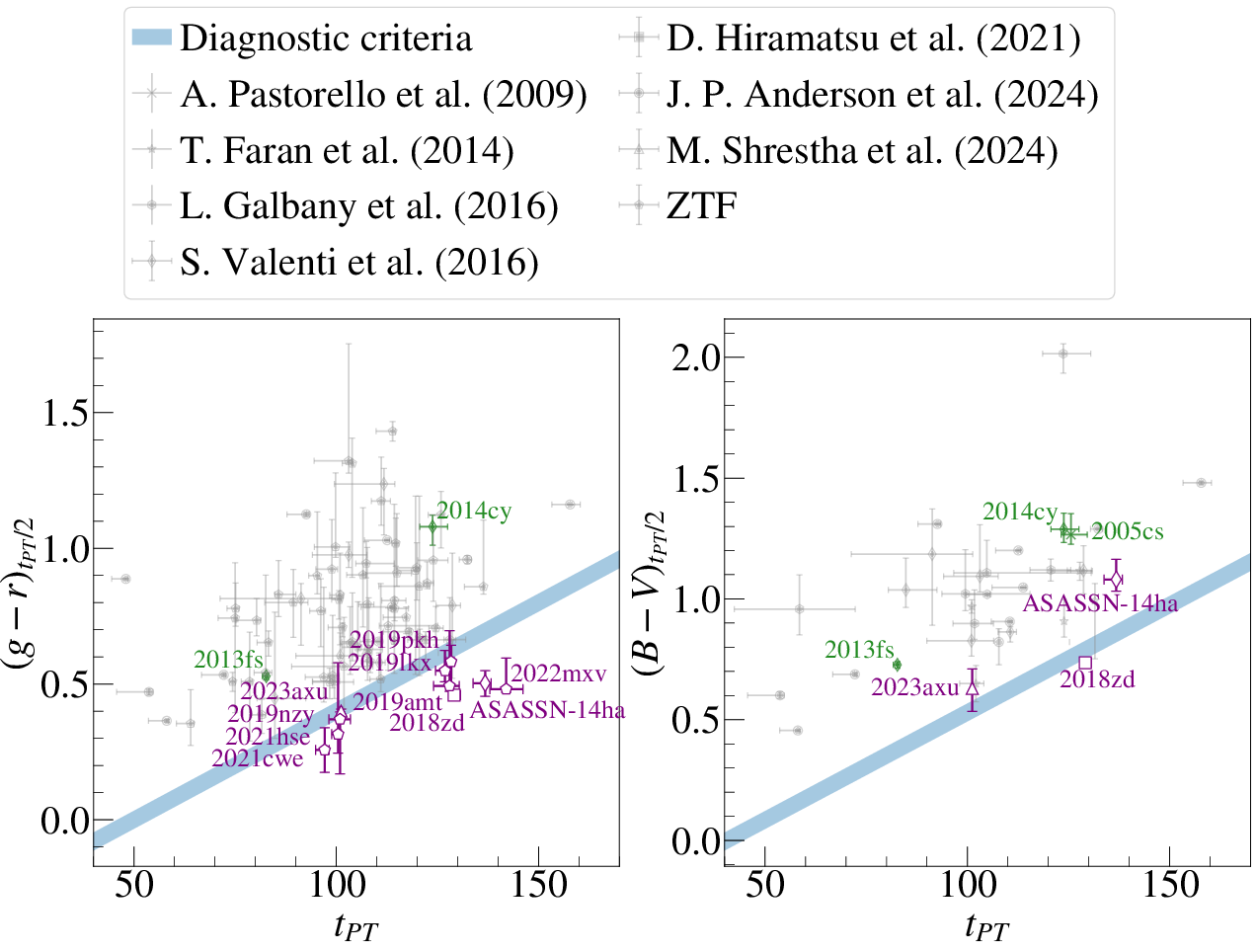
Figure 2: Color diagnostic in g−r and B−V for SNe II, showing ECSN candidates (purple) versus normal SNe II (gray); bluest objects at a given plateau length are selected.
Of the ten ECSN candidates identified, three ("gold") possess sufficiently contemporaneous spectra to exclude strong CSM interaction (ASASSN-14ha, SN~2018zd, SN~2023axu), while seven ("silver") lack such spectral vetting.
Observational Properties and Multicolor Light Curves
The gold candidates span plateau lengths of 100–140 days, with ASASSN-14ha at the long end. Plateau absolute magnitudes show diversity: ASASSN-14ha is relatively faint (V∼−15), SN~2018zd is intermediate (V∼−16), and SN~2023axu luminous (V∼−17). Tails are generally faint, with derived 56Ni masses ranging from $0.0014$ to $0.058$ (B−V)tPT/2<0.0089×tPT−0.360. Reference SNe (e.g., SN~2005cs, SN~2014cy, SN~2013fs) span the normal II-P light curve parameter space for context.
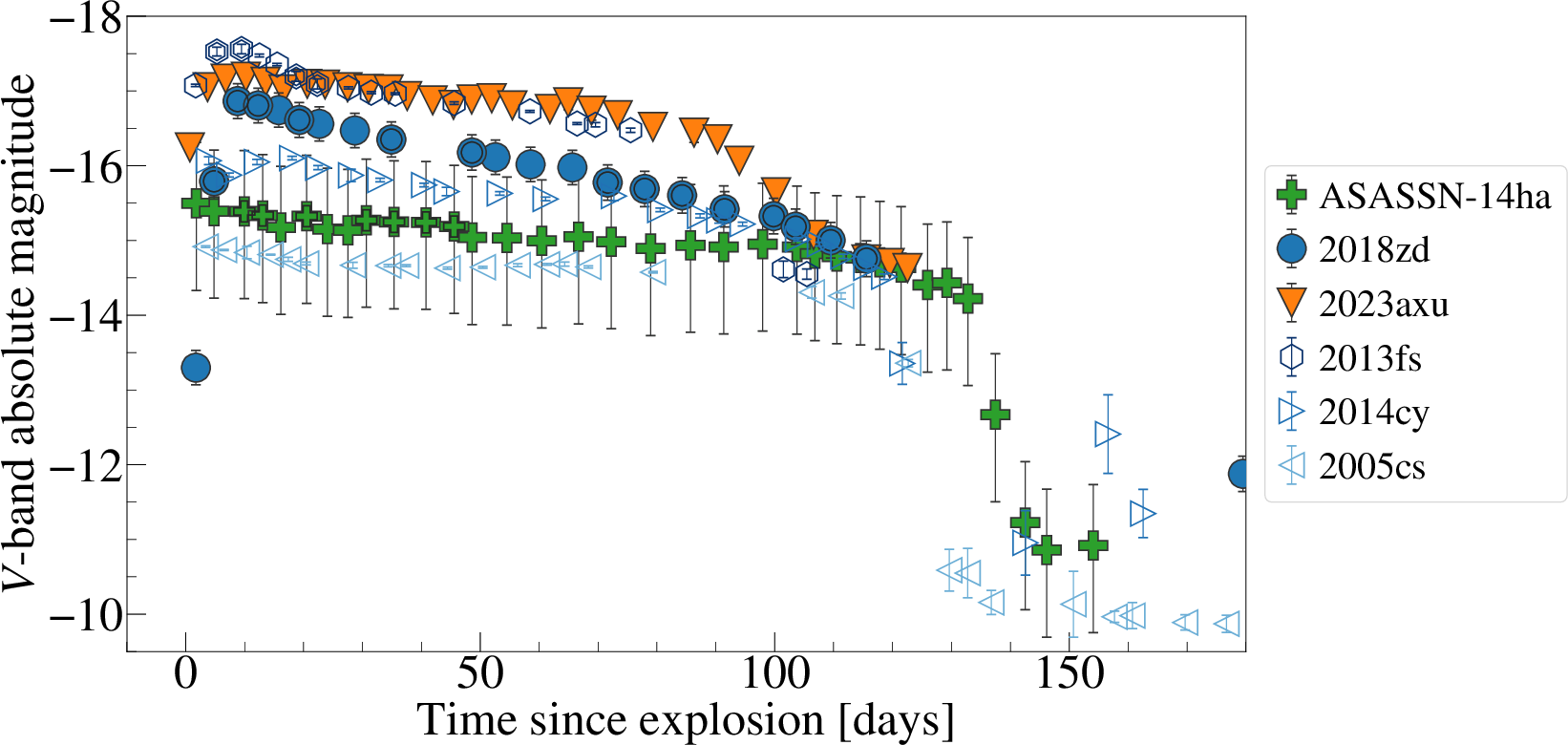
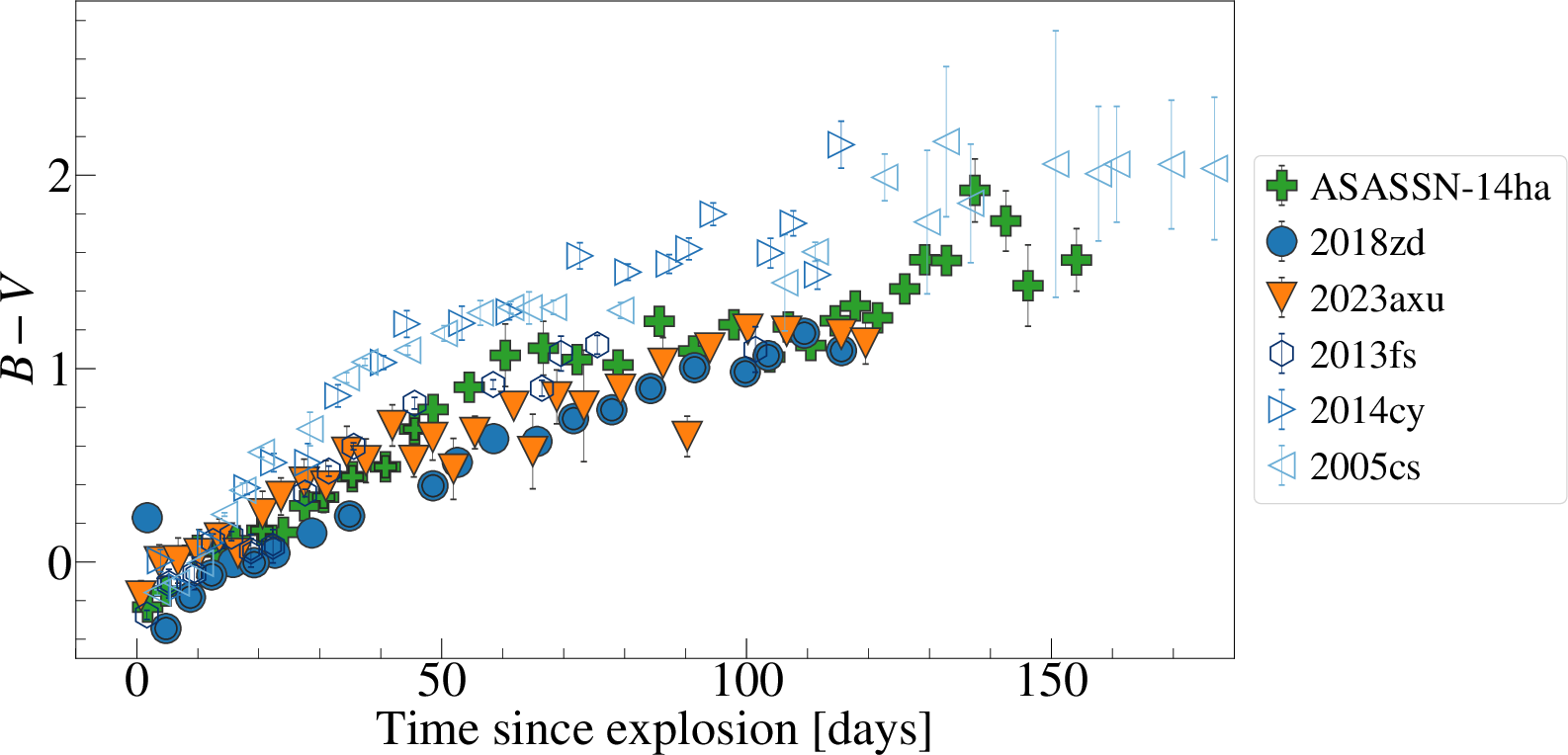
Figure 1: (B−V)tPT/2<0.0089×tPT−0.361-band light curves and (B−V)tPT/2<0.0089×tPT−0.362 color evolution for gold ECSN candidates in comparison to reference normal SNe II.
Silver candidates are typically more luminous and have similarly long or longer plateaus. Several (notably SNe~2019amt, 2019lkx, 2019pkh, 2021cwe) display anomalously bright tails, suggesting the possible presence of additional power sources (CSM interaction or central engine effects) beyond radioactive decay.
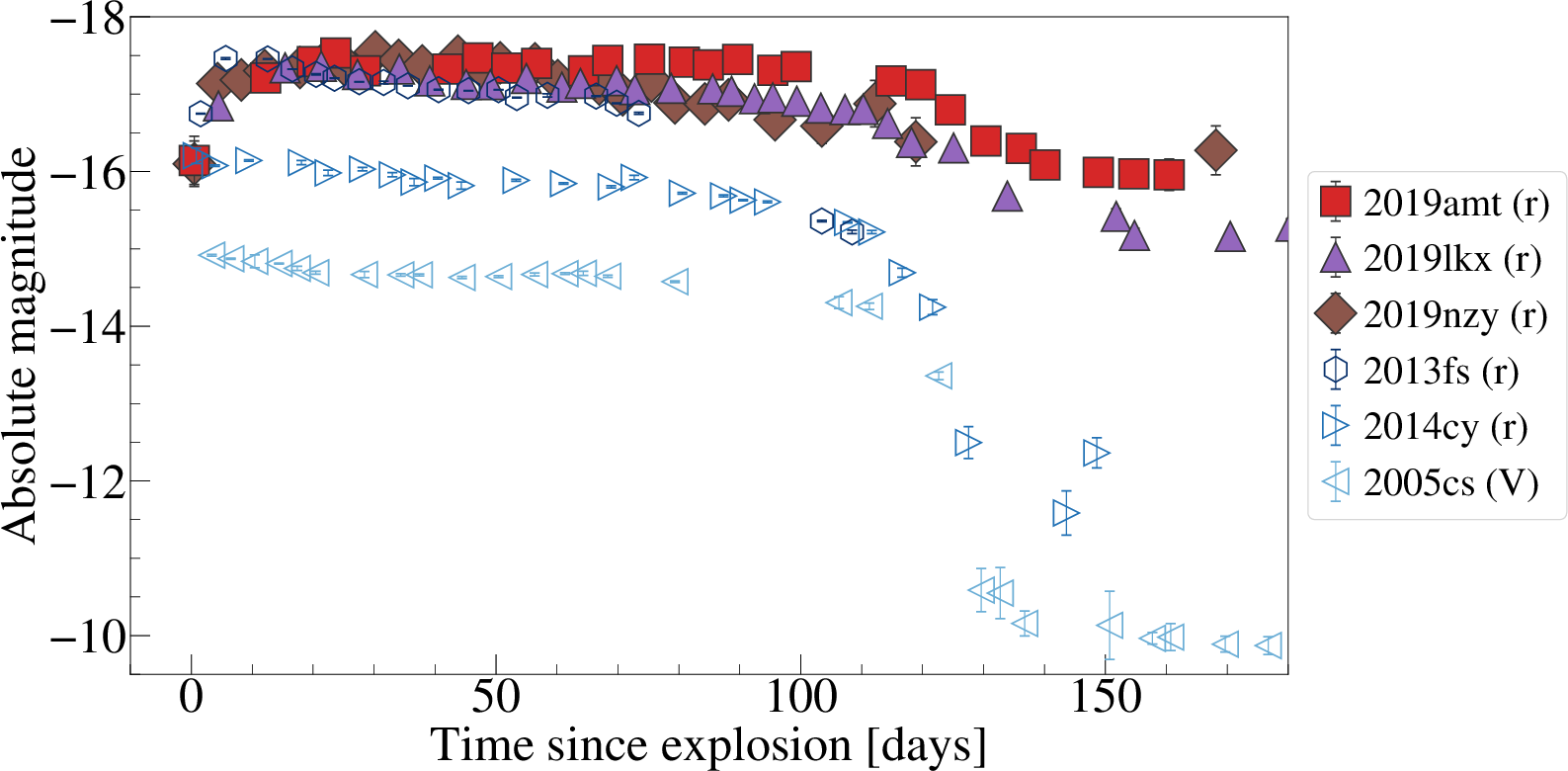
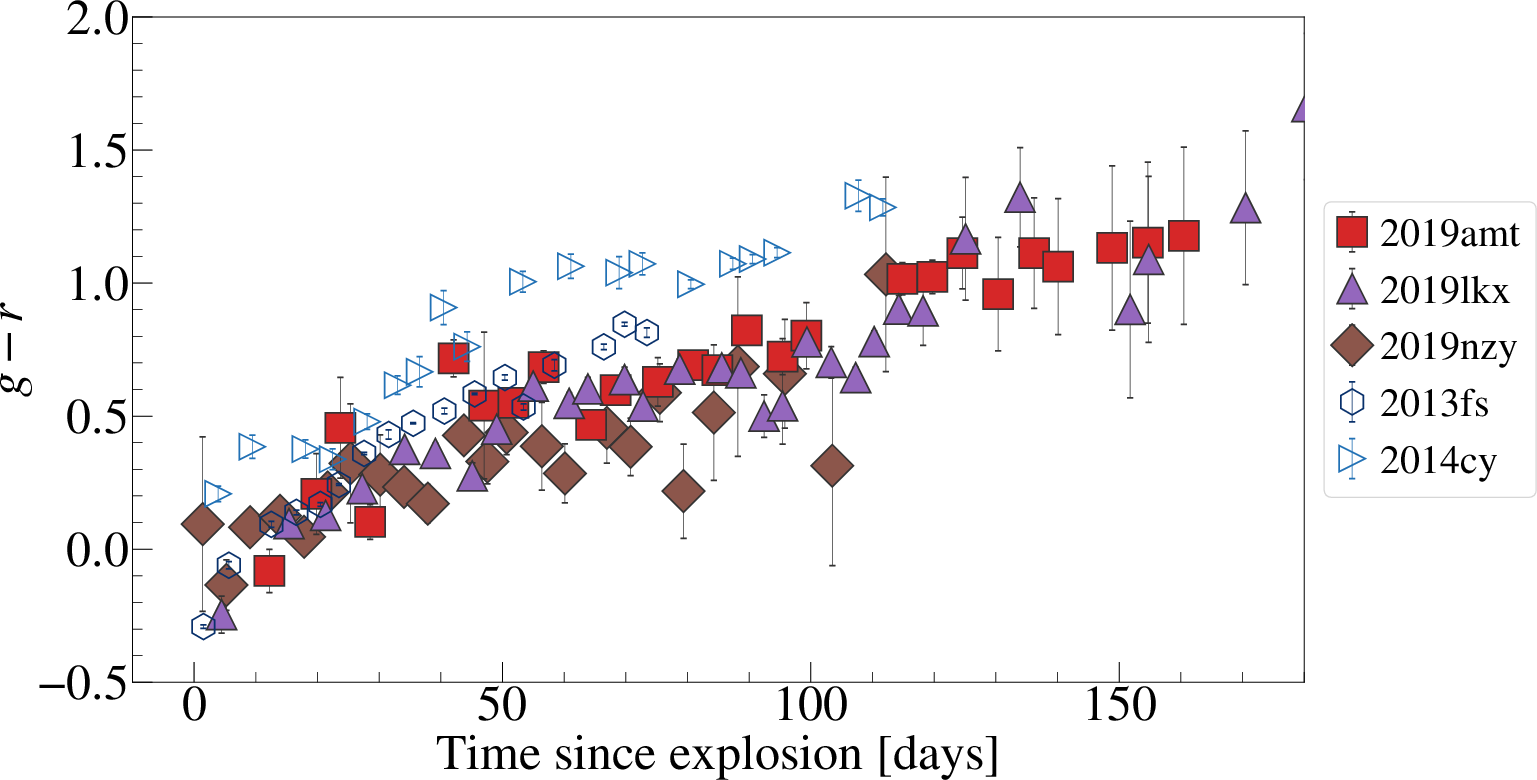
Figure 5: (B−V)tPT/2<0.0089×tPT−0.363-band light curves and (B−V)tPT/2<0.0089×tPT−0.364 color evolution for silver ECSN candidates and reference SNe II.
Quantitative Light Curve Modeling and Physical Inference
Radiation-hydrodynamical models based on super-AGB progenitors (Tominaga2013) are fit to the observed multi-band light curves of the candidates. The parameter space spans envelope mass, explosion energy, CSM structure (mass-loss rate, CSM radius), and (B−V)tPT/2<0.0089×tPT−0.365Ni mass. For the robust (gold) candidates, best-fit models indicate:
- Explosion energies (B−V)tPT/2<0.0089×tPT−0.366 erg, well below typical FeCCSNe.
- Progenitor envelope masses (B−V)tPT/2<0.0089×tPT−0.367.
- Pre-explosion mass-loss rates (B−V)tPT/2<0.0089×tPT−0.368, sustained in compact, dense CSM ((B−V)tPT/2<0.0089×tPT−0.369 cm), indicative of enhanced terminal super-AGB winds.
For silver candidates, best-fit explosion energies extend up to g−r0 erg; however, several favor more extended CSM, and ambiguities in the tail energetics inject greater uncertainty into their physical interpretation.
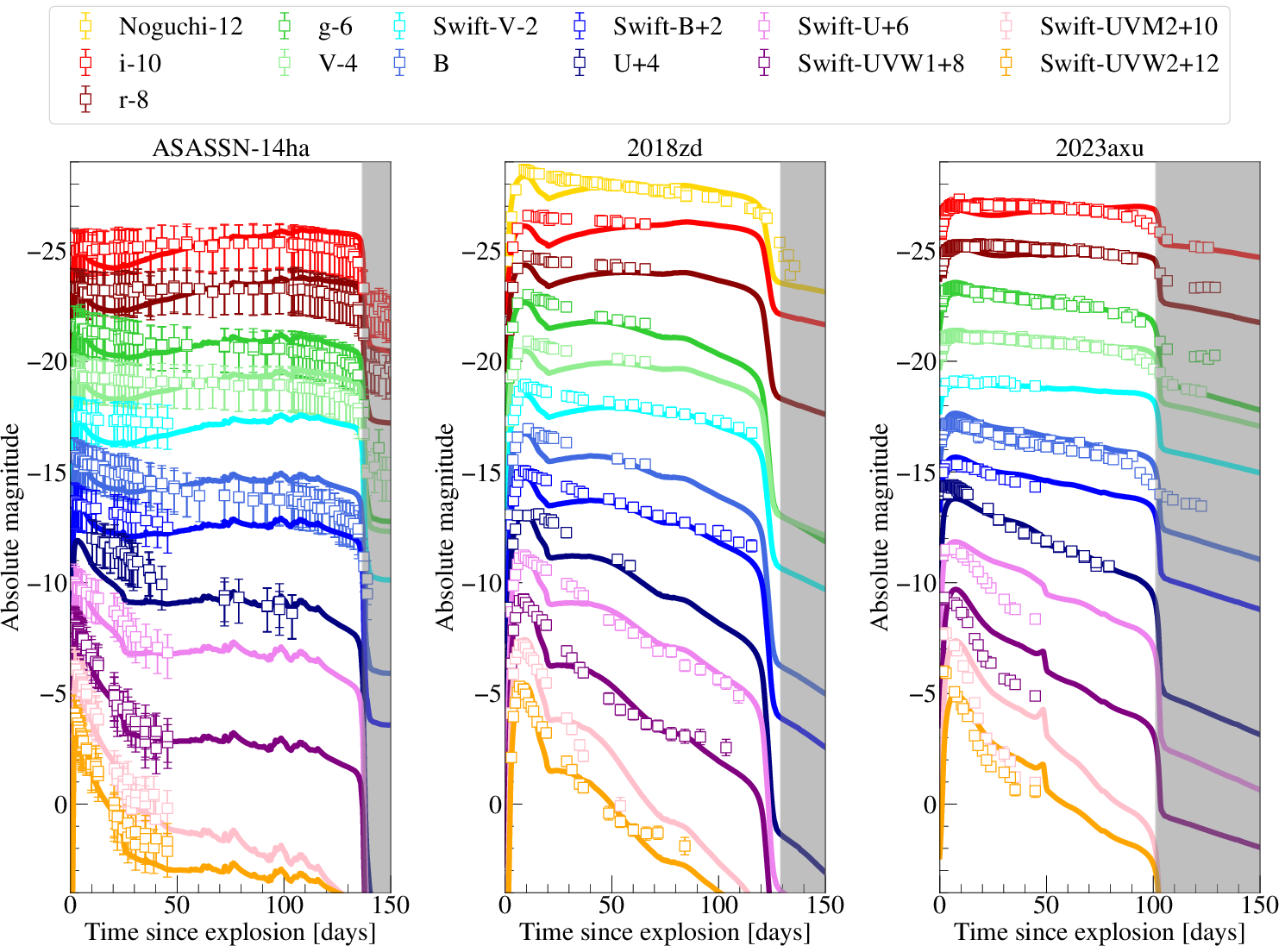
Figure 3: Comparison of observed light curves (points) and best-fit ECSN models (lines) for gold ECSN candidates; post-plateau epochs shaded and excluded from g−r1 minimization.
Spectroscopic Vetting
The crucial model assumption of negligible CSM interaction at the diagnostic epoch is spectroscopically checked for the gold candidates: their spectra lack narrow emission features associated with strong CSM interaction, separating them from SNe IIn or those with prominent flash/interaction signatures.
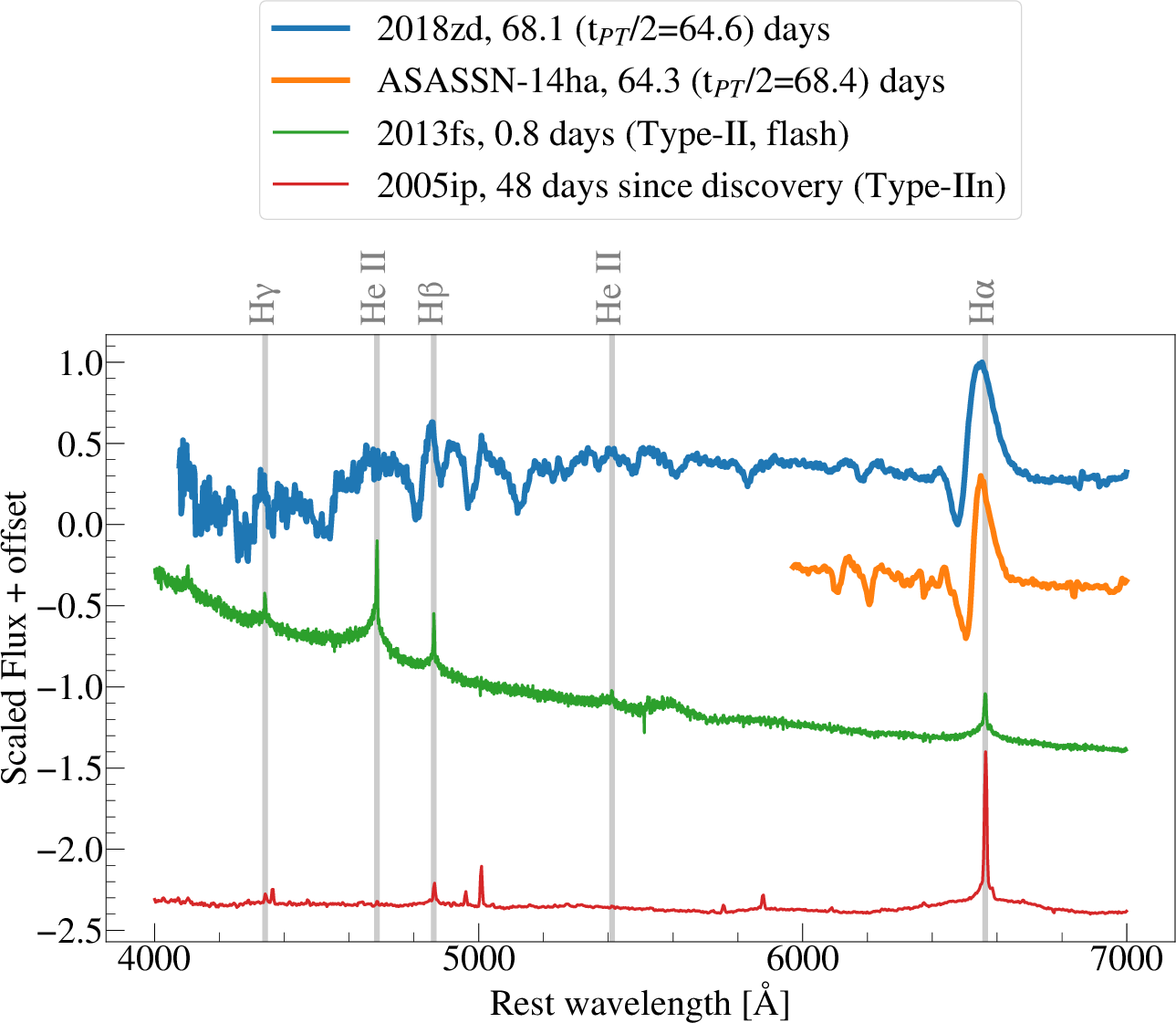
Figure 4: Plateau-epoch spectra for gold ECSN candidates, contrasted with flash-ionized and CSM-interacting Type II SNe (examples: SN~2013fs, SN~2005ip).
Statistical Occurrence Rate and Population Implications
By leveraging the ZTF volumetric survey and the gold/silver partitioning, lower and upper bounds on the ECSN fraction among SNe II are obtained: g−r2 (gold), g−r3 (silver), with host extinction assumptions further modulating the upper bound. Accounting for the CCSN subtype fraction, this implies ECSN rates of g−r4 of all core-collapse SNe, and a volumetric occurrence of g−r5, congruent with nucleosynthetic constraints from solar g−r6Kr and other neutron-rich isotopes [Wanajo2018-qu].
Theoretical and Practical Implications
The results provide quantitative confirmation of ECSN models, with explosion energies, envelope masses, and CSM properties in the gold candidates matching first-principles theoretical predictions [Kitaura2006-ia, Janka2008-ai]. The systematically high terminal mass-loss rates inferred, significantly above standard super-AGB prescriptions [Limongi2023-db], reinforce the need for time-dependent wind models capturing eruptive events, possibly linked to final core processes.
The large inferred CSM densities within g−r7 cm suggest that the final decades of evolution in super-AGB stars may feature elevated or even episodic mass-loss, which has ramifications for pre-explosion progenitor identification and for the diversity of observed light curve morphologies in SNe II.
Population synthesis implications include an initial-mass window for ECSN progenitors of g−r8 (assuming a standard IMF structure and ECSN/FeCCSN transition at g−r9–B−V0). The possible presence of subtle ECSN signatures in some SNe II previously classified as FeCCSNe—particularly in the low-luminosity regime—remains to be elucidated by future volumetric, multi-color, and spectroscopic time-domain surveys.
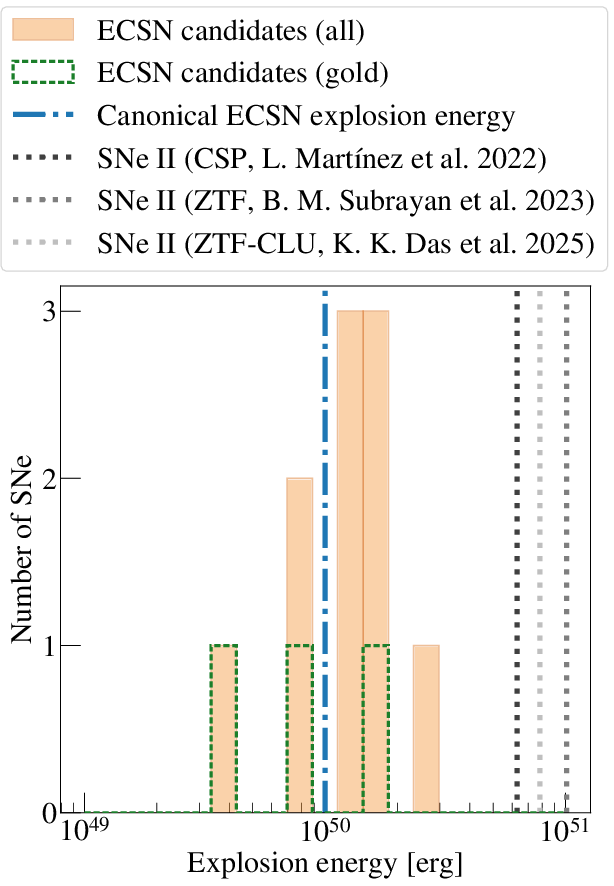
Figure 8: Explosion energy distribution inferred for ECSN candidates, showing lower energies than normal SNe II and clustering around theoretical ECSN explosion energies B−V1 erg.
Future Developments
The work underscores the necessity of time-resolved spectroscopy at plateau midpoints for all photometrically blue SNe II to robustly separate ECSNe from CSM-interacting impostors. LSST-era surveys, in combination with modern classification pipelines, will enable vastly improved statistics, while UV and IR follow-up will help disambiguate degenerate light curve contributions from CSM and radioactive processes.
MHD and multidimensional simulations of super-AGB winds and ECSN explosions are needed to refine mass-loss and mixing prescriptions, including the role of binary evolution [Burrows2024-cu, Doherty2017-vu]. Synergies with advanced nucleosynthetic yield modeling [Wanajo2018-qu, Wang2023-gv] will test the integrated chemical evidence for the ECSN channel using elemental abundance patterns in low-metallicity and solar-like populations.
Conclusion
This paper delivers the first systematic, color-based search and physical characterization of ECSN candidates via light curve modeling, producing explosion energy and mass-loss rate inferences consistent with ECSN theory and providing the most robust observational occurrence rate constraints to date (2606.14044). It highlights the observational and theoretical synergy required to unravel the terminal evolutionary pathways of the lowest-mass core-collapse progenitors and establishes a framework for ECSN identification in future time-domain surveys. Ongoing progress in both spectroscopic and theoretical investigations will further clarify the landscape of ECSN and their broader astrophysical significance.

