- The paper introduces a semismooth Newton-based proximal ALM method that jointly estimates clustered GGMs with both individual and shared sparsity.
- It leverages a novel screening rule to identify block diagonal structures, significantly reducing computational complexity in high-dimensional problems.
- Empirical evaluations demonstrate that the proposed algorithm outperforms ADMM and other proximal methods with faster convergence and robust accuracy.
Semismooth Newton-Based Proximal Augmented Lagrangian Methods for Joint Estimation of Clustered Multiple GGMs
Introduction and Problem Setting
The estimation of multiple related Gaussian graphical models (GGMs) is a core problem in high-dimensional multivariate statistics, with extensive applications in genomics, finance, and neuroscience. Specifically, estimating joint sparsity structures across several distinct but related GGMs requires solving coupled log-determinant optimization problems, typically regularized to capture both within- and between-class dependency patterns. The paper "A Semismooth Newton-Based Proximal Augmented Lagrangian Method for Joint Estimation of Multiple Gaussian Graphical Models with Clustered Structure" (2606.14041) addresses the clustered multiple GGM (cMGGM) setup, wherein multiple precision matrices are estimated jointly while enforcing both individual sparsity and shared (clustered) edge patterns.
Formally, for K groups, with each group's data modeled as a p-variate Gaussian, the task is to estimate K precision matrices {Θk} by minimizing the sum of (negative) log-determinants plus a clustered group lasso penalty that favors both individual and shared sparsity structures. The regularizer encourages edges to be either jointly included across groups or jointly shrunk toward zero.
Penalty Structure and Optimization Challenge
The penalty analyzed is the clustered group lasso of Danaher et al., which, for each pair (i,j), combines an ℓ1 penalty across groups and a pairwise fusion term across all group differences:
(Θ)=μ1j=j′∑(k=1∑K∣Θjj′k∣)+μ2j=j′∑(k<k′∑∣Θjj′k−Θjj′k′∣)
When μ2 is large, the solution tends toward identical edge values across all groups, thus strongly encouraging shared structural features.
The resulting optimization problem is high-dimensional, involving nonsmooth penalties and coupled matrix variables. Classical approaches such as ADMM can handle moderate dimensionality, but computational cost becomes prohibitive as dimensionality increases, especially when second-order accuracy is required.
Semismooth Newton-Based Proximal ALM Algorithm
The authors contribute a proximal augmented Lagrangian method (PALM), with dual problem reformulation, and an inner semismooth Newton (SsN) method for subproblem solution. The key features are:
- Inexact Proximal ALM Framework: Each ALM subproblem is strongly convex due to an adaptive proximal term, ensuring unique solutions and robust convergence. The dual variables are efficiently updated using closed-form properties of the log-determinant's proximal mapping.
- Semismooth Newton Updates: The subproblems are solved via semismooth Newton steps, exploiting explicit expressions for the generalized Jacobians of block-separable nonsmooth mappings arising from the clustered lasso, enabling quadratic local convergence.
- Parallelized Prox Calculations: Due to the block structure of the penalty, proximal and generalized Jacobian computations are parallelizable across off-diagonal elements.
- Screening Rule for Block Structure: The paper establishes a necessary and sufficient condition for the solution to have a block diagonal form. This enables decomposition into smaller subproblems. The derived screening rule not only generalizes previous conditions to K>2 but is also demonstrated to significantly accelerate computation in practice.
Screening Rule and Block Diagonal Structure
A major computational gain is achieved by pre-identifying block structures in the estimated precision matrices via a sharp screening rule. The derived necessary and sufficient condition characterizes when certain blocks of variables can be decoupled:
p2
for all nonempty p3, then the MLE solution is block diagonal, and estimation can be restricted to individual blocks.
This screening not only reduces the computational burden drastically for large p4 but also provides theoretical guarantees for statistical interpretability, e.g., in genomics where true subnetwork modularity is expected.
Numerical Results and Empirical Evaluation
Empirical evaluation is conducted on multiple synthetic and real datasets, including financial data (S&P 500), text data (20 Newsgroups, university webpages), and structured synthetic networks simulating common, chain, and scale-free graphs.
Key findings:
- The proposed SsNPAL method consistently outperforms ADMM and the proximal Newton-type methods (MGL) in computing time, especially as p5 and p6 increase.
- When the block screening rule is enabled, computational time is reduced by an order of magnitude for all methods.
- Strong accuracy is maintained across a variety of graph structures, network sizes, and regularization settings.
- Block structure screening identifies large independent subproblems in favorable regimes (p7 not too small), enabling tractable estimation even for p8.
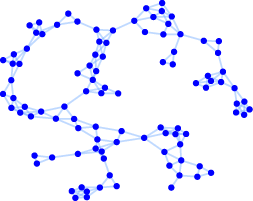
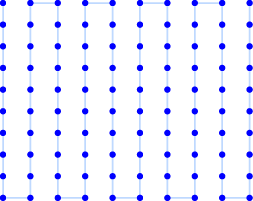
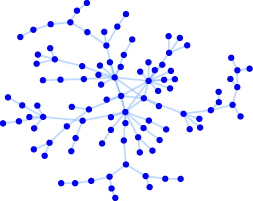
Figure 1: The common links present in all categories in the three simulated networks; these form the structural basis for performance evaluation under different generative regimes.
On stock market data, temporal variations in network structure—such as increased inter-sector connectivity during the 2008 financial crisis—are captured by the estimated precision graph dynamics. The proportion of within-sector and cross-sector links over time is visualized, demonstrating the interpretability of the cMGGM estimators.
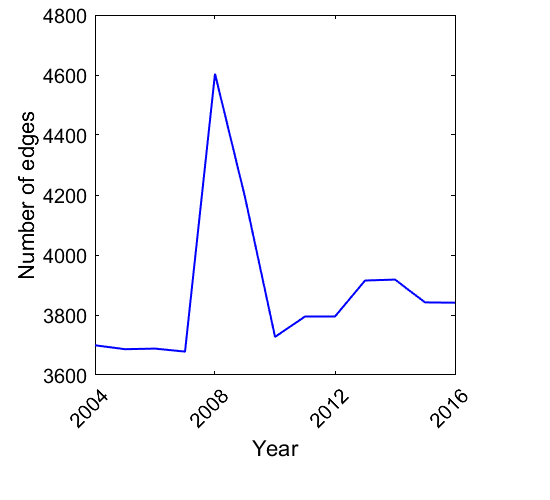
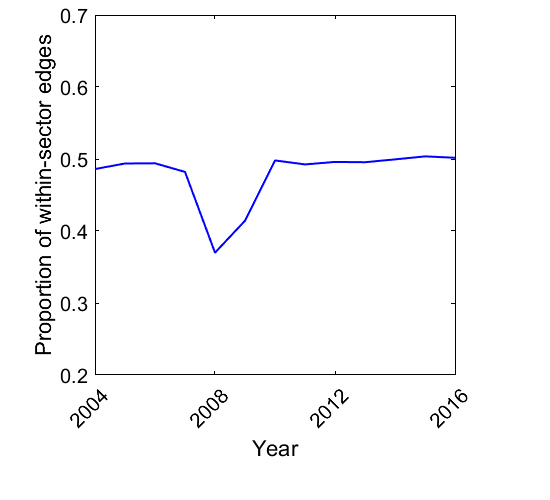
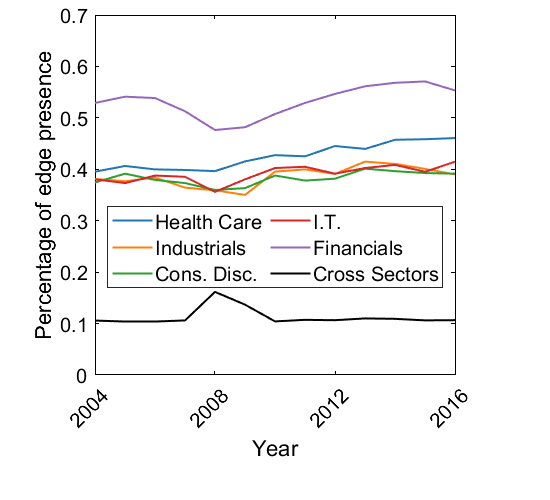
Figure 2: Patterns of estimated precision matrices over nine years for S&P 500 data: (a) total nonzero edges; (b) within-sector edge proportion; (c) presence percentage by sector and across sectors, highlighting structural dynamics.
Theoretical and Practical Implications
The proposed methodological contributions are significant for both statistical network inference and large-scale convex optimization:
- The combination of PALM and semismooth Newton guarantees global and locally superlinear convergence, with rigorous error bounds.
- Screening enables modularized estimation, aligning computational efficiency with the modularity commonly expected in biological and financial real-world networks.
- The methods scale to problems previously out of reach for second-order methods, closing the gap between theoretically optimal estimators and practical compute resources.
Implications for Future Developments
The approach outlined holds promise for further applications in scenarios with high-dimensional, heterogeneous data across multi-task learning, neuroimaging, and multi-population genomics. Prospective research directions include:
- Generalizing screening rules for even broader classes of penalties (e.g., nonconvex or adaptive fusion).
- Applying blockwise decomposition jointly with distributed and parallel computation frameworks.
- Extending to other exponential family graphical models beyond the Gaussian, leveraging similar first- and second-order optimization machinery.
Conclusion
This paper advances the estimation of clustered multiple GGMs via an integrated optimization framework consisting of proximal ALM with semismooth Newton subproblem solution and pre-estimation structure screening. The method achieves notable improvements in efficiency and scalability compared to established methods, with robust empirical performance across diverse datasets. The theoretical developments regarding necessary and sufficient conditions for block-diagonal structure enable modular modeling aligned with natural data heterogeneity, signaling rich opportunities for further extensions in high-dimensional inference (2606.14041).