- The paper presents novel atmosphere models using a four-dimensional grid (T_eff, log(g), Y, Z) to couple interior composition with spectral evolution.
- It integrates advanced line-by-line opacities, state-of-the-art EOS, and non-adiabatic processes like helium rain to enhance modeling across varied giant planet masses and temperatures.
- The development of an automated multilinear interpolator enables precise, time-resolved spectral predictions, facilitating improved observational retrievals and evolutionary studies.
Comprehensive Review of Next-Generation Atmosphere Models for Giant Planets (Cloudless Models with Equilibrium Chemistry)
Model Framework and Physical Ingredients
Chen et al. present a new generation of 1D atmosphere models for giant planets, targeting masses spanning 0.3−10MJ and effective temperatures from $100-1400$ K, with boundary-condition tables enabling consistent cooling and spectral evolution calculations (2606.14026). Their methodology synthesizes the CoolTLusty radiative–convective equilibrium code with updated line-by-line opacities and state-of-the-art EOS, explicitly parameterizing helium fraction and metallicity across a wide grid. The resulting four-dimensional parameter space (Teff,log10g,Y,Z) substantially broadens the physical fidelity compared to prior boundary grids, allowing for interior compositional evolution (helium rain, convective mixing) to impact outer boundary conditions and observable spectra.
The models employ latest line lists from ExoMol, EXOPLINES, and high-temperature broadband coverage for molecular and atomic absorbers, with pressure-dependent Voigt profiles. Metallicity is treated consistently in both opacity and EOS, contrasting earlier approaches that conflated heavy element effects with helium via an effective Y′=Y+Z prescription.
Comparison with Existing Atmosphere Grids
Temperature–pressure profiles produced for representative surface gravities and compositions show strong agreement with Sonora-Bobcat and ATMO2020 grids at depth—with differences in base entropy typically ≲5%—and systematic variation with metallicity, particularly in the upper atmosphere. The model grid’s enhanced metallicity is motivated by Jupiter’s inferred water abundance.
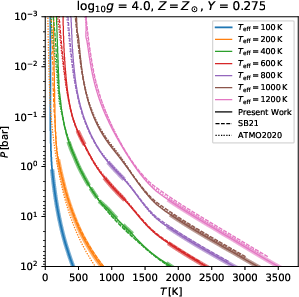
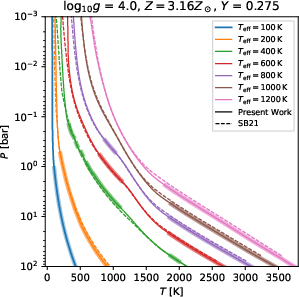
Figure 1: Radiative–convective equilibrium T–P profiles compared across models for fixed log10g and Y; deviations are largest in shallow layers but converge in convective regions where cooling history is set.
Emergent spectra are compared as a function of surface gravity, metallicity, and helium abundance. Increasing Z suppresses short-wavelength flux and enhances mid/long IR emission; decreasing g shifts molecular absorption features due to lower pressure and favoring formation. Spectral agreement with Sonora-Bobcat is generally robust, with the greatest sensitivity to metallicity.
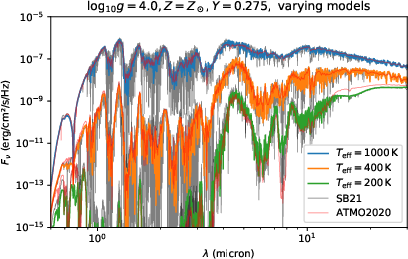
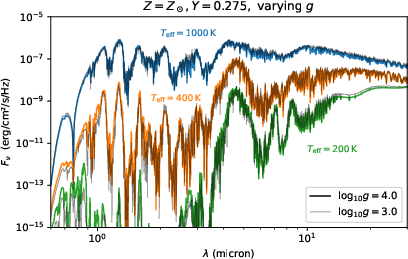
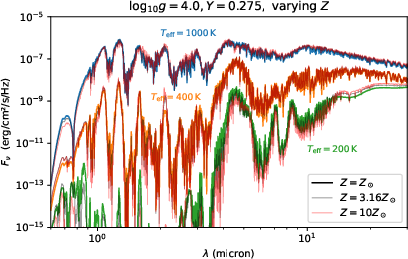
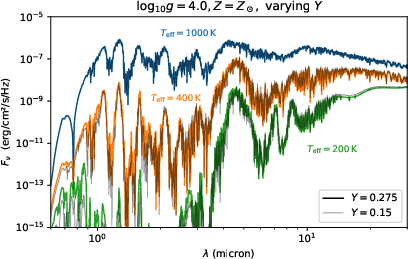
Figure 2: Spectra for different atmospheric grids, gravities, metallicities, and helium fractions; Z most strongly modulates broadband spectral features below $100-1400$0m.
Across the $100-1400$1 grid, spectral surfaces show marked suppression of submicron flux as planets cool, with implications for time-resolved spectral evolution of aging giant planets.
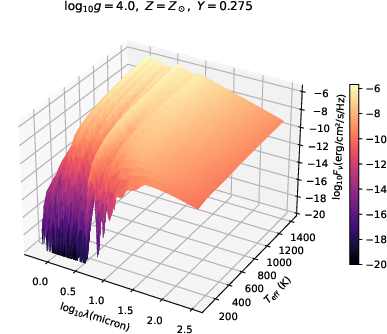
Figure 3: 3D spectral surfaces for a representative parameter combination, illustrating cooling-induced flux redistribution.
Each atmosphere model generates an entropy value below the deep radiative–convective boundary. Constructing a 4D $100-1400$2 table enables the mapping of interior cooling and contraction to observable properties.
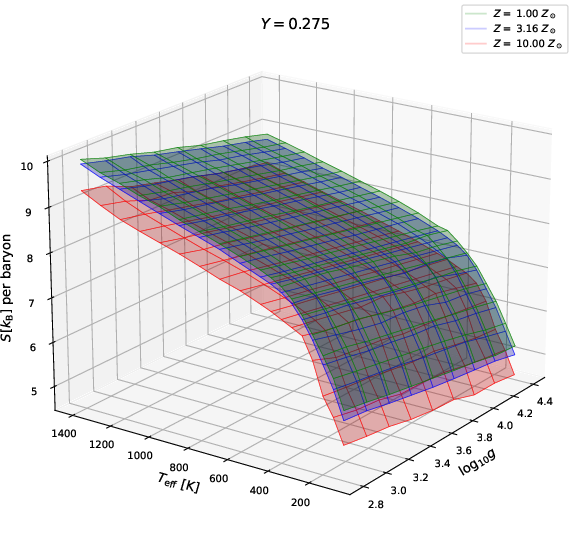
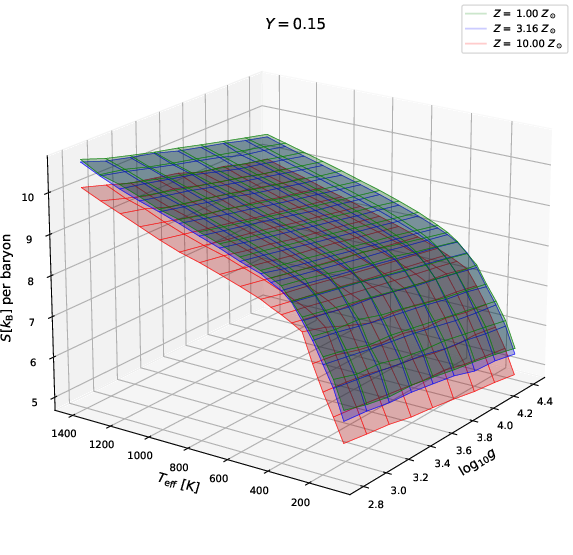
Figure 4: Entropy surfaces for distinct $100-1400$3 and $100-1400$4 combinations; higher metallicity accelerates cooling via lower base entropy.
Evolutionary tracks calculated using the APPLE gas giant evolution code demonstrate consistency with prior boundary conditions (SB21, ATMO2020, Burrows97). For fixed homogeneous composition, the new tracks closely follow established models, with slightly larger radii and comparable cooling rates.
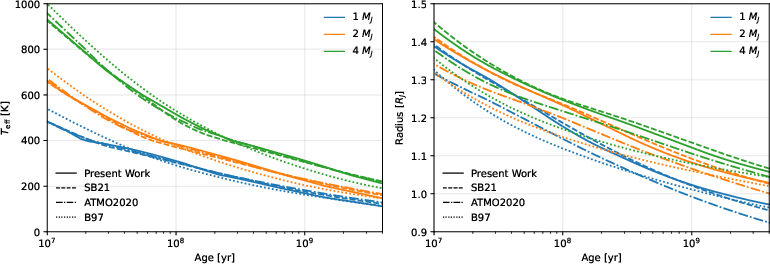
Figure 5: Adiabatic evolution tracks for different masses across boundary models; the new atmosphere grid yields similar $100-1400$5 histories, with larger radii for high-mass objects.
When non-adiabatic interior physics is included (fuzzy core, inhomogeneous stratification, helium rain), atmospheric composition evolves—$100-1400$6 and $100-1400$7 change dynamically via mixing and rain. Allowing boundary conditions to self-consistently interpolate in both $100-1400$8 and $100-1400$9 accelerates cooling, advancing the onset of helium rain by (Teff,log10g,Y,Z)02 Gyr versus fixed-composition models, and leading to more severe atmospheric helium depletion. This highlights that compositional feedback at the boundary is critical for accurate long-term evolutionary modeling.
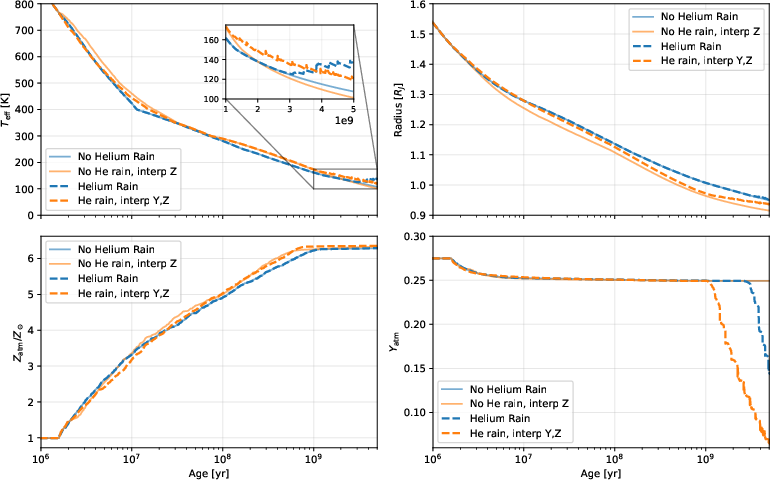
Figure 6: Non-adiabatic and compositional evolution for (Teff,log10g,Y,Z)1 planet with fuzzy core; boundary composition interpolation hastens helium rain, intensifies helium depletion, and modifies cooling profiles.
Radial structure at late times reflects the cumulative impact of boundary treatment on temperature, entropy, and composition profiles.
A key practical advance is a fully automated multilinear interpolator for spectral and thermal boundary condition generation. This toolkit enables prediction of spectra at arbitrary points along evolution tracks and supports atmospheric retrieval for observed planets not on tabulated grid points. Computational complexity of grid search and interpolation is minimized via efficient integer arithmetic.
The interpolator’s utility is illustrated by post-processing an interior evolution track (including compositional evolution and helium rain), generating time-resolved spectra for each evolutionary snapshot.
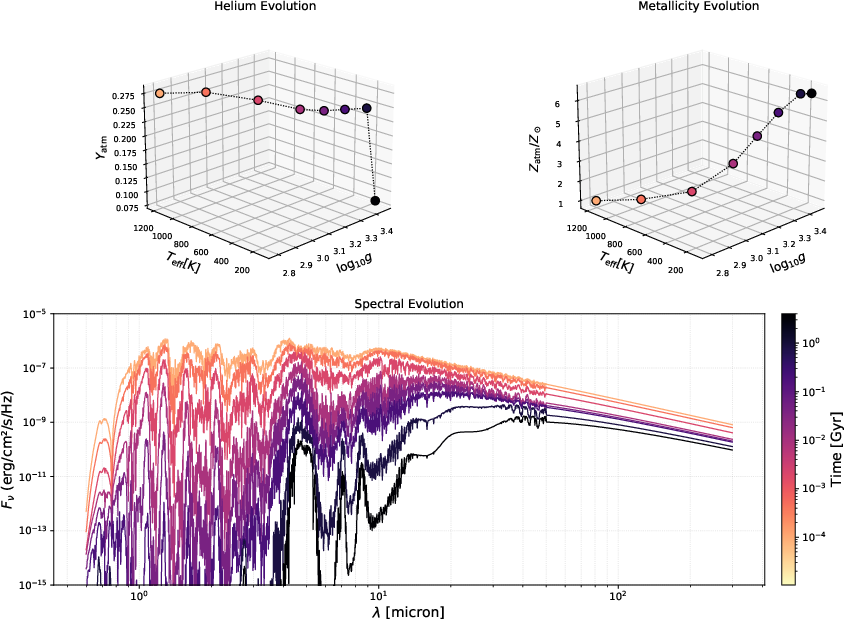
Figure 7: Evolutionary trajectory in (Teff,log10g,Y,Z)2 parameter space sampled with colored markers; interpolated spectral evolution reflects compositional and thermal history.
Implications for Exoplanetary Evolution and Observational Modeling
This model set advances the fidelity of planetary evolutionary modeling, particularly for late-stage gas giants where mixing and compositional changes are pronounced. The explicit treatment of both helium fraction and metallicity enables rigorous coupling between interior physics and atmospheric observables, reducing the reliance on approximations that obscure underlying thermodynamic trends. The release of the boundary-condition dataset and interpolation tool support community adoption for both modeling and retrieval.
In practical terms, compositional feedback at the boundary can significantly affect predicted observable properties, e.g., the timing and severity of helium rain, radius evolution, and broadband spectra. This will sharpen characterization of gas giants including Jupiter, Saturn, and exoplanets within the mass and temperature range targeted.
Future developments will integrate clouds, disequilibrium chemistry, and stellar irradiation, expanding applicability to irradiated and cloudy substellar atmospheres.
Conclusion
This work provides a comprehensive, physically consistent atmospheric boundary condition grid for giant planet evolution, leveraging state-of-the-art opacity and EOS modeling. The explicit parameterization of helium and metallicity, coupled with an efficient interpolation toolkit, underpins improved theoretical and observational modeling of gas giants. The implications for planetary cooling, contraction, and atmospheric composition evolution are significant, and forthcoming releases incorporating clouds and irradiation will further enhance the dataset’s utility.