- The paper demonstrates that LLC conditions ensure quantitative comparability between unilateral (beta) and bilateral (theta) flatness.
- The paper establishes sharp Menger energy thresholds that guarantee C¹,α regularity and bi-Lipschitz parametrization of manifolds.
- The paper introduces new discrete curvature criteria that offer concrete, algorithmic insights for recognizing rectifiable sets and rough geometric structures.
Flatness, Menger Curvature, and Parametrization: An Expert Synthesis
This paper investigates the quantifiable interplay between geometric flatness (via beta and theta numbers), discrete curvature (Menger energy), and the parametrizability of subsets and manifolds in Euclidean space. Its central contributions are precise equivalences and sharp thresholds for these geometric quantities, spanning both local and global properties of linearly locally contractible (LLC) manifolds, with detailed consequences for parametrization theory, smooth manifold structure, and geometric function theory.
Beta and Theta Numbers: Quantitative Flatness
The central objects of study—the beta numbers βEm(B) (unilateral flatness) and theta numbers θEm(B) (bilateral flatness)—provide rigorous, scale-dependent measurements of how close a set E is to being (or lying within) an m-plane in Rn. While βEm(B)≤θEm(B) holds in general, the reverse inequality is typically false, and the gap can be significant in the absence of topological or geometric constraints.
A foundational result in this work is that on LLC manifolds, these two measurements of flatness are quantitatively comparable: θMm(Bn(x,r))≤KβMm(Bn(x,2r))
for closed (C,R)-LLC m-manifolds M and appropriate universal constants θEm(B)0 and θEm(B)1. This demonstrates that LLC, a topological condition, is sufficient to ensure that small unilateral flatness implies small bilateral flatness—thereby bridging a critical gap for applications in parametrization theory.
Sharpness and Criticality in Menger Energy Bounds
A core application of this equivalence addresses the regularity and parametrizability of manifolds with bounded Menger θEm(B)2-energy. The Menger curvature θEm(B)3 is a multi-point, discrete generalization of classical curvature, and the θEm(B)4-energy integrates powers of this curvature over all θEm(B)5-tuples of points on θEm(B)6: θEm(B)7
The paper proves that, for compact LLC θEm(B)8-manifolds in θEm(B)9, finiteness of E0 with E1 guarantees that E2 is a E3 manifold for explicit E4 depending on E5 and E6. This threshold E7 is demonstrated to be sharp: for each E8, they construct LLC E9-spheres in m0 with finite Menger m1-energy for all m2, yet which fail to admit quasisymmetric equivalence with the standard m3-sphere.
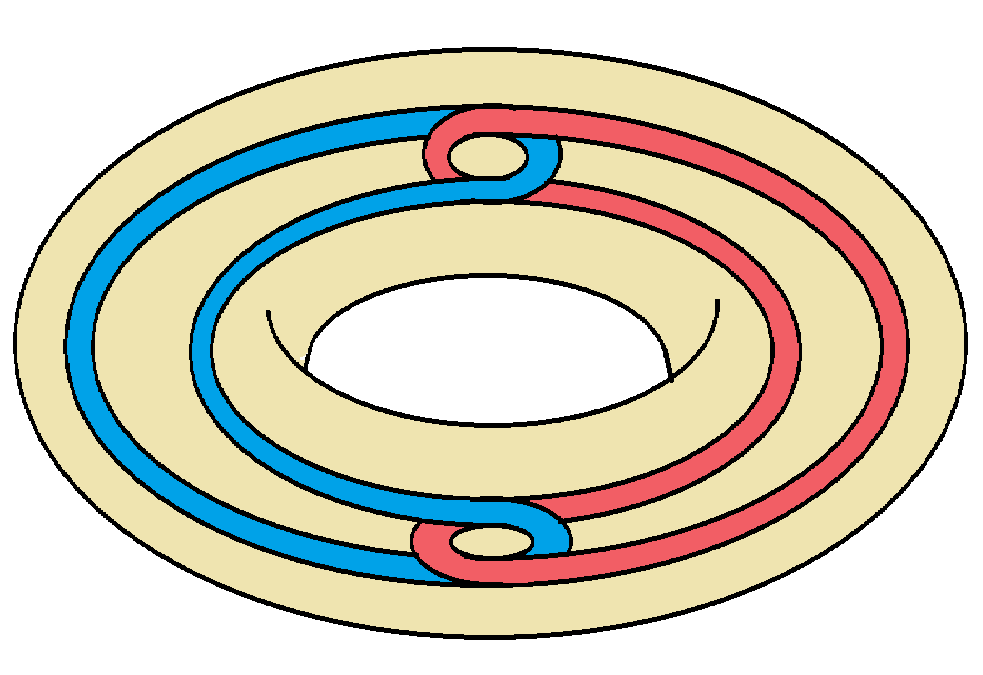
Figure 1: The solid tori m4 (blue and red) linked inside m5, as used in the Bing-type constructions for pathological spheres.
This result underscores the critical role of combinatorial curvature in determining both the analytic and geometric structure of high-dimensional sets.
The relationships between these geometric quantities critically inform questions of uniformization and parametrization. In dimension 2, LLC and Ahlfors regularity suffice for quasisymmetric parametrization of 2-spheres, but higher-dimensional analogues are much more subtle. The criteria developed in this paper allow for new sufficient conditions for parametrizability (bi-Lipschitz or quasisymmetric) via discrete curvature integrals rather than only via local flatness or topological assumptions.
Furthermore, the results yield an upgrade of previous unilateral flatness control to bilateral estimates for images of quasisymmetries (quasiplanes) in all codimensions—solving a notable open extension from codimension one to higher codimensions and influencing the theory of quasiconformal geometry in metric spaces.
Special Case: 1-Manifolds and the Linear Approximation Property
For m6, the paper provides a complete solution, showing that for topological circles in m7, uniform smallness of beta numbers implies small theta numbers quantitatively. The argument employs local geometric connectivity and topological properties to establish the LLC property, and hence quantitative improvements in the comparability of flatness indicators. This resolves a specific open question for 1-manifolds and suggests how the full theory might further advance in higher dimensions.
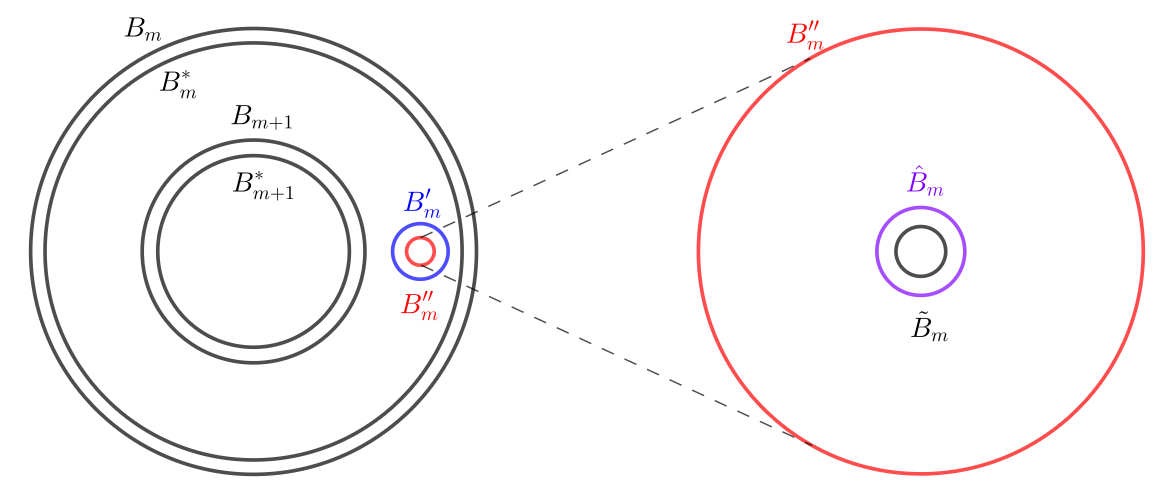
Figure 2: Illustrative nested balls m8 used in the construction and measure estimates for pathological examples.
Theoretical and Practical Implications
The results unify several threads in geometric measure theory and analysis, including parametrization theorems (Reifenberg, Jones' TST), curvature-based rectifiability, and the classification of quasisymmetric spheres and spaces. The establishment of sharp thresholds for curvature energy strengthens the foundation of regularity theory for metric and analytic geometries and sets new benchmarks for the role of discrete curvature in structure theorems.
On a practical front, this work stipulates concrete criteria (in terms of Menger energy, flatness indices, and LLC) for algorithmic and analytic recognition of rectifiable sets and regular manifolds, with potential applications in computational geometry, imaging, and the analysis of rough spaces.
Outlook and Future Directions
Open problems remain—most notably, the necessity of the LLC assumption for the equivalence between beta and theta numbers in dimensions m9, and the full characterization of the critical case Rn0. Clarifying these thresholds would further resolve long-standing uniformization and parametrization questions in geometric function theory. The combinatorial and curvature-based perspectives introduced here will likely inform future developments in higher-dimensional quasiconformal analysis and the geometric study of metric measure spaces.
Conclusion
This paper rigorously relates unilateral and bilateral flatness for LLC manifolds, identifies sharp Menger energy regularity thresholds for Rn1 structure and bi-Lipschitz parametrizability, and demonstrates the topological and geometric sources of these phenomena. The results both consolidate and sharpen the theoretical landscape at the interface of discrete curvature, quantitative rectifiability, and geometric function theory, while opening avenues for further research into the fine structure of singular metric spaces.
(2606.14013)

