- The paper presents a unified convex-geometric approach by defining decision tree splits using Bregman divergences, subsuming classical impurity measures.
- Empirical evaluations demonstrate that Bregman Trees often outperform standard CART, with notable improvements in deviance measures and mean squared error under diverse distributions.
- The framework offers robust theoretical guarantees, including nonnegative split gain, consistency, and explicit lower bounds, which enhance model interpretability and selection.
A Unified Convex-Geometric Framework for Decision Trees: Bregman Divergences in Recursive Partitioning
Introduction
The proposition of decision trees as a nonparametric, interpretable tool for statistical learning is well-established through the influential CART methodology. However, impurity criteria in classical tree algorithms are traditionally selected in an ad hoc, model-specific fashion, lacking a unified principled foundation. The framework developed in "A General Framework for Decision Trees via Bregman Divergences" (2606.13984) addresses this limitation by systematically generalizing impurity measures in tree-based learning to the family of Bregman divergences—a class of statistical discrepancies underpinned by convex analysis and deeply connected to exponential family models. This establishes an invariant geometric and analytic basis, providing rich theoretical links, practical implications in terms of model adaptation, and empirical advantages.
Bregman Divergences: Convex Analytic Foundation
Bregman divergences, defined from strictly convex, differentiable generators ψ, encapsulate many key loss functions: squared error, Kullback–Leibler, Poisson, Itakura–Saito, etc. Specifically:
Dψ(x,y)=ψ(x)−ψ(y)−⟨∇ψ(y),x−y⟩
For ψ(x)=x2, Dψ reduces to the Euclidean distance; for ψ(p)=∑ipilogpi, it yields the KL divergence. The geometry is visualized by the gap between the function and its tangent at a reference, as illustrated for both quadratic and Poisson cases.
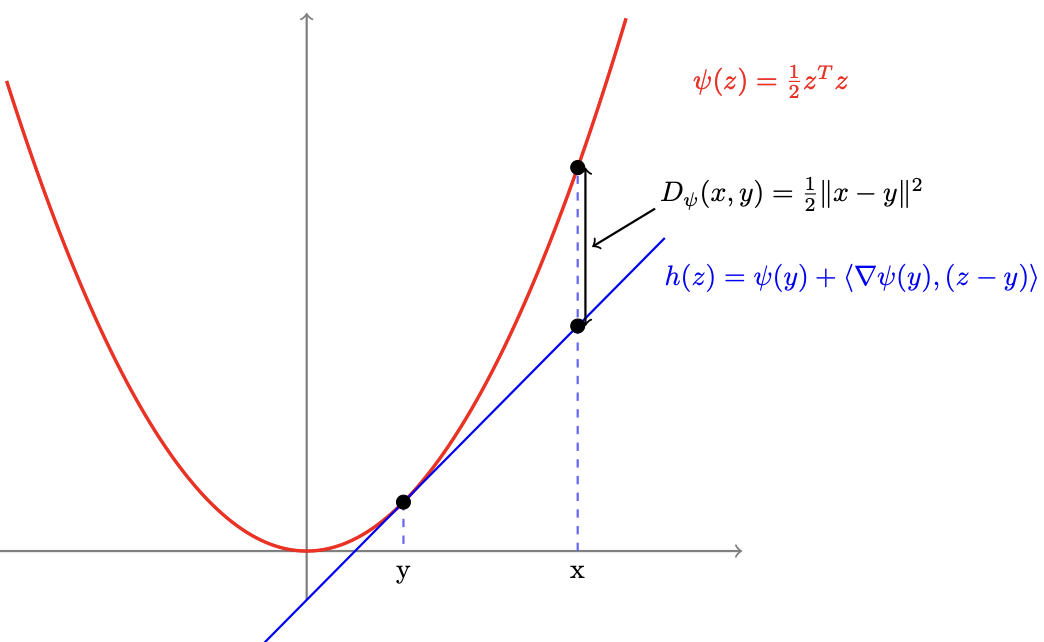
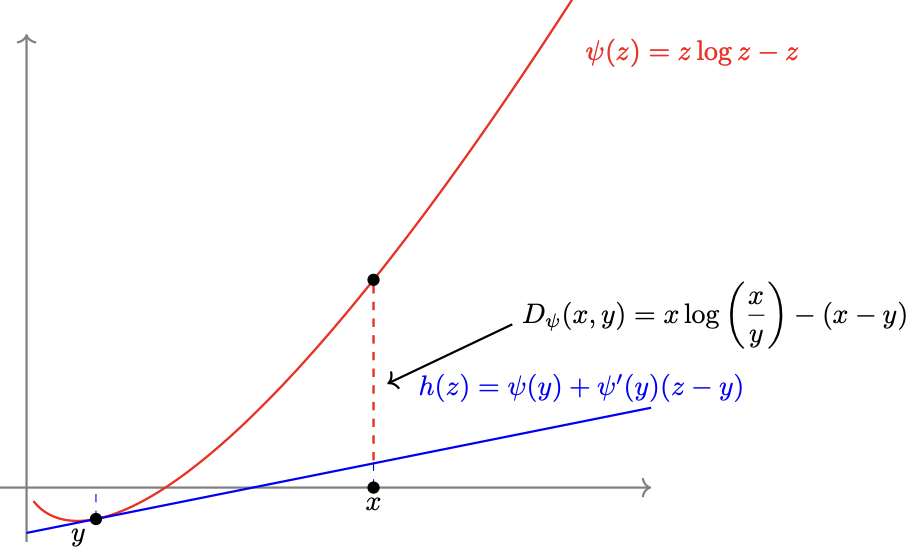
Figure 1: Examples of Bregman divergences—quadratic (left), Poisson (right)—visualized as the gap between a convex function and its tangent at the reference.
Crucially, Bregman divergences do not require symmetry or the triangle inequality, but they are always non-negative and zero iff arguments coincide. From a probabilistic perspective, Bregman divergences naturally align with maximum likelihood estimation in exponential family models.
These divergences are fundamentally linked to Legendre convex conjugacy. The convex conjugate ψ∗ plays a central role in expressing dual parameterizations (natural vs mean), with Dψ∗(x,y) providing the divergence in the mean-parameter space. Figure 2 outlines the mechanics of the Legendre transform.
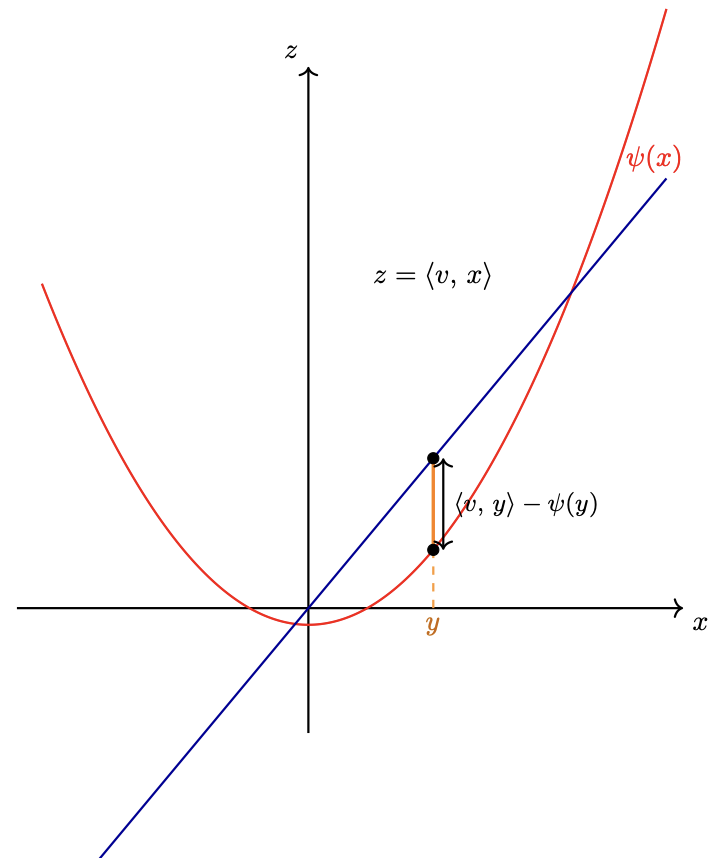
Figure 2: Convex Legendre conjugate, mapping the graph of ψ to its dual via supremizing over affine shifts.
Decision Trees and Bregman Divergences
Classical decision tree impurities—Gini, entropy, variance—have latent interpretations as Bregman divergences, but previous algorithms instantiated these in an uncoordinated manner. The present framework elevates Bregman divergence as the primitive impurity, and thus the split gain at every node is interpreted as the Jensen gap:
Δϕ(t)=pLDϕ(μL,μt)+pRDϕ(μR,μt)
where ϕ=ψ∗ is the convex generator, and Dψ(x,y)=ψ(x)−ψ(y)−⟨∇ψ(y),x−y⟩0, Dψ(x,y)=ψ(x)−ψ(y)−⟨∇ψ(y),x−y⟩1, Dψ(x,y)=ψ(x)−ψ(y)−⟨∇ψ(y),x−y⟩2 are the (possibly multi-dimensional) means within the parent and each child, weighted by cardinalities.
This perspective unifies existing impurity criteria as follows:
- Variance reduction is induced by Dψ(x,y)=ψ(x)−ψ(y)−⟨∇ψ(y),x−y⟩3, yielding classical ANOVA splitting.
- Cross-entropy/entropy is generated by Dψ(x,y)=ψ(x)−ψ(y)−⟨∇ψ(y),x−y⟩4.
- Poisson deviance corresponds to Dψ(x,y)=ψ(x)−ψ(y)−⟨∇ψ(y),x−y⟩5.
The framework is therefore inherently compatible with any exponential family for which the canonical link is available, as the divergence and impurity are defined by the Legendre duals of the cumulant function (Dψ(x,y)=ψ(x)−ψ(y)−⟨∇ψ(y),x−y⟩6).
Theoretical Properties of Bregman Trees
The paper establishes several kernel theoretical results:
- Split Gain Nonnegativity and Lower Bound: For any split, impurity reduction is always non-negative by convexity of Dψ(x,y)=ψ(x)−ψ(y)−⟨∇ψ(y),x−y⟩7. Moreover, if Dψ(x,y)=ψ(x)−ψ(y)−⟨∇ψ(y),x−y⟩8 is Dψ(x,y)=ψ(x)−ψ(y)−⟨∇ψ(y),x−y⟩9-strongly convex, the gain is lower-bounded by the squared norm of the child means' separation:
ψ(x)=x20
- Jensen Gap Characterization: The impurity reduction for a split is precisely the Jensen gap of ψ(x)=x21 evaluated on the mixture of child means, giving a variational interpretation of split optimality.
- Consistency: Under additional assumptions on the smoothness of ψ(x)=x22 and the shrinking of node diameters, the Bregman tree estimator is universally risk-consistent in the sense that the Bregman excess risk vanishes, i.e.,
ψ(x)=x23
where the population risk is defined via the mean Bregman divergence between predictions and true conditional response.
These properties generalize classical results for tree regressors to arbitrary convex geometry, governed by the chosen Bregman divergence.
Empirical Evaluation and Numerical Results
The framework is empirically validated via comprehensive simulation studies spanning Exponential, Gamma, Inverse Gaussian, Poisson, and Gaussian generative models. The protocol contrasts standard CART (using quadratic loss or Poisson deviance) with Bregman Trees tailor-adapted to the data's exponential family by selecting the corresponding divergence as the impurity.
- On the Exponential and Gamma models, Bregman Trees (using the Itakura–Saito divergence) yield substantive improvements in both distribution-appropriate deviance and MSE, e.g., reducing mean IS deviance by approximately ψ(x)=x24 and ψ(x)=x25, respectively, while also outperforming standard CART on MSE despite not optimizing for it directly.
- Advantage under the Inverse Gaussian (using its canonical divergence) is moderate, reflecting increased tail risk.
- As a negative control, on Poisson and Gaussian data where the classical CART and Bregman Tree optimize the exact same criterion, no significant differences are observed, confirming theoretical predictions.
Results are succinctly captured in box plots contrasting empirical distributions of deviance and MSE for both methods:
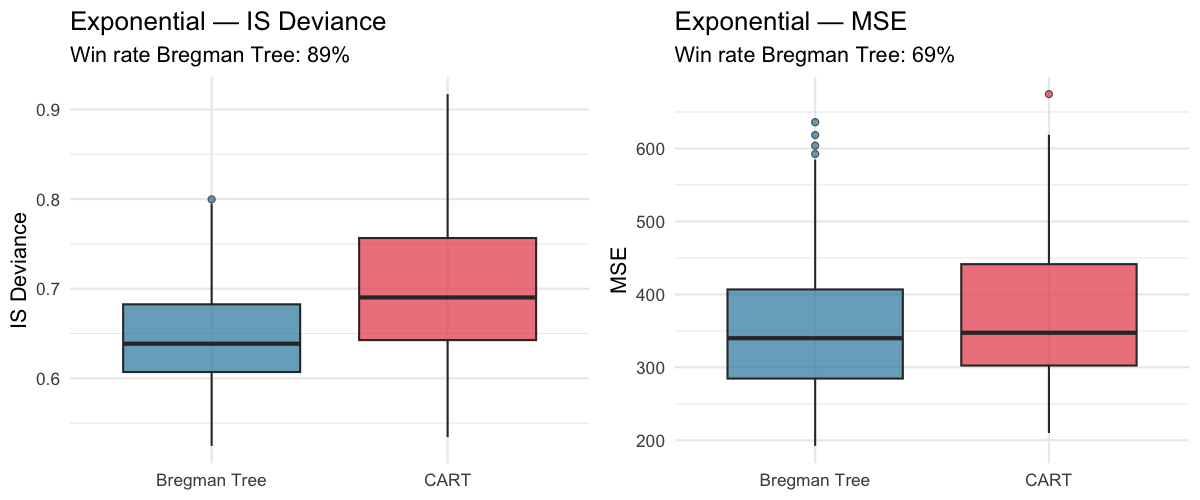
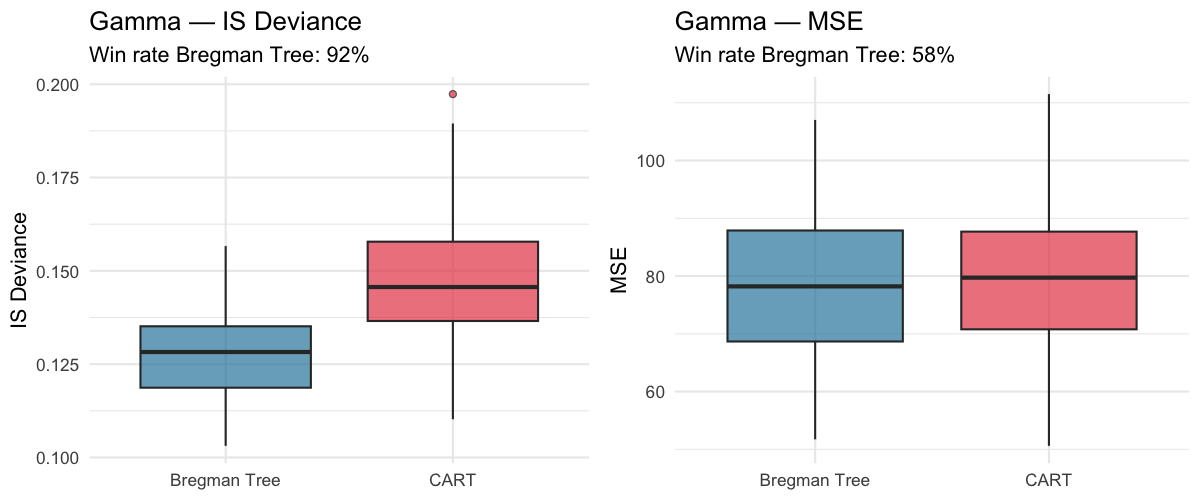
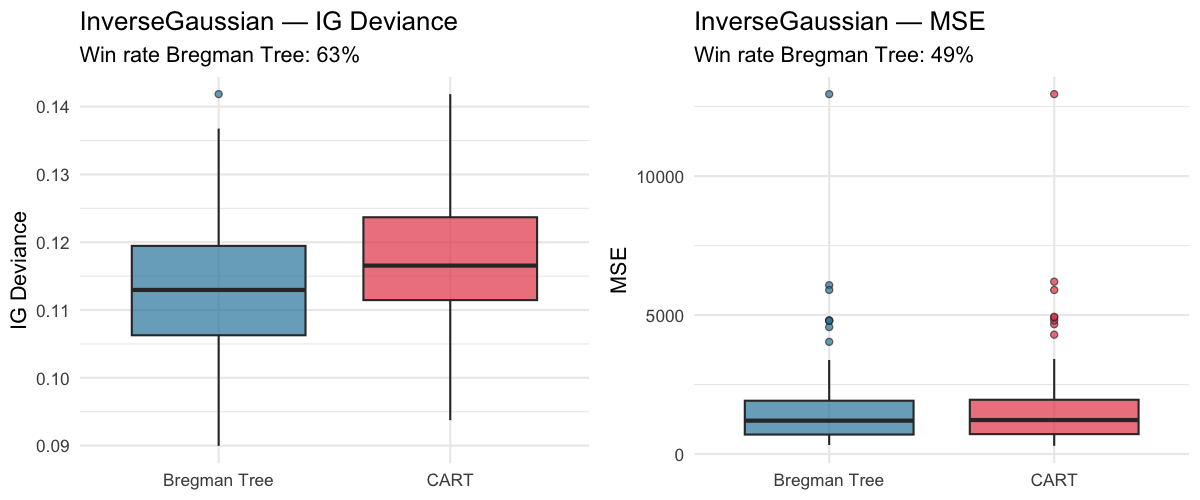
Figure 3: Empirical distribution of test deviance and MSE for Exponential data; Bregman Trees consistently yield lower IS deviance.
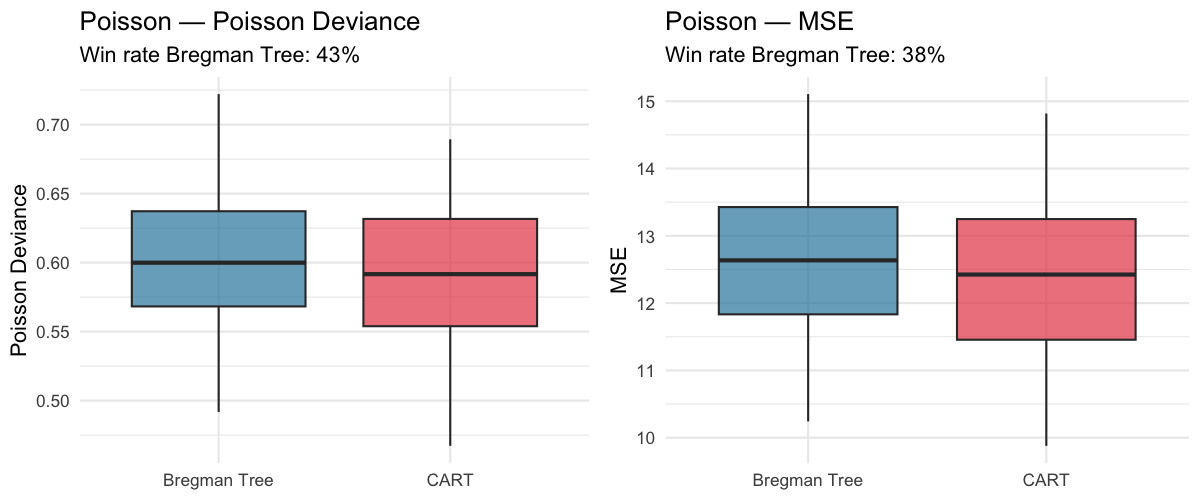
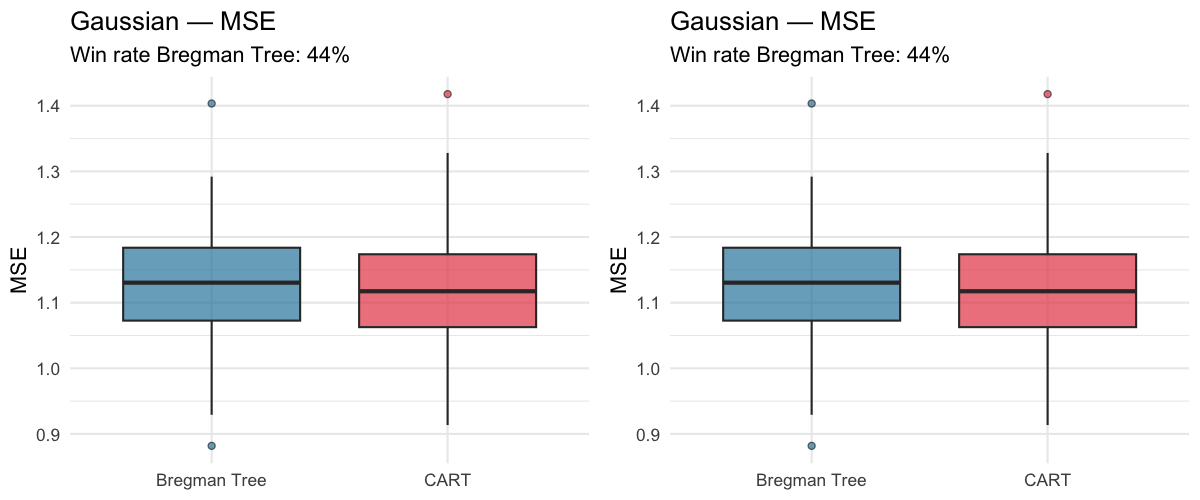
Figure 4: Empirical results on the Poisson setting, where both algorithms coincide in loss, demonstrating nearly identical performance.
Application to the real-world insurance cost dataset further corroborates the framework. The Bregman Tree, optimizing the Gamma-appropriate IS divergence, yields the lowest out-of-sample IS deviance among all models evaluated, and offers a favorable trade-off between parsimony (number of leaves) and predictive accuracy across three metrics (IS deviance, Poisson deviance, MSE).
Implications and Future Directions
The Bregman Tree methodology enables principled adaptation of decision trees to the statistical geometry induced by the data's generative process—especially crucial for distributions with non-constant variance or asymmetric error, e.g., Gamma, Exponential, or Inverse Gaussian outcomes. This generalization subsumes classical variants as special cases and offers flexibility for new loss functions as novel data modalities arise. The explicit dependence of split gain and risk behavior on the generator’s convexity and smoothness facilitates precise theoretical characterization, such as convergence rates and stability analysis.
Future research directions opened by this framework include (i) formal convergence rates beyond consistency, (ii) extension to classification with non-standard impurity, (iii) ensemble models (random forests, boosting) using non-Euclidean divergences as aggregation criteria, and (iv) integration with optimal transport tools exploiting the Bregman-Wasserstein metric. The approach could also augment model selection procedures and foster interpretability in complex models by aligning impurity with inferential or operational objectives.
Conclusion
A fully general framework for decision tree construction via Bregman divergences is established, unifying diverse impurity measures, providing geometric and statistical insight, and delivering empirical gains—particularly under model misspecification—when classical CART is inapplicable. The proposed formalism resolves longstanding ad hoc choices in impurity selection and grounds all splitting and pruning procedures in convex geometric principles, thereby extending the scope and robustness of tree-based statistical learning.

