- The paper introduces a novel hierarchical formulation for Einstein-Maxwell equations coupled to a charged scalar field in arbitrary n-dimensions.
- It employs affine-null coordinates with auxiliary variables to regularize the equations near horizons and facilitate well-posed initial-boundary value problems.
- The approach recovers higher-dimensional Reissner-Nordström-Tangherlini solutions and enhances numerical studies of gravitational collapse and black hole mechanics.
Introduction and Motivation
This work develops a hierarchical characteristic formulation for the Einstein-Maxwell equations minimally coupled to a charged, complex, massless scalar field in arbitrary spacetime dimension n≥3, under spherical symmetry and using affine-null coordinates. The approach is motivated by the need for coordinate systems that remain regular across horizons and facilitate the formulation of well-posed characteristic initial-boundary value problems (CIBVPs), with direct relevance to problems involving gravitational collapse, black hole interiors, and the behavior of fields near null infinity.
Traditional characteristic Einstein equations in Bondi-Sachs form exploit the causal nature of null hypersurfaces but face limitations when using the areal radius as the radial coordinate, especially near trapped or marginally trapped surfaces where the coordinates become singular. The affine-null formulation resolves this by using an affine parameter along outgoing (or ingoing) null geodesics, which remains regular even where the outgoing expansion vanishes. However, in affine-null coordinates, key radial hierarchies in the field equations are not manifest without the introduction of auxiliary variables to absorb problematic derivatives.
This paper extends previous four-dimensional treatments to generic n-dimensional spacetimes, developing a robust, hierarchical system for evolving self-gravitating, charged scalar fields, and explicitly recovers the higher-dimensional Reissner-Nordström-Tangherlini (RNT) solutions, thereby confirming consistency. The framework is positioned for future applications that include studies of higher-dimensional critical collapse, the approach to extremal horizons, violations of the third law of black hole mechanics, and new classes of geometric diagnostics relevant to universal behavior in gravitational dynamics.
Construction of the Affine-Null Hierarchy
The field content includes the n-dimensional Einstein-Hilbert term, a Maxwell field, and a charged, complex massless scalar. Spherical symmetry implies that all dynamical variables depend only on two coordinates: a null coordinate w and an affine parameter λ, with the latter serving as the radial variable.
The affine-null metric takes the form
ds2=−V(w,λ)dw2+2ϵdwdλ+r2(w,λ)qABdxAdxB
where ϵ=±1 selects outgoing or ingoing null hypersurfaces and qAB is the metric of the unit (n−2)-sphere.
The Maxwell sector is implemented in a gauge with vanishing Aλ, reducing the dynamical component to n0.
The full Einstein-Maxwell-scalar system reduces under symmetry, yielding a set of PDEs involving derivatives of n1, and their conjugates. Integration difficulties arising from cross-derivatives (e.g., appearance of n2 in equations that would otherwise be pure radial ODEs) are circumvented by introducing the auxiliary fields:
- n3 (radial charge),
- n4 (combining n5 and n6 into a regular variable), and
- n7 (a field capturing scalar-matter derivatives).
The result is a strictly hierarchical set:
- n8 — areal radius propagation,
- n9 — radial evolution of charge,
- n0 — evolution of gauge potential,
- n1 — auxiliary variable for metric regularity,
- n2 — combination of matter and metric,
- n3 — final closure for the metric coefficient.
Once these variables are known on a given null hypersurface, the (fully first-order) scalar field transport equation advances n4 to the next hypersurface.
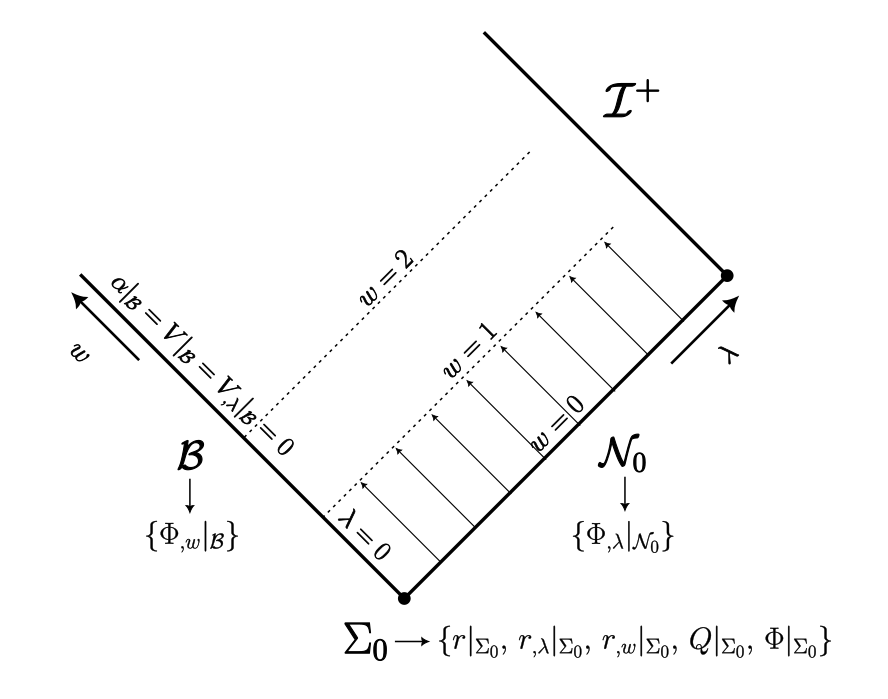
Figure 1: Initial data on the bifurcation sphere n5 and on the null hypersurfaces n6 and n7 for the case n8.
Initial-Boundary Value Problems and Asymptotics
Asymptotic Null Infinity
Regular asymptotic expansions are derived for all fields in Bondi gauge, allowing for identification of the Bondi mass, charge, and the radiative degrees of freedom (scalar monopole and news function) intrinsically in n9 dimensions. The asymptotic expansions enable direct extraction of invariant quantities:
- Total charge w0,
- Bondi mass w1,
- Scalar monopole w2,
- Scalar news function w3.
Balance laws at null infinity are obtained: w4
which enforce energy and charge conservation in the presence of scalar radiation. These reduce to energy loss (mass decrease) and charge flux relations familiar from 4D Bondi-Sachs theory, appropriately generalized to w5 dimensions and to the charged scalar case.
Local Analysis: Vertex and Null-Boundary Problems
Near the center (w6), regularity enforces specific leading behavior on all variables. The hierarchy enables a systematic perturbative solution near the vertex, determining all fields order-by-order from the Taylor expansion of the scalar field and the gauge potential.
In the null-boundary context, the hierarchy efficiently propagates and constrains data posed on the intersection of two null hypersurfaces, capturing the interplay between boundary values, radial integration, and the update via the transported matter degrees of freedom. The approach unifies treatment of boundaries at finite location, at the regular center, or at null infinity.
Reissner-Nordström-Tangherlini Solutions: Non-Extremal and Extremal Branches
As a stringent check, the scalar-free reduction of the hierarchy yields all branches of the w7-dimensional RNT solution in affine-null form. Both non-extremal and extremal limits are handled explicitly, including cases with zero and non-zero surface gravity. For example, in the non-extremal branch, with suitable boundary and initial data,
w8
w9
where λ0 is the effective potential with charge and cosmological terms, and all other fields (Maxwell, auxiliary) are constructed via exact integration of the hierarchy.
The extremal limit is not obtained by naive surface gravity zero limit; rather, it requires independent integration in the hierarchy adapted to the degenerate case, reflecting subtle geometric and analytic distinctions that are only manifest in the affine-null formalism.
Implications and Theoretical Developments
This framework has multifaceted implications:
- Numerical relativity and collapse studies: The regularity at trapped regions and across apparent horizons enables stable characteristic evolution through black hole formation, necessary for probing critical phenomena (e.g., Choptuik scaling, universality, higher-dimensional exponents).
- Analysis of black hole mechanics: The approach permits precise tracking of the approach to extremality, providing a controlled setting for investigations into the validity or violation of the third law (no finite-time formation of extremal black holes), and for the study of horizon structure in dynamical spacetimes.
- Asymptotic structure and balance laws: The hierarchy's compatibility with regular expansions at null infinity permits extraction of radiative fluxes, Bondi mass loss, and charge dynamics, confirming and extending analytic predictions in higher dimensions.
- Extension to mass terms and other matter models: The structure is robust under the introduction of mass terms and more general field content, with only minor modifications in the auxiliary hierarchy.
- Conformal compactification and critical geometry: While conformal affine-null completions have subtle obstacles in λ1, this formulation is a natural launching point for generalizations studying conformal boundaries and universal geometric diagnostics such as the "NEC angle".
Conclusion
The hierarchical affine-null approach developed systematically organizes the Einstein-Maxwell-charged scalar field system in arbitrary dimension into a tractable system well-suited for both analytic studies and numerical evolution. Explicit connections to invariant masses, charges, and scalar radiative data are made precise. The framework's capacity to handle black hole formation—including extremal limits, null infinity, and horizon crossing—provides essential tools for ongoing theoretical and computational research in higher-dimensional general relativity, critical collapse, and the dynamical behavior of matter-gravity systems. These developments set the stage for future work on conformal completions, universality in gravitational collapse, and violations of classical black hole mechanical laws.

