- The paper demonstrates that the thermal scalar’s temperature-dependent mass creates distinct sub-, critical, and super-Hagedorn regimes, critically influencing cosmological dynamics.
- It employs a gravi-dilaton effective action to reveal a bifurcated phase space with the (+) branch leading to pre-big bang behavior and the (–) branch aligning with standard FLRW cosmology.
- The analysis concludes that quadratic truncations fail to provide a graceful Hagedorn exit, underscoring the need for quartic interactions and explicit winding-number violations.
Cosmological Dynamics of the Thermal Scalar Near the Hagedorn Temperature
Introduction
The study investigates the dynamical role of the thermal scalar in string cosmology near the Hagedorn temperature, utilizing the low-energy gravi-dilaton effective action coupled to this winding-string mode. The motivation includes addressing the Hagedorn exit problem—specifically, the inability to connect the quasi-static Hagedorn regime to a standard FLRW cosmological evolution within the standard quadratic effective theory. Building upon the frameworks established by Atick-Witten and Horowitz-Polchinski, the analysis employs the thermal scalar with temperature-dependent mass to map out the cosmological phase-space structure in three distinct regimes: sub-Hagedorn, critical, and super-Hagedorn.
Gravi-Dilaton Cosmology and Branch Structure
The gravi-dilaton system yields two dynamically disconnected branches in phase space, distinguished by the sign of the shifted dilaton velocity, φ˙=ϕ˙−dλ˙. This dichotomy, first formalized in [Kaloper, Watson], is robust when the (string-frame) matter energy density is non-negative. The (+) branch supports growing string coupling and leads to a future singularity, corresponding to a pre-big bang or “lingering” phase, while the (−) branch includes standard post-Hagedorn FLRW cosmologies. Transitions between branches require violations of the null energy condition (NEC) or negative energy density contributions, which are typically absent in basic string gas models. This branch structure is essential in classifying the allowed cosmological trajectories and constrains the permissible dynamical mechanisms for a Hagedorn exit.
The thermal scalar χ, encapsulating the lowest-energy winding mode on the Euclidean thermal circle, is introduced as a complex scalar field with mass parameter μ2(β) that interpolates across the Hagedorn transition:
μ2(β)=(β2−βH2)/(2πα′)2
where β=1/T and TH is the Hagedorn temperature. The field-theoretic status of χ is subtle: while not a physical propagating field in Lorentzian signature, its effective description captures the dominant critical thermodynamics of highly excited strings.
By coupling χ (and the dilaton (+)0) to the string-frame action, the equations of motion define the allowed region of phase space for the system. The Hamiltonian constraint restricts trajectories to
(+)1
with the boundary (+)2 corresponding to static (or “lingering”) configurations.
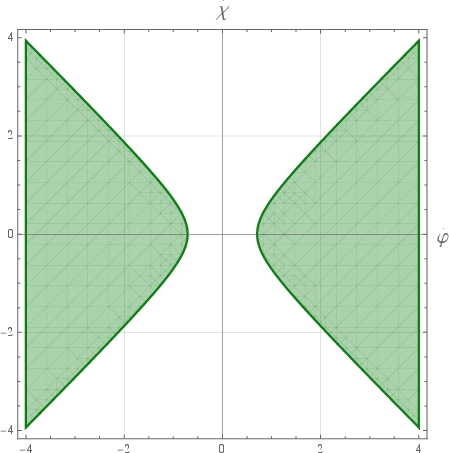
Figure 1: Allowed region of phase space in (+)3; the boundary marks (+)4 (static solutions), demarcating physically admissible initial conditions.
Phase Space Dynamics Across the Hagedorn Transition
The phase-space analysis in the (+)5 plane reveals distinct structures below, at, and above the Hagedorn temperature due to the variation of the thermal scalar mass (+)6:
Below Hagedorn ((+)7)
In the regime (+)8, two fixed points exist at (+)9, corresponding to static cosmological configurations where the energy density and pressure from (−)0 balance the gravi-dilaton background.
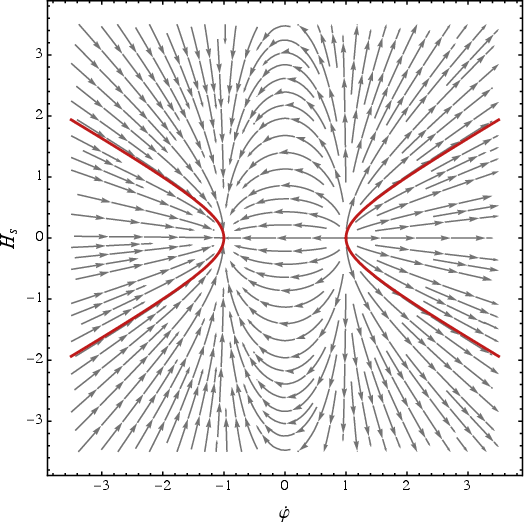
Figure 2: Phase portrait in (−)1 for (−)2, (−)3; fixed points at (−)4 with static solutions along the constraint curve.
The effective pressure term (−)5 determines the backreaction of winding modes. For (−)6 growing with the scale factor, this term opposes expansion, in agreement with the classical thermodynamic interpretation of winding-mode-induced contraction. Numerical solutions further demonstrate that the back-reaction generically reverses expansion and drives the universe into a phase of increasing curvature in the (−)7 branch:
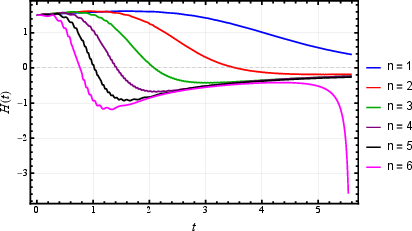
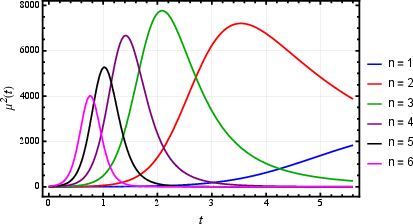
Figure 3: Hubble rate (−)8 for increasing steepness in (−)9 (χ0); winding-mode back-reaction reverses initial expansion, pushing the cosmology toward strong curvature regimes.
The phase space admits static “lingering” solutions, but these are boundary states and not attractors. Dynamical attraction toward a sustained expanding phase is absent; the system instead flows toward high-curvature (strong χ1 corrections), where the low-energy approximation fails.
Above Hagedorn (χ2)
In the tachyonic regime, the energy density associated with χ3 turns negative for small enough χ4. The constraint curves become hyperbolas that never intersect χ5:
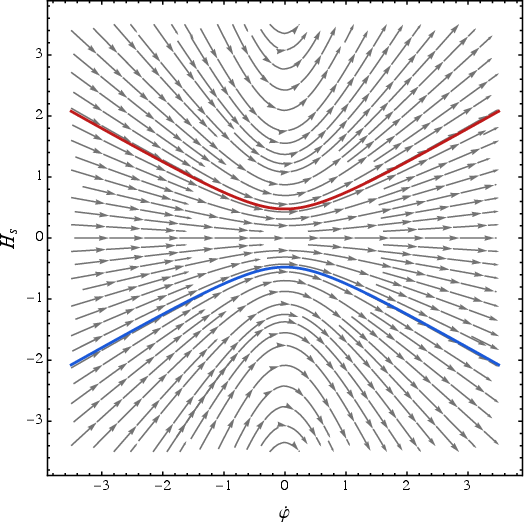
Figure 4: Phase portrait in χ6 for χ7; constraint curves do not reach χ8, allowing for branch-changing trajectories that remain entirely within the physical region.
The evolution allows for branch change (from χ9 to μ2(β)0) without NEC violation, an explicit realization of the Brustein-Veneziano mechanism with negative energy density. Analytically, for μ2(β)1, the crossing occurs over a time interval μ2(β)2, diverging as μ2(β)3. Notably, all such transitions proceed in the “wrong” direction—i.e., they do not solve the Hagedorn exit problem, which requires a μ2(β)4 change for a graceful connection to standard cosmology.
At Hagedorn (μ2(β)5)
At the critical point, the fixed points collapse to the origin and the quadratic effective theory loses predictivity as quartic terms, neglected at quadratic order, become significant.
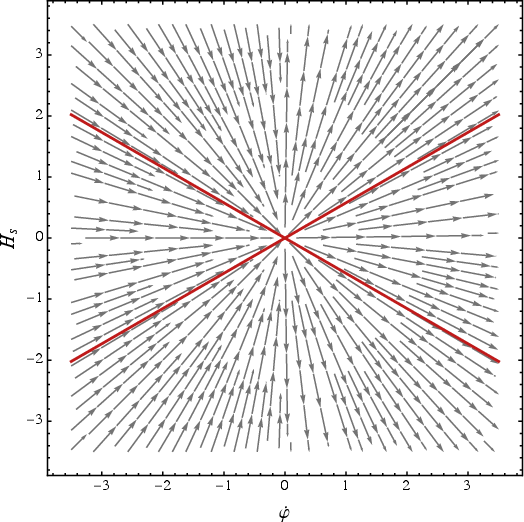
Figure 5: Phase portrait in μ2(β)6 at μ2(β)7; fixed points merge at the origin, which acts as a degenerate saddle for all trajectories with μ2(β)8.
The breakdown of the effective description at μ2(β)9 reflects the need for a full quartic (and higher order) effective field theory, as well as the intrinsic limitations of real-time modeling with the thermal scalar, which arises as a Euclidean order parameter.
Momentum Modes and Interaction Structure
A parallel light mode for momentum is not available: for the relevant string spectrum, the lowest momentum mode is tachyonic at μ2(β)=(β2−βH2)/(2πα′)20 unless a bosonic tachyon is present. Even if a momentum partner (μ2(β)=(β2−βH2)/(2πα′)21 mode) becomes massless at μ2(β)=(β2−βH2)/(2πα′)22, as in the construction of Brustein-Zigdon, it couples to μ2(β)=(β2−βH2)/(2πα′)23 only at quartic order (μ2(β)=(β2−βH2)/(2πα′)24), and thus is dynamically decoupled at quadratic order. The full exit mechanism—e.g., annihilation of winding into momentum modes and loops—requires these higher-order terms and explicit winding-number violation, which are forbidden in the quadratic truncation.
Theoretical Implications
The analysis clarifies foundational obstructions to a dynamical Hagedorn exit:
- Below μ2(β)=(β2−βH2)/(2πα′)25, winding-mode backreaction strongly resists expansion and leads to contraction, but lingering static configurations are non-attractive boundary states.
- Above μ2(β)=(β2−βH2)/(2πα′)26, negative energy density enables branch changing consistent with the Brustein–Veneziano scenario, but always in the μ2(β)=(β2−βH2)/(2πα′)27 direction, leaving the anthropically relevant μ2(β)=(β2−βH2)/(2πα′)28 transition forbidden.
- At μ2(β)=(β2−βH2)/(2πα′)29, the effective field theory becomes strongly coupled, requiring the inclusion of quartic and higher-order operators, as well as real-time breakdown of the thermal description itself.
No regime within the quadratic theory supports a graceful Hagedorn exit. Only with the full quartic action, which incorporates momentum interactions and explicit winding-number violation, can the transition process be dynamically addressed.
Future Directions
Resolution of the Hagedorn exit problem necessitates:
- Derivation of the scale-factor dependence of β=1/T0 directly from string thermodynamics.
- Dynamical inclusion of quartic and winding-violating terms as in the Brustein-Zigdon formalism.
- Generalization to superstring theories, potentially altering available light degrees of freedom near β=1/T1.
Further work will clarify the domain of validity of effective thermal-scalar models and their real-time cosmological implications.
Conclusion
The coupled gravi-dilaton–thermal scalar analysis provides a comprehensive mapping of cosmological dynamics around the Hagedorn transition within the constraints of the quadratic effective theory. While it elucidates the dynamical structure and highlights each obstruction to a successful Hagedorn exit, it simultaneously demonstrates the insufficiency of any low-order truncation to resolve the exit problem. A proper solution mandates inclusion of winding-momentum interactions, winding-number violation, and strong-coupling effects near β=1/T2, which remain essential open directions for string cosmology.