- The paper establishes a rigorous, nonperturbative connection between temporal glide symmetry and parity-selective sideband conversion in scalar bulk media.
- It details an algebraic framework in time-modulated trilayer waveguides that yields an exact selection rule, suppressing forbidden parity channels to numerical precision.
- FDTD simulations confirm that over 90% of the modal power adheres to the predicted parity allocation, validating the robust modulation and parity mixing observed.
Introduction
Temporal modulation in electromagnetic media provides a powerful suite of levers for frequency conversion, nonreciprocity, and synthetic dimensionality. The paper "Temporal glide symmetry enforces a parity sideband selection rule in scalar bulk media" (2606.13609) establishes an exact, nonperturbative relationship between temporal glide symmetry and parity-resolved mode conversion in time-modulated scalar waveguide structures. Unlike spatial glide operations, which are well-explored in photonic crystals and lead to spectral features like band sticking, temporal glide in scalar bulk scenarios exhibits qualitatively different physics, enforceable as a symmetry selection rule governing the allowed transverse parity of excited sidebands.
Temporal Glide Symmetry: Algebraic Structure and Selection Rule
Temporal glide is a spatio-temporal operation combining spatial reflection with a half-period time translation. In a scalar, time-modulated trilayer waveguide, the relation PzUA=UBPz—where Pz is reflection and UA,B are propagation over first/second half-periods—yields a glide operator Gt=PzUA whose square equals the Floquet evolution operator over one period, Gt2=M. Critically, this operator algebra ties the glide eigenvalue to Floquet multipliers: glide is not an independent symmetry label for band structure, but its presence enforces a harmonic-wise selection rule. For any Floquet eigenstate, the transverse reflection parity of the m-th sideband alternates as (−1)m (up to a state-dependent sign), i.e., Pzϕm=σ(−1)mϕm.
This result is fundamentally distinct from conventional, perturbatively derived coupling selection rules. It applies exactly for arbitrary modulation strength and structure, and does not require tailored spatiotemporal modulation profiles. The implication is that in a finite glide-symmetric modulated region, scattering from an input carrier of fixed transverse parity p can yield output in only the same parity at even sidebands, and only in the opposite parity at odd sidebands; all other channels are symmetry-forbidden and strictly vanish (to numerical precision). This structure is intricate and robust, as opposed to an approximate outcome of engineered phase matching.
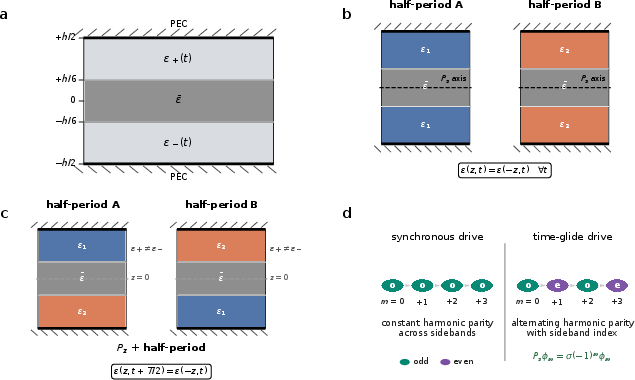
Figure 1: Synchronous modulation preserves parity across sidebands, whereas time-glide enforces an exact alternation of allowable parity between sidebands in a trilayer waveguide.
Static-Parity Hybridization and Modal Perspective
The distinction between synchronous (mirror-symmetric) and glide (reflection + half-period) modulation protocols results in qualitatively different modal structure. Synchronous modulation maintains parity purity across all sidebands, leading to block-diagonal Floquet operators and permitted crossings between branches of opposite static parity.
By contrast, temporal glide destroys static parity conservation at the field level. Floquet eigenmodes are highly hybridized, with a modal entropy SP per eigenstate (quantifying energy fractionalization between even and odd sectors) reaching median values of Pz0 (for TE polarization at moderate modulation contrast and period). Across the entire computed spectral window, parity mixing is of order unity, confirming the profound reorganization induced by the glide protocol.
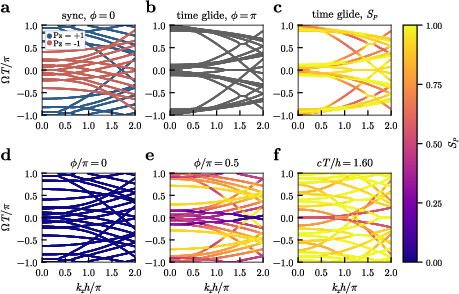
Figure 2: Floquet spectra comparing synchronous versus glide modulation, showing (a) static parity conservation and (c,f) extensive parity mixing (quantified by Pz1) under temporal glide for a range of operation parameters.
Temporal glide's field-level effect is further confirmed by the harmonic-wise violation metric Pz2, which detects non-adherence to the parity alternation rule. At the glide point, violations drop below Pz3 for all tested scenarios, whereas for phase-delays away from symmetry endpoints, violations climb to as high as Pz4 in the median and maximum.
Scattering Signatures and Parity-Selective Conversion
A principal operational consequence is that, in a finite section with global glide symmetry, input modes of definite parity are transformed such that each sideband only projects onto parity sectors strictly dictated by the selection rule: even sidebands retain input parity, odd sidebands switch it. This phenomenon is experimentally robust and spectrally isolated from ordinary phase-matching effects.
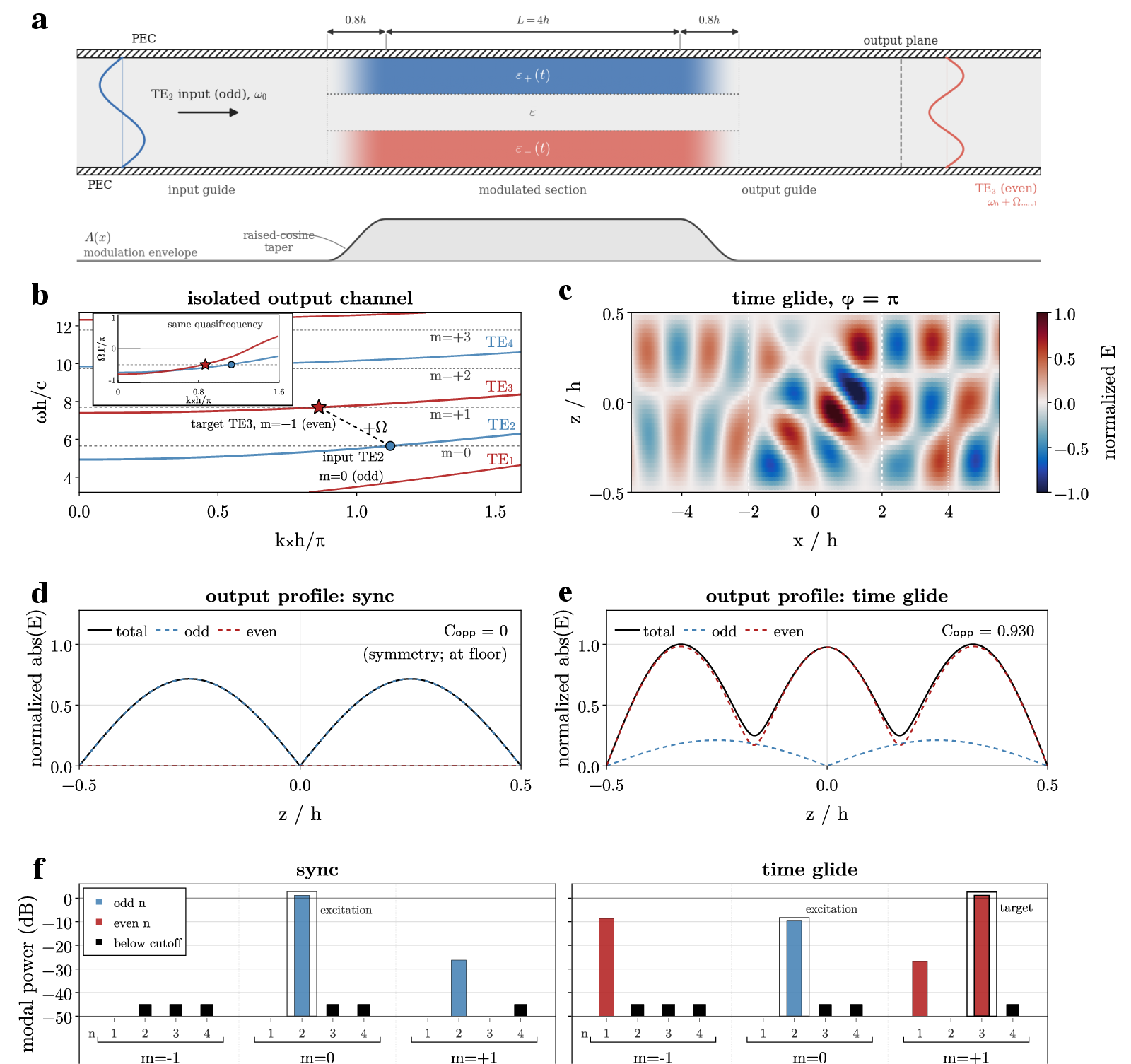
Figure 3: FDTD simulation of a glide-modulated trilayer, showing conversion from an incident odd Pz5 mode to an even Pz6 in the Pz7 sideband; opposite-parity power in forbidden channels is suppressed to the numerical error floor.
Numerical simulations using FDTD validate that for a glide-modulated section designed to convert a Pz8 (odd) mode at Pz9 into a UA,B0 (even) at UA,B1, more than UA,B2 of the generated propagating modal power is allocated as predicted, and the forbidden parity content per sideband (UA,B3) falls below calibrated numerical floor levels (e.g., UA,B4 in these simulations). The effect persists across a range of grid discretizations, ramp protocols, and guide geometries, and is corroborated by independent external solvers.
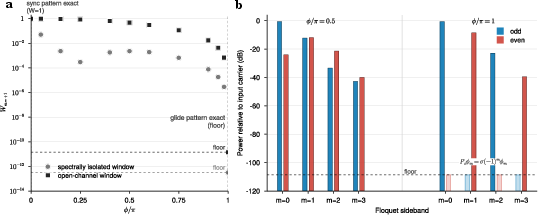
Figure 4: Wrong-parity power fraction UA,B5 versus modulation phase delay; only at exact glide symmetry (UA,B6) does UA,B7 collapse to the numerical floor for both isolated-channel and open-channel cases.
Sweeping the inter-layer phase delay between synchronous and glide endpoints interpolates between exact patterns: only at UA,B8 (the glide point) does the forbidden parity content drop precipitously, confirming symmetry enforcement rather than accidental suppression by phase matching. At intermediate phases, the forbidden sector is significantly populated; only the symmetry drive enforces its strict exclusion.
Experimental Robustness and Design Implications
The signature—nulling of forbidden parity sidebands and alternation of sideband parity—is accessible in experiment via straightforward near-field demodulation and modal decomposition. Realization and detection are feasible in microwave guides utilizing programmable inclusions or transmission-line networks, with tolerance to drive phase imbalances extending to a few degrees or picoseconds in timing. Glide-breaking perturbations, not symmetric losses or tapers, set the practical limits on forbidden-sideband suppression, yielding quadratic dependence of UA,B9 on phase error near the symmetry point.
The prescribed modulation protocol does not require careful tuning of mode-specific coupling strengths; instead, group-symmetry in the temporal protocol guarantees the desired ladder structure. This provides a basis for robust, multi-channel, parity-selective frequency conversion—of direct applicability in synthetic-frequency-dimensional photonics, Floquet engineering, and time-varying microwave circuits.
Outlook and Theoretical Implications
The current results are restricted to scalar modulations of bulk permittivity, where the glide operation ties directly to the physical field without additional internal degrees of freedom. Extensions to vectorial, bianisotropic, or coupled-channel systems (e.g., dual transmission lines, polarization-mixed media, active or nonlocal structures) could realize richer symmetry-protected subspaces, akin to those characterized in full Floquet topological classifications. Generalizing the protocol to order-Gt=PzUA0 operations (not limited to reflection) could enforce more complex modulations on sideband index modulo Gt=PzUA1, useful for synthetic lattice engineering or topological photonic phases in driven systems.
Conclusion
This work rigorously establishes that temporal glide symmetry in scalar bulk media enforces an exact, sideband-dependent parity selection rule for Floquet eigenstates and scattering amplitudes. The effect is robust, quantitative, and symmetry-protected, offering a powerful modality for multi-channel, parity-selective frequency conversion and synthetic spectral engineering. Extensions to coupled or vectorial systems, exploration in photonic and phononic metamaterials, and exploitation for topological or programmable photonic applications are natural directions for further research.