- The paper presents an all-optical, ultrafast method for enantiomer discrimination using UV vector beams through infrared-driven high-harmonic generation.
- It utilizes elliptically polarized IR beams whose topological vector structure is transferred to the harmonics, encoding molecular handedness in spatial and spectral patterns.
- Adjustable parameters like beam waist and ellipticity enable robust chiral sensing in isotropic, randomly oriented gas-phase samples with high enantio-sensitivity.
Ultrafast Optical Discrimination of Chiral Molecules via High-Harmonic Generation with Vector Beams
Introduction
The paper "Ultrafast chiral sensing with an ultraviolet vector beam" (2606.13402) describes a fully all-optical methodology for enantiomer discrimination using topological vector beams in infrared (IR) to drive high-order harmonic generation (HHG) in isotropic ensembles of chiral molecules. This process yields ultraviolet (UV) vector harmonics whose spatial and spectral properties encode the molecular handedness. The presented approach achieves high enantio-sensitivity through purely electric-dipole interactions, rendering the technique robust, ultrafast, and applicable to randomly oriented gas-phase samples, which constitutes a marked contrast to conventional schemes relying on weaker magnetic-dipole effects or requiring molecular alignment.
Theoretical Framework and Experimental Configuration
The method utilizes elliptically polarized IR vector beams, a form of structured light possessing a spatially variant polarization singularity characterized by a nonzero Poincaré index. This macroscopic polarization structure can be mapped to high-order harmonics via the nonperturbative HHG process. The polarization topology is transferred from the driver to the harmonics, manifesting as azimuthally inhomogeneous UV vector beams.
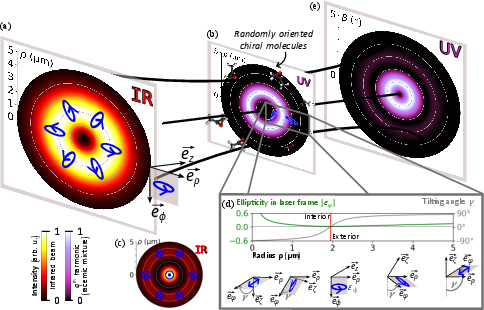
Figure 1: Illustration of ultrafast and topological chiral imaging via HHG: vector beam profile, polarization tilting, and harmonic emission from randomly oriented molecules.
The vectorial structure of the focal IR beam is manipulated through tight focusing, introducing significant longitudinal components (Ez) that tilt the effective polarization plane. This tilt is essential: the chiral component of the molecular polarization (Pζ), orthogonal to the laser polarization, only couples efficiently to the emitted harmonics when the local polarization tilts away from the propagation axis. The interplay between achiral (Pρ, Pφ) and chiral (Pζ) nonlinear polarization projections, and their distinct phase behaviors for each enantiomer, results in characteristic near- and far-field UV intensity patterns (Figure 2).
Quantitative Modeling
Microscopically, time-dependent density functional theory (TDDFT) simulations are performed on single propylene oxide molecules for a set of 208 orientations, enabling orientationally averaged chiral and achiral response extraction. The resulting dipole accelerations explicitly exhibit (i) odd harmonics due to achiral response in the local polarization plane and (ii) enantio-sensitive, even harmonics from the orthogonal chiral response. Scaling these microscopic densities according to the spatial IR field distribution yields the macroscopic nonlinear polarization and, subsequently, the near-field harmonic emission.
Spatial and Spectral Manifestations of Enantio-sensitivity
The main signature of enantiomeric discrimination is the distinct radial dependence of the UV harmonic intensity and phase profiles. In the interaction (near-field) plane, the interference of chiral and achiral channels results in multi-ring patterns, with the dominant ring position switching between L- and R-enantiomers. Upon propagation to the detection (far-field) plane, these features persist but are radially redistributed, allowing robust spatial filtering or imaging.
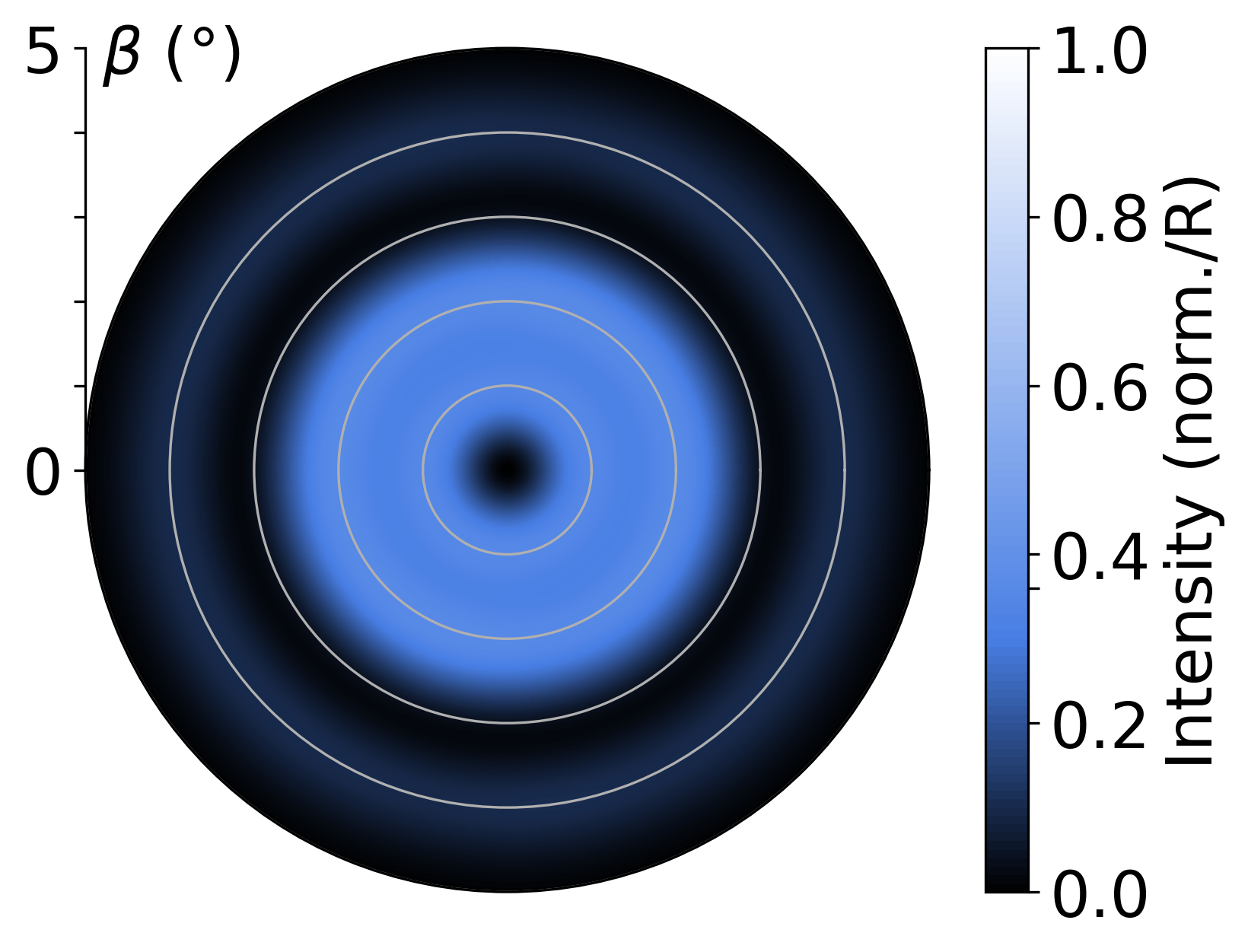
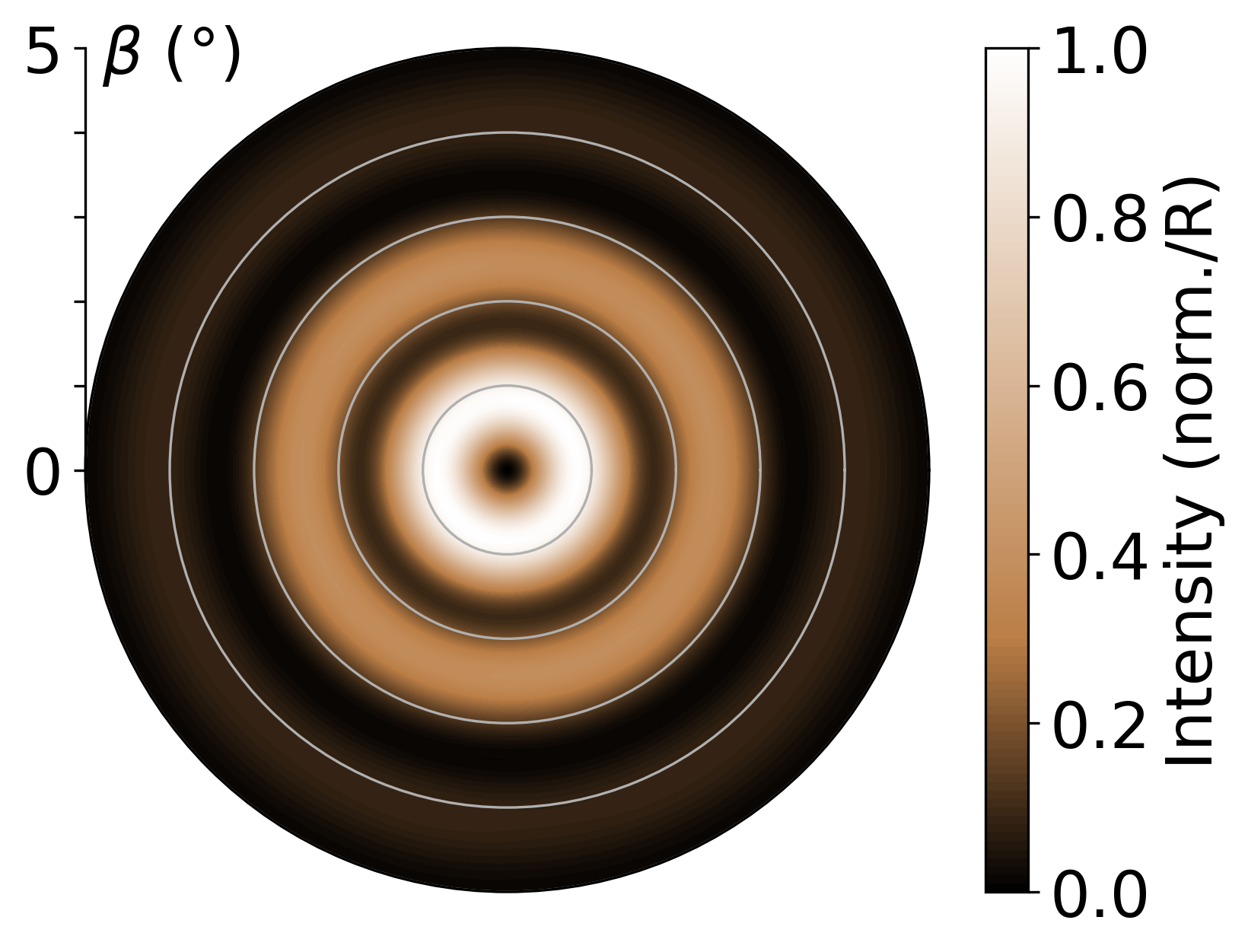
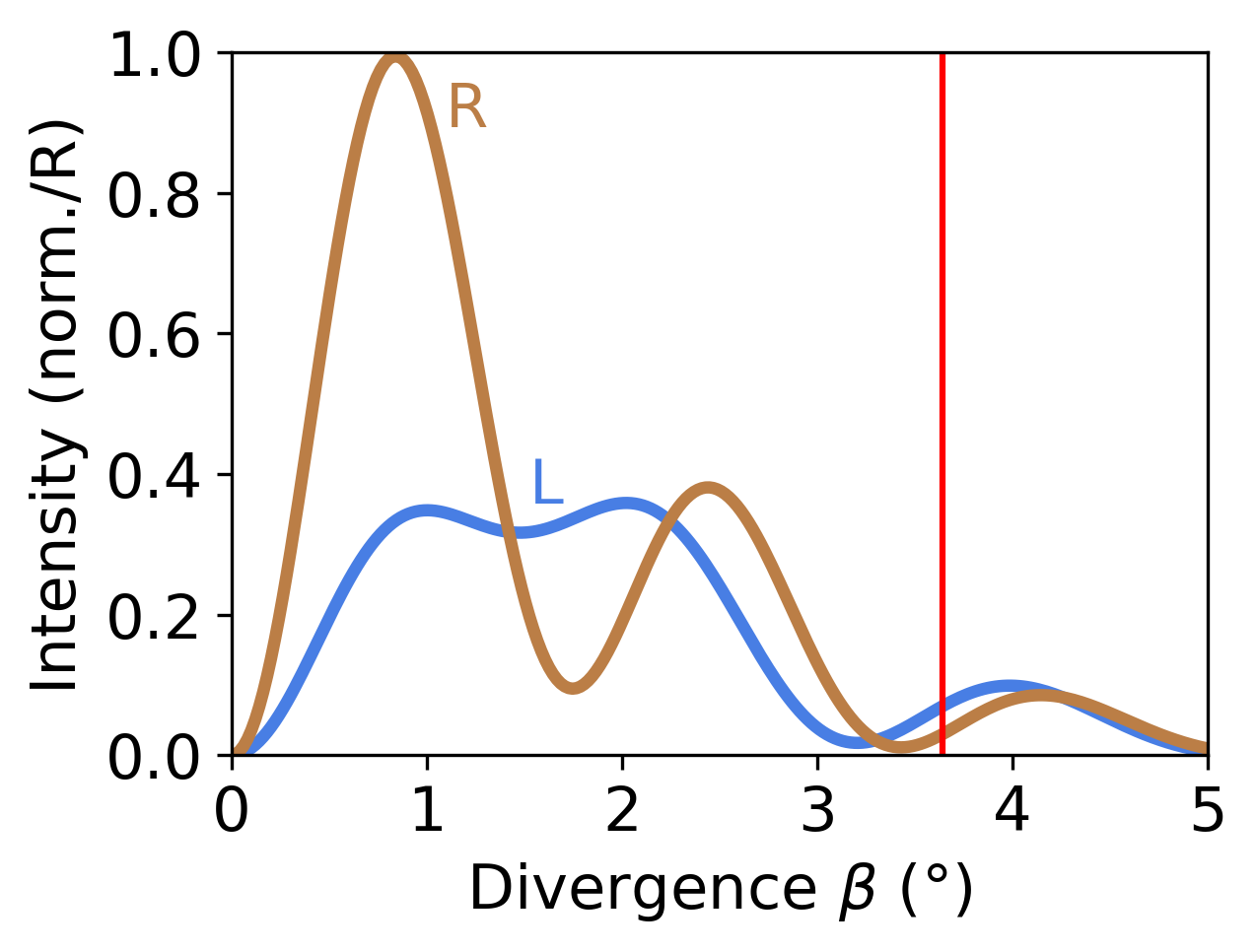
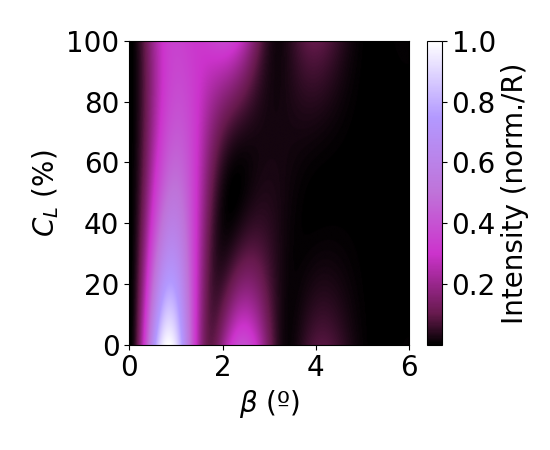
Figure 2: Transverse far-field profiles of the 6\textsuperscript{th} harmonic for L- and R-enantiomer samples, and their dependence on enantiomeric composition.
The difference in ring radii, intensity maxima, and overall spatial profile provides a quantitative measure of enantiomeric excess, as shown in mixture analysis. Notably, the chiral discrimination is maximized near the 6\textsuperscript{th} harmonic (frequency q=5.85), where the chiral-to-achiral signal ratio is greatest.
The method enables direct mapping from the observed UV intensity distribution to the enantiomeric composition, supporting both binary discrimination and analog quantification in racemic mixtures.
Parameter Control and Robustness
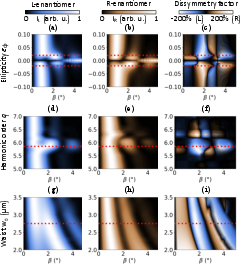
A salient aspect of the scheme is its tunability and robustness. As demonstrated, key experimental parameters provide flexible control over the discrimination signal:
The dissymmetry factor 2(IL−IR)/(IL+IR) strongly supports the robustness of the scheme against parameter variations.
Theoretical and Practical Implications
The approach demonstrates that ultrafast, high-sensitivity, enantio-discrimination in isotropic, randomly oriented samples is feasible solely via topological, purely electric-dipole optical excitation. The vector beam topology ensures topological protection and intrinsic symmetry robustness, advantages over schemes based on Gaussian beams, conical HHG, or non-collinear setups.
From a theoretical perspective, this work connects the topology of structured light (specifically, vector beams) with chiral quantum electrodynamics and the ultrafast nonlinear response of matter. The analysis reveals that macroscopic beam geometry, typically disregarded in chiral spectroscopies, acts as a knob for controlling matter-light interaction selectivity at the electric-dipole level.
Prospective Extensions
Practically, the method provides a pathway for spatiotemporally resolved chiral sensing with attosecond resolution, facilitating studies of ultrafast molecular chirality, photochemistry, and dynamics in complex systems. The all-optical, robust, and parameter-tunable nature makes the approach attractive for applications in enantiomeric purity assessment, ultrafast chiral photonic devices, and high-throughput chiral imaging.
Future work may extend the methodology to larger molecular systems, condensed phases, higher photon energies (soft X-ray and beyond), or integration with spatiotemporally resolved detection schemes (e.g., ultrafast electron or ion imaging) for real-time observation of chiral dynamics.
Conclusion
This paper establishes a comprehensive framework for enantio-sensitive high-harmonic generation in gases using ultraviolet vector beams. By leveraging topological features of structured light, tight focusing effects, and the nonlinear chiral response, the authors provide an electrically driven, robust, and ultrafast method for chiral discrimination in randomly oriented samples. The spatial UV intensity patterns serve as a direct observable for enantiomeric identification and quantification, with tunable sensitivity and high throughput. This platform connects the rapidly progressing fields of ultrafast spectroscopy, structured light, and chiral sensing, indicating broad implications for both fundamental studies and applied photonic technologies.