- The paper derives an explicit mapping between 2D Yang-Mills theory coupled to a colored particle and a Calogero-Sutherland integrable model using systematic gauge reduction.
- It employs Hamiltonian reduction to reveal the SU(N) holonomy structure, orbifold gauge orbit space, and anomaly-induced spectral flows in the system.
- The study bridges non-Abelian gauge theory and integrable quantum many-body physics, offering insights for quantum entanglement and matrix model applications.
2D Yang-Mills Theory and Calogero-Sutherland Dynamics via a Colored Particle
Overview and Motivation
This work investigates the quantum mechanics that emerges upon coupling a non-relativistic, color-charged particle to 2D Yang-Mills theory formulated on a cylinder. Through systematic gauge reduction, the analysis yields an explicit mapping between this gauge-matter system and a Calogero-Sutherland (CS) quantum many-body problem, with the gauge group SU(N) dictating the integrable structure and root system underlying the effective dynamics.
Hamiltonian Reduction and Integrable Structure
The key observation is that pure 2D Yang-Mills on a cylinder supports only global degrees of freedom, namely holonomies of the spatial gauge field. The minimal coupling of a non-Abelian color charge introduces non-trivial dynamics for these global modes. The physical Hilbert space is obtained via explicit solution of the Gauss law constraint, which reduces the system to quantum mechanics on the space of gauge orbits, identified as a quotient of a torus by the Weyl group.
Choosing the Cartan basis and performing the gauge-fixing procedure, the authors show that the coupled system reduces to a particle moving in the presence of (N−1) degrees of freedom parameterizing the SU(N) holonomies. The reduced Hamiltonian is
H=2m1(pz−r1YiQ0i)2+mYM1P0iP0i+2mYM1V(Y)
where V(Y) encodes the singular CS potential via the AN−1 root system, and Q0i denotes conserved Cartan charges.
The CS potential in holonomy coordinates {ym} takes the canonical form
V(y)=m<n∑sin2(π(ym−yn))Kmn
where Kmn are functions of initial color data. This explicitly realizes the equivalence between the colored-particle+YM system and the (N−1)0 CS model with periodic boundary conditions.
Gauge Orbit Structure and Weyl Quotient
A salient feature is the residual gauge symmetry: large gauge transformations and the Weyl group act non-freely, resulting in orbifold identification of the physical configuration space. For (N−1)1 and (N−1)2, the gauge orbit manifold is a 1D segment or a triangular simplex, respectively, further modded out by permutations. The corresponding CS system is thus quantized on these orbifold spaces, leading to nontrivial boundary conditions on wavefunctions.
The explicit periodic and Weyl symmetry structure is visualized for (N−1)3, where the toroidal covering decomposes into a honeycomb lattice of triangles, representing Weyl chambers.
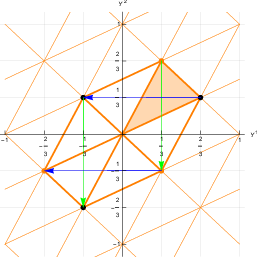
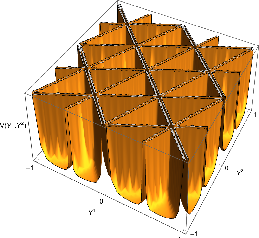
Figure 2: (N−1)4: lattice of gauge-inequivalent configurations (left), with the fundamental Weyl chamber a triangle (orange). Right: CS potential (N−1)5, (N−1)6; singular ridges delineate reflection planes.
Spectral Features and Quantization Conditions
Quantization on the Weyl-orbifolded torus yields a spectrum reflecting charge quantization and anomaly-induced spectral flows. The non-Abelian charge must satisfy integrality conditions arising from the non-commuting cycles of the configuration space. For (N−1)7, half-integer and integer charges are allowed, while for generic (N−1)8, the global structure enforces selection rules concerning wavefunction monodromy and large gauge transformation invariance.
The Hamiltonian's singular inverse-square terms necessitate specification of physically admissible domains (self-adjoint extensions), echoing well-known subtleties in CS models with singular potentials. The harmonic minimal coupling term and CS potential together generate a rich spectrum of entangled particle-gauge sector states.
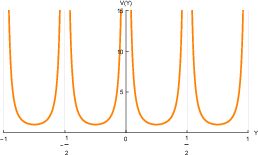
Figure 4: Potential (N−1)9 for SU(N)0 and SU(N)1; the periodic and singular structure reflects the Weyl chamber boundaries.
Theoretical and Practical Implications
This construction concretely realizes the correspondence between non-Abelian gauge-matter systems and exactly solvable many-body quantum integrable models. The identification of the reduced dynamics with the CS system has several key implications:
- Quantum Information Content: The explicit mapping establishes a tractable setting for analyzing entanglement entropy between particle and gauge sectors, extending Abelian calculations to the non-Abelian domain and exposing the nontrivial anomaly structure due to boundary conditions.
- Integrability and Matrix Models: The result embeds Yang-Mills matter systems within the landscape of integrable matrix models, with direct connections to 2D QCD, quantum Hall physics, and Chern-Simons theory on compact spatial manifolds. The mapping clarifies spectral and dynamical properties of these gauge theories in finite volume.
- Anomaly Structure: The fact that boundary conditions on physical wavefunctions break Weyl invariance (while the Hamiltonian remains Weyl-invariant) highlights anomaly phenomena. This is theoretically significant for the classification of admissible quantum states and for the study of symmetry-protected topological sectors.
The approach sets the stage for subsequent analysis of quantum entanglement in the presence of constraints, with broader relevance for both quantum field theory and quantum information theory in systems lacking conventional Hilbert space factorization.
Conclusion
This paper delivers an explicit derivation of how 2D SU(N)2 Yang-Mills theory, when coupled to a non-relativistic colored particle on a cylinder, reduces to a Calogero-Sutherland integrable model with internal root-system-dependent interactions. The geometry of the gauge orbit space and the induced potential are characterized in detail for low-rank groups, exposing the interplay of gauge symmetry, anomalies, and solvable quantum dynamics. These results open avenues for rigorous entanglement analysis and provide a concrete bridge between gauge theory and integrable quantum many-body physics (2606.13388).