- The paper introduces SurfNet, integrating dual-channel transmission with modular surface code error correction to enhance quantum network fidelity.
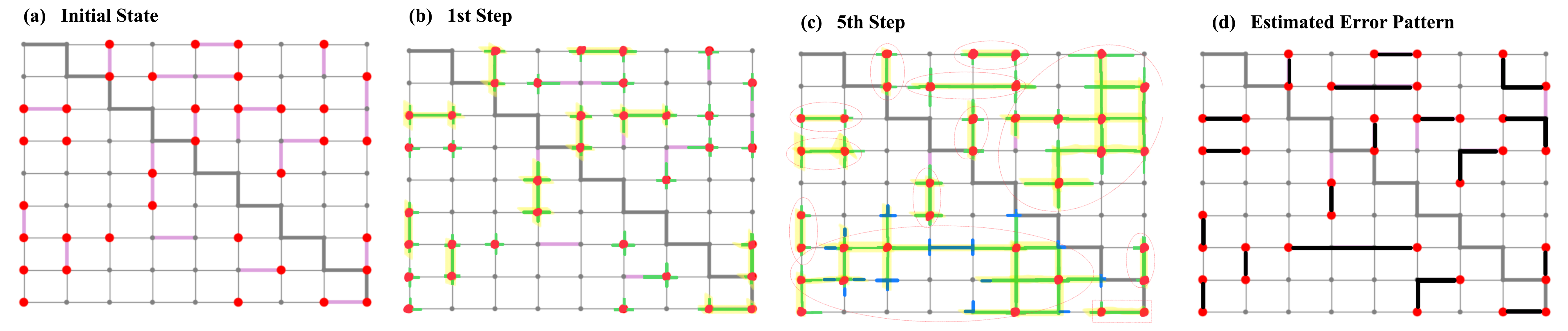
- It details weighted MWPM and SurfNet decoders, achieving almost-linear complexity and a Pauli error threshold of 7.25%, surpassing baseline methods.
- Simulation results validate improved throughput, resource allocation, and scalability, supporting practical and high-fidelity quantum communication.
Quantum Network Routing with Surface Code Error Correction: The SurfNet Architecture
Motivation and Context
Quantum networking necessitates both reliable and efficient communication in the presence of unavoidable noise and erasure errors. Conventional approaches, classified into entanglement-based teleportation protocols and direct quantum state transmission, bear inherent limitations. Entanglement-based networks suffer scalability and efficiency challenges due to probabilistic entanglement distribution and substantial classical communication overhead, while direct transmission using logical qubits substantially increases resource consumption due to the need for multiple physical qubits per logical qubit.
This work articulates SurfNet, a quantum network architecture that synthesizes these two paradigms, employing surface code logical qubits with modular error correction, dual-channel transmission, and optimized routing to enhance throughput and fidelity.
Dual-Channel Architecture and Modular Transmission
SurfNet leverages the modular structure of surface codes. Each logical surface code is decomposed into a "Core" (qubits critical to logical error rate) and "Support" (qubits essential for error correction but less critical to logical error). Transmission occurs via:
- Entanglement-based Channel: High-fidelity teleportation for the Core, utilizing entanglement purification to suppress error rates.
- Plain Channel: Physical transmission of Support via photonic links, decoupling it from the resource-intensive entanglement pipeline.
The two parts traverse potentially disjoint paths and are merged for final error correction at designated server nodes. This modular approach allows the network to optimize resource allocation and parallelize operations, improving both throughput and fidelity under bandwidth and entanglement-generation constraints.
Error Correction and Decoding Algorithms
Surface codes constitute the logical qubit encoding due to their favorable error thresholds and compactness. The paper introduces two primary decoding strategies adapted for SurfNet:
Routing in SurfNet is modeled as an integer programming problem akin to a multi-commodity network flow (MCNF) with additional constraints enforcing quantum resource capacity, entanglement generation scheduling, and noise thresholds for both Core and Support paths. The protocol features:
- Offline scheduling: Resource allocation and path selection are solved globally, optimizing for concurrent request throughput while respecting fidelity thresholds.
- Online execution: Paths are dynamically adapted based on entanglement availability and network errors, with local error mitigation and opportunistic routing for the Core, leveraging parallelism between data transfer and error correction.
The fidelity constraints are constructed to enforce both Core and overall logical qubit noise below design thresholds, balancing reliability and throughput. Parameterized tuning of these thresholds provides operators with a fidelity/throughput control knob.
Simulation experiments cover networks of various resource densities (abundant/sparse nodes, high/low fidelity links), with performance assessed in terms of throughput, latency, and end-to-end fidelity. Notable results:
- Fidelity Gains: SurfNet consistently yields superior average communication fidelity compared to both single-channel direct transmission and purely entanglement-based approaches at similar throughput, due to its strategic allocation of high-value quantum resources to critical Core qubits.
- Decoder Performance: The SurfNet Decoder exhibits a Pauli error threshold of 7.25%, exceeding the Union-Find decoder baseline at 7.1%. This is attributable to its tailored treatment of modular code geometries and channel disparities.
- Scalability and Efficiency: The almost-linear time complexity of the SurfNet Decoder and the modular error correction permit practical scaling to large logical qubits and high network load, a key consideration for quantum repeater-based networks.
Theoretical and Practical Implications
SurfNet demonstrates that architectural modularity in quantum network coding, coupled with asymmetrically-resourced transmission channels and tailored decoding strategies, can jointly optimize reliability and efficiency against real-world resource constraints. Practically, this paradigm supports:
- Enhanced fault tolerance in quantum communication, especially in environments where entanglement generation is a bottleneck.
- Flexible network design, decoupling critical/qubit and auxiliary transmission, compatible with heterogeneous quantum hardware and network topologies.
- Scalable decoder synthesis, readily adaptable for alternative modular code layouts and network error models beyond i.i.d. Pauli and erasure.
Future Directions and Outlook
Several avenues emerge from the SurfNet framework:
- Adaptive Code Partitioning: Dynamically varying Core/Support partitioning as a function of network state, resource availability, or application requirements.
- Joint optimization of code geometry and routing for further improvements in decoder performance and overall network utility.
- Integration with quantum-classical network stacks and real-time network tomography to inform adaptive scheduling.
- Deployment studies on hardware testbeds with realistic error and entanglement generation profiles.
Conclusion
SurfNet represents a thorough application of topological error correction and quantum networking co-design principles, employing dual-channel network architecture, modular surface code transmission, and tailored decoding to achieve high-fidelity, resource-efficient quantum communication. The approach provides clear guidance for further research on modular quantum network protocols, code-adaptive routing, and scalable decoders—advancing practical quantum network infrastructures.