- The paper introduces a three-level certification hierarchy that distinguishes classical mixtures from quantum coherent proper-time histories using selective erasure in a Ramsey experiment.
- It employs a Choi-rank separation theorem and targeted measurement strategies to demonstrate that observed imbalances cannot be reproduced by classical stochastic models.
- The protocol leverages trapped-ion optical clocks and realistic phase accumulation to validate nonclassical proper-time evolutions, advancing both quantum metrology and foundational studies.
Certifying Nonclassical Proper-Time Histories with a Quantum Clock
Introduction and Context
This work addresses a fundamental operational question at the intersection of quantum metrology and relativity: under what conditions can observed signatures in a quantum clock be certified as nonclassical proper-time histories, as opposed to being generated via classical random proper-time distributions? While relativistic phase shifts and visibility loss in quantum clocks—especially in trapped-ion optical systems—have been experimentally observed, these effects alone do not rule out classical stochastic models for proper-time histories. The paper rigorously formulates the simulability boundary and provides explicit certification protocols delineating when reduced dephasing is classically simulable and when it is not.
Hierarchy of Certification: Reduced Dephasing, Classical Mixtures, and Coherent Recombination
A central contribution is the introduction of a three-level hierarchy for the certification of proper-time effects:
- Single-Time Reduced Dephasing: For two-level systems, any reduced dephasing, even when generated by quantum motional degrees of freedom or effective quantum proper-time labels, is always simulable by a classical random proper-time channel. This is underpinned by a convex analysis: the accessible region for the coherence factor is precisely the convex hull of phases generated by classical proper-time evolution. Thus, phase and contrast data from the Ramsey experiment admit a classical explanation and cannot by themselves certify nonclassicality.
- Classical Mixtures of Specified Histories: When the history set H of proper-time evolutions and clock controls is explicitly specified—as is the case in well-controlled Ramsey experiments—any average over these histories is described by the convex set CPTH(H) of all classically allowed mixtures. This set accommodates classical stochasticity, postselection, and predetermined control sequences.
- Certified Nonclassicality via Conditioned Coherent Recombination: The crucial separation arises when considering selective measurements that erase which-history information and thereby coherently recombine proper-time branches. The paper proves, via a Choi-rank separation theorem, that these conditioned operations can produce channels that fall outside CPTH(H), i.e., are not simulable by any classical mixture of the same implemented histories.
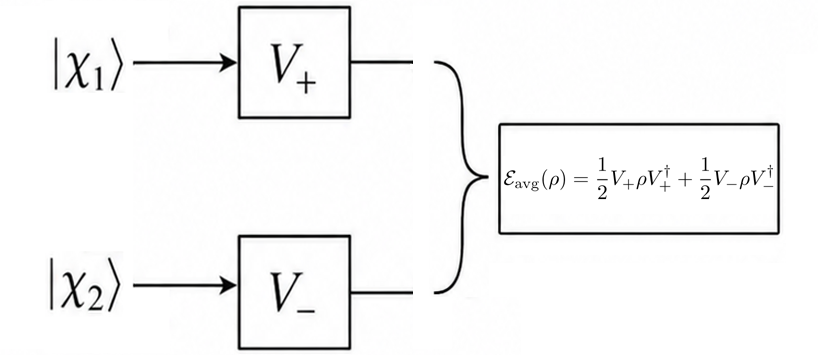
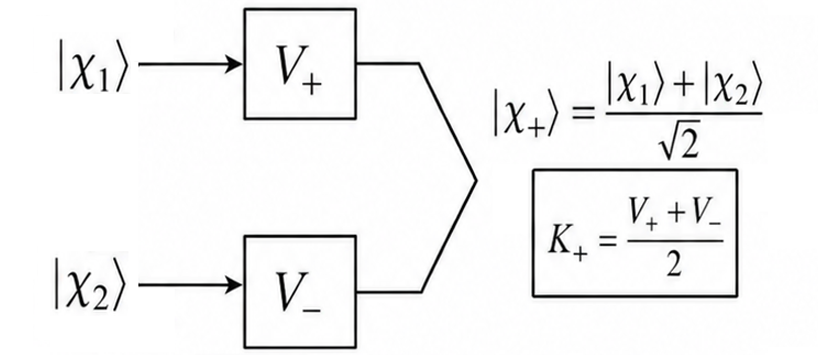
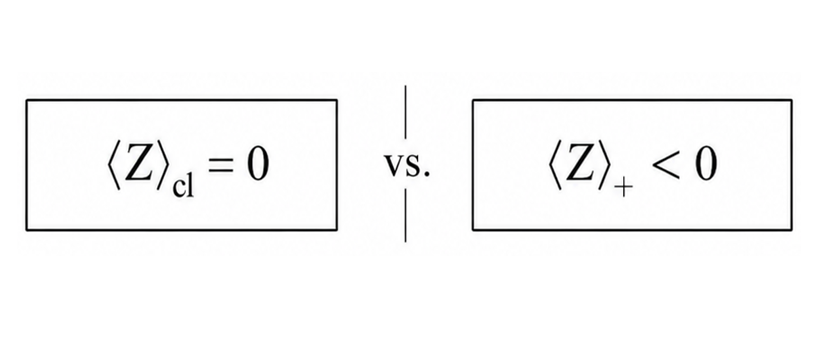
Figure 1: (a) Classical mixtures yield only averaged channels within CPTH(H); (b) Selective erasure induces channels via coherent recombination, which can exit the classical set; (c) The observable imbalance for such postselected outcomes constitutes a witness of nonclassicality.
The Choi-rank separation criterion is formalized as follows. Let Vh denote the sequence of unitaries composing a proper-time history labeled by h∈H, and let K=∑hchVh be the postselected Kraus operator obtained via measurement in a history-erasing basis. If K†K∝I but K is not proportional to any Vh, then the resulting quantum channel cannot be written as a classical mixture over the history set and is thus certified nonclassical. The Choi-matrix rank distinguishes the respective classical (diagonal, rank-one) and quantum (potentially full-rank via coherent sums) channel structure.
This is made operational via a minimal Ramsey protocol: a two-branch experiment where the quantum clock undergoes controlled Ramsey sequences corresponding to distinct proper-time branches, with final measurement projecting the branch register onto the symmetric (history-erasing) basis. The resulting observable, such as the population imbalance CPTH(H)0 in the clock basis, cannot be explained by any (possibly stochastic or reweighted) classical mixture within CPTH(H)1.
Ramsey Protocol as a Minimal Nonclassicality Witness
The authors elaborate a minimal two-history Ramsey experiment, where the clock undergoes either CPTH(H)2 or CPTH(H)3 with CPTH(H)4 and an intermediate Ramsey pulse CPTH(H)5. Upon history-erasing postselection (measurement in the symmetric basis), the Kraus operator for the bright port is CPTH(H)6. The conditional population signal is then:
CPTH(H)7
Any classical mixture over the scenario predicts zero imbalance, hence a nonzero measurement suffices as a robust linear witness for nonclassical proper-time histories over the specified history set. The protocol further provides power analysis: large sample numbers are required to statistically resolve the small imbalance at realistically attainable phase accumulations.
Physical Implementability and Parameter Estimation
The protocol is mapped to an experimentally realistic platform: trapped-ion optical clocks. Distinct motional Fock branches, with energy spacing CPTH(H)8, demarcate the proper-time histories (via their relativistic kinetic energy differences), and selective readout and erasure are achievable using standard motional manipulation primitives. The paper quantifies phase accrual per experiment and estimates that with typical ion parameters (e.g., AlCPTH(H)9, CPTH(H)0~PHz, CPTH(H)1 atomic mass units, CPTH(H)2~MHz, CPTH(H)3~s, and CPTH(H)4 number difference), achievable phase shifts CPTH(H)5 are realistic. Further, protocol-level amplification (multiple rounds or engineered superpositions) can boost effective CPTH(H)6 and thus the detectable witness signal to a percent-scale.
Implications for Quantum Foundations and Quantum Metrology
The implications are twofold. Theoretically, the framework demarcates the boundary between what can and cannot be explained by classical stochastic proper-time processes, setting a well-defined target for quantum certification. This caters directly to ongoing debates in quantum foundations on the operational detectability of proper-time superpositions, time in quantum reference frames, and relational quantum dynamics.
From a metrological perspective, the work prescribes an explicit protocol for certifying nonclassicality in state-of-the-art atomic clocks, identifying concrete visibility and coherence requirements. Implementing these protocols will benchmark the classical-versus-quantum boundary of time in quantum systems, with applications ranging from relativistic clock synchronization to gravitational decoherence and quantum gravity phenomenology.
Discussion and Future Directions
The presented work leaves open the development of a full resource theory for proper-time nonclassicality: although robustness diagnostics and witness measures are outlined, a comprehensive theoretical structure remains to be formalized. Extensions to multi-history, continuous, or more complex control sequences, as well as integration with gravitational time dilation scenarios, are viable directions. Experimentally, the challenge remains to increase the witness phase shifts and minimize decoherence to reach the statistical detection requirements.
Conclusion
This work establishes a precise operational framework for certifying nonclassical proper-time histories in quantum clocks, situating the boundary of classical simulability via a convex set of history mixtures and introducing a practical protocol—grounded in standard Ramsey interferometry and selective erasure—to detect the nonclassical domain. The approach informs both foundational explorations of time in quantum theory and the ongoing advancement of precision quantum metrology.
(2606.12755)