- The paper presents RecSBART, a fully Bayesian approach using soft decision trees for nonparametric modeling of subject-specific recurrent event intensities.
- It employs a two-level data augmentation strategy to efficiently address intractable integrals, achieving lower mean squared error than competing methods.
- Application to colorectal cancer hospitalization data demonstrates RecSBART's capability to capture nonlinear covariate-time interactions and deliver superior generalization.
Bayesian Machine Learning for Recurrent Events via Soft Bayesian Additive Regression Trees
Introduction
This paper presents a novel Bayesian machine learning methodology for the analysis of recurrent event data, leveraging Soft Bayesian Additive Regression Trees (SBART). The methodology, termed RecSBART, addresses major limitations in classical and machine learning-based recurrent event models by enabling nonparametric estimation of the subject-specific conditional event intensity under a non-homogeneous Poisson process (NHPP) framework, with explicit modeling of complex, nonlinear covariate-time interactions and unobserved heterogeneity through frailty.
Methodological Framework
RecSBART models the conditional intensity of recurrent events as
λi(t∣Wi,xi)=λ0WiΦ(b(t,xi)),
where λ0 is a baseline intensity parameter, Wi is a subject-specific frailty (modeled as Gamma distributed), and b(t,xi) is an unknown function of time and covariates, modeled nonparametrically via an ensemble of soft decision trees (SBART). The function Φ denotes the standard normal CDF, ensuring stability and upper-bounding the intensity.
The SBART extension over classical BART employs soft splits (using logistic weight functions) to induce smoothness and mitigate piecewise-constant artifacts inherent to BART. RecSBART supports flexible adaptation to unknown smoothness and automatically models high-order interactions without parametric commitment.
Integration of RecSBART into Bayesian inference for NHPP with frailty presents computational challenges due to the presence of intractable integrals and high-dimensional latent structure. These are efficiently addressed via a two-level data augmentation strategy: (1) latent event times for the thinned Poisson process, and (2) auxiliary variables for Gibbs updates of the SBART parameterization, leveraging the Poisson thinning framework and probit data augmentation, respectively.
Simulation Studies
The authors perform extensive simulation studies comparing RecSBART with RecForest (a frequentist random forest for recurrent events) and Bayesian proportional intensity frailty models. Simulated settings encompass correct and misspecified intensities, including both homogeneous and non-homogeneous processes and correct/incorrect frailty distributions.
RecSBART consistently yields the lowest average mean squared error (AMSE) in estimation of the cumulative intensity Λ(t∣x) across all tested scenarios, including when frailty is misspecified. For instance, in a challenging non-homogeneous scenario with frailty misspecification, RecSBART attains AMSE = 0.032 versus RecForest's 0.036, and the proportional intensity model's 1.035. These results underscore the robustness of RecSBART to both intensity and frailty model misspecification.
Assessment of subject-level frailty recovery via AMSE further demonstrates superiority of RecSBART over the parametric approach, with lower error in all tested scenarios.
Application: Recurrent Hospitalizations in Colorectal Cancer
RecSBART is used to analyze a well-studied biomedical recurrent event dataset of rehospitalizations following colorectal cancer surgery (403 patients, 458 events). Covariates include gender, chemotherapy status, Dukes' stage, and Charlson's index. Competing methods are again RecForest and the Bayesian proportional intensity frailty model.
Model fit is assessed via the empirical distribution of martingale residuals. RecSBART achieves a residual distribution that is most tightly centered around zero and exhibits the lightest tails, indicating superior fit over both RecForest and the proportional intensity model.
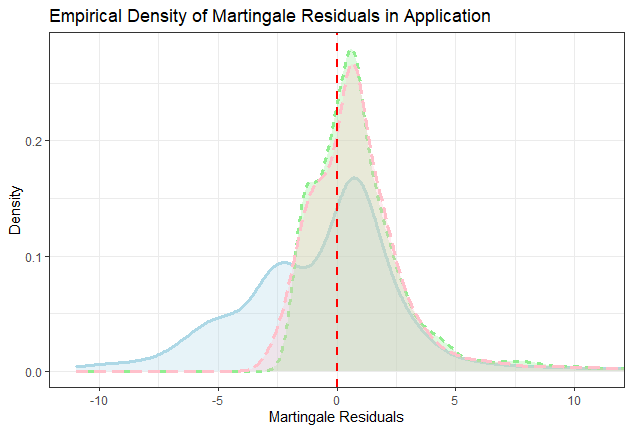
Figure 1: Empirical density of martingale residuals for RecSBART, RecForest, and the Bayesian proportional intensity model demonstrating RecSBART's lower bias and variance in residuals.
Estimation of the cumulative intensity function further reveals interpretable, nonlinear interactions among covariates and time, such as time-varying differential risk by gender and chemotherapy status not captured by standard models. Marginal effects and conditional covariate effect plots detect strong evidence against proportional hazards, as the effects are non-constant in time—a result the proportional intensity model cannot accommodate.
Model Generalizability and Overfitting Analysis
Out-of-sample predictive performance is assessed using 5-fold cross-validated mean squared martingale residuals (MSMRs). RecSBART maintains parity between training and test error (relative increase 8.7%), while RecForest displays a 28.4% test-train gap indicative of stronger overfitting and less stable generalization.
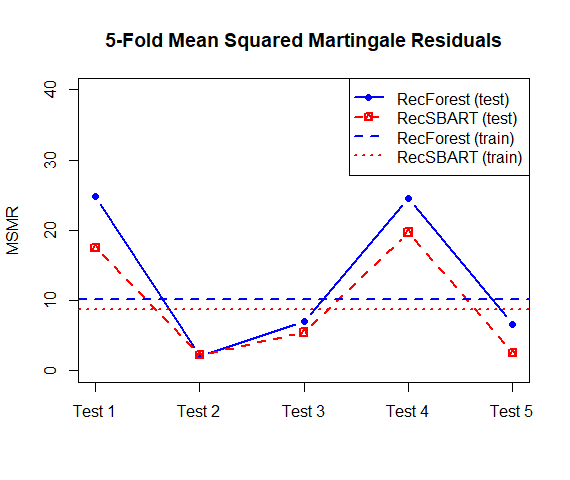
Figure 2: Five-fold cross-validated MSMRs for RecForest and RecSBART, illustrating superior generalization and reduced overfitting in RecSBART.
Practical and Theoretical Implications
RecSBART provides a flexible, computationally scalable solution to recurrent event modeling, supporting nonlinear and interactive covariate effects and explicit, interpretable frailty adjustment, all while delivering exact posterior Bayesian inference. Empirical robustness to model misspecification and improved generalization recommend RecSBART in biomedical and reliability studies where complex dependency structures are both plausible and consequential. The model's applicability is limited to vectorial covariates and outcomes but is readily extensible to ultrahigh-dimensional settings via sparsity-inducing priors and automated variable selection—a direction prompted by recent advances in high-dimensional SBART (2606.12701).
The demonstrated performance in recovering intricate covariate-time interactions and resilience under frailty and process misspecification positions RecSBART as a strong candidate for recurrent event analysis in settings where model fidelity is a critical design criterion.
Conclusion
RecSBART introduces a fully Bayesian, semiparametric approach for recurrent events analysis with robust and flexible modeling of subject-specific intensities and frailties. The model offers substantial improvements over classic proportional intensity models and tree-based machine learning competitors, in both simulation and real-world biomedical applications. Extension to structured (e.g., tensor) covariates and development of scalable, variable-selection regimes constitute promising avenues for future work.

