- The paper introduces a measurement-first framework that reformulates QRAC optimization as a spectral problem driven by the largest eigenvalue statistics of decoding measurements.
- It leverages Chernoff-type moment-generating functions and convexity techniques to derive tighter finite-size upper bounds, surpassing traditional limits like the Nayak bound.
- It formalizes mutually unbiased projector-valued measurements to construct near-optimal QRACs, enhancing decoding strategies for quantum communication protocols.
Measurement Geometry for Quantum Random Access Codes: Beyond Nayak Bound and Toward Optimality
Background and Motivation
Quantum random access codes (QRACs) study the efficient encoding of classical information into quantum systems such that each individual bit remains retrievable with high probability. For an (N,M,p)-QRAC, the task is to encode N bits into an M-qubit state so any individual bit can be recovered with at least probability p. Standard bounds, particularly the Nayak bound, have long characterized upper limits on this decoding probability using binary entropy constraints. However, these are not tight for finite M and N regimes, and empirical evidence indicates stronger, yet-unproven, bounds. This work shifts the focus from analyzing encoding states to decoding measurements, establishing a measurement-first geometric approach that results in stronger finite-size upper bounds and deeper optimality insights.
The authors reformulate QRAC optimization as a spectral problem: the optimal probability is determined by the extremal eigenvalue statistics of noncommuting Hermitian measurements, {σ(n)}. The central construct is the signed sum Yx=∑n=1Nxnσ(n) over the data string x∈{±1}N. Both the average-case and worst-case decoding probabilities reduce to evaluating the largest eigenvalues λmax(Yx) across all N0. This recasting enables the application of matrix concentration inequalities and minimax theorems in more elementary arguments, replacing traditional information-theoretical reductions.
By optimizing Chernoff-type moment-generating functions and leveraging convexity, the authors sharpen both expectation-based and tail probability bounds for N1. This derivation yields explicit, analytically tractable upper bounds strictly tighter than Nayak’s for all finite N2, subsuming and extending the Mančinska–Storgaard bound for N3. Notably, the new bounds approach the conjectured quadratic scaling N4 in the small-N5 regime.
Geometric Constraints and Mutually Unbiased Projector-Valued Measurements
Achieving the refined upper bounds imposes stringent geometric and spectral constraints on the decoding observable set. The authors establish that for two-qubit (N6) QRACs, attaining the conjectured bound is possible only for specific N7. The optimal observables must be traceless, involutory, pairwise Hilbert–Schmidt orthogonal, and satisfy higher-order noncommutative polynomial identities absent from the pairwise mutual unbiasedness framework.
This motivates the introduction and formalization of mutually unbiased projector-valued measurements (MUPVMs) as a generalized structure extending MUBs to higher-rank projectors. For binary outcome measurements, the MUPVM condition becomes: N8, involutory, and traceless. The Pauli group provides explicit examples saturating these conditions for N9.
The importance of these structures in constructing near-optimal QRACs extends beyond the two-qubit setting. Using a natural quantum circuit construction (Figure 1), MUPVMs, with the aid of a single ancillary qubit, deliver a family of M0-QRACs with a worst-case decoding probability lower bound M1, a scaling shown to be optimal under matrix discrepancy theory constraints.
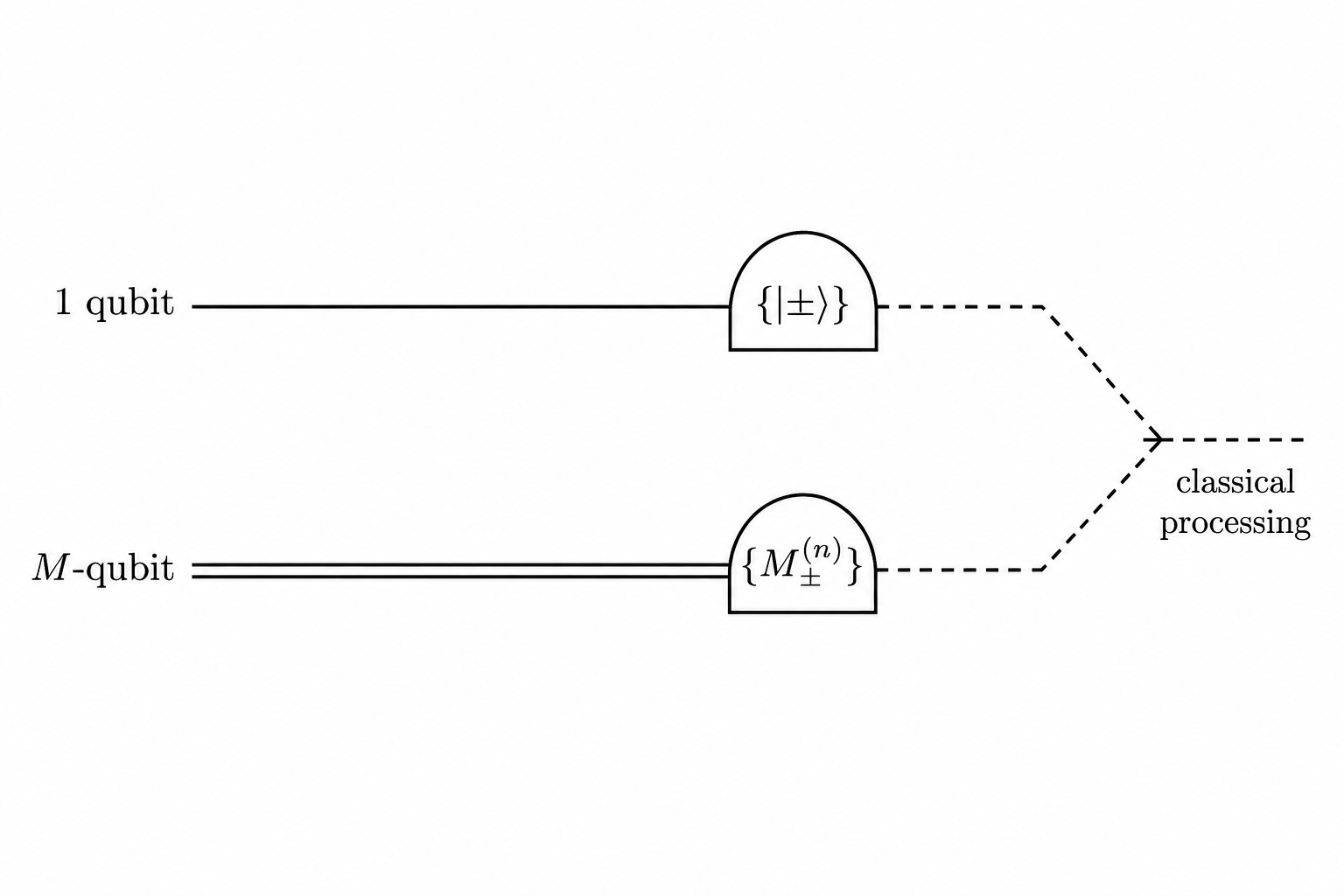
Figure 2: Quantum circuit implementing the MUPVM-based decoding measurement for optimal QRACs.
New QRAC Constructions and SDP Characterization
The authors use the MUPVM framework to produce explicit constructions for M2-QRACs, analytically matching the conjectured bound. The method exploits intricate Clifford algebra, parity projectors, and structured encoding states to certify both the required tight frame, uniform decode, and eigenvalue channel properties. Furthermore, they provide improved constructions for the previously suboptimal M3 and longer codes, accompanied by full verification certificates, establishing strong new benchmarks for projective QRAC performance.
The framework’s interplay with semidefinite optimization is explicit: encoding/decoding pairs are optimized through spectral program duality, with the relevant observables characterized by their action on projective tight frames. In the case of mutually unbiased measurements (MUMs), a subclass of MUPVMs associated with anticommuting observable sets, the attainable region is further restricted to M4, where Weyl-Brauer operator sets are known to yield equality.
The authors further examine cases where MUPVMs are suboptimal, providing new lower bounds for larger codes and demonstrating—empirically and analytically—the breakdown of conjectured asymptotic behavior for M5.
Theoretical and Practical Implications
The measurement-first formulation aligns with the trend toward operator-theoretical approaches in quantum information, enabling concrete spectral/SDP optimization rather than indirect information-theoretic bounding. The new finite-size bounds eliminate prior gaps between analytically proved and empirically observed code performance, clarifying the geometric–spectral regime transitions. For two-qubit codes, the negative result that optimality is unattainable for larger M6 codifies design limitations and supports the conjectured cutoff.
Practically, these results expand the operational utility of QRACs for cryptographic protocols, experimental dimension witnesses, and quantum certification tasks; thresholds for quantum advantage are now closer to achievable experimental parameters. The identification of MUPVMs as a diagnostic for optimality also simplifies the search for new codes in higher dimensions, offering a structured path to code design guided by spectral optimality rather than brute-force construction.
Further, the measurement-centric, convex optimization paradigm is directly extendible to other quantum primitives involving partial retrieval under resource constraints (e.g., quantum random access memories, quantum finite automata, network coding, dimension witnessing, and Hamiltonian spectral estimation).
Open Problems and Future Directions
Despite the progress, several open questions remain. The finite-size upper bounds, while strictly tighter than Nayak's, leave open the possibility of further improvements via analysis of noncommuting spectra or deeper connections to matrix discrepancy (e.g., the matrix Spencer conjecture). The algebraic relations required for higher M7 optimality are not yet fully characterized; understanding the full geometric hull of candidate decoders remains an important theoretical challenge.
Extending the framework to qudit systems or nonbinary output measurement scenarios is an attractive direction. On the practical side, the family of codes introduced here may facilitate reduced-resource experimental certification protocols and combinatorial quantum information methods in both finite and large-dimensional settings.
Conclusion
This work develops a measurement-first, spectral-geometric framework for finite-size quantum random access codes, yielding strictly improved upper bounds and unifying structural theory for decoder optimality. It formalizes the role of mutually unbiased projector-valued measurements and provides explicit constructions matching conjectured scaling in new parameter regimes. The interplay between convex optimization, quantum measurement geometry, and matrix analysis points toward a more complete characterization of quantum coding under physical constraints and stimulates further investigation into related operator-theoretic quantum primitives.