- The paper demonstrates that two-layer linear AR models can recover latent state estimates, approximating those produced by the Kalman filter using only observable data.
- It establishes that the loss landscape has a strict saddle property, enabling gradient-based methods to efficiently reach global optima with finite-sample guarantees.
- Empirical results confirm that, with sufficient trajectory data, the hidden layer activations align closely with the true latent states, ensuring reliable state recovery.
Two-Layer Linear Auto-Regressive Models Estimate Latent States: Technical Summary
Problem Setting and Theoretical Motivation
This paper addresses the statistical and optimization-theoretic underpinnings of two-layer linear auto-regressive (AR) models in the context of learning latent states from time series data generated by partially observed linear dynamical systems (LDS). Given only input-output sequences (no access to ground-truth state or system parameters), the goal is to recover—up to similarity—optimal state estimates as would be produced by the Kalman filter.
The prevalent approach in system identification has traditionally relied on learning a shallow AR model and applying a post hoc factorization (e.g., Ho–Kalman, nuclear norm regularization) to extract latent representations. In contrast, this work demonstrates that two-layer AR models, trained end-to-end via ERM on observable sequences, learn internal representations in the hidden layer that align (modulo similarity) with Kalman filter state estimates—without explicit knowledge of model structure or parameters.
Model Architecture and Main Theoretical Contributions
The modeling framework considers a standard LDS: xt+1=Axt+But+wt,yt=Cxt+vt
where xt is the latent state, ut is the input, yt is the observed output, and wt,vt are Gaussian noise sources. Crucially, the two-layer AR model maps concatenated histories of past L outputs and inputs (the covariate zt) through a linear hidden layer to a linearly decoded prediction of H future outputs.
The function class is f(z)=G2G1z with hidden dimension h, trained to minimize squared prediction error over an input-output trajectory. Both the history length xt0 and model dimension xt1 are treated as hyperparameters. The authors offer the following key theoretical advances:
- Kalman Filter Approximation: The Kalman filter state estimate at time xt2 can be approximated as a linear function of a sufficiently long history of past outputs and inputs, with the error decaying as xt3 where xt4 relates to the spectral radius of the closed-loop estimator.
- Benign Non-Convexity: The empirical risk minimization problem over xt5, despite its non-convexity (due to factorization), enjoys a benign landscape: all stationary points are either strict saddles or global minima. This ensures gradient-based methods can find global optimizers under reasonable data/initialization regimes.
- Finite-Sample Guarantees: The work provides non-asymptotic, finite-sample statistical bounds (in trajectory length xt6, problem dimensions, and noise) for prediction error, parameter estimation, and, critically, for error in latent state recovery (i.e., the distance between the hidden layer representation and true state, up to similarity).
The essential technical finding is that, under classical control-theoretic assumptions (stabilizability, observability, non-explosiveness), and given sufficient trajectory length and history xt7, the hidden activations of the trained model encode the Kalman state estimate, up to linear transformation. This effect is robust across diverse system classes.
Optimization Landscape and Statistical Learning Results
The authors rigorously show that:
- The two-layer factorized loss landscape satisfies the “strict saddle” property. All non-global stationary points correspond to strict saddles; thus, local optimization with random initialization and suitable perturbations will not get stuck in suboptimal points. This property is proven through an adaptation of existing matrix factorization non-convexity analyses and direct application to the AR loss.
- The sample complexity for predicting outputs and recovering latent states is explicit: as xt8 increases, prediction and estimation errors scale as xt9 (with problem-dependent constants and logarithmic dependencies).
- The alignment and sample complexity of latent recovery depends on full-rank conditions on extended observability and controllability matrices, as well as sufficient history length ut0 and prediction horizon ut1.
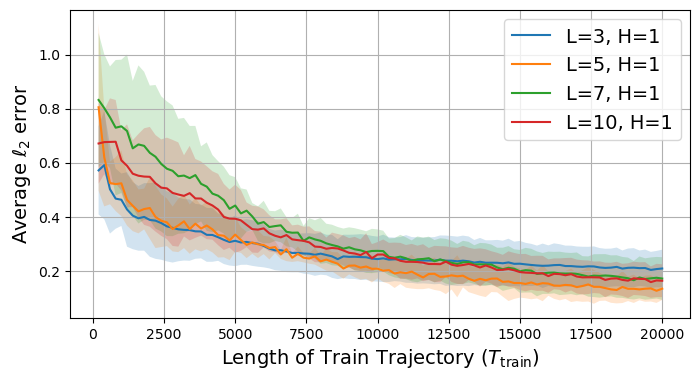
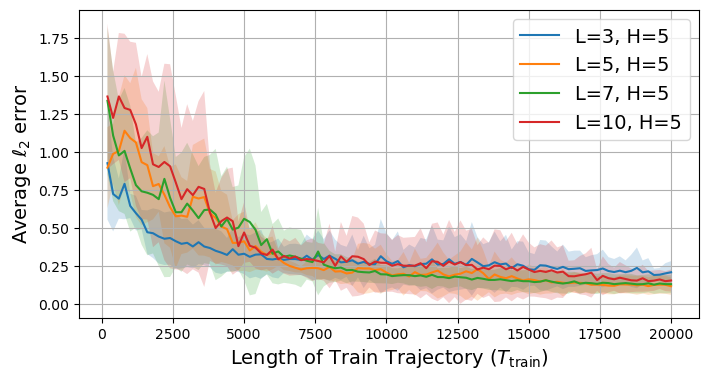
Figure 2: Sample complexity plot by varying the history length ut2, with fixed future window length ut3.
Empirical Results: Recovery of Latent States
Empirical studies support the theory using both synthetic and standard control benchmark (ControlGym) systems. The key findings are:
- When trained with ut4 (dimension of the latent state), the hidden activations of the model exhibit extremely high ut5 with the Kalman filter estimates after appropriate linear transformation. This holds consistently across random linear systems and practical control benchmarks, as validated by quantitative ut6 metrics.
- The success of latent recovery does not depend on system particulars, confirming the generality of the phenomenon.
- The observed decline in latent recovery error, as trajectory length ut7 increases, empirically matches the theoretical sample complexity rates.
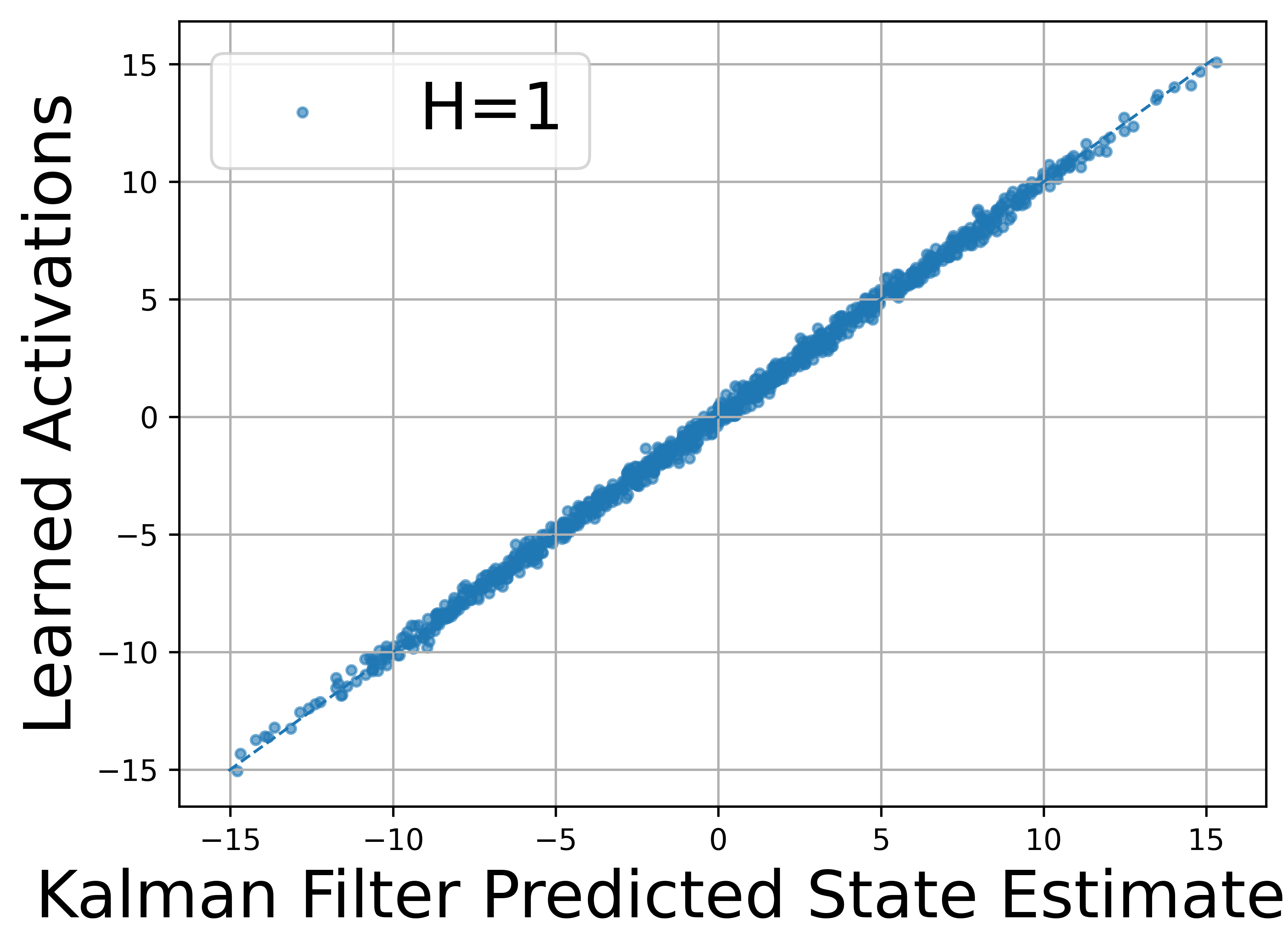
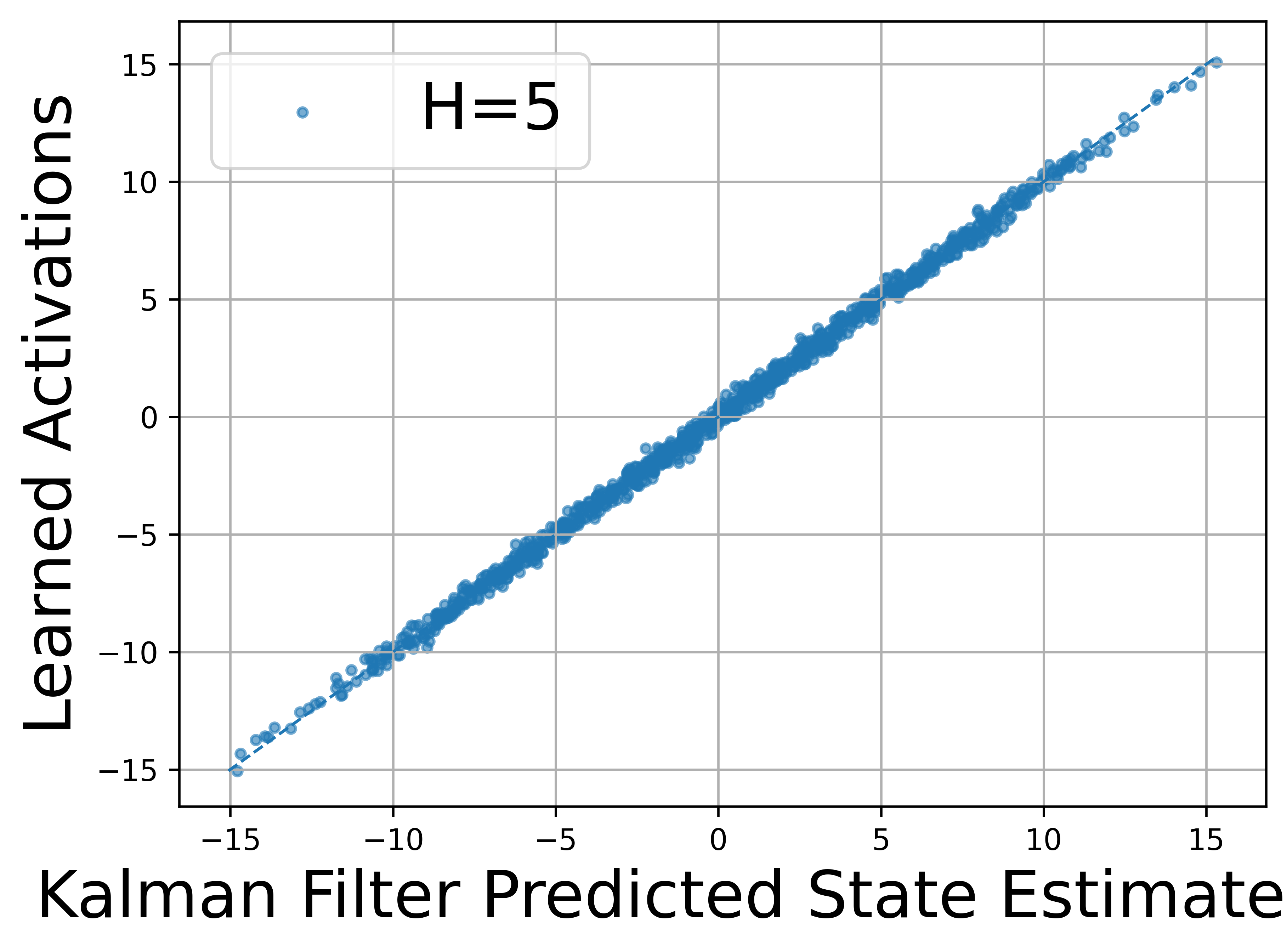
Figure 3: ut8.
These results are robust to various settings of history ut9 and prediction window yt0, with minor degradation for suboptimally chosen hyperparameters. Theoretical trade-offs are confirmed empirically: larger yt1 improves approximation at the cost of more parameters, while the choice of yt2 impacts the rank and identifiability of the underlying observability map.
Implications and Future Directions
These results have several theoretical and practical implications:
- Theoretical Implications: The findings unify perspectives from system identification and deep learning: end-to-end representation learning in AR models naturally (and provably) recovers the best linear sufficient statistic (Kalman state) without any explicit supervision or additional regularization, provided sufficient data and model size.
- Statistical Guarantees for Deep Architectures: This work provides a template for deeper or nonlinear architectures, suggesting that similar latent recovery phenomena may occur in higher-capacity or recurrent models—although further work is required to extend these results beyond the linear AR setting.
- Practical Relevance: In reinforcement learning and control, where interpretable latent representations are crucial, these guarantees provide a foundation for using simple AR models in pipeline designs, as well as benchmarking state recovery against classical methods in the presence of only observed input-output data.
Looking forward, future research is indicated in several directions, including:
- Extending statistical and landscape guarantees to non-Gaussian or adversarial noise settings, where Kalman filtering is not optimal and error correlations complicate the analysis.
- Investigating the emergence of state-encoding representations in deep or nonlinear AR and RNN architectures, and their alignment with classical observers or sufficient statistics.
- Understanding meta-generalization and “in-context learning” in high-capacity AR models trained on data from multiple systems, seeking conditions under which state recovery generalizes across system classes.
Conclusion
This paper provides a rigorous statistical and optimization-theoretic analysis showing that two-layer linear auto-regressive models, trained on observed input-output sequences from partially observed linear dynamical systems, automatically learn hidden representations that closely align with optimal state estimates produced by Kalman filtering, up to similarity. This effect is supported by finite-sample guarantees and robust empirical validation, bridging a key gap between modern representation learning methodology and classical control-theoretic state estimation. The analysis sets the stage for systematic investigation of representation and state recovery in more general architectures and data regimes.
Reference: "Two-Layer Linear Auto-Regressive Models Estimate Latent States" (2606.12691)