- The paper presents a canonical derivation of stochastic inflation as a quantum open system that unifies quantum fluctuations, dissipation, and decoherence.
- The methodology employs a canonical coarse-graining of field modes to construct a bulk Fock space whose evolution is governed by a GKLS master equation.
- It demonstrates a mass-dependent quantum-to-classical transition, reconciling the classical Fokker-Planck dynamics with underlying quantum open-system processes.
Quantum Stochastic Inflation: A Canonical Open-System Approach
Introduction and Motivation
Stochastic inflation provides a statistical framework to capture the super-Hubble dynamics of quantum fields during cosmic inflation. Traditionally, the Starobinsky formalism partitions field modes into infrared (IR) and ultraviolet (UV) sectors based on a moving physical cutoff, modeling the IR dynamics via classical stochastic differential equations (Langevin and Fokker-Planck). However, the explicit quantum-to-classical transition mechanisms and their implications for reduced phase-space dynamics and decoherence remain underexplored, particularly in connection with open quantum system theory. This work presents a canonical derivation of stochastic inflation as a quantum open system by tracking the time evolution of coarse-grained bulk variables in de Sitter, emphasizing how quantum fluctuations, dissipation, and decoherence are structurally connected in this context.
Canonical Coarse-Graining and Bulk Variable Construction
The authors construct a coarse-grained open system by defining canonical pairs (Q^N,P^N), representing the field averaged over a finite physical region and its total momentum content. These operators act on a one-mode Fock space (the "bulk"), isolated by integrating modes below the cutoff kσ(N)=σaH. This construction clarifies the canonical structure: the canonical partner of the averaged field is not the momentum density but the total enclosed momentum, ensuring [Q^N,P^N]=i is normalized for the bulk.
As new modes redshift below the cutoff, the effective bulk Fock space and canonical pair evolve. This time-dependent embedding is a nontrivial aspect: the coarse-grained system is continually redefined, entangling the redefined bulk with components of the newly included shell.
Open-System Dynamics: GKLS Structure and Single-Channel Dissipation
The redefinition of the bulk through mode entry generates entanglement between the updated bulk and a decoupled mode that is then traced out. This induces a non-unitary (decohering) Markovian evolution for the reduced bulk density matrix, formalized by a Gorini-Kossakowski-Lindblad-Sudarshan (GKLS) equation. The effective generator contains a quadratic Hamiltonian and a single non-Hermitian Lindblad operator, which acts as a boundary-adapted annihilation operator absorbing the vacuum shell entering at the cutoff.
Crucially, the resulting Kossakowski matrix is positive and rank one. This implies Hubble friction and phase-space diffusion both arise from the same quantum channel—they are not independent, disjoint effects. This provides a rigorous quantum prescription for the origin of stochasticity in inflation and ensures the correct preservation of phase-space commutators and uncertainty relations throughout the dynamics.
Wigner-Fokker-Planck and Langevin Correspondence
By considering the Wigner-Weyl transform of the Lindblad equation, the authors demonstrate that the evolution of the Wigner function for the bulk coincides with the phase-space Fokker-Planck equation used in classical stochastic inflation. For Gaussian states, the Wigner function is positive and can be identified with the classical probability density; in the overdamped (slow-roll) regime, integrating out the bulk momentum leads to the expected one-dimensional Starobinsky Fokker-Planck equation for the field variable.
The framework also allows for exact stochastic unravelings of the GKLS master equation into stochastic Schrödinger equations, contingent on the measurement protocol applied to the decoupled mode. In the field-adapted homodyne measurement, the stochastic equation for the quantum expectation value of the field reduces to the standard Starobinsky Langevin equation in the massless, super-Hubble limit.
Quantum-to-Classical Transition and Stationary Purity Diagnostics
The mass of the field fundamentally divides the regime of stochastic inflationary dynamics. For light fields (m<3H/2), the system displays strong overdamping, leading to rapid decoherence and phase-space diffusion: the field behaves classically with the marginal probability distribution strongly mixed (purity γ→0 as σ→0). The variance diverges as the cutoff is tightened, and the classical random-walk limit is attained.
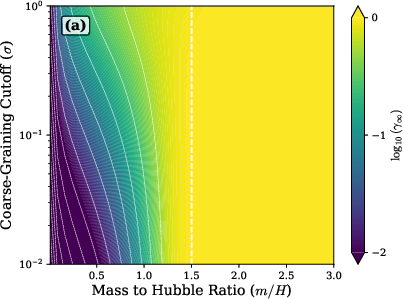
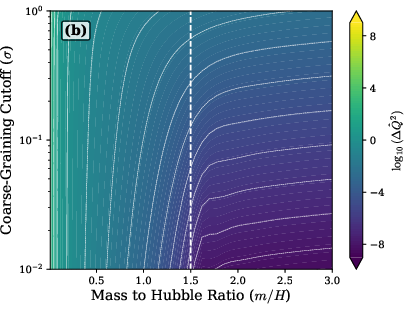
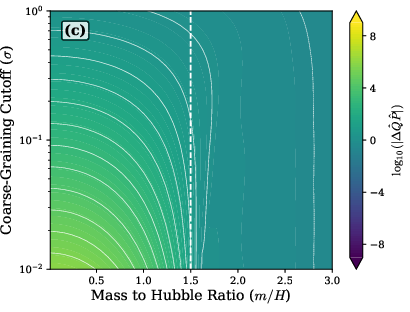
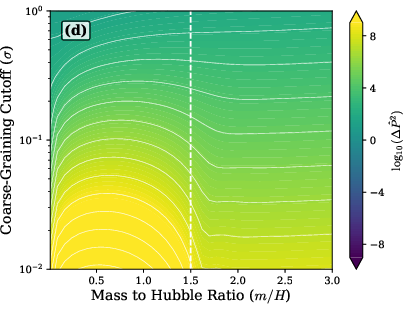
Figure 2: Phase-space diagrams of the Gaussian stationary state derived explicitly in Eq. (StationaryCovMatrixMain), showing convergence towards classicality for light fields.
At the critical mass m=3H/2 and for heavy fields m>3H/2, the field diffusion coefficient is suppressed as σ→0, and the reduced bulk instead approaches an underdamped quantum state of finite purity. Thus, strong classical stochasticity emerges only in the light-field overdamped regime, while heavier fields persist as nearly pure quantum oscillators, precluding a valid classical stochastic limit.
Contrasts with Prior Approaches
While other works (e.g., Li 2026) also derive a quantum open-system picture for inflationary perturbations via Schwinger-Keldysh and influence functional methods, the present construction, anchored in canonical variables and covariance structure, resolves ambiguities in the normalization of effective Lindblad channels and clarifies the connection between canonical pairs and momentum density variables used in previous literature. The single-channel structure and identification of diffusion and friction as aspects of the same quantum map is unique to this formulation.
Theoretical and Practical Implications
This canonical open quantum system treatment of stochastic inflation bridges rigorous quantum field theoretic treatments and phenomenological stochastic descriptions. The explicit identification of the quantum underpinnings of diffusion, dissipation, and decoherence elucidates the mass dependence of phase-space classicalization and clarifies the role of decoherence in suppressing quantum coherences on super-Hubble scales. The approach provides a natural framework for extending stochastic inflation to systems with additional interactions, non-Gaussianities, or inflaton self-couplings, where non-Markovian effects and higher-order Moyal terms would alter the Wigner function dynamics. Future generalizations are expected to affect predictions for rare fluctuation statistics, PBH formation, and non-Gaussian signatures in the inflationary perturbation spectrum.
Conclusion
This work systematically derives stochastic inflation as a canonical quantum open system, making explicit the quantum source of stochasticity and decoherence for coarse-grained fields in de Sitter. The identification of a single quantum channel generating both friction and diffusion, the precise reduction to the classical Fokker-Planck regime in the light-field limit, and the explicit structure of the quantum-to-classical transition by field mass are principal findings. The canonical approach provides a mathematically controlled foundation for exploring the emergence and limitations of classical stochastic dynamics from underlying quantum field theoretic principles in cosmological inflation.