Scalar Quantum Fields: Theory Space and its Geometry
Abstract: Scalar fields provide perhaps the simplest playground in which to develop our understanding of quantum field theory. In this lecture, we consider what it means to write down a scalar quantum field theory and how we can give geometrical interpretations to the space of such theories: the theory space.
- Matter relative to quantum hypersurfaces (2023)
- Minimal Supergeometric Quantum Field Theories (2023)
- Geometry of the Scalar Sector (2016)
- Supergeometric Approach to Quantum Field Theory (2024)
- Topics in Quantum Field Theory in Curved Space (2010)
- Field Theories on Quantum Space-Times: Towards the Phenomenology of Quantum Gravity (2024)
- Reformulating Scalar-Tensor Field Theories as Scalar-Scalar Field Theories Using a Novel Geometry (2022)
- Nonlinear Field Space Theory and Quantum Gravity (2017)
- The Nonlinear Field Space Theory (2016)
- Renormalising the Field-Space Geometry (2025)
Summary
- The paper introduces a novel geometric framework that recasts renormalization group trajectories as geodesics in theory space using effective actions.
- It rigorously bridges canonical and path-integral formulations by employing the 2PI effective action and covariant field redefinitions to ensure parameterization invariance.
- The study unifies perturbative and nonperturbative approaches in scalar QFT by leveraging Hessian geometry for a robust, coordinate-invariant analysis.
Geometry and Theory Space in Scalar Quantum Field Theory
This essay provides a technical summary and critical analysis of "Scalar Quantum Fields: Theory Space and its Geometry" (2606.12580), focusing on foundational, formal, and geometric aspects in the context of scalar QFT. Emphasis is placed on the interplay between effective action techniques, configuration/theory space geometries, and the implications for renormalization group (RG) analysis and field reparameterization invariance.
The Construction of Theory Space
The formulation of scalar QFT begins by distinguishing the mathematical structure of a "theory"—the delineation of model parameters, dynamical rules, and the induced relationships between parameters and observables. The analysis distinguishes:
- Perturbatively renormalizable theories (e.g., QCD), characterized by a finite set of parameters and UV completeness, and
- Non-perturbatively renormalizable (asymptotically safe) and effective theories (e.g., Standard Model EFT, QED with its Landau pole pathology), which retain predictivity via a finite parameter set, but may lack UV completion.
Central is the recognition that observables and their parameterization exhibit scale dependence, a core pillar for the renormalization group perspective. The paper approaches QFT via both the canonical and path-integral formulations, where the action functional is cast as a function of fields, their derivatives, and interaction vertices. State spaces are constructed through field eigenstates, leading to a rigorous definition of the path integral:
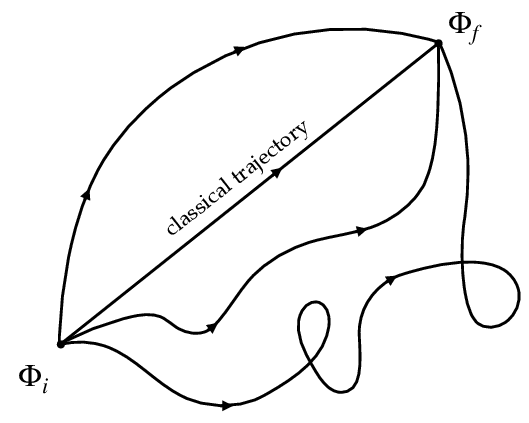
Figure 1: An example of possible paths between initial and final field configurations Φi and Φf. In the quantum regime, the transition amplitude sums over all such paths—the essence of the path integral.
This foundational structure underpins later geometric interpretations.
Effective Actions and Legendre Structure
From the path-integral generating functionals, the transition to n-point correlation functions and, subsequently, to effective actions via Legendre transforms is established. The Schwinger functional W[J,K] serves as the generator, while its double Legendre transform yields the two-particle-irreducible (2PI) effective action Γ[ϕ,Δ].
Explicitly, Γ[ϕ,Δ] generates quantum-corrected equations of motion for the connected one- and two-point functions. The expansion around the saddle point, with quantum fluctuations encoded in a second functional degree of freedom, leads to the recursive structure of loop corrections and the organization of reducible/irreducible diagrams.
The 2PI formalism enables nonperturbative resummations and is especially suited for investigating RG flows beyond the 1PI paradigm. Importantly, the structure of the 2PI effective action admits a geometric interpretation in terms of Hessian geometry.
Configuration-Space and Theory-Space Geometry
The authors proceed by constructing geometric frameworks associated with the fields and their correlation functions. The following dual perspectives are developed:
- Configuration-space Geometry (field manifold):
- The field variables are interpreted as coordinates on an infinite-dimensional manifold with a pseudo-Riemannian metric, extracted from the kinetic term as gab(Φ)=Zab(Φ).
- Covariant derivatives and curvature tensors are introduced, utilizing the analogy with differential geometry of finite-dimensional manifolds.
- Covariantization of the 1PI effective action is achieved, yielding expressions invariant under ultralocal field redefinitions. This resolves the longstanding issue of the non-covariance of the standard effective action, as first identified by Vilkovisky.
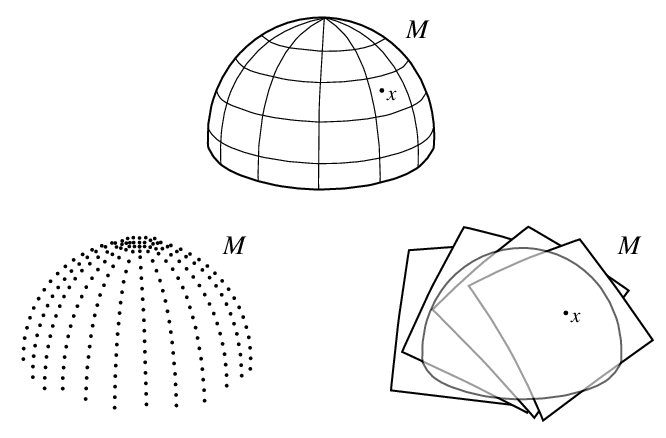
Figure 2: Two approaches to building a manifold: either by specifying its points or constructing tangent planes at each location, reflecting dual coordinate systems in manifold geometry.
- Theory-space (Hessian) Geometry:
- The set of theory-defining parameters (or, equivalently, functional sources and correlation functions) is treated as coordinates on a Hessian manifold. The metric is specified as the second functional derivative (Hessian) of a functional (Schwinger functional or effective action).
- Dual coordinate systems (Qα,Pα) correspond to sources and their conjugate expectation values or correlation functions.
- Connections, such as the Amari–Chentsov tensor, and non-metric compatibility lead to a rich structure, including geodesic flow equations associated with RG evolution, and the explicit emergence of information geometry concepts.
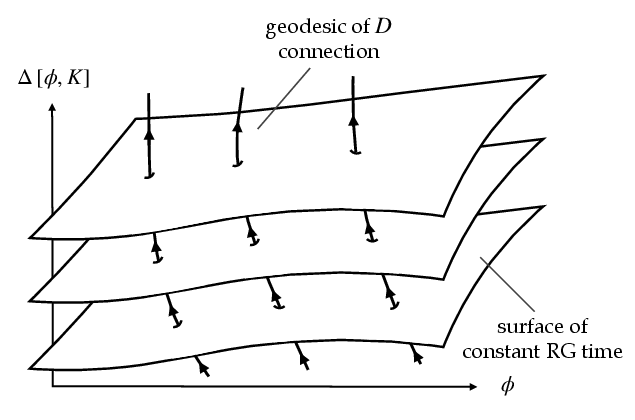
Figure 4: Schematic of the affine coordinate frame in theory space, showing how flows in configuration space correspond to changes in the RG scale, and how RG trajectories (geodesics) are constructed.
A critical result is that RG trajectories correspond to geodesics in theory space. Explicitly, by associating RG time with a flow parameter t∝lnk, and considering the equivalence between Legendre transforms, the flow of the effective action in 2PI formalism is recast as a geodesic equation with respect to the Hessian geometry induced by the Schwinger functional.
Field Redefinitions and Geometric Invariance
An important contribution is the rigorous treatment of field redefinitions. For scalar QFT with N fields, the action is shown to induce a metric on the field manifold such that under ultralocal redefinitions, the structure is preserved. This ensures that the Vilkovisky-covariant effective action is classically invariant under such changes, removing ambiguities due to redundant field parameterizations. However, the geometric approach illuminates the non-triviality of parameterization invariance off-shell and connects physical parameter flows to geometric data.
Implications and Future Directions
The geometric formalism developed enables:
- Coordinate-invariant computation of quantum effective actions, providing robustness under reparameterizations and deepening the connection to generalized information geometry.
- Natural non-perturbative RG equations derived from geometric properties, potentially improving the control over truncation errors and convergence in functional RG approaches.
- Unified interpretation of correlation functions, vertex resummation, and flow equations as geometric objects, facilitating the generalization to more complex field content, curved spacetime, or inclusion of additional symmetry sectors.
Potential extensions, as outlined in the discussion, include applications to open quantum field theories, inclusion of nonlocal redefinitions, gauge and gravitational sectors, and analysis of the subtle interplay between triviality and Landau poles in scalar field theory.
Conclusion
This work provides a comprehensive synthesis of scalar QFT, effective actions, and their geometry in the space of theories and configurations. The delineation between configuration-space (field) geometry and theory-space (Hessian) geometry is sharpened and operationalized for practical computations. The RG is reinterpreted as geometric flow, opening the door to further developments in the geometric analysis of QFTs, including applications to nonperturbative phenomena and the deep structure of quantum field-theoretic models. The framework delineated is well-positioned to inform advanced developments in field theory, functional RG analysis, and quantum gravity.
Paper to Video (Beta)
No one has generated a video about this paper yet.
Whiteboard
No one has generated a whiteboard explanation for this paper yet.
Paper Prompts
Sign up for free to create and run prompts on this paper.
Top Community Prompts
Open Problems
We haven't generated a list of open problems mentioned in this paper yet.
Continue Learning
- How does the geometric interpretation clarify the role of renormalization group flows in scalar quantum field theory?
- What are the advantages of using the 2PI effective action formulation over traditional 1PI methods in this context?
- How do covariant field redefinitions contribute to resolving ambiguities in parameterizing quantum field theories?
- Can the geometric framework presented be extended to more complex systems, such as gauge theories or theories in curved spacetime?
- Find recent papers about effective action techniques in quantum field theory.
Tweets
Sign up for free to view the 3 tweets with 38 likes about this paper.

