- The paper establishes that genuine multi-entropy, a refined tripartite entanglement measure, only becomes nonzero beyond linear perturbations in heavy local quenches.
- Using both holographic and CFT methods, the authors reveal that the multipartite entanglement dynamics is governed by distinct winding sector transitions in the dual geometry.
- Numerical and analytic results confirm sharp phase transitions in the entropy profiles, highlighting the breakdown of the quasiparticle paradigm in these non-equilibrium systems.
Genuine Multi-entropy Dynamics in Holographic Local Quenches
Introduction and Conceptual Framework
The paper "Multi-entropy in heavy local quenches" (2606.12526) conducts a detailed analytic and numerical study of the time evolution of genuine multipartite entanglement in two-dimensional holographic conformal field theories (CFTs) after a heavy local quench. The work explores the tripartite generalization of entanglement entropy—the so-called multi-entropy—and its refinement, genuine multi-entropy, which quantifies irreducible tripartite entanglement not accessible via bipartite diagnostics.
The central technical objects are:
- Genuine multi-entropy: This is defined as the tripartite multi-entropy minus appropriate combinations of bipartite multi-entropies, yielding a UV-finite, local-unitary-invariant measure that vanishes on layerwise-separable states.
- Heavy local quench: The excitation consists of inserting a primary operator with scaling dimension of order the central charge c at the origin. This operator introduces a falling massive particle in the dual AdS3 geometry, interpolating between conical defects and BTZ black holes, depending on the particle mass.
- Replica and holographic prescriptions: The study leverages the generalization of the replica trick to multipartite entanglement, with the holographic dual formulated in terms of an extremal ramifying network—bulk geodesic Steiner trees minimizing total length and subject to winding constraints.
Holographic and Boundary Methods
The analysis is performed using two parallel approaches: perturbative and fully back-reacted holographic calculations in the bulk, and vacuum block-dominant CFT calculations on the boundary.
Holographic prescription: The q-partite multi-entropy is computed via minimization of a bulk geodesic network homologous to the given boundary partition. In the tripartite (triangle) case, this is a network with three geodesics emanating from the three interval endpoints, meeting at a trivalent vertex. The following figure encapsulates the network structure:
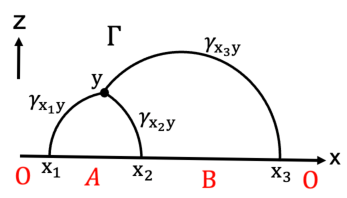
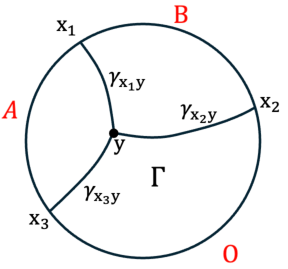
Figure 1: Holographic dual of tripartite multi-entropy for adjacent intervals in Poincaré coordinates (left) and global coordinates (right); the three endpoints are joined at a trivalent bulk vertex Y.
Replica partition function and twist formalism: On the CFT side, the multi-entropy becomes a correlation function of generalized replica twist operators inserted at the endpoints of the adjacent intervals, with branch choices in the uniformization map reflecting the winding sectors in the bulk.
Perturbative Bulk Analysis and Linearized Response
The first analytic result is that the leading order perturbative (linearized-mass) correction to the genuine multi-entropy vanishes identically for arbitrary adjacent intervals at any time after the local quench. This cancellation follows from specific polynomial identities relating the geodesic integrals for tri- and bi-entropy and the fact that all linearized (first-order) effects of the local energy injection are absorbed into the bipartite entanglement entropies. Thus, the genuine multi-entropy is "blind" to small local stress-energy perturbations and responds only to higher-order (nonlinear, global) data.
Fully Back-reacted Holographic Analysis: Winding Sectors
The core nontrivial content of the time-evolution of genuine multi-entropy arises only after accounting for the fully back-reacted geometry—i.e., with the complete gravitational field of the falling particle included. The key mechanism is a mismatch between the minimizing winding sectors for pairwise geodesics (bi-entropies) and the trivalent network (tri-entropy). Since the network minimization problems for the bipartite and tripartite cases are structurally distinct, there are intervals of time where the minimal windings are incompatible, leading to a nonzero vacuum-subtracted genuine multi-entropy.
Numerical solutions in both the conical defect and BTZ black hole regimes confirm that the time dependence of the genuine multi-entropy is characterized by multiple phase transitions:
- Support is delimited by bipartite winding transitions: The growth and decay of the measure are triggered by changes in the minimal winding number in the bipartite entropies (i.e., when a geodesic crosses the conical defect or black hole).
- Internal cusps arise from trivalent transitions: Within the support, the genuine multi-entropy is nonanalytic at times coinciding with jumps in the dominant trivalent network winding. The temporal profile exhibits either trapezoidal or triangular forms, depending on the subregion configuration.
- Independence from heavy operator dimension: In the sharp-quench limit (δ→0), the time dependence of the vacuum-subtracted genuine multi-entropy is given by explicit logarithms of rational functions in time, and is independent of the heavy operator's conformal dimension.
CFT Calculation and Saddle Matching
A parallel calculation based on the heavy-light vacuum block approximation (valid at large c and for a sparse spectrum) recovers exactly the same formula for the vacuum-subtracted genuine multi-entropy as the bulk computation. The branch choices in the multi-valued uniformization map (i.e., specifying which sheet of the branched covering one is on) are in one-to-one correspondence with bulk winding sectors for geodesics. The nonzero genuine multi-entropy measures the obstruction to simultaneously minimizing all entropic combinations on a compatible set of branches. The leading-order result is robust against the inclusion of further quantum or stringy corrections, which would generically smooth the sharp transitions.
Kinematic and Dynamical Structure: Beyond Quasiparticles
The global, nonlocal character of winding selection implies that the dynamics of multipartite entanglement cannot be captured by local or quasiparticle-based pictures. In particular, the time-dependence is purely kinematical in the sharp-quench limit, determined exclusively by the arrangement of interval endpoints. This is in contrast to quantities (like bipartite entropy) that are sensitive to local excitations and quasiparticle propagation. The breakdown of the quasiparticle paradigm is explicit in the occurrence of phase transitions in the genuine multi-entropy at times not associated with simple lightcone crossings of local excitations.
Numerical Results: Mass and Quench Width Dependence
The analysis includes extensive parameter scans demonstrating:
- The genuine multi-entropy profile is almost insensitive to the heavy operator mass (beyond the threshold distinguishing conical and black hole geometries).
- The onset becomes sharper with smaller quench width δ.
- The raw bipartite and tripartite entropies increase with mass and decreasing δ, but the genuine component remains robust.
Outlook and Implications
The results establish that, in holographic CFTs undergoing heavy local quenches, genuine multipartite entanglement is governed by global combinatorial and topological properties of the bulk and boundary networks. The genuine multi-entropy is a stringent probe of quantum information structure that detects features invisible to bipartite diagnostics.
Implications for quantum gravity and information:
- The work underscores the connection between entanglement geometry and the selection of saddle points/winding sectors in the gravitational dual, with implications for understanding information localization, entanglement wedge reconstruction, and entropy cone constraints.
- The breakdown of the quasiparticle picture for multipartite diagnostics signals the need for more global quantum information-theoretic approaches in dynamical settings.
- The independence from the local energy density or operator dimension at leading order suggests the universality and robustness of multipartite entanglement in non-equilibrium holographic systems.
Future directions include:
- Generalization to higher-partite entanglement, disjoint intervals, different quench protocols, higher-dimensional CFTs, and the incorporation of subleading quantum corrections or non-vacuum block contributions.
- Comparative studies with other multipartite diagnostics such as reflected multi-entropy, multipartite Markov gaps, and L-entropy.
Conclusion
This paper rigorously demonstrates that the time evolution of genuine multi-entropy in holographic local quenches obeys a robust, nonlocal, and topological selection mechanism governed by geodesic winding sectors, with sharp analytic control and numerical verification. These findings provide a foundational understanding for the structure and dynamics of multipartite entanglement in AdS/CFT and motivate continued investigation of multipartite measures as fundamental tools in quantum gravity and quantum many-body dynamics (2606.12526).

