- The paper demonstrates that direct detection experiments constrain reheating temperature by linking DM-SM coupling strengths to early-universe parameters.
- It shows that in the FISC regime, increasing the DM-SM coupling yields cross sections near current experimental limits while remaining consistent with relic density.
- The study integrates standard freeze-in with inflaton-seeded production, illustrating how a small inflaton branching ratio can dominate the dark matter abundance.
Direct Detection Constraints on Reheating Temperature: Freeze-In with Strong Couplings and Inflaton-Seeding
Introduction
This work provides a detailed analysis of how low-threshold direct detection experiments, specifically DAMIC-M and PandaX, impose constraints on the reheating temperature (TRH) in freeze-in Dark Matter (DM) scenarios. The study is set in the context of GeV–MeV scale DM with feeble interactions, mediated by an ultra-light U(1)X gauge boson kinetically mixed with the Standard Model (SM) hypercharge. The analysis explores standard freeze-in and the "freeze-in at stronger coupling" (FISC) regime, as well as hybrid production mechanisms including direct inflaton decay to the DM sector.
The central theme is the shift in the cosmological interpretation of direct detection: in strong coupling, low-reheating freeze-in scenarios, experiments transition from constraining DM interaction strength to constraining fundamental cosmological parameters such as TRH and the inflaton branching ratio to DM.
Freeze-In Mechanism and Strong Coupling Regime
Freeze-in is a non-equilibrium production mechanism for DM, characterized by extremely feeble couplings to visible sector particles. In standard freeze-in, the DM abundance is set by the integral of the production rate over cosmic time, typically requiring tiny interactions to avoid thermalization and DM overproduction.
The analysis demonstrates that relaxing the assumption of high TRH opens a regime where the relic density is exponentially sensitive to TRH (via Boltzmann suppression), rather than to a feeble DM-SM coupling. The FISC scenario leverages this feature: for mχ>TRH, the relic density can be matched by increasing the DM-SM coupling to the 10−9–10−8 range, which is within experimental reach, while still avoiding thermalization. The resulting direct detection cross sections can approach or exceed current exclusion limits.
The regions of parameter space allowed (or excluded) by both the relic density and direct detection limits are visualized by plotting iso-relic density curves for various TRH and experimental constraints in the (mχ,σe) plane.
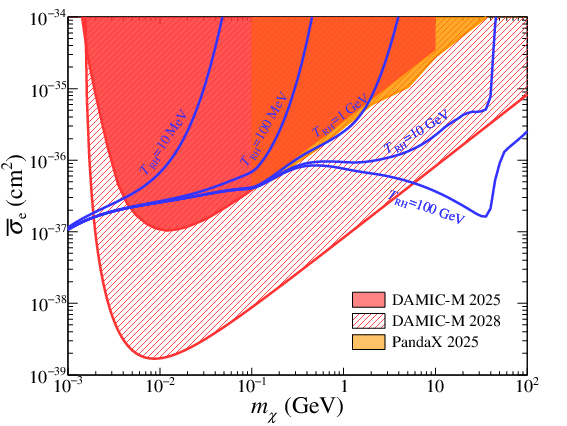
Figure 1: DM–electron cross section as a function of U(1)X0 for U(1)X1 ranging from U(1)X2 MeV to U(1)X3 GeV; blue curves show iso-relic density.
A key result is that DAMIC-M and PandaX have already excluded "standard" freeze-in for U(1)X4 in this vector portal scenario, and that the FISC mechanism allows viable models down to U(1)X5 1–10 GeV, considerably above the BBN floor.
Constraints on the Reheating Temperature
Direct detection limits are mapped into bounds on U(1)X6 by fixing the local DM abundance. For a given U(1)X7, the required cross-section for correct relic density increases rapidly as U(1)X8 drops below U(1)X9, until it violates current direct detection bounds, thus setting a lower bound on TRH0.
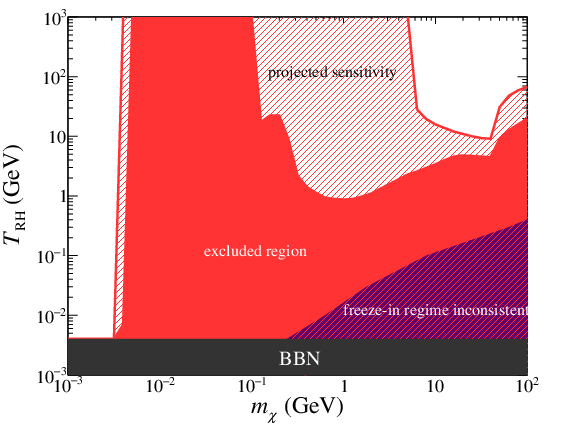
Figure 2: Exclusion zones of TRH1 as a function of TRH2; DAMIC-M excludes regions beyond the BBN limit, especially for TRH3.
The mapping is direct: since both the cosmological production rate and direct detection cross section scale quadratically with the coupling (TRH4), the exclusion is robust and only weakly model dependent, provided the mediator is ultra-light. The study delineates additional regions where the freeze-in mechanism is theoretically inconsistent (thermalization occurs in the dark sector) and where cosmological structure formation (Lyman-TRH5) restricts excessive DM free-streaming.
Inflaton-Seeded (Hybrid) Freeze-In
Given the lack of guaranteed thermalization in FISC/FIMP scenarios, the initial condition for the DM density cannot be neglected; any pre-existing abundance (e.g., from gravitational or inflaton-induced production) acts as a lower bound on the final relic density.
The paper extends the production analysis by including a direct non-thermal source: a small branching ratio for inflaton decays to DM (TRH6). The analysis computes the individual contributions from thermal freeze-in and inflaton decay, showing how even a tiny branching ratio can dominate the relic density if TRH7.
The interplay between the direct detection cross section, TRH8, inflaton branching ratio, and DM mass is visualized through contours in the TRH9 plane for fixed TRH0. This clearly demonstrates that in large regions of parameter space, the direct-detection-excluded cross section is decoupled from the total DM abundance if inflaton decay dominates.
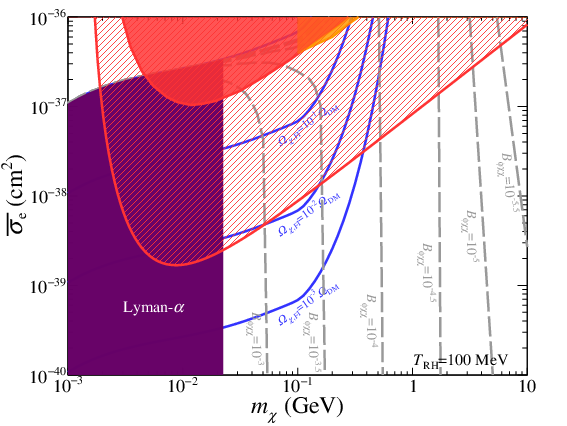
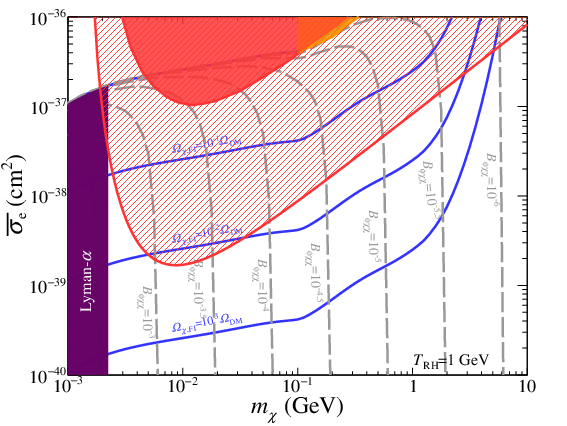
Figure 3: Contours of the branching ratio of inflaton decay into DM as a function of TRH1 and TRH2 for TRH3 MeV (top) and TRH4 GeV (bottom); freeze-in and inflaton decay contributions are disentangled.
The analysis identifies regions where Lyman-TRH5 structure formation bounds (on relativistic DM produced by inflaton decay) provide the strongest lower bound on TRH6, and regions where the relic density is insensitive to direct detection limits.
Implications and Outlook
The central implication is the reframing of low-threshold direct detection as a probe not only of DM-SM couplings but also of primordial cosmological history, specifically the energy scale of reheating and possible nonthermal DM sources. Current and next-generation direct detection experiments, especially those sensitive to DM–electron scattering, encroach upon cosmological territory traditionally only accessible via CMB or BBN.
Theoretically, the analysis mandates that DM model-building must always specify assumptions regarding TRH7 and initial dark sector abundance, and that future null results in direct detection will push constraints upward on TRH8 (and downward on inflaton branching fractions) independent of new physics mass scales. The study also provides a numeric framework that extends to generic freeze-in scenarios with arbitrary mediators.
Conclusion
This paper rigorously demonstrates that the landscape of viable freeze-in DM models—both standard and strong coupling—can be critically bounded by direct detection experiments, which now act as probes of the reheating temperature and associated cosmological parameters. Inflaton-seeded DM scenarios further complicate the mapping between cross section and relic abundance, necessitating careful consideration of all production channels. The ongoing improvement in experimental sensitivity ensures that direct detection will continue to play a significant role in constraining both particle and early-universe cosmology.
Reference: "When direct detection constrains reheating temperature: freeze-in with stronger couplings and inflaton-seeded freeze-in" (2606.12408)

