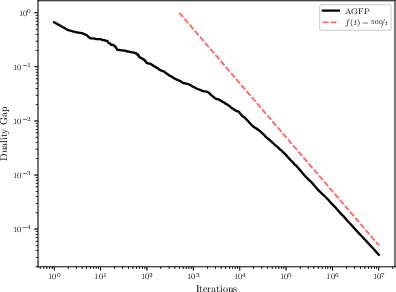
- The paper introduces AGFP, an adaptive stepsize method that almost minimizes the duality gap in zero-sum games, achieving an O(1/T) convergence rate.
- It reformulates classic Fictitious Play by integrating a constrained line search over [δ, 1] to avoid stagnation, with both theoretical guarantees and empirical validation.
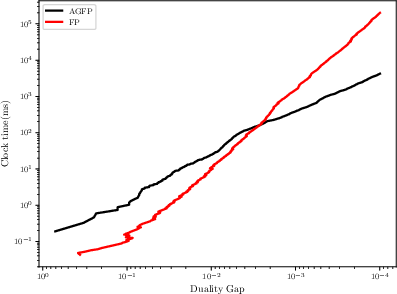
- Empirical results show significant improvements over standard FP, including up to 50x speedup in large-scale Gaussian games, demonstrating AGFP’s practical impact.
Almost Greedy Fictitious Play: Instance-Optimal Step Selection for Zero-Sum Games
Introduction
This work introduces Almost Greedy Fictitious Play (AGFP), a variant of Fictitious Play (FP) designed for efficient convergence to Nash equilibrium in zero-sum games without recourse to discretization artifacts. Building on the classic FP framework—where agents update their mixed strategies by best responding to opponent history and then averaging—AGFP employs an adaptive stepsize at each iteration, greedily chosen to (almost) minimize the duality gap along the line segment to the current best responses. The key innovation is constraining the stepsize search to [δ,1], with δ>0 serving as a regularization parameter to circumvent stalling at non-progressing points due to numerical or tie-breaking issues.
Algorithmic Framework
The core insight is that standard Fictitious Play (with step $1/(t+1)$) can be viewed as Frank-Wolfe with a canonical schedule. In contrast, the Greedy Fictitious Play variant replaces this schedule with a line search determining the step along the direction from the current iterate towards the best response in the strategy space, minimizing the duality gap. However, directly minimizing over [0,1] is problematic due to potential stagnation when the minimizer is at zero. AGFP avoids this by enforcing ηt≥δ.
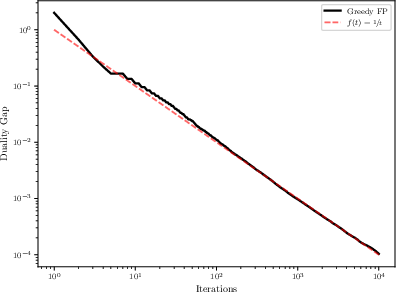
Figure 1: Greedy Fictitious Play progression in the Rock-Paper-Scissors game.
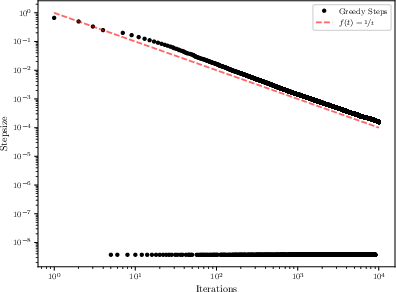
Figure 2: Greedy stepsize ηt selected in the initial iterations.
Formally, denoting the current average strategies by (xt−1,yt−1) and the best responses by (eit,ejt), AGFP computes
ηt=η∈[δ,1]argminψ((1−η)zt−1+η(eit,ejt)),
where ψ is the duality gap metric. The updated profile is set as the aforementioned convex combination.
Theoretical Properties
The primary theoretical result establishes that AGFP attains an δ>00 rate with respect to the duality gap, where the hidden constant is game-dependent and reflects a novel "condition-like number" δ>01. This rate matches that of continuous-time Fictitious Play without the discretization degradation inherent in the classic FP. The analysis hinges on the conditional decrease in the duality gap, the identification of tie-breaking and stability regimes for best responses, and structuring the sequence of iterates to avoid pathological stagnation.
Importantly, the results hold for last-iterate convergence, not merely on averaged sequences, and the adaptive stepsize is shown to be optimal up to game constants. The duality gap decrease is often geometric along segments where best responses remain stable and is maintained by δ>02-truncated steps elsewhere.
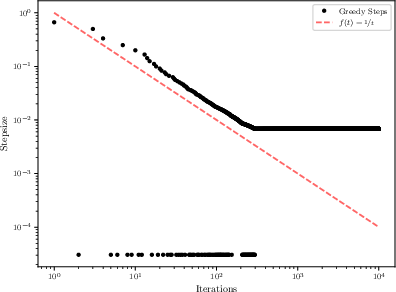
Figure 3: AGFP performance on Rock-Paper-Scissors with δ>03; duality gap approaches plateau determined by δ>04.
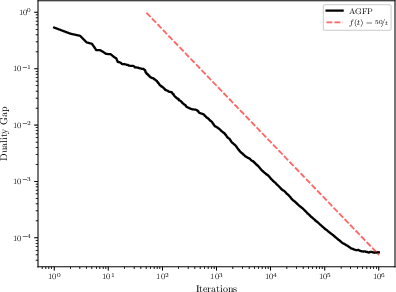
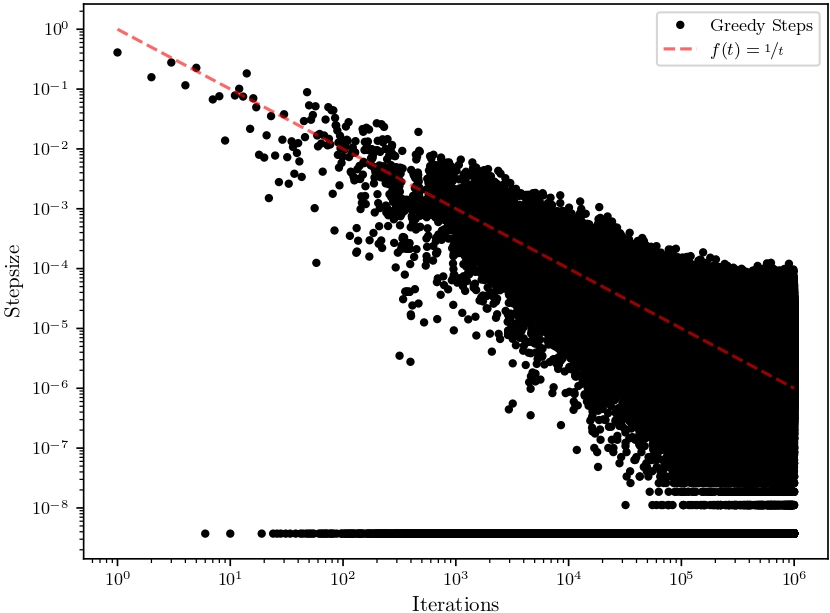
Figure 4: Duality gap per iteration, illustrating δ>05 behavior across iterations in random Gaussian games.
Empirical Evaluation
AGFP was evaluated on canonical and high-dimensional random zero-sum games. The algorithm consistently demonstrated superior convergence over classic FP:
In Rock-Paper-Scissors and its generalizations, the optimal stepsize schedule closely follows $1/(t+1)$3 when resolving in the correct tie-breaking regime, and $1/(t+1)$4-induced plateaus emerge as predicted by theory.
Implications and Future Directions
AGFP eliminates the reliance on coarse discretization, providing an instance-optimal, last-iterate convergent method for zero-sum games. This property is relevant for large-scale, distributed, or online equilibrium computation. The $1/(t+1)$5 constant, akin to a local condition number, invites further investigation, especially with respect to smoothed analysis and connections to recent advances in the convergence theory of gradient-based equilibrium algorithms (2606.12149).
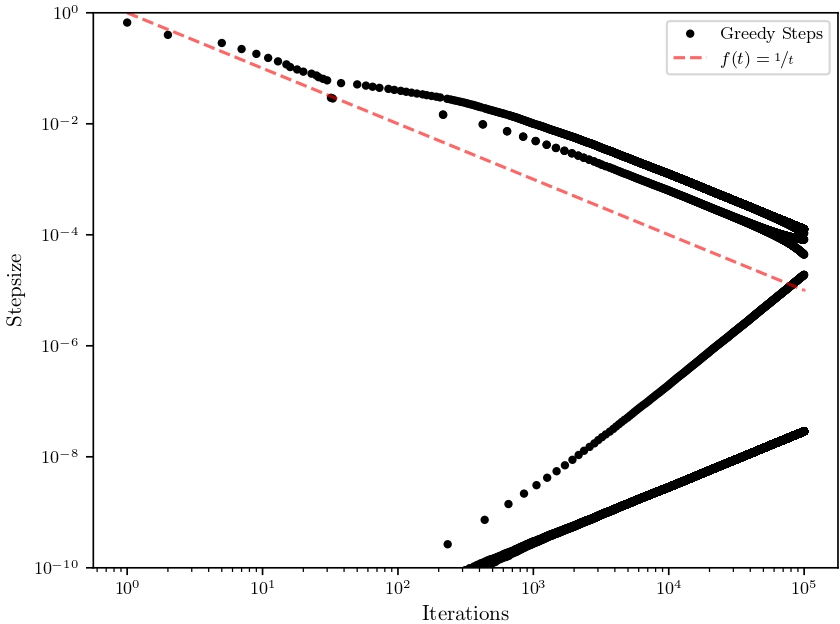
Figure 7: Stepsize trajectory in higher-dimensional RPS; emergence of line segments with stepsizes distinct from $1/(t+1)$6.
The methodology opens several avenues:
- Extension to Potential Games: AGFP presents a promising template for efficient equilibrium finding where jumps to pure Nash equilibria can be exploited.
- Smoothed Complexity: Bounding or characterizing $1/(t+1)$7 in generic settings could bridge gaps in longstanding conjectures concerning Fictitious Play, especially in random matrices.
- Non Zero-Sum and General-sum Extensions: Adapting the AGFP framework and duality gap minimization strategies to broader classes of games.
- Tie-Breaking and Memory-Augmented Dynamics: Unexplained empirical phenomena in high-dimensional RPS suggest further study on history-sensitive or stochastic tie-breaking rules.
Conclusion
AGFP leverages adaptive, instance-optimal step selection to achieve theoretically backed and empirically validated convergence in zero-sum games. Its regularization mechanism ensures robust progress, and its performance suggests AGFP as a compelling tool for equilibrium computation in high-dimensional, practical settings. Future research should focus on the theoretical understanding of $1/(t+1)$8, extensions beyond zero-sum settings, and integration with modern policy optimization and adversarial learning frameworks.