- The paper shows that the dinuclear Eu³⁺ complex exhibits a significantly enhanced 1.30% branching ratio for the coherent transition compared to 0.14% in the mononuclear form.
- The methodology employs photoluminescence and spectral hole burning at cryogenic temperatures to reveal long optical coherence with intrinsic linewidths of 28.8 kHz (mono) and 73.5 kHz (di).
- The work demonstrates cavity-enhanced emission with an effective Purcell factor of 380±40, establishing a pathway for deterministic multi-qubit quantum registers.
Controlled Ion-Ion Interactions and Cavity-Enhanced Emission in Dinuclear Eu3+ Molecular Complexes
Introduction
The integration of rare-earth ions (REIs) into molecular architectures presents a paradigm for scalable solid-state quantum technologies by leveraging the exceptional coherence properties of REIs and the versatility of chemical engineering. The study systematically investigates and compares a mononuclear and a dinuclear Eu3+ complex, focusing on photoluminescence (PL) properties, optical and hyperfine coherence, controlled dipole-dipole interactions, and the impact of photonic environment integration on emission efficiency. The dinuclear architecture enables precise control over intra-molecular ion positioning, offering a platform to study coupling-induced dephasing and to realize deterministic multi-qubit quantum registers.
Photoluminescence Properties and Transition Branching
The molecular structures of the mononuclear Eu(btfa)3(bipy) and dinuclear Eu2(btfa)6(bpim) complexes were characterized, confirming well-defined Eu3+ positions and fixed D4d-like core symmetries. The PL spectra show dominant 5D0→7FJ (3+0 = 0-4) transitions with highly resolved spectral lines. The dinuclear species exhibits a pronounced enhancement in the branching ratio of the coherent 3+1D3+2F3+3 transition—1.30% for Eu-di compared to 0.14% for Eu-mono. This increase is attributed to symmetry relaxation and inter-lanthanide dipolar perturbations, which promote 3+4-mixing, as also reflected in the broader full width at half maximum (FWHM) of the corresponding emission lines in Eu-di.
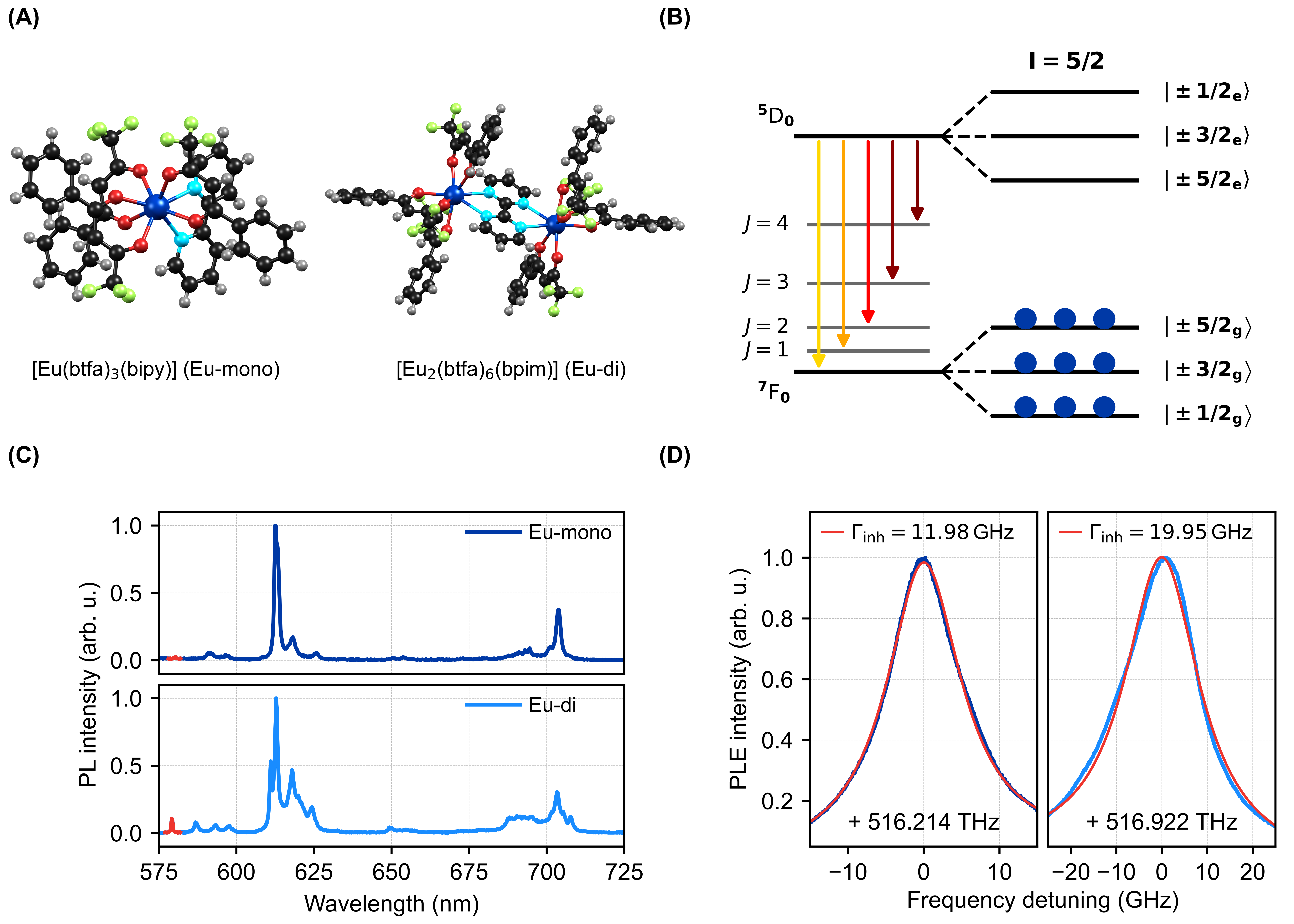
Figure 1: Photoluminescence properties and molecular structures of Eu-mono and Eu-di; Eu-di exhibits enhanced coherent transition spectral intensity and broadening.
Optical and Spin Coherence at Cryogenic Temperatures
The homogeneous and inhomogeneous optical linewidths were quantified through PL excitation and spectral hole burning (SHB) experiments at sub-Kelvin temperatures. Both complexes maintain low inhomogeneous broadening, with Eu-di presenting a broader profile, partially due to increased molecular disorder in the extended structure.
SHB reveals narrow homogeneous linewidths of 210 kHz (Eu-mono) and 235 kHz (Eu-di), signifying long optical coherence and placing an upper bound set by laser linewidth. Hyperfine lifetime analyses discern prolonged nuclear spin relaxation: hour-scale for sub-populations in Eu-mono and a bi-exponential decay with the dominant 3+5 s component for Eu-di. The latter indicates additional relaxation channels in the multinuclear framework, potentially mediated by increased phonon or paramagnetic coupling.
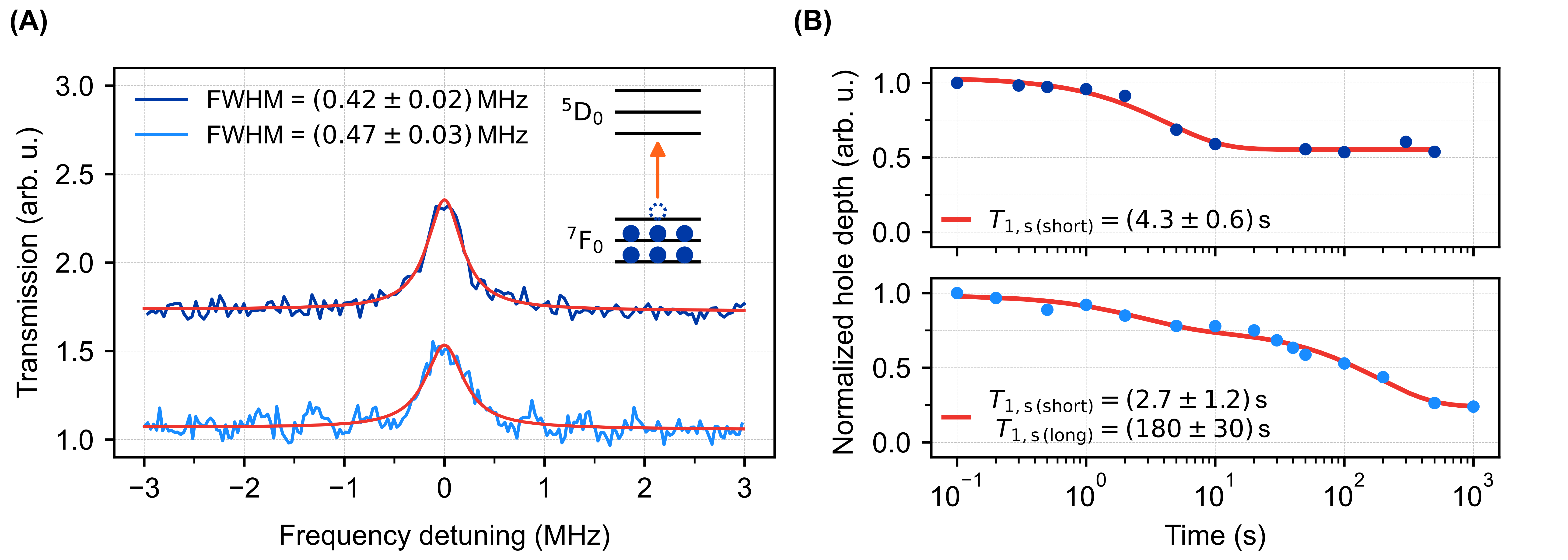
Figure 2: Spectral hole burning linewidths and hyperfine lifetime decays show narrow lines and long-lived hyperfine states, with distinct relaxation signatures for the mono- and dinuclear cases.
Optical coherence was further characterized using free induction decay (FID) and two-pulse photon echo techniques. The dinuclear complex, despite broader ISD, maintains long photon echo decays (3+6s for Eu-di, 3+7s for Eu-mono at lowest power), with the former exhibiting a stronger power dependence and a larger excitation-induced broadening slope. Zero-power extrapolation yields intrinsic homogeneous linewidths of 28.8 kHz (Eu-mono) and 73.5 kHz (Eu-di).
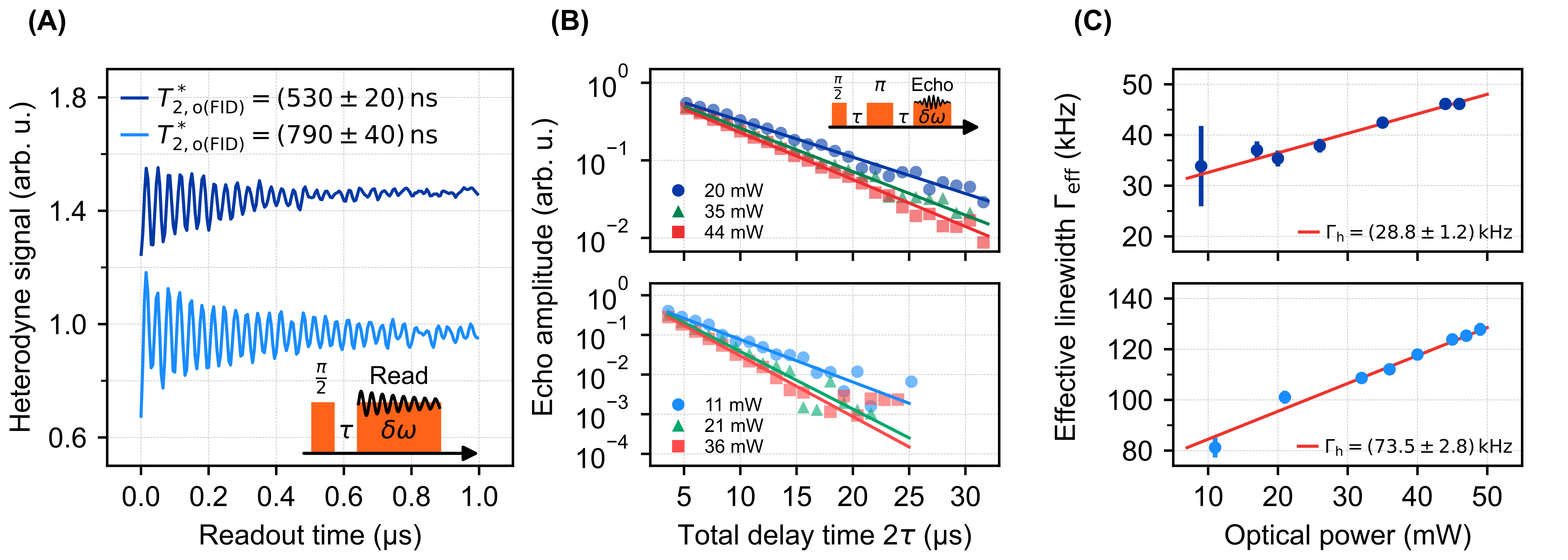
Figure 3: Optical coherence and dephasing dynamics via FID and photon echo, demonstrating long 3+8 and systematic power-dependent broadening.
Controlled Ion-Ion Interactions
A control-target protocol was implemented to probe optically induced dipole-dipole interactions. A frequency-selective “control” pulse excites a sub-ensemble (control ions), and the effect on the photon echo of a spectrally distinct “target” sub-ensemble is monitored. The dinuclear complex exhibits a significantly stronger interaction-induced broadening, with 3+9 kHz, over three times that observed in the mononuclear complex. This result directly links the deterministic Eu-Eu separation in the dinuclear complex to controllable, stronger dephasing, confirming the feasibility of using such molecular architectures for implementing two-qubit gates via conditional optical control.
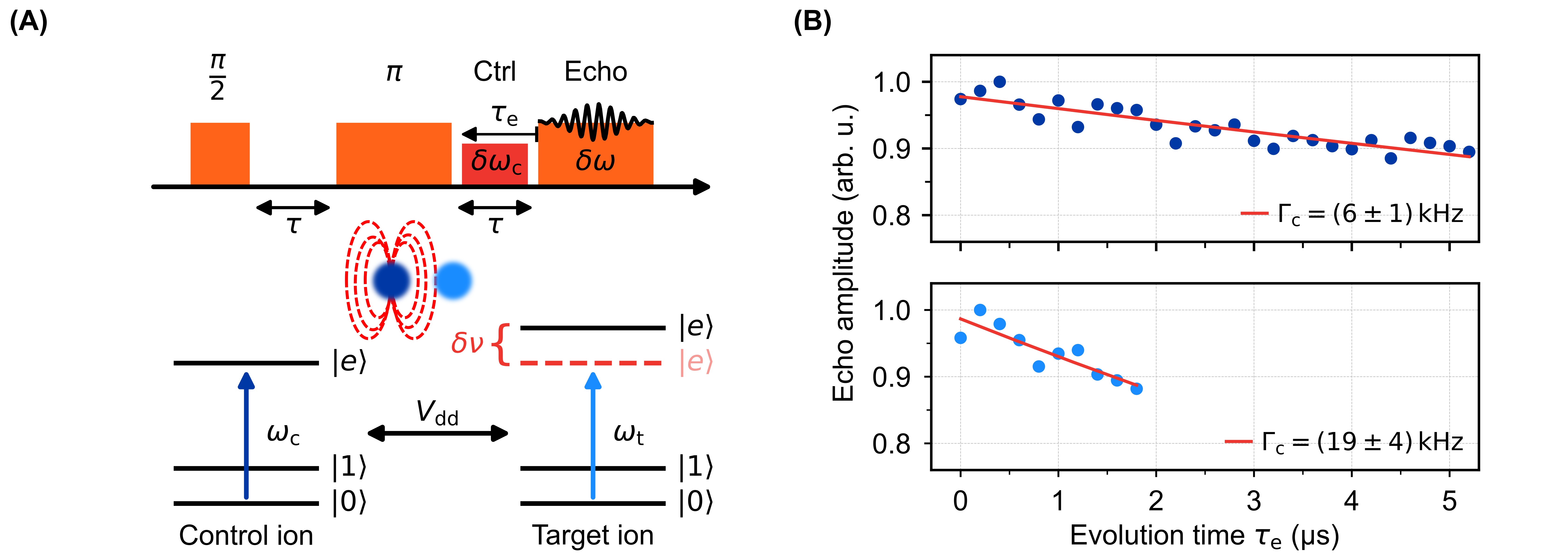
Figure 4: Pulse sequence and echo decay as evidence of optically controlled ion-ion interactions: Eu-di shows much stronger interaction-induced dephasing relative to Eu-mono.
Cavity-Enhanced Emission and Purcell Effect
Eu-di was integrated into a fiber-based Fabry-Pérot microcavity, yielding substantial Purcell enhancement of the coherent 30D31F32 transition. The measured cavity resonance at cryogenic temperatures indicates a linewidth of 1.6 GHz and a finesse of 21,500, enabling high quality factor and substantial field confinement.
Time-resolved emission experiments reveal a clear reduction in the excited state lifetime inside the cavity: analysis at 6 K indicates a two-component decay, with the short-lifetime component representing dipole-aligned emitters maximally coupled to the cavity mode. The extracted effective Purcell factor for optimal sub-ensembles is 33. This translates to over two orders of magnitude enhancement in the emission probability for the coherent optical transition, marked improvement in both quantum yield and collectable photon fraction into the cavity mode.
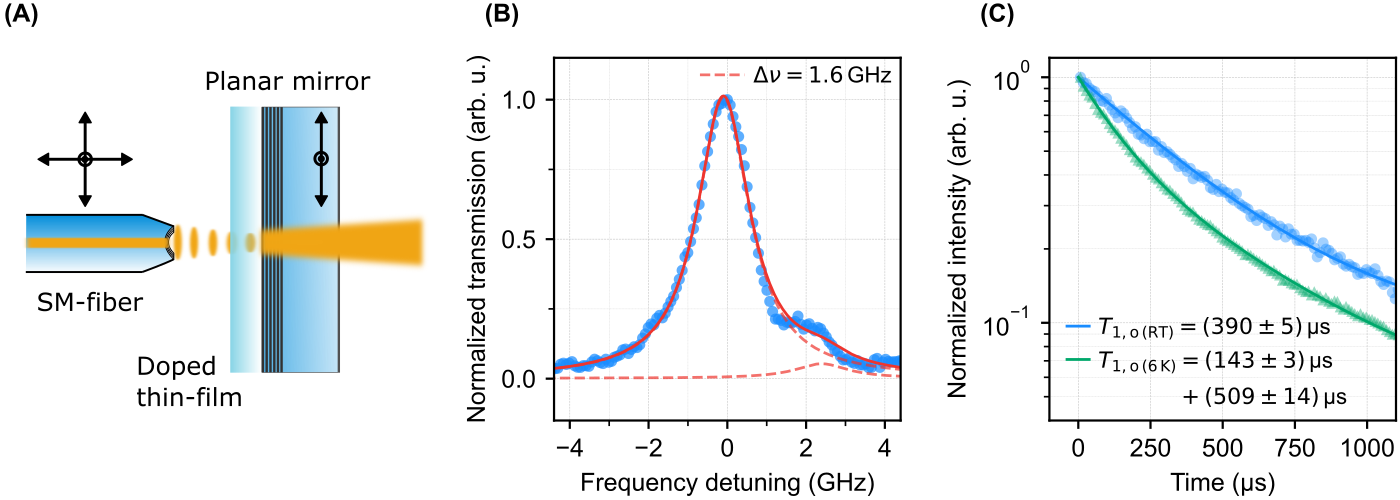
Figure 5: Fiber-based optical microcavity enables Purcell-enhanced emission, significantly increasing the quantum yield and branching ratio of the coherent optical transition in Eu-di.
Implications and Future Directions
The demonstration of chemically deterministic ion-ion coupling, power-tunable dephasing, and substantial cavity-induced emission enhancement establishes dinuclear Eu34 complexes as viable and tunable qubit resources for solid-state quantum technologies. The ability to engineer intra- and inter-molecular separations with chemical precision allows for customizable gate strengths and coherence properties, foundational for scalable quantum registers.
From a practical perspective, further optimization of dopant loading, molecular ligand design, and thin-film crystallinity will be necessary to maintain long coherence at high density and maximize cavity coupling efficiency. On the theoretical side, the results motivate systematic modeling of multi-ion decoherence channels, especially in architected multinuclear molecular networks, and the development of protocols for selective ion-pair distillation to isolate deterministic quantum gates.
Technologically, these findings enable routes toward hybrid quantum interfaces for photonic networks, quantum repeaters, and error-corrected quantum memory architectures with molecular-scale addressability and tunability, bridging synthetic chemistry and quantum device engineering.
Conclusion
This study establishes Eu35-based multinuclear molecular platforms as highly coherent, chemically tunable candidates for scalable quantum devices. Enhanced interaction control in dinuclear architectures, long-lived coherence, and robust cavity-based emission enhancement provide crucial advances toward deterministic multi-qubit registers and scalable quantum interconnects (2606.11947). The modularity and synthetic flexibility inherent to molecular design offer new dimensions for optimizing coherence, coupling, and readout, positioning these systems as a frontier for quantum science and technology.