Polarization-Resolved Photon Statistics of Cavity Quantum Materials
Published 10 Jun 2026 in cond-mat.mes-hall, cond-mat.str-el, physics.optics, and quant-ph | (2606.11550v1)
Abstract: By forming hybrid light-matter states, optical cavities offer a route for engineering material properties, however, unambiguously probing the effects of light-matter coupling remains difficult. Here, we show that the polarization-resolved statistics of photons transmitted through a cavity, measurable via $g{(2)}$, provide one such diagnostic. By relating $g{(2)}$ to matter correlation functions such as the Raman structure factor, we link photon bunching and antibunching to material properties. By applying this method to the stripy-to-antiferromagnetic transition in the Kitaev-Heisenberg spin model, we find that polarization-dependent patterns of bunching and antibunching encode the magnetic point-group symmetries of each phase and characterize the behavior at the phase boundary. Finally, we predict measuring $g{(2)}$ for output photon pairs polarized orthogonal to the input field will isolate higher-order light-matter scattering processes that probe higher-order material correlations.
The paper introduces a framework for employing polarization-resolved photon correlation functions to diagnose quantum many-body states in cavity materials.
It leverages Hanbury Brown-Twiss setups and Lanczos diagonalization to identify phase transitions via discontinuities in g^(2) spectra.
The work demonstrates that symmetry-filtered photon statistics can directly reveal hybrid light-matter interactions and enable non-classical light generation.
Polarization-Resolved Photon Correlation Diagnostics in Cavity Quantum Materials
Introduction and Motivation
The intersection of cavity quantum electrodynamics (QED) and quantum materials has rapidly evolved, targeting both the engineering of new materials phases via hybrid light-matter states and the identification of unambiguous observables that reveal photon-induced modifications of many-body ground states. This work, "Polarization-Resolved Photon Statistics of Cavity Quantum Materials" (2606.11550), develops a theoretical and computational framework for polarization-resolved photon correlation measurements and establishes their utility as sensitive, symmetry-resolving diagnostics for complex magnetic phases in cavity-embedded quantum magnets. In contrast to conventional linear spectroscopic observables—including transmission and Raman—which typically capture only polaritonic splitting and selection rules of single excitations, this paper demonstrates that polarization-resolved second-order coherence functions, g(2), are directly sensitive to quantum many-body correlations and light-matter induced nonlinearities.
The principal observable is the polarization-resolved equal-time second-order coherence function gμμ′(2)(0), accessed via Hanbury Brown-Twiss setups, and analytically tractable via the Gardiner-Collett input-output formalism. For a two-polarization cavity driven by a coherent input of polarization ν and frequency ωin, the ratio of two-photon to uncorrelated single-photon detection rates,
where U(n) are the system-plus-n-photon evolution operators incorporating the full matter-light coupling and O(n) projects onto the detector-filtered polarization sectors, quantifies deviations from classical photon statistics due to quantum many-body interactions. The photon statistics encode the effects of the material subsystem on the quantum state of the outgoing light via Raman-like and higher-order correlation functions.
Importantly, polarization selection in both the drive and the detection processes enables symmetry channel isolation—akin to polarization-resolved Raman—but in a distinctly non-linear, non-classical observable.
Model System: Kitaev-Heisenberg Magnet in a Cavity
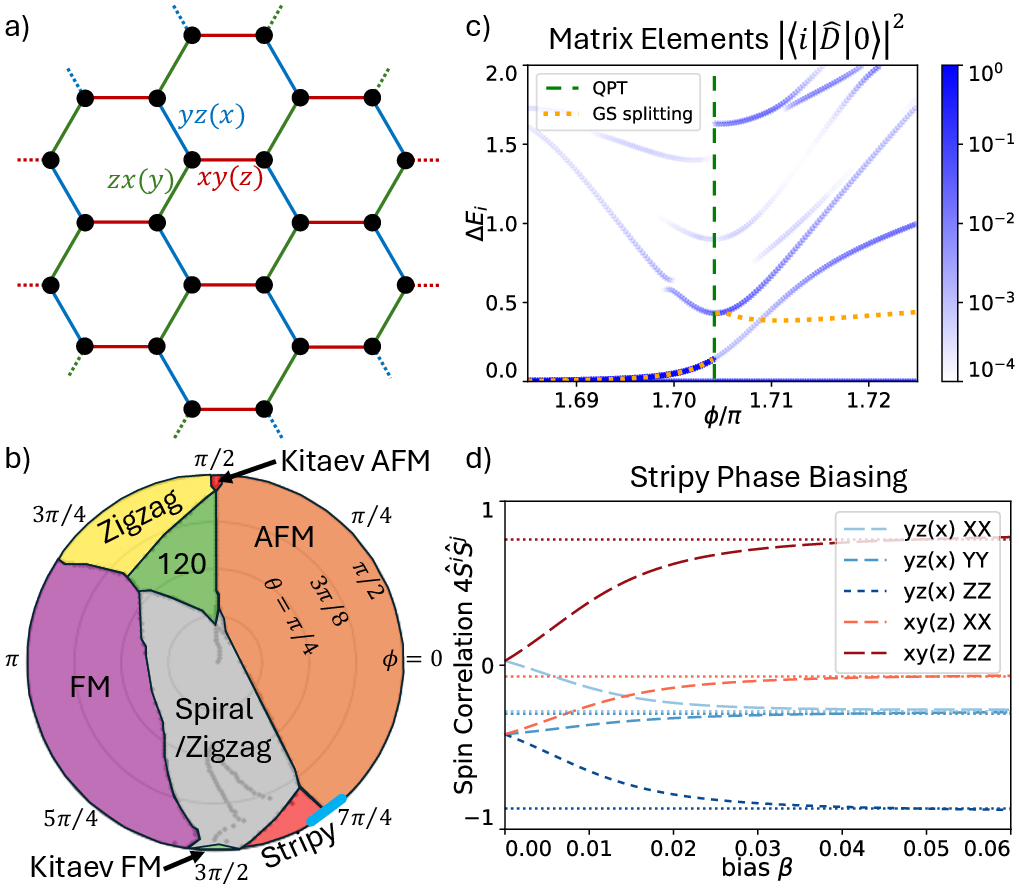
To concretely establish the diagnostic capability of polarization-resolved g(2), the study focuses on the honeycomb-lattice Kitaev-Heisenberg spin model under a small [111] magnetic field, a paradigm for correlated quantum magnets with strong spin-orbit coupling. The phase diagram exhibits a first-order transition between stripy (C2) and Néel antiferromagnet (gμμ′(2)(0)0) magnetic phases, allowing exploration of phase-symmetry fingerprints and phase-boundary features in photon statistics.
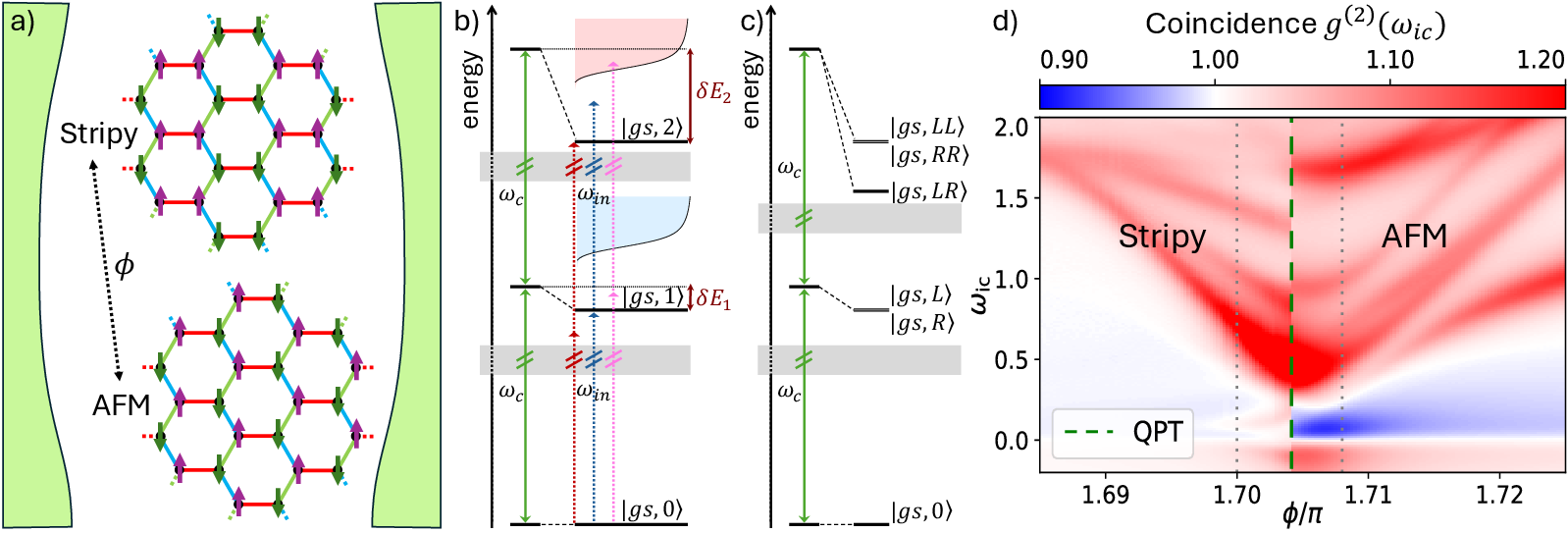
Figure 1: Many-body photon blockade and energy spectra for the cavity-embedded Kitaev-Heisenberg model. (a) The model phase competition. (b) Nonlinearity in energy levels with light-matter coupling. (c) Splitting of photon-polarization-resolved states. (d) Discontinuity in gμμ′(2)(0)1 at the first-order quantum phase transition.
Numerical Results: Phase-Resolved and Symmetry-Sensitive Photon Statistics
Single-Polarization Coincidence and Many-Body Photon Blockade
Lanczos diagonalization on a 24-site cluster establishes the single-polarization gμμ′(2)(0)2 spectrum versus cavity detuning and Hamiltonian parameters. Two critical signatures are observed across the stripy-to-AFM transition:
Antibunching regions appear inside the excitation gap, while bunching tracks matter excitation resonances. These features result from many-body photon blockade, a collective blockade mechanism originating from photon-induced ground-state energy shifts scaling nonlinearly with photon number (gμμ′(2)(0)3).
The phase transition is detected as a discontinuous jump in the gμμ′(2)(0)4 spectrum: for a first-order transition, the discontinuity directly reflects abrupt reorganization of the magnetic ground state and its symmetry, visible both as shifts in bunching peaks and jumps in antibunching strength.
Symmetry Diagnostics via Polarization-Dependent Coincidence
The polarization dependence of gμμ′(2)(0)5 provides direct access to magnetic point-group symmetries:
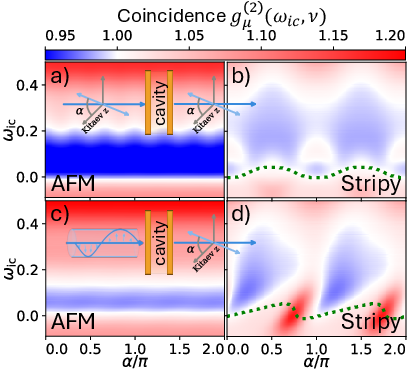
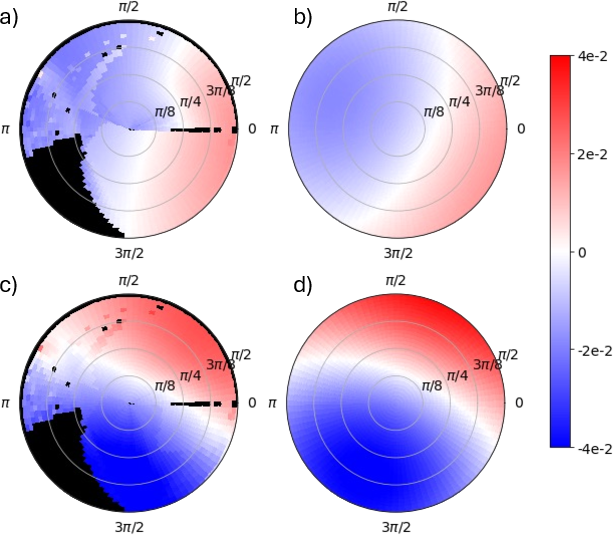
Figure 2: Coincidence gμμ′(2)(0)6 as a function of output polarization. (a, c) gμμ′(2)(0)7 symmetric AFM response. (b, d) gμμ′(2)(0)8 in the stripy phase. Color scale tracks bunched vs antibunched output distinguishable by phase.
Unrotated linear polarization: The AFM phase (gμμ′(2)(0)9 in finite clusters) yields six-fold rotational symmetry, while the stripy phase (ν0) presents only two-fold symmetry and anisotropy in the cavity’s mode splitting.
Rotated and circular polarization: For right-circularly polarized input, the response inherits the underlying phase symmetry; importantly, phases with ν1 symmetry yield a continuous rotationally symmetric ν2 signal—this is a robust group-theoretical consequence of the tensor structure of the response.
Nonlinear Correlation Filtering by Orthogonally Polarized Coincidence
A crucial result involves selectively measuring photon coincidences with polarization orthogonal to that of the input field:
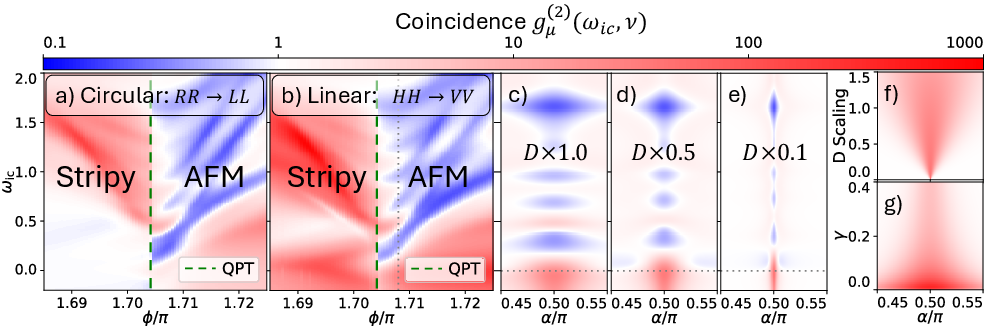
Figure 3: Coincidence response across the phase transition for cross-polarized output. Enhanced bunching and antibunching trace higher-order correlations inaccessible to unrotated configurations.
Forward-scattered photons are eliminated, so the observed ν3 is completely dominated by processes where both photons have scattered from the material. In linear response, this post-selection typically isolates four-point (or higher) matter correlation functions, making the measurement a direct probe of higher-order quantum fluctuations—not just the two-point Raman structure factor.
Strong numerical enhancement of bunching/antibunching: The magnitude and frequency structure of ν4 for rotated polarization can exceed that of unrotated channels, even for weak light-matter coupling. The dependence on light-matter coupling, cavity linewidth, and rotation angle is quantitatively established.
Figure 4: Angle- and coupling-dependence of cross-polarized coincidence. The signal remains robust at ν5 (orthogonal) as coupling ν6, vanishing elsewhere for weak coupling.
Implications, Limitations, and Future Directions
Diagnostic Power in Phase and Symmetry Identification
These findings directly demonstrate that polarization-resolved photon statistics offer a route to phase identification—via both continuous observables (symmetry fingerprints) and singular features at phase boundaries (discontinuities at first-order transitions)—in cavity-embedded materials. Unlike linear spectroscopies, ν7 provides sensitivity to many-body quantum correlations mediated by virtual photon exchange and symmetry-filtered higher-order fluctuations.
Quantum Light Generation and Applications
Regions of strong antibunching in the cross-polarized channel identify parameter regimes for the deterministic generation of non-classical light, such as antibunched single photons, in a manner tunable via the quantum material phase and cavity detuning. A detailed understanding of polarization-resolved ν8 informs both the synthesis and control of quantum light sources, with implications for quantum information science, entanglement generation, and quantum metrology.
Extensions and Open Questions
The methodology naturally generalizes to more complex correlated electron systems and other quantum phases (e.g., spin liquids), where large-scale quantum correlations and fractionalized excitations may yield unique signatures in cross-polarized higher-order photon correlations. The capability to access non-local and topological operators—potentially ν9 fluxes in the Kitaev spin liquid—via polarization-rotated ωin0 is identified as an important future direction.
A key practical limitation is finite system size—exact diagonalization becomes intractable for larger clusters, limiting direct access to thermodynamic signatures, especially in phases with subtle order or disorder (e.g., spin liquids). The study outlines directions for hybrid approaches exploiting tensor networks or quantum simulation platforms.
Conclusion
This work establishes polarization-resolved photon coincidence as a powerful, symmetry-sensitive, and phase-discriminating diagnostic for cavity quantum materials. By connecting the statistics of transmitted photons to material Raman and higher-order correlation functions, it realizes a direct probe of the underlying quantum state influenced by cavity QED effects—revealing not only symmetry and phase boundaries but also opening new paths for the generation and manipulation of quantum light in hybrid light-matter platforms.
Figure 5: Schematic phase diagram and symmetry correspondence, illustrating the capability of polarization-dependent ωin1 to resolve fine features of the quantum material state—symmetry, phase boundaries, and nonlinear light-matter interactions.
“Emergent Mind helps me see which AI papers have caught fire online.”
Philip
Creator, AI Explained on YouTube
Sign up for free to explore the frontiers of research
Discover trending papers, chat with arXiv, and track the latest research shaping the future of science and technology.Discover trending papers, chat with arXiv, and more.