- The paper demonstrates that strategic pre-trade communication in trader networks leads to only partially informative prices, even in a noise-free setting.
- The model extends the Kyle (1985) framework using a two-stage Bayesian game to capture the tradeoffs in information sharing and competitive trading.
- It further shows that endogenous network formation results in clique structures where traders balance the benefits of information access against the costs of competitive dilution.
Introduction
"Revealing information -- or not -- in a social network of traders" (2606.11053) develops a game-theoretic framework for asset markets with strategic communication. The model extends the canonical Kyle (1985) setting by endogenizing information transmission via trader social networks, scrutinizing the impact on equilibrium prices, allocative efficiency, and network endogeneity. A central and nonintuitive finding is that, even in environments where market prices would be fully revealing absent pre-trade communication, the possibility of information sharing induces equilibria where prices are only partially revealing—even with risk neutrality and in the absence of exogenous noise. This information inefficiency persists both with exogenously given and endogenously formed networks.
Model Description
The core mechanism is a two-stage Bayesian game among a finite set of strategic traders embedded in a directed social network.
- Information-Acquisition Stage: Nature selects a single trader (with known ex ante probabilities) and provides them with a perfectly informative signal about the fundamental return r of the traded asset. This informed trader decides whether to reveal the signal to all her direct out-neighbors or to conceal it.
- Trading Stage: All traders simultaneously choose asset positions conditioned on their information and beliefs; non-strategic agents contribute deterministic, price-sensitive demand.
Market clearing determines prices as a linear function of the strategic and non-strategic sector aggregate trades. The only payoff-relevant state variable is the signal r, typically assumed to have full support and differentiable density.
The possibility of information revelation induces informational asymmetry among traders, as shown schematically:
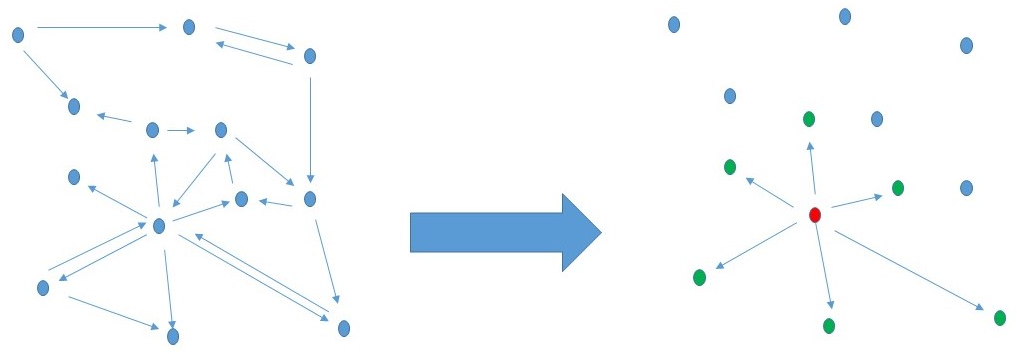
Figure 1: Informational partition after Nature’s signal, with the informed trader (red) possibly transmitting to a subset (green) of the network; others (blue) remain uninformed.
Equilibrium Characterization
Revelation Decision
The informed trader faces a tradeoff:
- If r is extreme (very high or low): Profits from exclusive access outweigh competitive losses and so information is concealed.
- If r is moderate: Revealing the signal to neighbors dilutes competition sufficiently to make sharing optimal. This is because when out-neighbors are informed, their subsequent trades are less aggressive, flattening the aggregate demand function and enabling the original informed trader to extract higher surplus by moderating overall demand impact.
As a result, in the unique PBE, revelation occurs on a non-degenerate interval (ai,bi). Both the lower and upper interval bounds are endogenous fixed points, determined by best responses in the trading subgame and dependent on the network's degree structure.
Trading Behavior
Conditional on revelation, all informed parties (original and out-neighbors) coordinate on the same optimal trade, given by:
xi(r)=2+ℓir−Zi
where ℓi is the out-degree of the informed trader and Zi is the aggregate trade of agents not in the information cluster.
If the informed trader conceals, they optimally choose
xˉi(r)=21(r−Zi−ℓiyˉj(i))
where yˉj(i) is the trade of uninformed out-neighbors, computed from their Bayesian posterior over the non-revelation region.
The equilibrium is fully pinned down via a fixed-point argument relating these trades, the revelation probability, and the network structure. Notably, there is equilibrium uniqueness.
A key theoretical contribution is demonstrating a robust breakdown of full price revelation: even though signals are, in a sense, perfectly transmissible, strategic interaction and asymmetric network connectivity make equilibrium prices only partially informative. Specifically, for intermediate r0, revelation to a subset of the market induces a discontinuity in the price-schedule mapping as illustrated below:
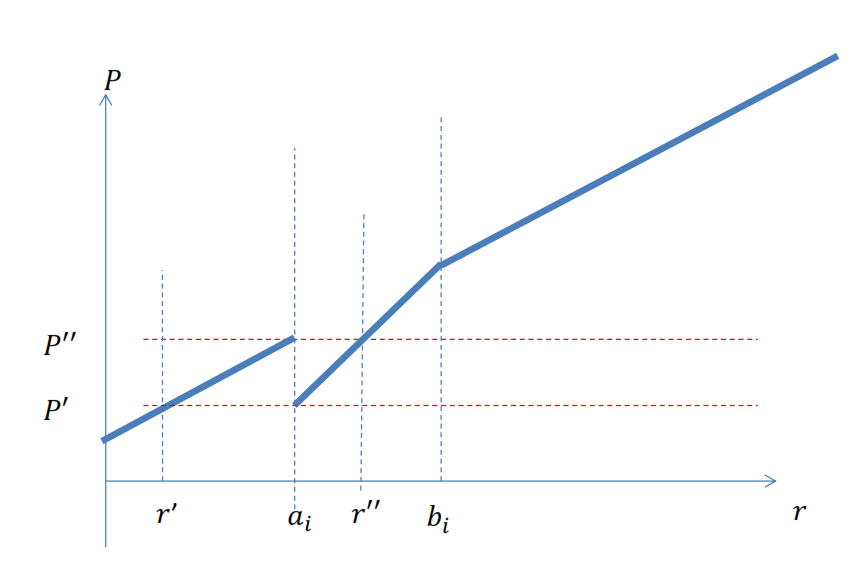
Figure 2: The market price as a function of the realized signal r1 is non-monotonic with discontinuity at the revelation threshold, generating information inefficiency.
This discontinuity arises because traders’ posterior over r2 (conditional on non-revelation) is strictly higher than the ex ante mean and jumps downward upon revelation. Thus, within an interval the mapping from observed price to r3 is non-injective: a range of distinct signals is consistent with the same observed price.
Notably, this strategic inefficiency emerges despite full rationality, risk-neutrality, and the absence of exogenous noise—contrasting with classic rational expectations outcomes.
The paper extends to endogenous network formation by embedding the communication stage within a bilateral network game. Agents can form symmetric links with consent; the network is realized before Nature's selection of the informed trader. The analysis employs a variant of Bilateral Equilibrium (BE):
- In equilibrium, networks are ordered partitions into cliques where trader positions are monotonic in their ex ante probability of being the informed agent.
- The size and composition of maximal cliques balance (a) the marginal benefit of gaining additional information sources against (b) the marginal cost of diluting future informational rents due to information leakage.
- Uniqueness: The equilibrium network is unique (modulo relabeling among identical types), composed of a core of high-probability traders fully connected, with lower-probability traders in smaller or singleton cliques.
This structure rationalizes observed real-world clustering in financial networks, where information-sensitive actors maintain dense but exclusive information-sharing relationships.
Implications and Future Directions
The findings have several implications:
- Asset Price Informativeness: Market prices need not fully aggregate fundamental information, especially when strategic pre-trade communication is possible—even in 'benchmark' settings devoid of noise or behavioral bias.
- Distributional Effects: Information sharing redistributes surplus—original asset owners lose when information is revealed (through lower prices), while the informed trader and their informed clique profit at others' expense.
- Network Design: There is a robust endogenous tendency towards clique formation among similarly-situated traders; highly connected networks do not necessarily maximize information diffusion due to competitive externalities.
Future research might explore:
- Dynamics of information diffusion with relaying and sequential revelation.
- Heterogeneity beyond ex ante probabilities (risk aversion, costs of link formation).
- Algorithmic or empirical characterization of clique formation in observed trading networks.
Conclusion
"Revealing information -- or not -- in a social network of traders" (2606.11053) analytically demonstrates that strategic information transmission within social networks fundamentally limits the informativeness of asset prices, introduces persistent informational rents, and drives the structural organization of trader interactions. Endogenizing network formation aligns network topology with equilibrium incentives for information control. The model delivers precise, robust predictions with direct implications for networked financial markets, information design, and market efficiency theory.

