- The paper establishes a first-principles method mapping strange correlators to KD quasiprobabilities, enabling direct detection of topological phases.
- The methodology is validated on the BHZ model, revealing distinct momentum-space scaling and finite-size effects between trivial and topological regimes.
- The work offers an experimental interferometric protocol using ancilla qubits, paving the way for reconstructing two-time quantum correlators in topological systems.
Topological Quantum State Characterization via Kirkwood-Dirac Quasiprobabilities
Introduction: From Topological Order to Quantum Correlators
This paper constructs a rigorous connection between the topology of quantum states in many-body systems and the Kirkwood-Dirac quasiprobability (KDQ) distribution, using strange correlators as mediators. Two principal classes of topological order are addressed: symmetry-protected (e.g., Chern insulators, topological superconductors) and genuine topological order (e.g., fractional quantum Hall states, spin liquids). Topological matter is typically characterized by nonlocal order parameters—often reflected in topological invariants, such as Chern numbers—which are not always experimentally accessible.
Strange correlators, introduced in prior works, act as discriminative witnesses for topological phases by comparing a nontrivial state ∣Ψ⟩ with a trivial reference ∣Ω⟩. The main technical advance of this paper lies in expressing strange correlators as functions of KDQs, providing both operational and conceptual clarity. The KDQ framework offers a first-principles approach to two-time quantum correlators and accommodates measurement-induced contextuality, negativity, and complex-valued probability statistics. The KDQ characterization is directly tied to weak values, where the strange correlator adopts the form of a weak value of an operator mediating the trivial-topological transition.
KDQs characterize the statistics of sequential quantum measurements, capturing the nonclassicality arising from incompatibility and noncommutativity of observables. The KDQ associated with sequential measurements of operators O^1 at t1 and O^2 at t2 is
qs1,s2=Tr(ρ^Π^s1(t1)Π^s2H(t2))
where ρ^ is the initial state, and Π^si are projectors. The characteristic function G(u) of the distribution of outcome differences connects closely to quantum echos and Loschmidt echo physics, and is highly sensitive to the underlying phase.
This formalism is leveraged to express strange correlators:
∣Ω⟩0
as KDQs, rendering them operationally accessible via interferometric schemes.
Case Study: BHZ Model and Momentum-space Topology Witness
The theory is exemplified on the paradigmatic Bernevig-Hughes-Zhang (BHZ) model—a two-dimensional Chern insulator. The model's phase structure is determined by the mass parameter ∣Ω⟩1, leading to transitions between trivial and topological phases (Chern number ∣Ω⟩2). The energy spectra under periodic and open boundary conditions reveal the appearance of gapless edge modes associated with nontrivial topology.
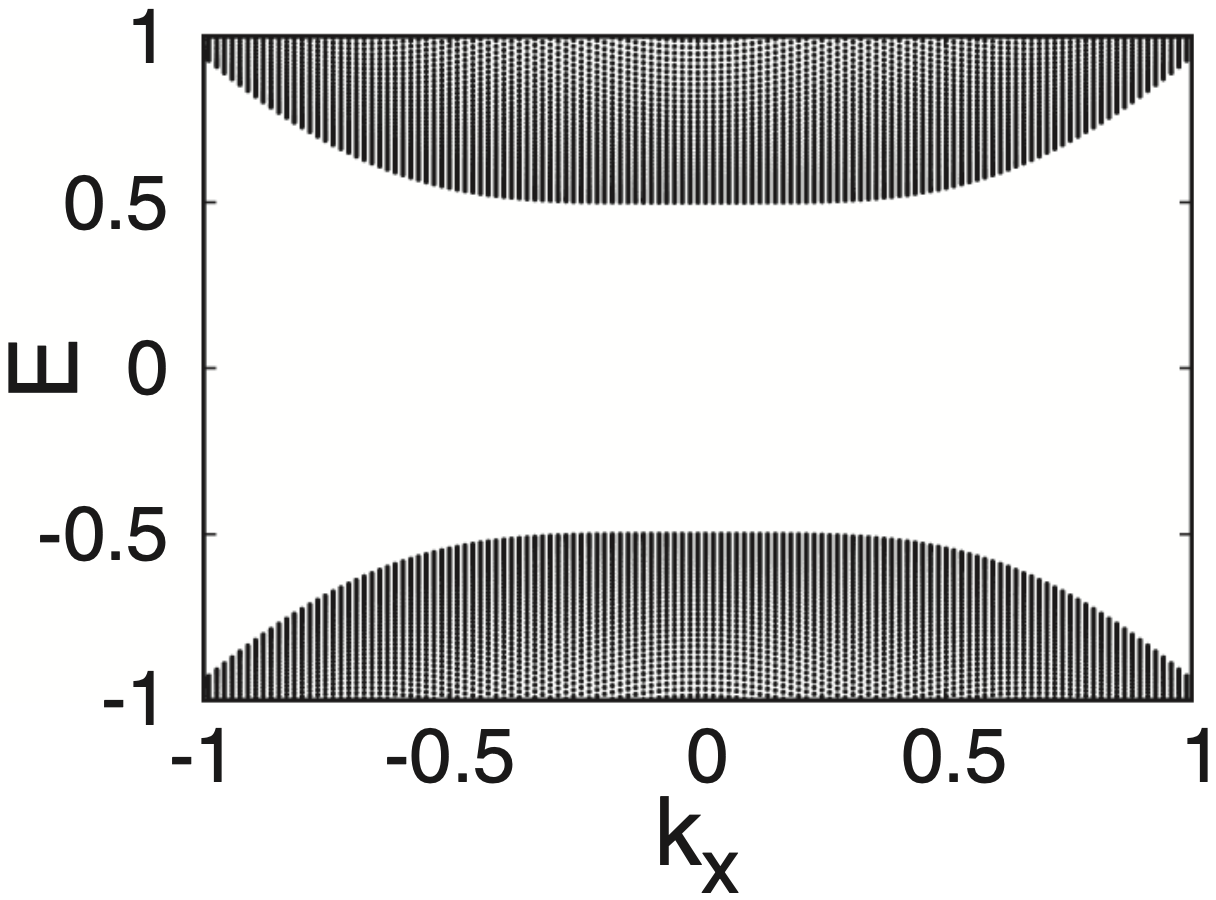
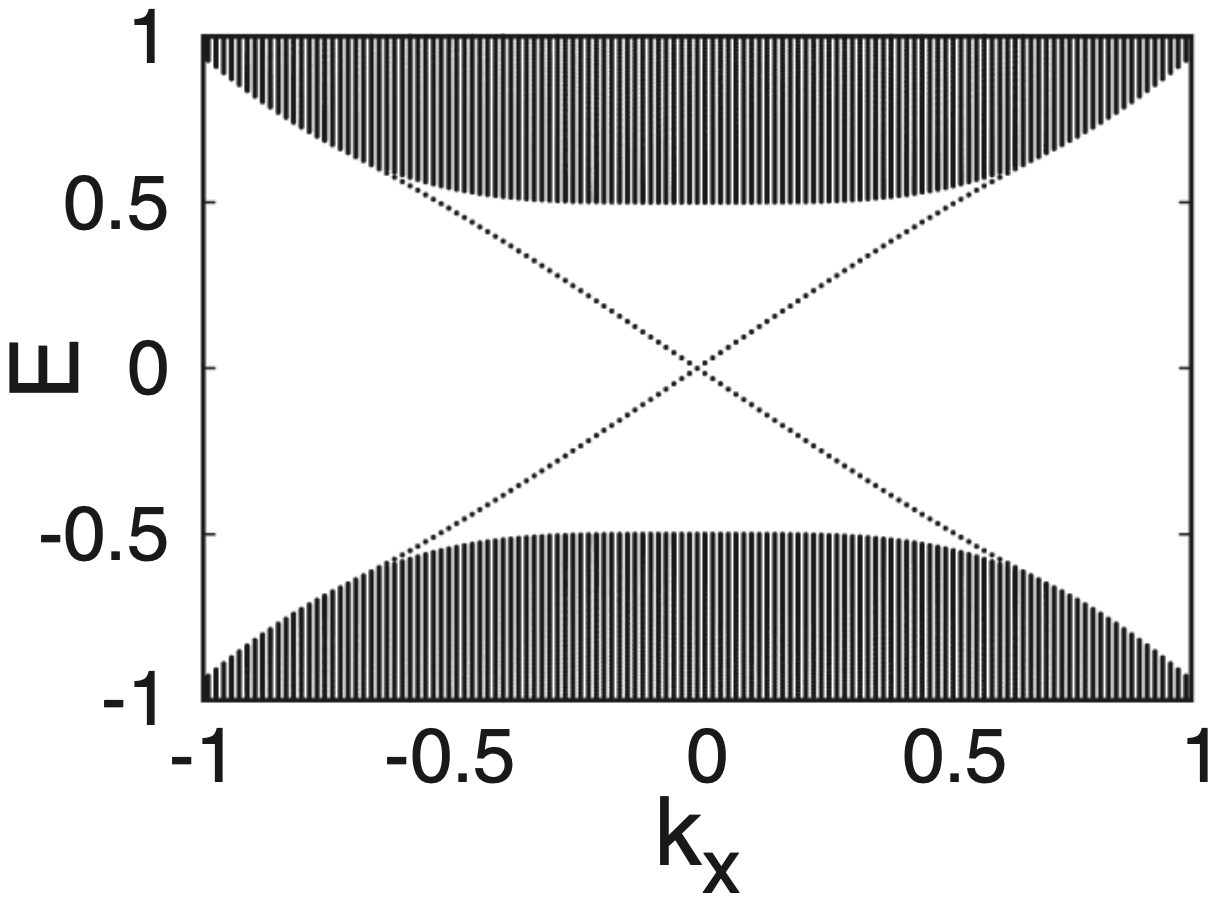
Figure 1: Energy spectra of the BHZ Hamiltonian; left: periodic boundaries (gapped bulk); right: open boundaries (topologically protected gapless edge modes).
Bulk annihilation operators transforming into edge states under boundary condition changes are identified as the appropriate ∣Ω⟩3. The strange correlator's momentum-space scaling reveals topological information:
- For ∣Ω⟩4 nontrivial and ∣Ω⟩5 trivial, ∣Ω⟩6 as ∣Ω⟩7, where ∣Ω⟩8.
- For both states in the same topological class, ∣Ω⟩9, O^10.
The correlator is recast as a sum over KDQs, and an explicit weak value structure is established:
O^11
with O^12 and O^13 built from bulk-quasiparticle operators.
Numerical evaluations for KDQ modulus O^14 in both trivial and topological regimes exhibit distinctive scaling and finite-size dependence.
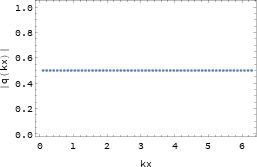
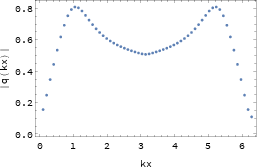
Figure 2: KDQ modulus O^15 behavior for trivial vs topological phases as a function of momentum.
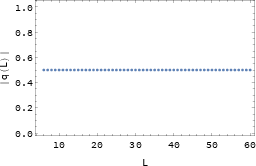
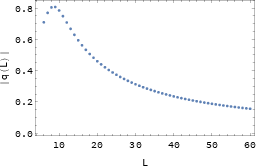
Figure 3: KDQ modulus O^16 dependence on system size O^17, showing nontrivial finite-size scaling in the topological regime.
Extensions: AKLT Chains, Laughlin States, and Mixed States
The KDQ-strange correlator methodology applies to other systems, including symmetry-protected AKLT chains and fractional quantum Hall Laughlin states. In AKLT chains, edge excitations created by local operators serve as topological witnesses, with constant strange correlator behavior in the thermodynamic limit.
Topological detection is robust to considering mixed probe states (e.g., thermal density matrices), with KDQ structure retaining sensitivity to ground-state topology unless temperature-driven transitions occur.
Experimental Protocol: Quantum Interferometry and KDQ Reconstruction
The practical measurement of KDQs—hence strange correlators—employs quantum interferometric schemes. The KDQ characteristic function O^18 is encoded in an ancilla qubit via a sequence of controlled rotations conditional on system observables, followed by ancilla Pauli measurement. The real and imaginary parts of O^19 are obtained as expectation values, and the KDQ distribution is reconstructed via Fourier transform.
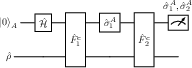
Figure 4: Interferometric protocol for measurement of the real and imaginary components of t10, enabling full KDQ reconstruction.
Ancilla-system entanglement is achievable in several architectures, such as NV centers, ultracold atoms with Rydberg blockade, or Floquet-engineered single-qubit systems. The BHZ model can be mapped to a time-dependent driven system, where KDQ measurement protocols are feasibly implemented.
Conclusion
The operational mapping of strange correlators to KDQs provides a fundamentally motivated topology witness for quantum states, recast in terms of experimentally accessible two-time quantum correlators and weak values. The theory is demonstrably applicable to a range of topological quantum systems, with robust numerical validation and finite-size analysis. The interferometric approach outlined paves the way for direct experimental detection of topological phases via KDQ reconstruction.
Future developments should address scalability of KDQ measurement schemes to extended systems, optimal control protocols for ancilla coupling, and integration with state-of-the-art quantum tomography platforms. The KDQ-strange correlator paradigm outlined here offers a versatile toolkit for both fundamental topology detection and applied quantum information processing in topologically nontrivial phases.

