- The paper demonstrates that burst-based gating in L5 pyramidal neurons yields rapid, context-sensitive motor adaptation.
- It models dendritic coincidence detection via a bilinear decomposition that combines state and goal signals for zero-shot generalization.
- The framework generalizes to reinforcement learning architectures, facilitating robust and efficient adaptive control in neuromorphic systems.
Bilinear Gating of Motor Primitives: Dendritic Computation and Rapid Goal-Directed Adaptation
Overview
The paper "Bilinear gating of motor primitives: a principle linking dendritic computation to rapid goal-directed adaptation" (2606.10891) presents a unifying computational framework grounded in the physiology of layer-5 (L5) pyramidal neurons. The authors demonstrate, using electrophysiological, biophysical, and algorithmic lines of evidence, that burst-based gating in motor cortex implements a bilinear combination of goal- and state-dependent signals, yielding rapid, robust goal-adaptive behavior and interpretable zero-shot generalization. The work establishes direct mechanistic connections between dendritic coincidence detection, reinforcement learning, and neuromorphic hardware for adaptive control.
Neural Evidence: Burst Coding for Goal Selectivity
The central empirical claim is that the fraction of burst spikes ("burst fraction") in motor cortical neurons encodes goal direction with substantially higher selectivity than tonic firing rate. Analyzing data from 12 sessions across three macaques, two institutions, and different tasks, the authors show that 69–95% of neurons exhibit significantly greater direction selectivity in burst fraction than in tonic rate (all p<10−12, Wilcoxon signed-rank test). This effect was robust under controls for firing-rate contributions and present even after regressing out tonic-rate effects.
This differential encoding predicts that burst events serve as a specific channel for contextual (goal-related) information. In canonical delayed center-out reach tasks, burst fraction population matrices reveal pronounced direction-tuned structure absent from tonic rate matrices.
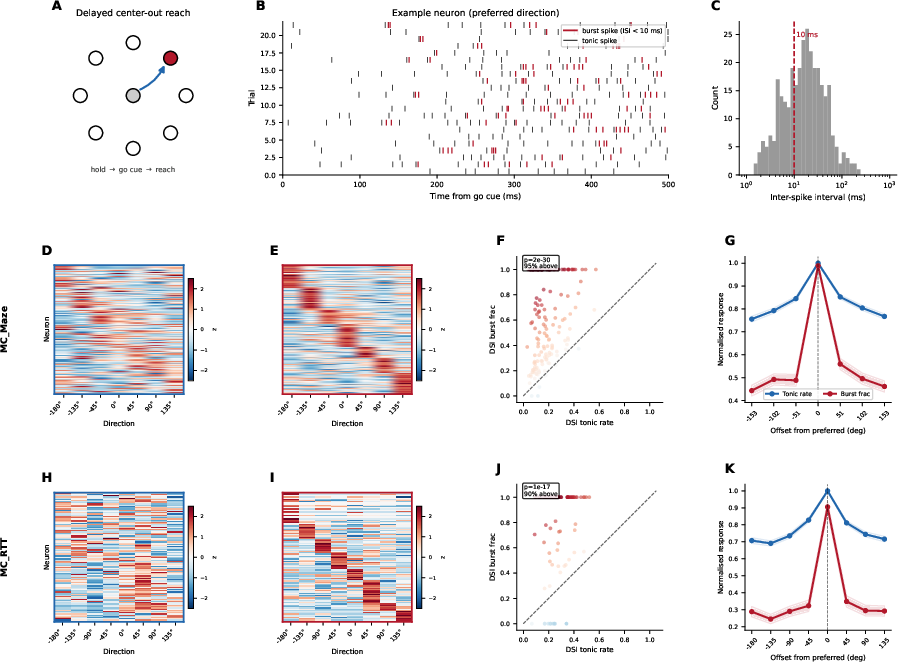
Figure 1: Burst fraction encodes reach direction more selectively than tonic spike rate, with pronounced direction-specific modulation of burst events across multiple data sets and tasks.
Dendritic Coincidence as Multiplicative Gating
The authors directly tie this burst phenomenon to L5 pyramidal neuron physiology. Dendritic coincidence detection — wherein coincident apical (goal/context) and basal (state) inputs are required for bursts — naturally implements a multiplicative gate. This is captured formally by the bilinear decomposition:
μ(s,g)=∑k=1KGk(g)Yk(s)
where Yk(s) are state-dependent, goal-independent primitives, and Gk(g) are goal-dependent gates. A minimal two-compartment spiking neuron model demonstrates that voltage-based burst probability implements pburst(s,g)∼G(g)Y(s), supporting context-selective gating and rapid behavioral switching.
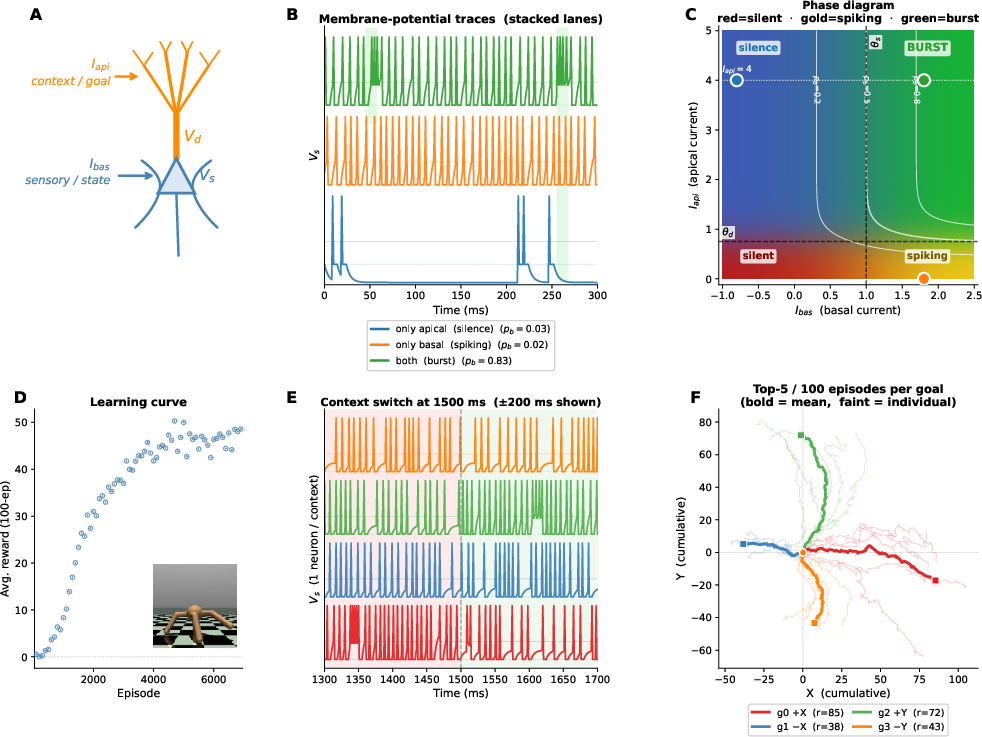
Figure 2: Burst-gated pyramidal neuron model implements bilinear gating, with coincidence of apical and basal inputs producing context-specific bursting and enabling rapid goal switching in simulated locomotion tasks.
The model’s learning dynamics enable rapid and context-specific modulation; goal-directed bursting transitions occur within one burst cycle (∼45 ms), supporting abrupt behavioral shifts.
Bilinear Decomposition in Reinforcement Learning Architectures
Beyond biophysical models, the bilinear gating principle is instantiated in deep RL through an actor-critic architecture where both modules are linear in a shared goal-gating vector G and nonlinear in their state-primitive bases. This explicit multiplicative structure imparts several key algorithmic advantages:
- A single shared G parameterizes both policy and value functions, making policy improvement a direct outcome of value estimation.
- Rapid adaptation is structurally enabled, as re-estimation of G alone suffices for behavioral adjustment without re-optimizing the primitive bases or full policy network.
On goal-conditioned MuJoCo tasks, a single-layer bilinear network achieves faster reward acquisition and high asymptotic performance, despite reduced depth compared to MLP baselines. Sharing G between actor and critic yields no performance degradation, demonstrating that a unified context representation suffices for both control and evaluation.
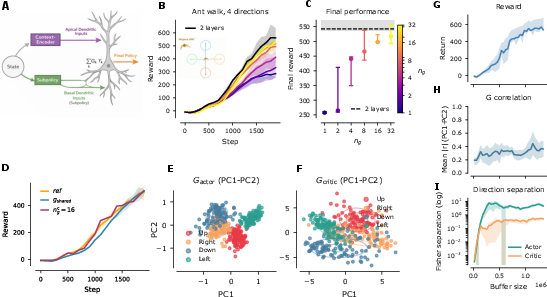
Figure 3: MLP-based bilinear actor-critic architecture achieves superior or equivalent learning efficiency as compared to deeper MLP baselines and demonstrates that actor-critic coupling via a shared gating vector preserves or improves performance.
Properties of Zero-Shot Adaptation and Control
The model’s principle structural claim is validated through zero-shot generalization testing: the bilinear agent, trained on a subset of goal directions, immediately generalizes to novel directions without parameter updates, by conditioning solely on the goal descriptor μ(s,g)=∑k=1KGk(g)Yk(s)0. Behavioral trajectories for untrained headings show smooth interpolation and only modest performance drops (μ(s,g)=∑k=1KGk(g)Yk(s)1 r/step mean reward) compared to seen goals.
Cold-start adaptation, performed by online reward-weighted updates of μ(s,g)=∑k=1KGk(g)Yk(s)2, achieves μ(s,g)=∑k=1KGk(g)Yk(s)3 of zero-shot performance within 10 episodes. The μ(s,g)=∑k=1KGk(g)Yk(s)4-space organizes parametrically by direction and norm, supporting independent heading and speed control. Instantaneous reward updates outperform TD-based methods for rapid adaptation.
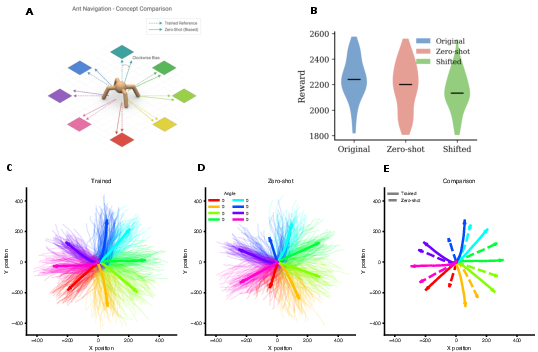
Figure 4: Zero-shot learning: a pretrained bilinear agent generalizes robustly to unseen goal directions and interpolates behavior appropriately, maintaining competitive performance compared to direct training.
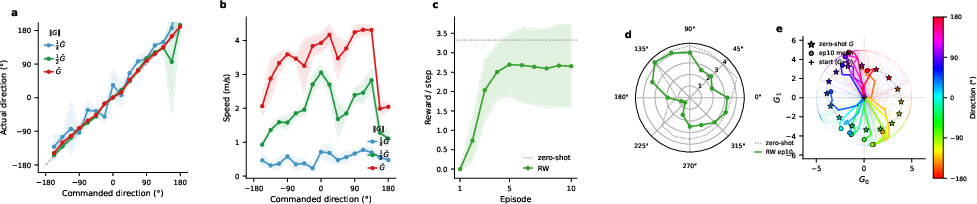
Figure 5: Zero-shot directional control and cold-start adaptation via reward-weighted gating-vector updates enable rapid recovery of behavioral competence by tuning μ(s,g)=∑k=1KGk(g)Yk(s)5 alone; μ(s,g)=∑k=1KGk(g)Yk(s)6-space geometry discovers axis-aligned mappings of heading and speed.
Robust Generalization to Contextual Changes
The framework naturally accommodates contextual variables beyond direction, as exemplified by friction generalization experiments. Principal component analyses reveal that the gating network learns an implicit low-dimensional manifold for friction levels. Performance is maximized when contextual encoding matches environmental friction; departures yield pronounced degradation. The bilinear decomposition induces more stable, adaptive gaits than MLP baselines, as measured by fall rates across friction conditions.
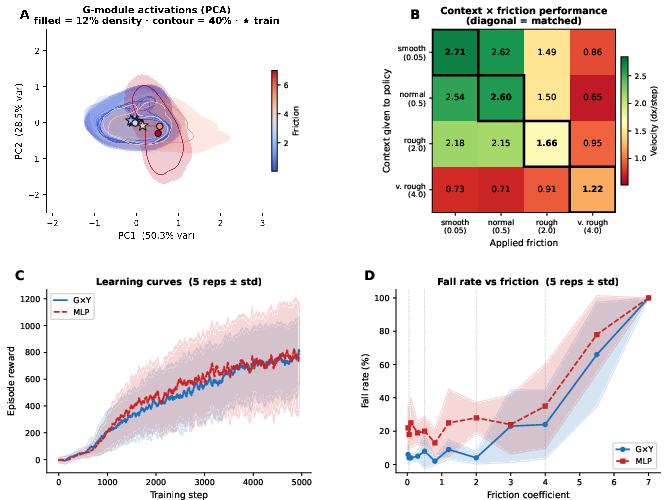
Figure 6: Multiplicative context-gating supports robust adaptation across a spectrum of floor friction conditions via smooth organization of gating representations; Gμ(s,g)=∑k=1KGk(g)Yk(s)7Y agents maintain lower fall rates and higher stability than standard MLP baselines.
Biological and Engineering Implications
The presented framework tightly couples neurophysiology, computational control, and AI/robotics. Biophysically, the data suggest that L5 burst fraction serves as the goal-selective signal in cortical output, and that coincidence-detection implements exact multiplication in expectation, aligning with stochastic multiplication hardware concepts (von Neumann, 1956). Algorithmically, the bilinear decomposition matches the functional demands of rapid, continual adaptation prevalent in animal behavior and provides a robust inductive bias for out-of-distribution generalization.
Practically, the architecture offers guidance for neuromorphic systems: burst-based multiplication can be implemented in low-power spiking hardware, with local Hebbian updates to the gating weights (μ(s,g)=∑k=1KGk(g)Yk(s)8) enabling fast, interpretable adaptation, aligning well with efficient, online control requirements in robotics.
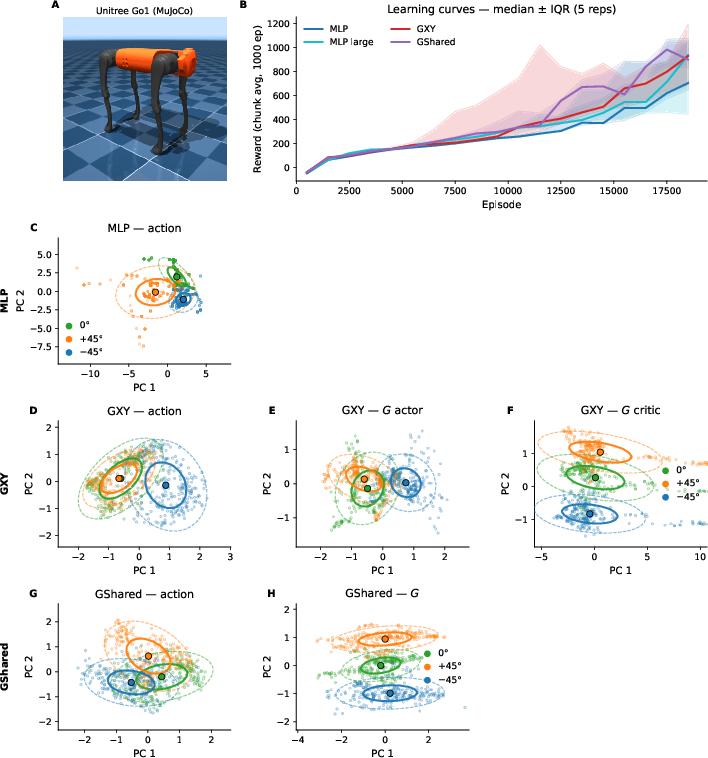
Figure 7: Gating representations in Unitree Go1 quadruped simulation demonstrate emergent direction-selective clusters in gating space, facilitating modular control and continual adaptation on embodied platforms.
Relation to Successor Features and Continual Learning
The bilinear μ(s,g)=∑k=1KGk(g)Yk(s)9 approach shares linear-in-goal value structure with Successor Features (SF) frameworks, but differs crucially: Yk(s)0 is a continuously-adaptable, context-parametric function, and policy improvement via Yk(s)1 is aligned to value learning, not decoupled as in GPI. Adaptation thus proceeds by updating the gating vector alone, with no separation between value and policy reoptimization, reducing sample and computational complexity for lifelong and continual learning settings.
Conclusion
This work synthesizes cellular, systems, and algorithmic perspectives, introducing bilinear gating as a computational principle instantiated in both neural physiology and agent architectures. Burst-based gating of motor primitives emerges as an efficient, interpretable mechanism for rapid, goal-conditioned adaptation, supporting robust generalization and efficient transfer in a broad array of control tasks. Future directions include scaling the approach to manipulation, sparse tasks, physical platforms, and, at the neuroscience level, further probing the mapping between learned gating spaces and circuit-level representations in motor and associative cortex. The blueprint of bilinear gating, grounded in both biology and computation, provides a tangible route toward modular, adaptive AI and neuromorphic systems.