Schmidt Decomposition-Based Methods for Efficient Quantum Image Encoding
Abstract: In quantum image processing, a fundamental step is encoding classical image data into quantum states. This can be achieved using methods such as Flexible Representation of Quantum Images (FRQI), Quantum Probability Image Encoding (QPIE), and Novel Enhanced Quantum Representation (NEQR). However, on real quantum hardware, these encodings can quickly lead to circuits with many gates, large circuit depth, and high qubit usage, which is a problem for Noisy Intermediate-Scale Quantum (NISQ) devices. In this work, we investigate whether low-rank state approximation, formulated via Schmidt decomposition, can help reduce this complexity. The method keeps only the most significant parts of a quantum state's entanglement structure, making state preparation more efficient while preserving most of the image information. We compare the three encoding techniques in their original form and with low-rank approximation, evaluating metrics such as circuit depth, CNOT count, MSE, and visual quality of reconstructed images. The results reveal meaningful trade-offs between accuracy and resource efficiency, with the FRQI model achieving a 97 percent reduction in circuit depth while maintaining a near-perfect reconstruction (MSE of about 0.27). This demonstrates the potential of low-rank techniques for advancing practical quantum image processing on near-term hardware.
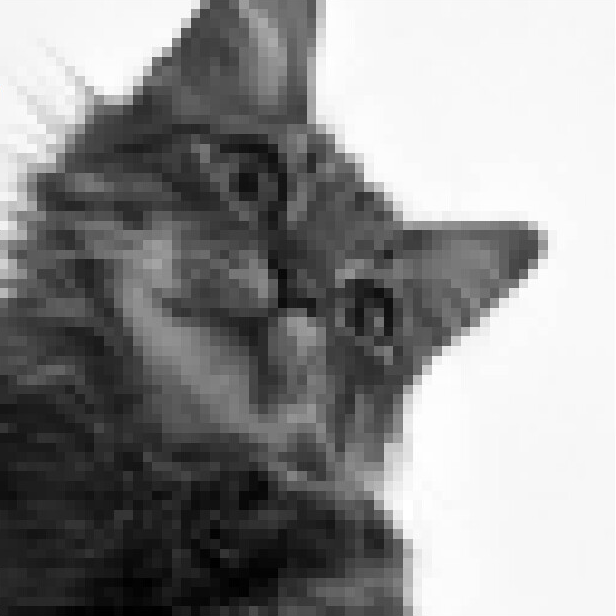

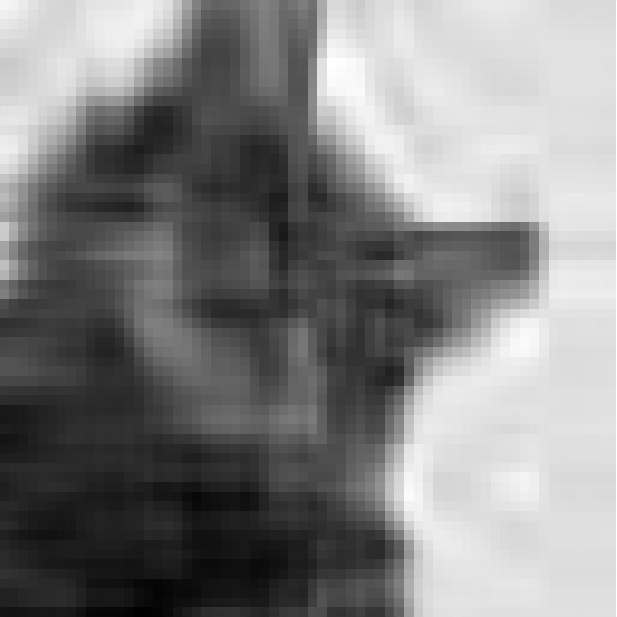
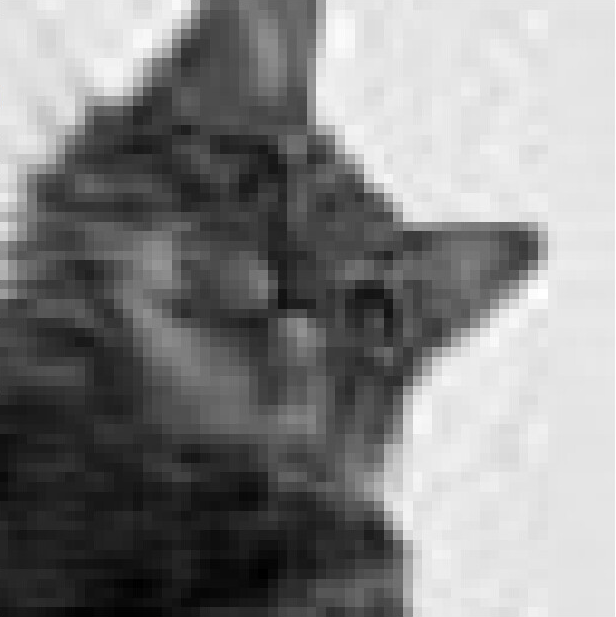
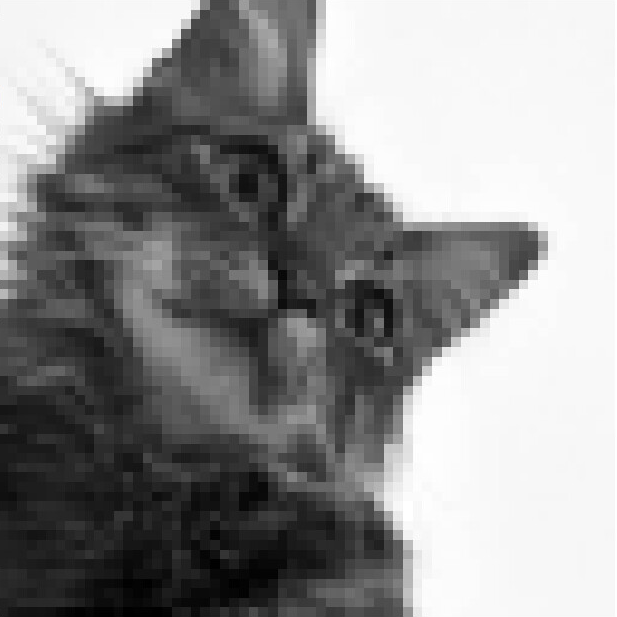



Paper Prompts
Sign up for free to create and run prompts on this paper using GPT-5.
Top Community Prompts
Explain it Like I'm 14
What is this paper about?
This paper looks at how to store and handle images on a quantum computer in a way that uses fewer resources while keeping the picture looking almost the same. The authors test a simple but powerful idea: compress the quantum version of an image by keeping only its most important “pieces” of information. This is done with a math tool called the Schmidt decomposition, which helps cut down the number of quantum operations needed. The goal is to make quantum image processing work better on today’s small and noisy quantum machines.
What questions were the researchers asking?
- Can we shrink the amount of work (gates, circuit depth, and qubits) needed to load an image into a quantum computer?
- If we compress the quantum image (low-rank approximation), do we still get a picture that looks almost the same?
- Which popular quantum image encodings benefit the most from this compression?
- Are there certain “sweet spot” sizes of compression that give big quality jumps for little extra cost?
How did they do it?
The team studies three common ways to put a grayscale image into a quantum state (think: a special kind of data format for quantum computers). Then they apply a compression trick to each one and measure the savings and the image quality.
The three ways to store an image on a quantum computer
- FRQI (Flexible Representation of Quantum Images): It stores pixel brightness as an angle on a special “color” qubit and links it to “position” qubits that mark where each pixel is. It uses few qubits, but reading exact pixel values is a bit like estimating—you need many tries.
- NEQR (Novel Enhanced Quantum Representation): It stores each pixel’s brightness directly as bits across several qubits. This makes reading the image exact and easy, but it uses many more qubits and deeper, heavier circuits.
- QPIE (Quantum Probability Image Encoding): It puts pixel values into the probabilities (amplitudes) of the quantum state. It’s very qubit-efficient, but you must normalize the image (which can lose some info), and reading exact values is again an estimate over many measurements.
The low-rank trick (Schmidt decomposition), in simple terms
Imagine splitting the image’s quantum state into two parts (like cutting a photo into left and right halves). The Schmidt decomposition is a way to describe how strongly those two halves are linked (entangled) using a set of “patterns” with weights (called Schmidt coefficients). Many natural images are repetitive and structured, so only a few patterns carry most of the meaningful detail.
Low-rank approximation means: keep only the top r most important patterns and throw away the tiny ones. It’s like compressing a photo by keeping the main shapes and shades and ignoring subtle, repeating noise. On quantum hardware, fewer important patterns means:
- simpler circuits
- fewer error-prone two-qubit gates (like CNOTs)
- less chance for noise to ruin the result
What they measured
To compare methods and settings, they looked at:
- Qubits used (how much “quantum memory”)
- Circuit depth (how many steps in a row the circuit has)
- CNOT count (how many two-qubit entangling gates, which are costly and noisy)
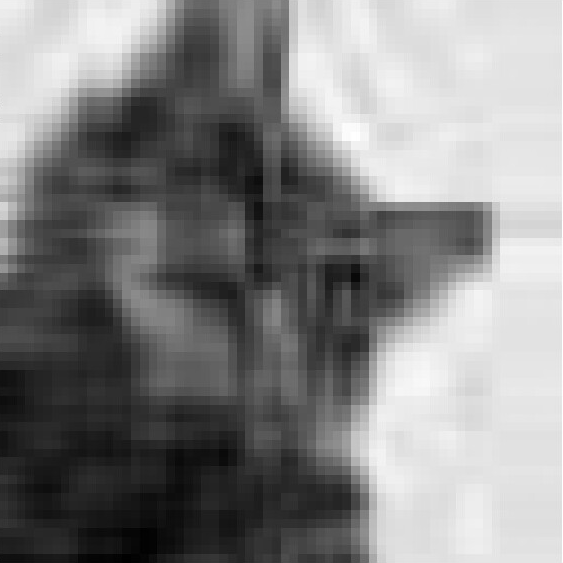
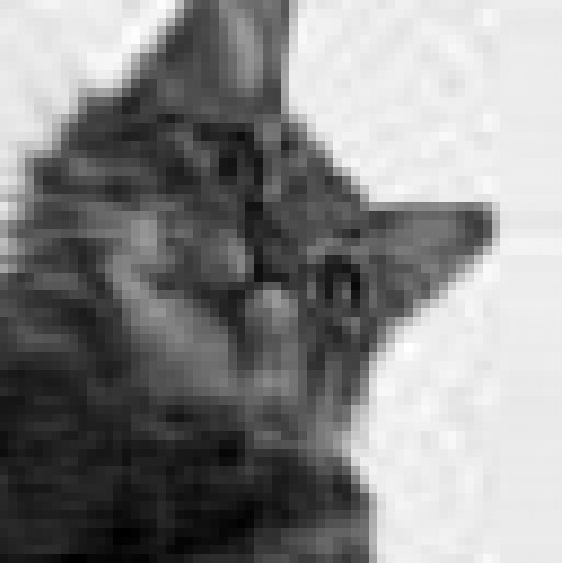
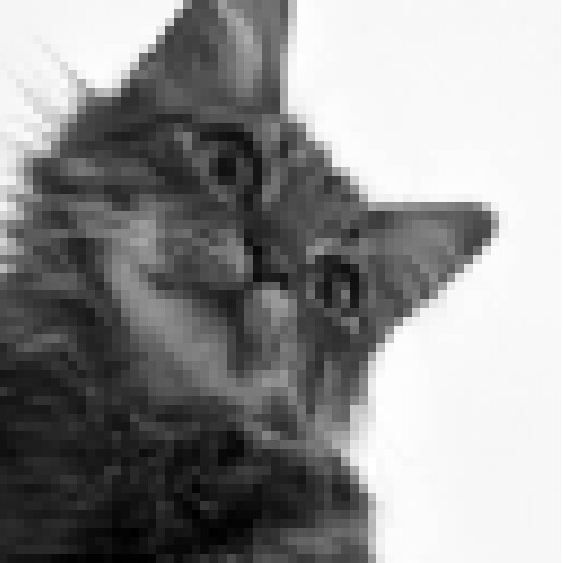
- MSE (Mean Squared Error): a number that says how different the reconstructed image is from the original; lower is better. Here, an MSE around 0.27 means the average pixel is off by less than 1 gray level on a 0–255 scale, which is barely noticeable.
All tests were done in a simulator (not on real hardware) using a 64×64 grayscale image.
What did they find?
Here are the main results for a 64×64 image:
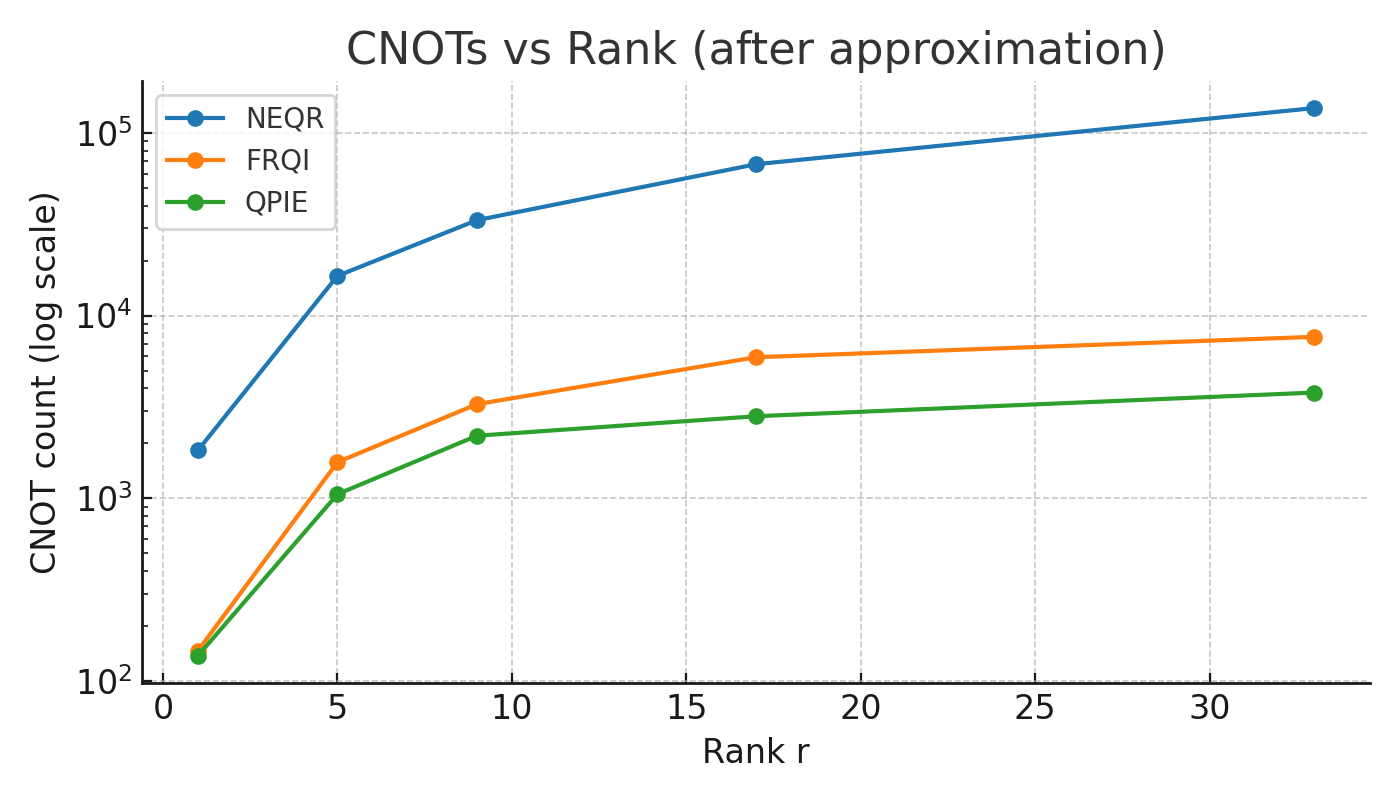
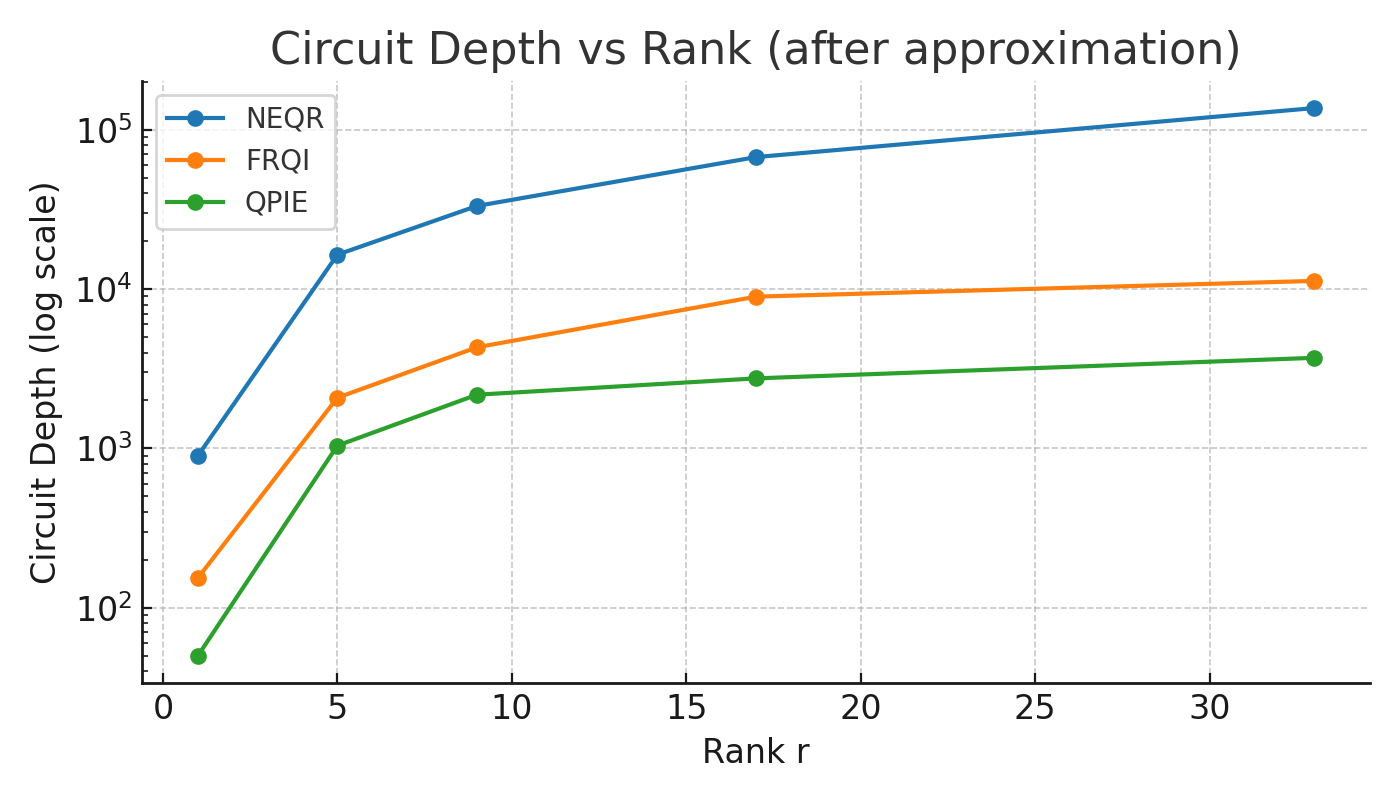
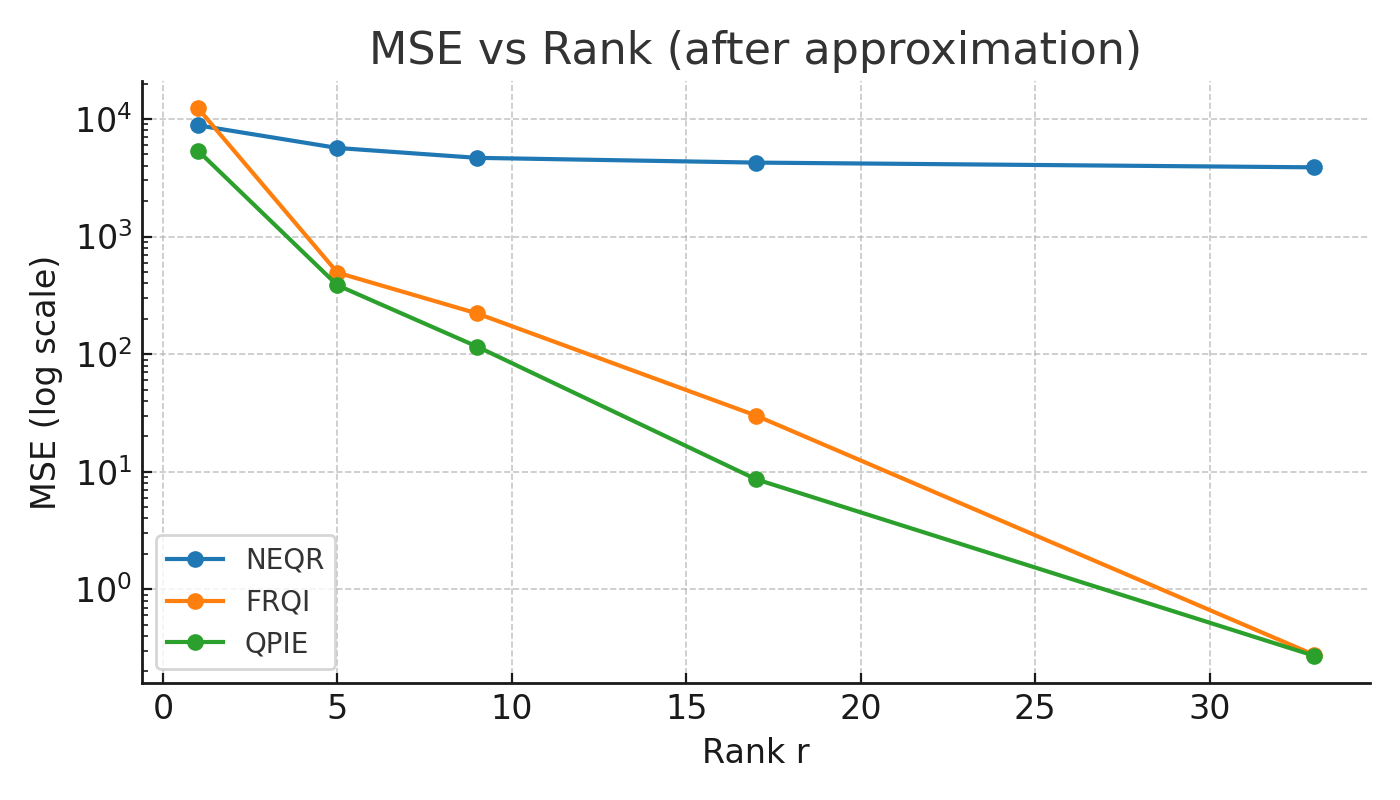
- FRQI: Big wins. With compression (rank r = 33), the circuit depth dropped by about 97% (from 385,025 down to 11,256), and CNOTs dropped from 221,184 to 7,649. The image quality stayed almost perfect (MSE ≈ 0.277).
- QPIE: Very qubit-efficient and also improved with compression. Depth went from 19,910 to 3,704 at r = 33. CNOTs only slightly dropped (4,083 to 3,788). Image quality stayed excellent (MSE ≈ 0.272). But there’s a catch: compiling the full version took almost three days on the simulator, showing it can be slow to set up.
- NEQR: Most accurate when fully loaded (you can read pixels exactly), but very heavy. Full depth was 2,737,166 with 2,072,898 CNOTs. Compression helped a lot: at r = 257, depth fell to 735,168 and CNOTs to 751,554, with MSE ≈ 0.273. At r = 513, the reconstruction was perfect (MSE = 0). Still, NEQR remains the most resource-hungry.
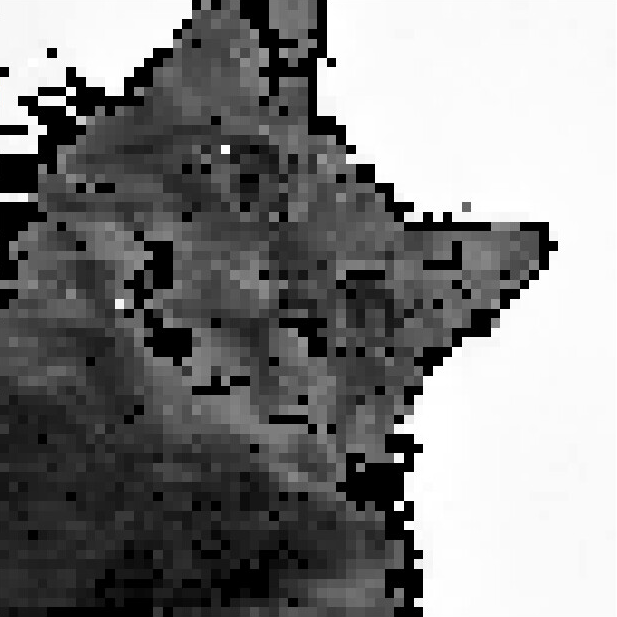
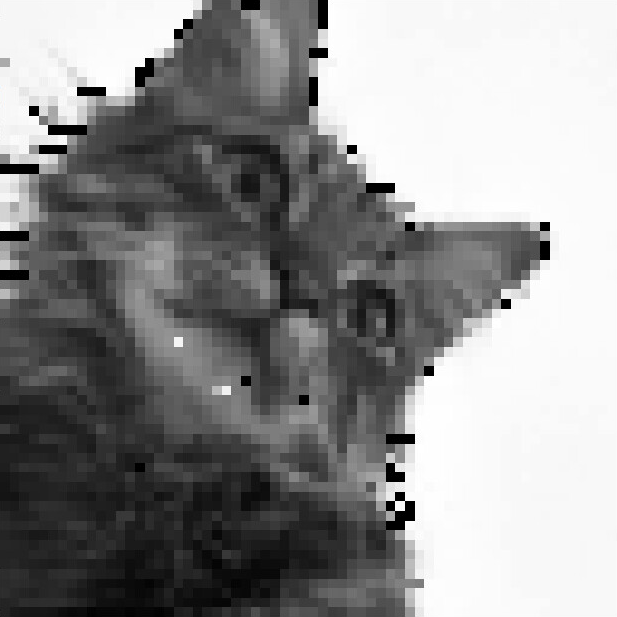
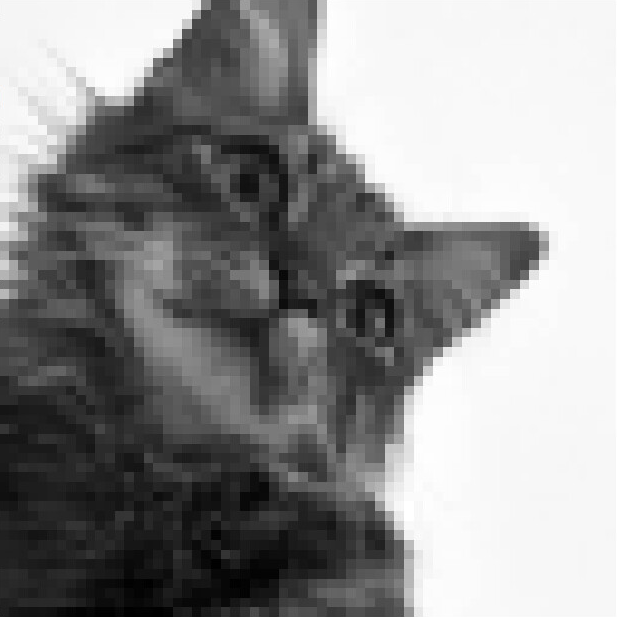
A surprising pattern showed up: image quality and circuits didn’t improve smoothly with rank. Instead, big jumps happened at specific ranks: 1, 2, 3, 5, 9, 17, 33, 65, 129, 257, and so on. Between these points, not much changed. This “stepwise” behavior suggests there are special ranks where you gain a lot for a little extra cost—useful for picking efficient settings.
Why is this important?
Today’s quantum computers are “NISQ” devices: they’re small and noisy. Deep circuits with many two-qubit gates tend to fail. The low-rank method cuts circuit depth and the number of error-prone gates while keeping the picture almost the same. That means:
- more chance of success on real machines
- shorter, simpler programs
- better practical image quality under noise than trying to load the full, exact state
In short, smart compression can beat “exact but fragile” on current hardware.
Limitations and what’s next
- All tests were in a simulator, not on real quantum chips. The next step is to try these compressed circuits on hardware to see how they stand up to real noise.
- The study used one 64×64 image. Testing many images and sizes will show how well the trick scales.
- The “stepwise” rank pattern needs a deeper explanation. Understanding it could help choose the best ranks automatically.
- Some quantum image algorithms expect the original, uncompressed state. Future work could tune these algorithms to work directly with low-rank states.
Bottom line
Compressing quantum images with the Schmidt decomposition keeps the important parts, tosses small details, and massively shrinks the quantum circuit—often with almost no visible loss. FRQI benefited the most, QPIE was the most qubit-efficient but slow to compile, and NEQR stayed heaviest but still improved. This approach could make quantum image processing actually usable on near-term quantum computers.
Knowledge Gaps
Knowledge gaps, limitations, and open questions
The paper advances low-rank (Schmidt) approximation for quantum image encodings but leaves several concrete issues unresolved:
- Hardware validation absent: results are exclusively from a noiseless simulator; performance and fidelity of low-rank circuits under realistic noise (decoherence, 2-qubit error rates, readout error) on specific devices and coupling maps remain untested.
- Connectivity and SWAP overheads: reported depth/CNOT counts exclude mapping to hardware topologies; the impact of layout, routing, and SWAP insertion on the low-rank advantage is unknown.
- Limited dataset and scope: only a single 64×64 grayscale image was used; generalization across diverse images (textures, edges, noise levels), resolutions (≥128×128), aspect ratios, and content remains unquantified.
- Color and multispectral images: extension of the approach to RGB/hyperspectral data, including how cross-channel correlations affect Schmidt spectra and rank requirements, is not explored.
- Bipartition choice unspecified: the Schmidt decomposition depends on the chosen bipartition; the paper does not analyze how different partitions (e.g., color vs position, spatially contiguous vs interleaved splits, multiway/hierarchical partitions) change rank and circuit cost, nor how to select an optimal partition.
- No theoretical explanation for “discrete rank progression”: the observed stepwise quality/circuit changes at ranks r = 1,2,3,5,9,17,33,65,… lack a mathematical account; it is unclear whether this is due to image structure, circuit synthesis constraints, power-of-two artifacts, or transpiler behavior.
- Rank-selection strategy missing: there is no principled method to choose r (e.g., threshold on cumulative Schmidt weight, predicted hardware fidelity, or cost–benefit objective); automated, budget-aware selection remains open.
- Sampling/readout complexity unquantified: for FRQI and QPIE (probabilistic retrieval), the number of shots needed to recover pixel intensities at a given rank and target error—with and without readout noise—was not measured.
- Effect of LRA on determinism (NEQR): for NEQR, how low-rank truncation interacts with deterministic readout is unclear; the minimal rank for exact recovery and its relation to bit-planes or intensity structure need characterization.
- QPIE normalization pathology under LRA: whether LRA mitigates or exacerbates QPIE’s inability to distinguish uniform images (e.g., all-black vs all-white) is not assessed.
- Compile-time scalability: only an anecdotal three-day transpilation for QPIE is reported; systematic profiling of synthesis/transpilation time vs rank, qubit count, and image size is missing, as is evaluation of alternative preparation pipelines to reduce compile time.
- Alternative state-preparation baselines: no comparison to other compressive loaders (e.g., MPS/TTN/MERA-based preparation, divide-and-conquer, sparse isometries, qROM/qGAN/qSVT-based loading, approximate Householder/Givens schemes) to assess if Schmidt-based LRA is Pareto-optimal.
- Metrics limited to MSE: perceptual and structural metrics (SSIM, PSNR), worst-case/quantile pixel errors, and task-oriented measures (e.g., edge detection accuracy) are not evaluated; phase vs amplitude error analyses for FRQI/QPIE are absent.
- Downstream algorithm compatibility: the impact of altered state structure after LRA on typical QIP operations (filters, edge detection, classifiers) is untested; guidelines for adapting algorithms to low-rank states are lacking.
- Analytical scaling laws: the paper reports empirical depth/CNOT reductions but provides no closed-form bounds linking depth/CNOT to rank, qubit count, and partition for each encoding; tight upper/lower bounds are open.
- Image-statistics-to-rank link: no theory connects classical image features (e.g., total variation, frequency content, sparsity in DCT/wavelet bases) to the Schmidt spectrum and required rank for a target error.
- Robustness under noise models: the claim that low-rank circuits can outperform exact ones on NISQ is not substantiated with noise-injected simulations (depolarizing, amplitude damping, coherent crosstalk) or error-mitigation experiments.
- Transpiler/target dependence: results are tied to a specific library (qclib LowRankInitialize) and Qiskit Aer; the sensitivity to synthesis algorithms, gate sets, transpiler passes/optimization levels, and target hardware (superconducting vs trapped ion) is unknown.
- Memory/time cost of LRA itself: computing the Schmidt decomposition for large registers can be expensive; scalability of the SVD/Schmidt step (and potential use of randomized/iterative SVD) is not addressed.
- Fairness of cross-encoding comparisons: differences in retrieval semantics (probabilistic vs deterministic), normalization, and amplitude/phase representation are not normalized in the comparison; a standardized evaluation protocol is needed.
- Blockwise and hierarchical variants: the study does not test block/tile-based LRA, multi-scale decompositions, or hierarchical tensor-network partitions that could further reduce rank and synthesis cost.
- Effects of quantization/angle mapping: interactions between FRQI angle quantization, NEQR bit-depth, renormalization after truncation, and resulting brightness/contrast bias are not analyzed.
- Automatic, hardware-in-the-loop optimization: there is no pipeline to choose partition and rank adaptively based on device calibration (error rates, coherence) to maximize expected end-to-end fidelity under resource constraints.
- Reproducibility gaps: code, seeds, and circuit artifacts enabling independent verification (including the long QPIE transpilation) are not provided.
Practical Applications
Immediate Applications
These applications can be prototyped or deployed now using existing simulators, quantum cloud access, and open-source tooling (e.g., Qiskit, qclib).
- Low-rank state-prep pass for quantum compilers
- Sectors: Software, Quantum hardware vendors, Academia
- What: Implement a compiler/transpiler pass that detects image inputs, performs Schmidt-based truncation, and emits Low-Rank State Preparation (LRSP) circuits for FRQI/QPIE/NEQR.
- Tools/products/workflows: Qiskit transpiler plugin; “LowRankInitialize” wrappers; preset rank ladder r ∈ {1,2,3,5,9,17,33,…}.
- Assumptions/dependencies: Image compressibility (natural images); availability of LRSP implementations; device topology-aware synthesis; acceptance of approximate reconstructions (MSE ≈ 0.27 is often visually imperceptible for 8-bit images).
- Rank tuner for hardware-aware image loading
- Sectors: Software, Hardware providers, Academia
- What: An automated “rank tuner” that selects r by balancing target error (MSE threshold) against device noise budget and allowable depth/CNOTs.
- Tools/products/workflows: Calibration routine that measures error vs. depth per device; config file for project CI pipelines.
- Assumptions/dependencies: Device-specific noise models; stable calibration; stepwise “discrete rank progression” holds across datasets.
- Progressive image loading for benchmarking and demos
- Sectors: Academia, Hardware providers, Education
- What: Progressive reconstruction demos using ranks r = 1→33 to show coarse-to-fine image quality under realistic noise, serving as a visual benchmark for device performance.
- Tools/products/workflows: Notebook demos; education modules; public benchmark repository with fixed test images and MSE/depth/CNOT leaderboards.
- Assumptions/dependencies: Access to quantum cloud or high-quality simulators; consistent measurement protocols.
- NISQ-friendly image data loaders for quantum ML
- Sectors: Software, Quantum ML, Academia
- What: Replace exact amplitude/basis loaders with low-rank FRQI/QPIE/NEQR loaders to reduce depth and CNOTs in training pipelines (e.g., qGANs, classifiers).
- Tools/products/workflows: PyTorch/TensorFlow Quantum “QuantumImageDataset(LR)” that wraps classical SVD and emits LRSP circuits.
- Assumptions/dependencies: Training tasks tolerate approximate inputs; classical preprocessing (SVD) does not dominate latency; image sizes mapped to 2n × 2n or padded.
- Transpile-time reduction for QPIE use cases
- Sectors: Software, Academia
- What: Cap rank for QPIE to curb extreme transpilation times (days for full-rank) while maintaining near-perfect MSE in practice.
- Tools/products/workflows: Transpiler guardrails (rank caps); queue-time budgets; CI timeouts.
- Assumptions/dependencies: Acceptance of normalized intensities and probabilistic readout; pre-agreed MSE targets.
- Design-of-experiments (DoE) for device characterization
- Sectors: Hardware providers, Academia, Policy (benchmarking programs)
- What: A standard test suite correlating rank r, CNOT count, depth, and MSE to characterize devices, useful for procurement and capability reporting.
- Tools/products/workflows: Fixed test images; rank ladder profiles; summary KPIs (depth reduction %, CNOT reduction %, MSE).
- Assumptions/dependencies: Noiseless-to-noisy extrapolation validity; transparent reporting of transpilation settings.
- Hybrid classical–quantum image pipelines
- Sectors: Software, Academia, Applied research labs
- What: Classical SVD to extract dominant modes followed by LRSP-based state prep for downstream quantum image operators (e.g., simple filters, edge detection prototypes).
- Tools/products/workflows: Workflow templates with classical preprocessor + quantum kernels; integration examples in Qiskit notebooks.
- Assumptions/dependencies: Available quantum kernels that accept approximate states; limited circuit depth budgets.
- Educational curricula and lab modules on low-rank quantum imaging
- Sectors: Education, Academia
- What: Course modules illustrating FRQI/QPIE/NEQR trade-offs, Schmidt truncation, and discrete rank progression with hands-on labs.
- Tools/products/workflows: Open-source labs; Jupyter notebooks; video walkthroughs.
- Assumptions/dependencies: Access to simulators; simplified hardware runs (few qubits, shallow ranks).
- Pre-feasibility screening for sector datasets
- Sectors: Healthcare, Remote sensing, Industrial inspection
- What: Offline analysis of dataset Schmidt spectra to estimate feasible ranks and resource curves (depth/CNOT vs. MSE), guiding whether a quantum POC is viable.
- Tools/products/workflows: Batch analyzer that outputs rank–error–resource curves; reports for stakeholders.
- Assumptions/dependencies: Availability of representative, anonymized images; willingness to use approximation; compliance with data governance.
- Noise-aware error mitigation pairing
- Sectors: Hardware providers, Academia
- What: Combine low-rank state prep with error mitigation (e.g., ZNE, PEC) to improve effective fidelity at fixed depth budgets.
- Tools/products/workflows: Recipe libraries pairing rank r and mitigation settings; evaluation harnesses.
- Assumptions/dependencies: Mitigation overhead acceptable; mitigation calibrated for current devices.
- Reference implementations and baselines for papers/grants
- Sectors: Academia, Policy (funding agencies)
- What: Encourage reporting of LRA baselines (depth/CNOT/MSE) alongside exact encodings to ensure fair, hardware-aware comparisons in proposals and publications.
- Tools/products/workflows: Checklist templates; baseline scripts.
- Assumptions/dependencies: Community buy-in; review criteria include hardware feasibility.
Long-Term Applications
These require further research, scaling, or hardware advances (e.g., better qubit counts, error rates, or error correction).
- Real-time quantum image processing for edge devices and robotics
- Sectors: Robotics, Autonomous systems, Drones
- What: Onboard quantum co-processors performing low-rank image encoding for rapid tasks (coarse detection, tracking) with progressive rank refinement as time allows.
- Dependencies: Portable quantum hardware; fast LRSP synthesis; robust, rank-adaptive algorithms; low-latency I/O.
- Quantum-assisted medical imaging and diagnostics
- Sectors: Healthcare
- What: Low-rank quantum pipelines for denoising, reconstruction, or feature enhancement in modalities with strong correlations (MRI, CT), potentially leveraging compressed sensing synergies.
- Dependencies: Error-corrected or high-quality NISQ hardware; clinical-grade validation; regulatory approval; privacy/security controls.
- Standardized quantum image formats with embedded rank metadata
- Sectors: Standards bodies, Media/telecom, Software
- What: A “QIR-LR” format: quantum image representations that include rank, error bounds, and synthesis metadata to ensure portability and reproducibility across stacks.
- Dependencies: Community consensus; interoperability specs; reference validators.
- Rank-adaptive quantum vision algorithms
- Sectors: Software, Academia, Robotics
- What: Algorithms that adjust Schmidt rank on-the-fly based on intermediate measurements and error budgets (e.g., adaptive filtering, detection, or registration).
- Dependencies: Fast feedback loops; theory for rank-selection policies; robust hardware calibration.
- Quantum image databases and retrieval over QRAM-like architectures
- Sectors: Cloud providers, Enterprise data
- What: Low-rank-optimized quantum image stores enabling query and retrieval with resource-aware encoding.
- Dependencies: Practical QRAM or scalable alternatives; error-corrected hardware; data governance and cost models.
- Tensor-network–inspired quantum state preparation for video and 3D
- Sectors: Media, Gaming, Industrial inspection
- What: Generalize beyond bipartite Schmidt truncation to MPS/PEPS-like circuits for videos or volumetric data with structured correlations.
- Dependencies: Compiler support for tensor-network circuit synthesis; hardware with suitable connectivity; large-scale benchmarks.
- Hardware–software co-design for low-rank circuits
- Sectors: Quantum hardware vendors
- What: Architectures and native gate sets optimized for LRSP patterns (e.g., connectivity tuned to position–color bipartitions).
- Dependencies: Device design cycles; empirical studies of LRSP on hardware; economic viability.
- Quantum-secure watermarking and content authentication
- Sectors: Media/entertainment, Security
- What: Embed and verify global watermark features using low-rank quantum encodings that preserve coarse structures efficiently.
- Dependencies: Robust, scalable state prep; protocols for secure measurement; integration with digital rights workflows.
- Large-scale, hardware-validated benchmarks for public policy and procurement
- Sectors: Policy, Government, Standards bodies
- What: Mandate reporting of “rank–resource–fidelity” curves in device RFPs and national benchmarking programs to reflect practical, application-driven capability.
- Dependencies: Agreement on KPIs; neutral evaluation centers; sustained funding.
- Toolchains for automatic rank prediction from classical features
- Sectors: Software, Academia, Enterprise
- What: “RankOracle” models predict feasible Schmidt rank from classical image statistics (entropy, texture metrics), driving synthesis before quantum compilation.
- Dependencies: Labeled corpora mapping structures → ranks; ML model validation; integration into compilers.
- End-to-end quantum imaging pipelines with error correction
- Sectors: Healthcare, Remote sensing, Defense
- What: Fully fault-tolerant pipelines where low-rank encodings minimize logical circuit resources while meeting stringent fidelity guarantees.
- Dependencies: Error-corrected quantum computers; precise resource estimation; verified software stacks.
- IP-core libraries and certifications for hardware-aware quantum imaging
- Sectors: Software vendors, Certification bodies
- What: Certified IP blocks for low-rank image encoding/decoding and rank-adaptive operators with documented performance envelopes.
- Dependencies: Mature supply chain; certification frameworks; reproducible hardware results.
Notes on feasibility across applications
- Core assumptions: Natural images and many domain images exhibit strong correlations enabling low-rank truncation; approximate reconstructions are acceptable for target tasks; discrete rank progression persists across datasets and device stacks.
- Hardware dependencies: Gate fidelities (especially CNOT), coherence times, topology-aware synthesis; availability of error mitigation/correction.
- Software dependencies: Efficient LRSP implementations; device-calibrated transpilation; integration with ML frameworks; reproducible measurement protocols.
- Data/layout dependencies: Image sizes mapped to powers of two (or padded/blocked); normalization constraints for amplitude-based models (QPIE); deterministic vs. probabilistic readout trade-offs (NEQR vs. FRQI/QPIE).
- Compliance and ethics: For healthcare and sensitive domains, adherence to privacy, security, and regulatory requirements is mandatory.
Glossary
- Amplitude-based state preparation: Building quantum circuits that load classical data by directly setting state amplitudes. "reflecting the computational overhead of amplitude-based state preparation."
- Amplitude encoding: Representing classical data in the amplitudes of a quantum state’s basis vectors. "This method is a direct application of amplitude encoding"
- Ancillary qubit: An extra helper qubit used to facilitate encoding or computation. "a single ancillary qubit entangled with a set of position qubits"
- Basis encoding: Encoding values directly into computational basis states of qubits. "This method utilizes basis encoding"
- Basis state: A computational state vector (e.g., |i⟩) used as a component of a quantum superposition. "stores a pixel's entire grayscale value directly into the basis state of a sequence of qubits"
- Bipartite quantum system: A composite quantum system divided into two subsystems for analysis. "a pure state in a bipartite quantum system"
- CNOT (Controlled-NOT) gate: A two-qubit entangling gate that flips a target qubit conditional on a control qubit. "CNOT gate count"
- Circuit depth: The number of sequential layers of gates in a quantum circuit. "circuit depth"
- Coherence times: The duration over which qubits maintain quantum coherence. "short coherence times"
- Decoherence: Loss of quantum information due to interaction with the environment. "prone to decoherence caused by noise and environmental interactions"
- Entanglement: Nonclassical correlations between quantum subsystems. "superposition and entanglement"
- Entanglement structure: The pattern and degree of entanglement present in a quantum state. "its entanglement structure, which is measured by the Schmidt rank"
- Entangling gates: Multi-qubit operations that create or manipulate entanglement. "fewer entangling gates."
- Flexible Representation of Quantum Images (FRQI): A quantum image model encoding pixel intensity as a rotation on a color qubit entangled with position qubits. "The Flexible Representation of Quantum Images (FRQI)"
- Hilbert space: The mathematical vector space in which quantum states reside. "a composite Hilbert space"
- Low-Rank Approximation (LRA): Approximating a quantum state by keeping only its most significant Schmidt components to reduce complexity. "Low-Rank Approximation (LRA) based on the Schmidt decomposition"
- Low-Rank State Preparation (LRSP): A method to synthesize circuits whose cost scales with the Schmidt rank of the target state. "the Low-Rank State Preparation (LRSP) method"
- Mean Squared Error (MSE): A measure of reconstruction error comparing pixel intensities. "Mean Squared Error (MSE)"
- Multi-controlled gates: Quantum gates activated only when multiple control qubits are in specified states. "multi-controlled gates - operations that are difficult to execute reliably"
- Noisy Intermediate-Scale Quantum (NISQ): The current era of quantum devices with limited qubits and noise. "Noisy Intermediate-Scale Quantum (NISQ) devices"
- Novel Enhanced Quantum Representation (NEQR): A basis-encoding quantum image model storing pixel values directly in qubits. "Novel Enhanced Quantum Representation (NEQR)"
- Normalization requirement: The constraint that state amplitudes must sum to one in probability, potentially obscuring absolute scales. "Its main limitation, however, lies in its normalization requirement"
- Orthonormal product states: Tensor-product states forming orthonormal bases for subsystems in a decomposition. "a sum of orthonormal product states"
- Phase encoding: Encoding information in the relative phases or rotation angles of qubits. "uses phase encoding: each pixel's grayscale value is mapped to the rotation angle"
- Probability amplitudes: Complex coefficients whose squared magnitudes give measurement probabilities. "probability amplitudes of basis states"
- Quantum Probability Image Encoding (QPIE): An amplitude-encoding model placing normalized pixel values directly into state amplitudes. "Quantum Probability Image Encoding (QPIE)"
- Qubit register: A collection of qubits used together to encode information. "NEQR, due to its larger qubit register, supported higher ranks up to ."
- Reconstruction fidelity: The quality with which the original image is recovered from measurements. "reconstruction fidelity"
- Schmidt basis: The pair of orthonormal subsystem bases appearing in the Schmidt decomposition. "compressible in the Schmidt basis"
- Schmidt coefficients: Non-negative values in the Schmidt decomposition indicating weight of each product component. "dominant Schmidt coefficients"
- Schmidt decomposition: A canonical expansion of a bipartite pure state into orthonormal product terms. "The Schmidt decomposition is the quantum analogue of the classical Singular Value Decomposition (SVD)"
- Schmidt expansion: The explicit sum representation yielded by the Schmidt decomposition. "By truncating the Schmidt expansion"
- Schmidt rank: The number of nonzero Schmidt coefficients; a measure of entanglement. "The number of non-zero coefficients, , is called the Schmidt rank"
- Schmidt spectrum: The full set of Schmidt coefficients characterizing entanglement distribution. "how the Schmidt spectrum and compression efficiency scale"
- Singular Value Decomposition (SVD): A classical matrix factorization related to the Schmidt decomposition. "the classical Singular Value Decomposition (SVD)"
- State preparation: The process of constructing a desired quantum state via a circuit. "state preparation"
- Transpilation: Compiler transformations adapting circuits to backend constraints and optimizing them. "circuits were transpiled on the AerSimulator"
- Two-qubit gates: Operations acting on two qubits, typically costlier and noisier than single-qubit gates. "Two-qubit gates such as CNOTs"
Collections
Sign up for free to add this paper to one or more collections.