- The paper demonstrates the induction of effective Haldane-type mass terms via circularly polarized phonon Floquet engineering in honeycomb lattices.
- It details how electron-phonon interactions, modulated by high-frequency driving and Rashba spin-orbit coupling, lead to robust bandgaps and Chern number transitions.
- The study quantifies both orbital and spin magnetizations, revealing practical routes for achieving long-lived topological states without static magnetic fields.
Magnetism and Topology Engineered by Circularly Polarized Phonons
Introduction
The study presents a thorough theoretical investigation into the induction of electronic magnetization and topological phase transitions in honeycomb-lattice systems through the action of circularly polarized phonons, using high-frequency Floquet engineering. This approach unveils routes to dynamically manipulate quantum phases, achieving Haldane-type mass terms and topologically nontrivial electronic states without static magnetic fields or direct optical excitation of electrons. The analysis extends to the quantification and control of both orbital and spin magnetizations, addressing both spinless and spinful scenarios and elucidating the interplay between electron-phonon couplings, spin-orbit interaction, and symmetry breaking.
Floquet Mechanism and Effective Hamiltonian Induced by Chiral Phonons
The system under consideration is a two-dimensional honeycomb lattice subject to optical phonon modes at the Brillouin zone center, specifically circularly polarized phonons. The microscopic electron-phonon coupling modulates real-space hoppings, leading to effective time-periodic modulation of the electronic Hamiltonian. In the van Vleck high-frequency limit, a commutator expansion yields an effective static Floquet Hamiltonian containing emergent next-nearest-neighbor (NNN) hopping processes induced by the emission and absorption of phonons. These NNN hoppings manifest as a Haldane-type complex matrix element, thereby inducing a mass gap at Dirac points and explicitly breaking time-reversal symmetry (TRS).
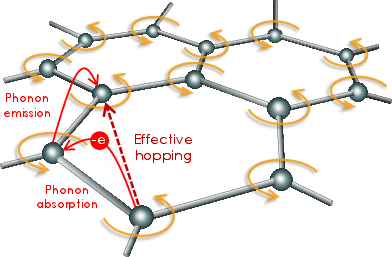
Figure 1: Schematic of electron-phonon coupling on a honeycomb lattice, with circularly polarized phonon-driven effective NNN hopping generating topological mass terms and magnetizations.
This framework generalizes previous optical Floquet topological insulator proposals by mediating the effective magnetic field via phonon angular momentum, decoupling the electronic system from direct photoexcitation, and making it accessible to a wider class of materials including those with weak light–electron coupling.
Topological Transitions and Chern Number Control
For λR=0, the model reduces to a spinless Haldane model, where tuning the phonon rotational amplitude ur/a0 or staggered potential δ enables a transition between trivial and topological insulating phases characterized by nonzero Chern number. The phase boundary and induced bandgaps are analytically captured by low-energy Dirac Hamiltonian expansions, and numerical calculations confirm the presence of robust gaps on the order of tens of meV for realistic parameters (notably, in graphene-like settings).
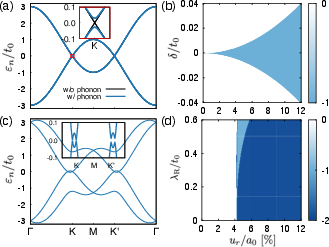
Figure 2: Topological transitions driven by phonon parameters—band structure evolution, phase diagrams of Chern number versus relevant system parameters, and gap-closing transitions in the presence of Rashba SOC.
Introducing Rashba SOC (λR=0) lifts the spin degeneracy, yielding a richer phase diagram with multiple gap-closing and reopening events controllable by tuning SOC and phonon parameters. The Chern number thus assumes integer values (such as C=0,−1,−2) contingent on the interplay between these parameters, directly impacting observable transport coefficients such as quantized Hall conductivity.
Emergence of Phonon-Induced Orbital Magnetization
Circularly polarized phonons, by breaking TRS, remove the valley cancellation of orbital magnetization (OM) characteristic of honeycomb lattices. Semiclassical theory reveals that both the intrinsic magnetic moment and the Berry curvature distributions are skewed by the phonon-induced mass terms.
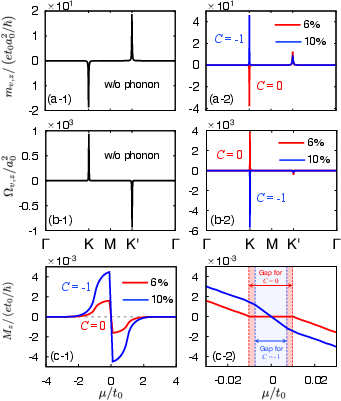
Figure 3: Intrinsic magnetic moment and Berry curvature distributions showing valley lifting under phonon driving; chemical potential dependence of orbital magnetization displaying Chern-number contingent behavior.
Remarkably, for topologically trivial states (C=0), the OM is suppressed within the bandgap, while for nontrivial states (C=0), the OM displays a linear dependence on the chemical potential within the gap: Mz=(e/2πℏ)μC. Quantitative estimates suggest that the orbital moment per unit cell reaches the 10−3μB scale under realistic phonon amplitudes in graphene.
Although direct spin-phonon coupling is absent, the inclusion of Rashba SOC permits nonzero spin magnetization, particularly a finite out-of-plane spin expectation value. The three-fold rotation symmetry (C3z) restricts the spin polarization to the ur/a00-axis, and the computed ur/a01 exhibits strong dependence on both Rashba SOC and the phonon rotation amplitude, peaking near the charge neutrality point.
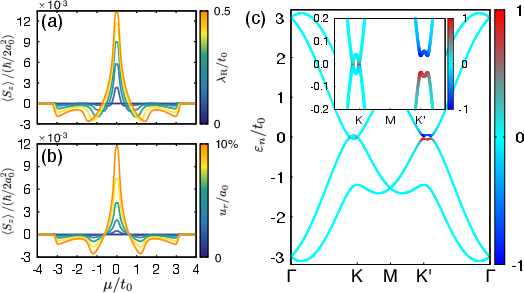
Figure 4: Out-of-plane spin magnetization as a function of chemical potential, Rashba SOC, and phonon amplitude. Bandcoloring depicts spin texture at different ur/a02-points.
The achievable spin polarization scale is on the order of ur/a03 per unit cell, similar to the orbital contribution. Even in materials with weak intrinsic SOC, engineering interfaces with enhanced Rashba effects (for instance, via heavy-atom substrates or gating) can generate substantial phononic spin magnetization.
Implications and Future Prospects
The demonstrated mechanism highlights circularly polarized phonons as effective tools for engineering electronic topology and magnetism without magnetic fields or strong light-matter coupling. Unlike optical Floquet approaches, phononic driving persists on longer timescales and accesses a regime where electron relaxation is typically much faster than that of the phonon bath. This opens prospects for long-lived topological states, robust switching between Chern phases, and the realization of phonon-driven quantum anomalous Hall effects. The phonon-driven mechanism also offers new strategies for probing, manipulating, and detecting Berry phase phenomena and magnetic responses in van der Waals and 2D materials systems.
The theoretical groundwork set by this approach suggests several future directions:
- Synthetic design of materials with tunable optical phonon frequencies and angular momentum content.
- Exploration of non-equilibrium and quantum statistical effects in the strong electron-phonon coupling regime.
- Integration of chiral phonon driving with heterostructure engineering for tailored magnetoelectric responses.
- Extension to magnonic, photonic, and superconducting analogs of phonon-induced topology and magnetism.
Conclusion
The paper establishes that circularly polarized phonon Floquet engineering offers a robust route to induce and control topological and magnetic responses in honeycomb-lattice electron systems. By generating effective Haldane mass terms, breaking TRS, and enabling the emergence of both orbital and spin magnetizations, this methodology enables dynamical access to Chern insulating phases and associated topological responses. This framework strengthens the conceptual and practical unification of phononics and topological electronics, positioning circularly polarized phonons as versatile actuators of emergent quantum phases (2606.10854).

