Balancing bias, baryons, and scale cuts in LSST 3x2pt analysis
Abstract: Stage IV surveys such as LSST will probe deeply into the nonlinear regime, where systematic effects from galaxy bias and baryonic feedback become dominant and poorly constrained nuisance parameters can lead to degeneracies. In this work we present a $3\times2$pt analysis for LSST Y1 and Y10 data using the BACCO emulator for modelling both the hybrid-effective field theory (HEFT) for nonlinear galaxy bias and the baryonic feedback using the baryonification mechanism. We aim to find a balance between model complexity and scale cuts, with particular attention to parameter degeneracies and baryonic feedback effects on the galaxy--matter and galaxy--galaxy power spectra. First, we find that a linear bias model delivers percent-level, unbiased constraints on $Ω{\rm m}$ and $σ_8$ only up to $k{\rm max}=0.1\,h/$Mpc, but pushing to smaller scales requires a perturbative approach. Second, we compare HEFT with a minimal bias variant with fixed higher-order terms, and find that the latter is unbiased in $Λ$CDM even at $k_{\rm max}=0.7\,h/$Mpc. We show that higher-order bias can mimic baryonic suppression, but baryons cannot reproduce the full range of higher-order bias behaviour. Third, we find that a detection of the total neutrino mass $M_ν$ is possible for both Y1 and Y10 for $k\geq0.3\,h/$Mpc, at least when photo-$z$ uncertainties and related nuisance parameters are precisely known. However, the specific measured value is not robust across equally plausible mock scenarios: the inferred $M_ν$ can be significantly biased by adopting the minimal bias model. The entire analysis is conducted with a new independent, open source pipeline (MGL) that we present for the first time in this work.
Paper Prompts
Sign up for free to create and run prompts on this paper using GPT-5.
Top Community Prompts
Explain it Like I'm 14
A simple explanation of “Balancing bias, baryons, and scale cuts in LSST 3×2pt analysis”
What is this paper about?
This paper is about how to get the most reliable information about the Universe from a huge upcoming sky survey called LSST. The authors focus on a popular way to combine three kinds of measurements of galaxies and weak lensing (this combo is called “3×2pt”). They ask: how can we safely use very small-scale details in the data, where the physics is messy, without fooling ourselves?
In simple terms: they want to measure how much matter the Universe has (Ωm), how “clumpy” it is (σ8), and even the total mass of neutrinos. But to do that correctly, they must handle two tricky effects: galaxy bias and baryonic feedback.
- Galaxy bias: galaxies don’t perfectly trace dark matter; they’re “biased” tracers.
- Baryonic feedback: gas, stars, and black holes push matter around, changing the small-scale patterns we see.
What questions are the authors asking?
- How far into small scales can we go before our simple models start giving wrong answers?
- Can we use a simpler galaxy-bias model and still get trustworthy results?
- How much do gas and star physics (baryonic feedback) change the signals we measure?
- Can LSST detect the total mass of neutrinos, and under what conditions will that measurement be trustworthy?
How did they study this? (Methods explained simply)
Think of the Universe’s structure like patterns in sand: there are big dunes (large scales) and fine ripples (small scales). The team looks at how strong those patterns are at different sizes. That “strength vs size” is called a power spectrum.
They combine three related patterns (the “3×2pt”):
- Galaxy clustering: how galaxies group together.
- Weak lensing (cosmic shear): how galaxy shapes are subtly stretched by gravity.
- Galaxy–galaxy lensing: how galaxies bend light from background galaxies.
Because the smallest ripples are the messiest, analysts often use “scale cuts” to ignore the tiniest details. The authors test different “maximum smallness” limits (how deep into small scales they can safely go).
To model the messy physics:
- They use an “emulator” (BACCO), which is like a very fast, smart shortcut trained on detailed simulations.
- For galaxy bias, they use HEFT (Hybrid Effective Field Theory): do simple math at early times, then let simulations handle the later, messy evolution. This lets them push to smaller scales than basic math alone.
- For baryonic feedback, they use “baryonification,” which tweaks dark-matter-only simulations to mimic how gas, stars, and black holes move matter around.
- They create realistic mock LSST data for Year 1 (Y1) and Year 10 (Y10), then test different model choices.
- They also try a “minimal bias” setup: a simplified version of the bias model that fixes some higher-order terms instead of fitting them.
They built and used a new, open-source pipeline called MGL to run all of this.
Key ideas in everyday terms:
- Scale cuts: choosing how much “fine detail” to trust.
- Degeneracy: when two different causes produce very similar effects in the data, making them hard to tell apart.
- Ωm: the overall amount of matter in the Universe.
- σ8: how clumpy matter is on a common reference scale.
- Neutrino mass: a small but important ingredient that slightly smooths small-scale structure.
What did they find, and why does it matter?
Here are the headline results, translated:
- Simple bias is safe only on big scales:
- Using a very simple “linear bias” model is fine and unbiased for Ωm and σ8 if you stay on large scales (roughly k ≤ 0.1 h/Mpc). If you push to smaller scales, it starts to give biased answers.
- A simplified, but smarter, bias model works surprisingly well:
- A “minimal bias” version (which keeps the main parts and fixes some higher-order terms) stays accurate even when using much smaller scales (down to k ≈ 0.7 h/Mpc) in a standard cosmology. This is good news: you can get more information without exploding the number of nuisance parameters.
- Bias can imitate baryons, but not the other way around:
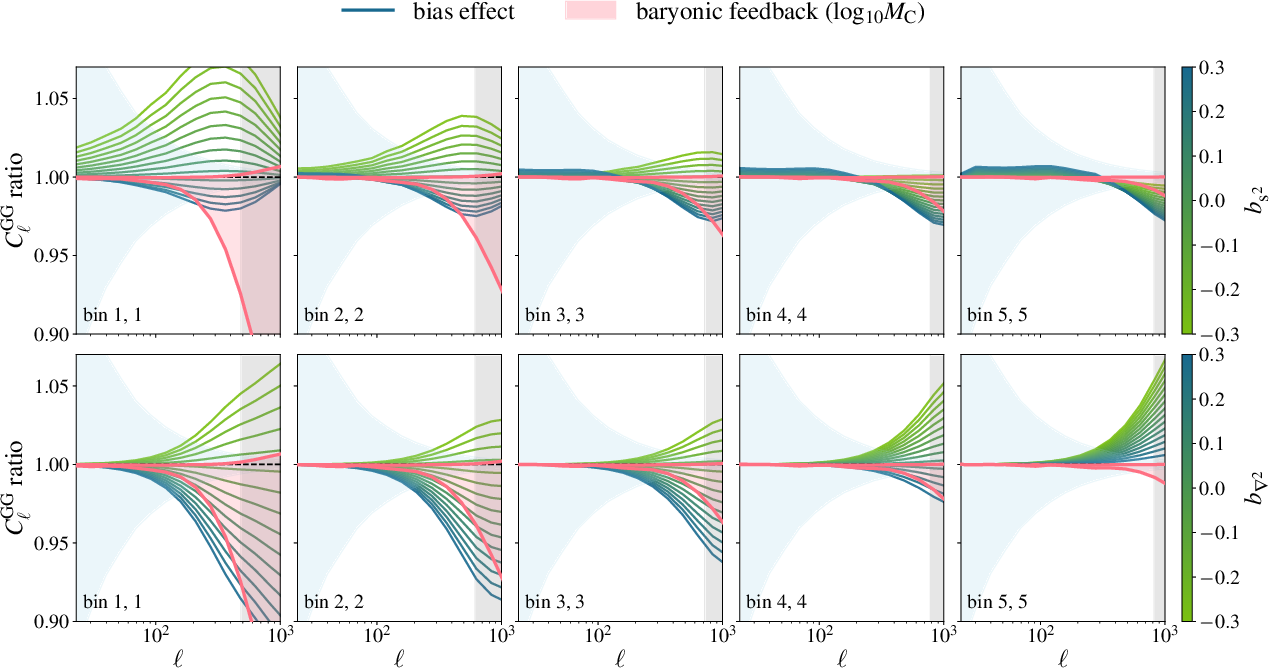
- The extra freedom in galaxy-bias parameters can produce changes that look a lot like baryonic feedback on certain signals, especially galaxy clustering. That means bias and baryons can be confused if you don’t model them with care.
- However, baryons alone cannot reproduce the full variety of higher-order bias effects. So the bias model still needs to be flexible enough.
- Neutrino mass is detectable with small-scale data, but be careful:
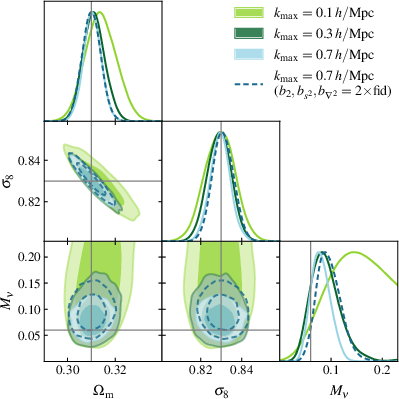
- Both LSST Y1 and Y10 could detect a non-zero total neutrino mass if you include moderately small scales (k ≥ 0.3 h/Mpc).
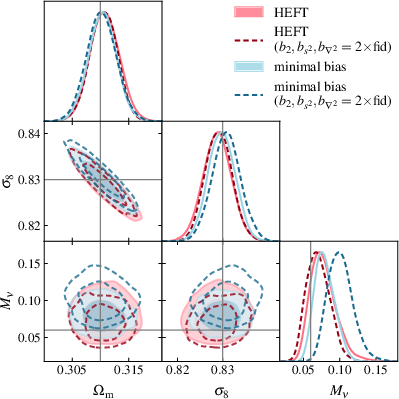
- But the exact value you infer can be biased if you use a too-simple bias model or if other uncertainties (like photometric redshifts) aren’t tightly controlled. In short: a detection is possible, but getting the right number requires careful modelling.
- Combining the three signals (3×2pt) helps:
- Because galaxy clustering and weak lensing respond differently to bias and baryons, analyzing them together helps untangle degeneracies and improves overall reliability.
- Tools:
- The authors present MGL, a new independent, open-source analysis pipeline, helping the community test these ideas transparently.
What does this mean for future research and LSST?
- For basic cosmology (Ωm and σ8), you can either:
- Play it safe with simple models and only use large scales; or
- Use smarter, still-manageable models (like the minimal bias approach) to safely include much smaller scales and gain sharper results.
- For more delicate goals, like measuring the total neutrino mass, the modelling really matters. Using small scales boosts your chances of detecting it, but you must control other uncertainties and avoid over-simplified bias models.
- Baryonic physics is important at small scales and must be included, but galaxy-bias flexibility can “absorb” some of its effects. That’s both a warning (they can be confused) and an opportunity (combined probes and careful modelling can separate them).
- The methods and open-source tools here can guide LSST analyses to balance model complexity and data usage, aiming for maximum science with minimal bias.
In short: this paper shows how to push LSST’s small-scale data safely. With the right balance of model simplicity and flexibility, we can sharpen our view of the Universe—just be extra careful when chasing subtle signals like neutrino mass.
Knowledge Gaps
Knowledge gaps, limitations, and open questions
Below is a concise list of unresolved issues, limitations, and uncertainties that future work should address to make the paper’s conclusions robust and broadly applicable.
Modelling of galaxy bias and baryonic effects
- The “minimal bias” HEFT variant (fixing higher-order terms such as and ) is only validated for a specific CDM-like fiducial; its robustness across:
- different galaxy selections and redshift distributions,
- alternative fiducial values, redshift evolution, and priors for , , , ,
- and beyond-CDM models (e.g., , modified gravity),
- remains unquantified.
- The study varies only a single baryonic parameter () while fixing the other six BACCO baryonification parameters; the resulting degeneracy structure and parameter biases if the fixed baryonic degrees of freedom differ from reality are not assessed.
- The assumption that can absorb baryonic effects purely via HEFT bias terms (and scales as ) lacks validation across:
- higher redshifts relevant for LSST,
- alternative hydrodynamical models beyond those underlying BACCO and FLAMINGO,
- and scales near the HEFT validity boundary.
- The demonstrated mimicry between higher-order bias and baryonic suppression is shown only at the level for specific bins; a systematic, global quantification (e.g., across all tomographic bins and ranges) of the degeneracy (and where it breaks) is missing.
- The stochastic term in is treated as scale-independent shot noise; potential scale dependence and non-Poissonian stochasticity at are not modeled or tested.
- The redshift evolution of bias parameters is imported from HSC-based fits; sensitivity to different galaxy samples, selection functions, and LSST-specific target samples is unexplored.
Neutrino mass constraints and robustness
- The reported detectability of a non-zero at assumes:
- fixed and precisely known photo- systematics,
- a single-parameter baryonic model (),
- and a specific bias model choice; the stability of the inference when relaxing these assumptions is not quantified.
- The finding that adopting the minimal bias model can bias highlights a need for:
- a principled model-selection or goodness-of-fit criterion to decide between HEFT vs. minimal bias per dataset,
- scale-cut prescriptions optimized specifically for ,
- and external priors (e.g., from CMB/BAO) to mitigate degeneracies—none of which are explored.
- Degeneracies between , small-scale baryonic suppression, and higher-order bias across tomographic bins and scales are not mapped to identify where information is most robust.
Covariance and likelihood assumptions
- Only the Gaussian covariance is used; the impact of non-Gaussian and super-sample covariance at the small scales leveraged (up to ) is not quantified and may be non-negligible.
- The data vectors are “noiseless” realisations (mean-theory vectors), which can overestimate constraining power and understate parameter volume effects; the sensitivity of results to realistic data scatter is not tested.
- Posterior non-Gaussianity is present for several parameters, but both FoM and FoB assume Gaussian posteriors; the reliability of these figures in non-Gaussian regimes is not assessed.
Survey and astrophysical systematics omitted or fixed
- Photometric redshift uncertainties (bias, scatter, outlier fractions) are held fixed throughout; their degeneracies with bias, baryons, and —especially at small scales—are not evaluated.
- Intrinsic alignments are modeled with NLA-z and often fixed; the impact of more flexible IA models (e.g., TATT), scale dependence, and IA–baryon–bias degeneracies is not explored.
- Shear calibration systematics (multiplicative and additive biases), PSF residuals, blending, depth variations, and selection effects are ignored; potential coupling with small-scale modeling is unknown.
- Galaxy magnification, lensing bias, and redshift-space distortions are not included in or ; their omission at the adopted scales is not justified quantitatively.
Projection, scale cuts, and modeling choices
- The same scale cuts are used for galaxy clustering and galaxy–galaxy lensing “for simplicity”; the performance and biases of optimized, bin-dependent cuts are not studied.
- The mapping uses a single per probe; the approximation’s impact on multi-bin analyses and scale-cut accuracy is not quantified.
- The Limber approximation is assumed at without testing its residual bias for cross-correlations and wide kernels; non-Limber corrections are not evaluated.
- Lensing analyses are capped at due to BACCO limitations; the lost information and trade-offs with alternative nonlinear matter models (e.g., HMCode with emulator uncertainties) are not assessed.
Emulator validity and uncertainty propagation
- BACCO HEFT and baryonification emulators are extrapolated to and near the validity edge ( for HEFT); the impact of these extrapolations on cosmological inferences is not rigorously bounded.
- Emulator prediction uncertainties (1–5% for baryons; similar for HEFT cross-spectra) are not propagated into the likelihood; their effect on FoM/FoB and on detection claims is unknown.
- Validation of the Zennaro24 recipe is restricted to specific simulations () and 3D power spectra; its accuracy when projected to across LSST redshift ranges is not fully established.
Generalizability and cross-validation
- The conclusions (e.g., that minimal bias is “safe” up to ) are explicitly sample- and analysis-dependent; no systematic exploration across different galaxy populations, selection functions, or HOD-based mocks is provided.
- No joint analysis with external data (e.g., CMB, BAO, RSD, CMB lensing, tSZ, X-ray) is performed to help constrain baryonic parameters and break degeneracies; the incremental gains are not quantified.
- The ability of pt to self-calibrate against baryons and bias in the presence of realistic systematics (photo-, IA, shear calibration) is not demonstrated.
Pipeline validation and reproducibility
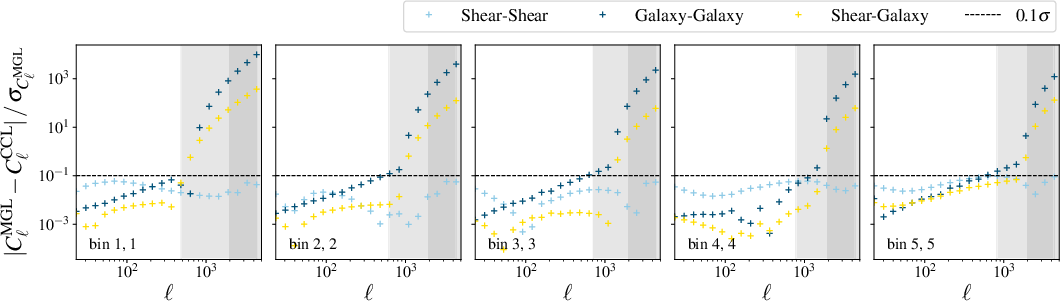
- MGL is newly introduced and compared to CCL in limited configurations; end-to-end validation (including baryons, HEFT, , IA, and covariance choices) against multiple independent pipelines is incomplete.
- Sampler convergence diagnostics, posterior multi-modality (noted for some ), and sensitivity to prior choices are not systematically reported; the robustness of inferences to these practical choices is unclear.
Specific actionable follow-ups
- Jointly vary all seven BACCO baryonic parameters with informative priors (e.g., from hydros or external probes) and propagate emulator uncertainty; reassess FoM/FoB and sensitivity.
- Introduce realistic photo- uncertainties and IA model flexibility (e.g., TATT), and quantify their coupled degeneracies with HEFT parameters and at –.
- Replace Gaussian-only covariance with a full covariance (including non-Gaussian and super-sample terms) and test the stability of results vs. scale cuts.
- Develop and test parameter-dependent, bin-specific scale-cut strategies optimized separately for and , with model-selection metrics for minimal vs. full HEFT choices.
- Validate the prescription and “absorption” of baryons against multiple hydro suites and at , using projected and tomographic combinations.
- Explore extended cosmologies (e.g., , modified gravity) to evaluate whether conclusions on bias/baryon degeneracies and scale usage persist beyond CDM.
Practical Applications
Immediate Applications
The following applications can be deployed now by leveraging the paper’s findings, modeling choices, and open-source tools.
- Minimal-bias 3×2pt pipeline for Stage IV surveys (academia; software)
- Description: Adopt the “minimal bias” model (fixing higher-order HEFT terms) for galaxy clustering and galaxy–galaxy lensing to include quasi-nonlinear scales up to k≈0.7 h/Mpc without biasing ΛCDM constraints on Ωm and σ8 in LSST-like analyses.
- Tools/workflows: Use the MGL pipeline with the BACCO emulator; configure HEFT with b1 and b2 free, set bs2 and blap to zero; apply the paper’s scale-cut mapping (kmax→ℓmax).
- Assumptions/dependencies: Valid for the fiducial-like galaxy samples and cosmology tested; HEFT validity to k≤0.7 h/Mpc; relies on BACCO’s calibrated regime and Zennaro24 assumptions. Bias safety depends on fiducials—should be validated on real data and per sample.
- Scale-cut decision framework using FoM/FoB (academia; survey operations)
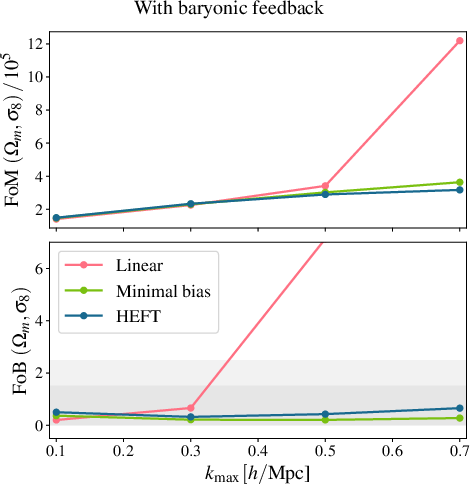
- Description: Apply the paper’s figure-of-merit (FoM) and figure-of-bias (FoB) diagnostics to select k-cuts that balance precision and robustness.
- Tools/workflows: Integrate FoM/FoB dashboards into cosmology pipelines to assess tradeoffs for kmax∈[0.1,0.7] h/Mpc; map to ℓmax per tomographic bin.
- Assumptions/dependencies: Gaussian covariance approximation; posterior near-Gaussianity for FoM/FoB; survey-specific validation needed.
- Linear-bias “safe mode” for conservative analyses (academia; survey QA)
- Description: Use linear bias with k≤0.1 h/Mpc for unbiased Ωm, σ8 constraints at the percent level; a robust baseline for cross-checks and systematics audits.
- Tools/workflows: Parallel chains with linear-bias+conservative scale cuts for robustness tests; compare shifts against minimal-bias/HEFT runs.
- Assumptions/dependencies: Reduced constraining power; sensitive to priors on Ωb, h, ns if used alone—combine with external data as needed.
- Pragmatic baryon treatment in galaxy–galaxy lensing (academia; software)
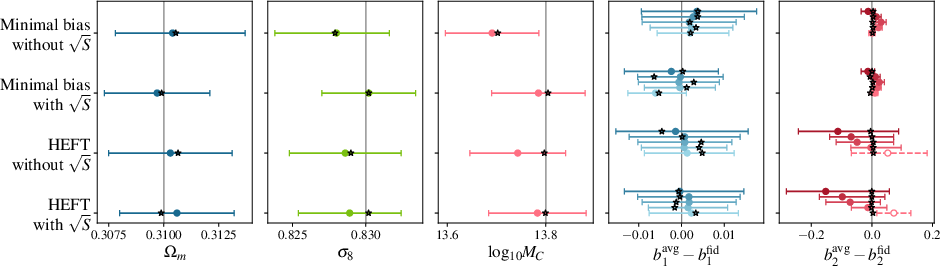
- Description: Use the Zennaro24 prescription: Pgg unchanged; include √S(k) factor in Pgm (or, in a pinch, omit √S in GGL with negligible cosmology bias but shifted baryonic parameters).
- Tools/workflows: Implement √S(k) in GGL within MGL or CCL-based pipelines; stress-test with/without √S to quantify sensitivity.
- Assumptions/dependencies: Validated to k≈0.7 h/Mpc at z≈0–1; accuracy relies on BACCO’s suppression S(k,z) calibrated to hydrodynamical suites.
- Accelerator-ready emulator integration for fast MCMC (software; HPC/cloud)
- Description: Deploy neural-network emulators (BACCO) to model nonlinear Pmm and HEFT bias terms, enabling efficient 3×2pt inference over large parameter spaces.
- Tools/workflows: Containerize MGL+BACC0 for cloud/HPC; cache emulator queries; exploit parallel samplers (e.g., nautilus) at scale.
- Assumptions/dependencies: Emulator training domain coverage; version control and provenance for reproducibility; careful treatment of z and k extrapolations.
- Reproducible, open-source forecasting and validation (academia; education)
- Description: Use MGL’s public code and accompanying notebooks to reproduce forecasts, perform cross-checks (vs. CCL), and train students in modern 3×2pt inference.
- Tools/workflows: Distribute tutorial notebooks; build CI tests comparing MGL vs. alternative pipelines; standardize emulator/extrapolation options.
- Assumptions/dependencies: Maintenance of open repositories; alignment of code versions with survey analyses; community contributions.
- Photo-z investment prioritization for small-scale science (policy; survey strategy)
- Description: Prioritize photometric redshift calibration programs to enable robust use of k≥0.3 h/Mpc for neutrino mass sensitivity and small-scale gains.
- Tools/workflows: Use FoM improvements per kmax as a function of photo-z priors to motivate calibration targets (cross-matching, spectroscopy, ML calibration).
- Assumptions/dependencies: Tighter photo-z systematics and IA controls are preconditions to realize small-scale gains without bias.
- Robustness checks for baryon–bias degeneracy (academia; survey QA)
- Description: Exploit the paper’s finding that higher-order bias can mimic baryonic suppression in Pgg to design targeted robustness tests in data analyses.
- Tools/workflows: Run alternative chains toggling bs2, blap and S(k) to isolate degeneracy directions; use external probes (tSZ/X-ray) to inform baryonic parameters.
- Assumptions/dependencies: Degeneracy structure is sample- and model-dependent; requires cross-probe priors for high-fidelity baryon inference.
- Y1→Y10 scaling forecasts to guide pipeline complexity (academia; survey planning)
- Description: Use demonstrated FoM gains (≈2.3× from Y1 to Y10 at kmax=0.7 h/Mpc) to plan when to activate more complex bias models or tighter priors.
- Tools/workflows: Stage rollout plans where minimal bias is default; switch to full HEFT for specific science cases or when justified by Y10 statistics.
- Assumptions/dependencies: Similar galaxy samples and systematics; performance hinges on data quality and accurate covariances.
- Educational adoption in advanced cosmology courses (education)
- Description: Use the MGL pipeline and the paper’s results to teach emulator-based inference, scale cuts, and model misspecification diagnostics.
- Tools/workflows: Capstone projects reproducing 3×2pt forecasts with varying kmax and bias models; classroom exercises on FoM/FoB.
- Assumptions/dependencies: Access to modest compute; faculty familiarity with Python and emulator-based cosmology.
Long-Term Applications
The following applications will benefit from further research, development, or scaling and are likely to materialize over LSST Y10 and beyond.
- Neutrino mass detection and cross-field synthesis (academia; particle physics policy)
- Description: Leverage small-scale information (k≥0.3 h/Mpc) with improved photo-z and systematics control to achieve robust detections/limits on total neutrino mass Mν.
- Tools/workflows: Joint analyses with spectroscopic surveys (DESI), CMB lensing, and multi-wavelength baryon probes; hierarchical modeling of systematics.
- Assumptions/dependencies: Tight priors on photo-z, IA, Ωb, h, ns; validated baryonic models; cross-survey covariance handling and data-sharing policies.
- Next-generation hybrid modeling beyond k≈0.7 h/Mpc (academia; software; HPC)
- Description: Extend HEFT+baryonification with improved emulators trained on larger N-body+hydro suites (e.g., FLAMINGO-class) to safely harvest smaller scales.
- Tools/workflows: New emulator training with uncertainty quantification; differentiable forward models; automated validity domain checks.
- Assumptions/dependencies: Availability of large simulation suites; community-standard benchmarks; compute resources and funding.
- Adaptive model-selection and parameter reduction (software; academia)
- Description: Develop data-driven toggling of higher-order bias parameters (e.g., enable bs2/blap only where supported by the data), minimizing bias while maximizing precision.
- Tools/workflows: Bayesian model comparison, sparsity-inducing priors, or ML surrogates to predict when minimal bias suffices.
- Assumptions/dependencies: Reliable evidence calculations; safeguards against overfitting; standardized diagnostic protocols.
- Community-standard baryon corrections across probes (academia; policy; software)
- Description: Standardize S(k,z) prescriptions and their propagation into Pgm and Pgg for weak lensing, clustering, and CMB lensing analyses.
- Tools/workflows: Modular libraries with versioned baryon models; cross-validation with tSZ, X-ray, and kinetic SZ measurements; uncertainty envelopes.
- Assumptions/dependencies: Consensus on simulation-calibrated models; cross-probe consistency; reproducible pipelines.
- “Cosmo-as-a-Service” platforms (industry; software; education)
- Description: Package emulator-based 3×2pt inference (MGL+BACC0 and successors) into managed cloud services for collaborative analyses and education.
- Tools/workflows: Web APIs, authenticated data access, provenance tracking, scalable MCMC backends, reproducible containers.
- Assumptions/dependencies: Data governance and security; sustained funding; community adoption and maintenance.
- Cross-probe baryonic physics inference (academia)
- Description: Jointly constrain baryonic feedback parameters (e.g., log Mc) with 3×2pt, SZ, X-ray, and galaxy–cluster observables to break degeneracies with bias parameters.
- Tools/workflows: Likelihood-level integration of multi-wavelength datasets; shared emulator backends; hierarchical priors for halo gas physics.
- Assumptions/dependencies: Survey overlap and calibration; systematics inter-calibration; consistent selection functions.
- Generalized bias–variance tradeoff analytics in inference pipelines (software; cross-domain)
- Description: Export FoM/FoB-based frameworks to other domains (e.g., climate emulation, materials, aero) to optimize model simplifications under misspecification.
- Tools/workflows: Domain-agnostic FoM/FoB toolkits; scenario-based stress testing and projection bias diagnostics.
- Assumptions/dependencies: Availability of surrogate models; domain-specific validation datasets; community uptake.
- Workforce development and reproducibility standards (policy; education)
- Description: Use open pipelines (MGL) and standardized comparisons (vs. CCL) to drive reproducibility norms and train the next generation of survey analysts.
- Tools/workflows: Curriculum-integrated open-source projects; reproducibility checklists; community-led benchmark challenges.
- Assumptions/dependencies: Institutional support; alignment with survey collaboration policies; recognition of software contributions.
- Targeted investment in small-scale systematics (policy; survey strategy)
- Description: Inform funding and scheduling for IA modeling, photo-z calibration, and hydrodynamical simulation programs to unlock small-scale cosmology at Y10.
- Tools/workflows: Cost–benefit analyses based on FoM gains vs. required systematics control; adaptive milestones as data accumulates.
- Assumptions/dependencies: Accurate projections of FoM improvements; coordination across surveys; robust project management.
- Technology transfer of emulator-driven hybrid modeling (industry; R&D)
- Description: Apply the “hybrid EFT + emulator” paradigm to accelerate high-fidelity simulations in engineering and applied physics (e.g., semiconductors, CFD).
- Tools/workflows: Build domain-specific emulators calibrated on expensive simulators; uncertainty-aware predictions; adaptive scale inclusion.
- Assumptions/dependencies: Adequate training data; domain acceptance of emulator approximations; rigorous validation and certification.
Notes on key dependencies spanning many applications:
- Validity ranges: HEFT to k≲0.7 h/Mpc; BACCO coverage in k, z, cosmology; Zennaro24 accuracy for Pgm.
- Systematics control: photo-z, IA, shear calibration, intrinsic alignments must be well modeled for small-scale gains and extension parameters (e.g., Mν).
- Prior choices: Constraints and bias sensitivity depend on priors on Ωb, h, ns and on the chosen nuisance parameterization.
- Data quality and covariance: Gaussian covariance assumption is sub-dominant for LSST-like configurations but should be revisited with real data (non-Gaussian and super-sample terms).
- Sample dependence: Minimal-bias safety is sample-dependent; validate per galaxy sample and redshift binning before adoption in production analyses.
Glossary
- 3×2pt statistic: Joint analysis of three two-point functions (galaxy clustering, cosmic shear, and their cross-correlation) to improve cosmological constraints. "A key observable for these cosmological surveys is the so-called pt statistic, which refers to the joint analysis of three two-point correlation functions: the autocorrelation of galaxy positions, the autocorrelation of galaxy shapes, and their cross-correlation."
- Angular diameter distance: The distance inferred from an object's physical size and angular size, relevant for converting wavenumber to multipole. "where is the angular diameter distance"
- Angular power spectrum: The variance of a field on the sky as a function of multipole ℓ, often denoted by Cℓ. "the angular power spectrum between two fields and is defined as:"
- Autocorrelation: Correlation of a field with itself, either for galaxy positions or shapes. "the autocorrelation of galaxy positions, the autocorrelation of galaxy shapes, and their cross-correlation."
- BACCO emulator: A neural-network-based emulator that predicts nonlinear matter and biased tracer power spectra, including baryonic effects. "BACCO ~is a neural network-based emulator which includes 7 additional baryonic parameters"
- Baryonic Correction Models: Semi-empirical methods to incorporate baryonic physics into matter clustering predictions. "semi-empirical approaches such as Baryonic Correction Models or baryonification"
- Baryonic feedback: Astrophysical processes (e.g., AGN, stellar feedback) that redistribute matter and suppress small-scale power. "the redistribution of dark matter due to baryonic physics (i.e., the so-called baryonic feedback) becomes non negligible."
- Baryonification: An algorithmic procedure to imprint baryonic effects onto dark-matter-only simulations. "through a baryonification algorithm."
- Baryonified density profile: A halo or matter distribution modified to include baryonic effects via baryonification. "The result is a ``baryonified'' density profile"
- Comoving distance: The cosmological distance measure factoring out cosmic expansion, used in projections. "where the subscripts and indicate a specific redshift bin, is the wavelength number, is the 2D multipole moment and is the comoving distance,"
- Cosmic shear: Weak-lensing-induced distortions of galaxy shapes used to trace matter distribution. "Our data vector consists of the cosmic shear, galaxy clustering auto, and galaxy--matter cross-spectra,"
- Cross-correlation: Correlation between two different fields (e.g., positions and shapes) to exploit complementary information. "the autocorrelation of galaxy positions, the autocorrelation of galaxy shapes, and their cross-correlation."
- Dark matter-only (DMO): Simulations or spectra that exclude baryonic physics, used as a baseline for baryonic corrections. "nonlinear dark matter-only (DMO) power spectrum"
- Dirac delta function: A distribution that enforces equality of arguments, appearing in power-spectrum definitions. "where indicates the Dirac delta function."
- Effective Field Theory of Large-Scale Structure (EFTofLSS): A perturbative framework that accounts for small-scale physics via effective terms to extend modeling to mildly nonlinear scales. "The Effective Field Theory of Large-Scale Structure (EFTofLSS) \citep{Baumann2012, Carrasco2012, Pajer2013}, further extends this range by incorporating the effect of complex small-scales physics in mildly nonlinear effective terms."
- Effective number density: The number density of usable galaxies after weighting, relevant for noise estimates. "with an effective number density of "
- Eulerian framework: Describes fields at fixed spatial positions in the evolved (observed) universe. "where is the linear bias parameter in the Eulerian framework (E)."
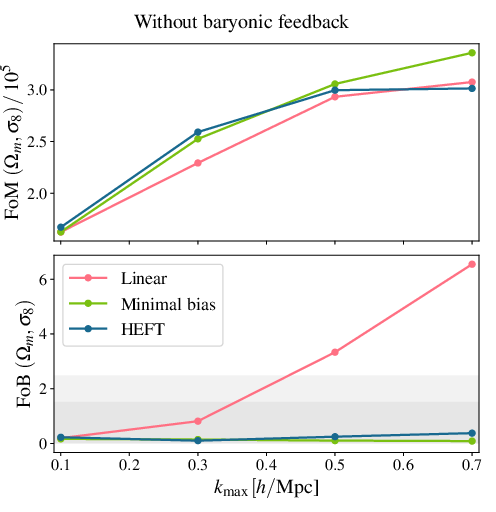
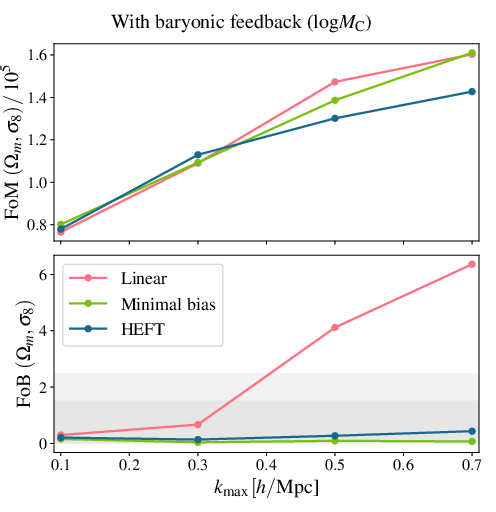
- Figure of bias (FoB): A scalar measure of how far inferred parameters are from fiducials in units of the posterior covariance. "The figure of bias (FoB) quantifies the relative separation of the measured parameters from their fiducial values in terms of the variance of the posterior distribution."
- Figure of merit (FoM): A scalar proportional to the inverse uncertainty volume, used to summarize constraining power. "We quantify the constraining power of a considered model with respect to the parameters varied in the fit with the figure of merit (FoM)."
- FLAMINGO Simulation: A large cosmological hydrodynamical simulation suite used to calibrate baryonic effects. "e.g., the FLAMINGO Simulation \citep{Schaye2023}"
- Fourier space (k): The wavenumber domain where power spectra are defined and modeled. "In Fourier space (), the matter power spectrum is defined by the two-point correlation function"
- Galaxy bias: The relation between galaxy and matter overdensities, including linear and higher-order terms. "the way galaxies trace the underlying dark matter distribution (i.e., galaxy bias) also becomes nonlinear at nonlinear scales."
- Galaxy clustering: The spatial distribution and correlations of galaxy positions tracing underlying matter. "these surveys will also probe galaxy clustering over vast volumes and to high redshift,"
- Galaxy–galaxy lensing (GGL): The cross-correlation between foreground galaxy positions and background galaxy shapes. "galaxy-galaxy (GG) and galaxy-galaxy lensing (GGL)"
- Galaxy–galaxy power spectrum: The power spectrum of galaxy position fluctuations, often denoted P_gg. "baryonic feedback effects on the galaxy--matter and galaxy--galaxy power spectra."
- Galaxy–matter power spectrum: The cross power spectrum between galaxies and matter, often denoted P_gm. "baryonic feedback effects on the galaxy--matter and galaxy--galaxy power spectra."
- Gaussian covariance: The covariance contribution assuming Gaussian-distributed fields, dominant on large scales. "we include only the Gaussian component of the pt covariance matrix"
- Growth factor: The linear-theory factor describing the growth of structure with redshift. " is the growth factor,"
- HEFT (Hybrid Effective Field Theory): A hybrid bias framework evolving perturbative initial conditions with N-body simulations to extend to smaller scales. "we adopt here the Hybrid Effective Field Theory (HEFT) approach"
- Hubble expansion rate (H0): The present-day expansion rate of the universe. "where is the Hubble expansion rate today,"
- Hydrodynamical simulations: Simulations that include gas, stars, and feedback to model baryonic physics. "mitigation relies on hydrodynamical simulations,"
- Intrinsic alignments (IA): Alignments of galaxy shapes with the tidal field that contaminate weak-lensing measurements. "such as galaxy bias, intrinsic alignments, and photometric redshift errors,"
- Lagrangian approach: A bias framework relating galaxy formation to initial conditions in the primordial density field. "For instance, in the Lagrangian approach, which relates the bias parameters to the initial density field"
- Lagrangian displacement field: The mapping from initial (Lagrangian) to final (Eulerian) positions due to gravitational evolution. "while is the Lagrangian displacement field."
- Limber approximation: A projection approximation used to compute angular power spectra from 3D power spectra. "Under the Limber approximation \citep{Limber1953, LoVerde2008} and assuming a flat Universe cosmology,"
- LIMD (Local-in-matter-density) bias: A bias model where tracer overdensity depends only on the local matter density. "the so-called local-in-matter-density (LIMD) Lagrangian bias,"
- Linear bias model: The first-order relation between galaxy and matter overdensities with a single bias parameter. "a simple linear bias model,"
- ΛCDM: The standard cosmological model with a cosmological constant and cold dark matter. "and find that the latter is unbiased in CDM even at Mpc."
- Massive neutrinos (total neutrino mass): Non-zero neutrino masses that suppress small-scale structure growth, parameterized by Mν. "a detection of the total neutrino mass is possible"
- MCMC: Markov Chain Monte Carlo, a sampling method for posterior inference. "performs MCMC analysis for Stage IV surveys."
- MGL (Modified Gravity Lensing): An open-source Bayesian pipeline for Stage IV photometric probes and small-scale systematics. "is a Bayesian inference code for different photometric probes that performs MCMC analysis for Stage IV surveys."
- Multipole moment (ℓ): The angular wavenumber on the sky indexing Cℓ. " is the 2D multipole moment"
- N-body simulations: Numerical simulations evolving many particles under gravity to model structure formation. "via numerical -body simulations."
- Nonlinear alignment model (NLA-z): A phenomenological IA model with redshift dependence. "the redshift-dependent nonlinear alignment model (NLA-z)"
- Nonlinear matter power spectrum: The matter power spectrum including nonlinear gravitational evolution. " is the nonlinear matter power spectrum,"
- Photometric redshift (photo-z): Redshift estimates derived from multiband imaging, with associated uncertainties. "photo- uncertainties"
- Scale cuts: The practice of removing small (or large) scales from analysis to avoid modeling systematics. "We choose to explore the impact of scale cuts on the galaxy-galaxy correlation function,"
- Shape noise: Random intrinsic ellipticity noise in galaxy shape measurements. "the variance on the ellipticity (the shape noise per component) is taken to be "
- Stochastic term (P_SN): The scale-independent shot-noise-like contribution to galaxy power from stochasticity in galaxy formation. "and is the power spectrum of the stochastic term in the previous bias equation, which is assumed to be scale-independent."
- Suppression factor (S_mm): The ratio of baryonic to dark-matter-only matter power spectra quantifying baryonic impact. "i.e., by a suppression factor:"
- Super-sample covariance: Covariance induced by modes larger than the survey window that modulate small-scale power. "since the other two -- the super-sample and non-Gaussian components -- are sub-dominant"
- Tidal field: The shear component of the gravitational potential entering higher-order bias terms. "the squared tidal field, "
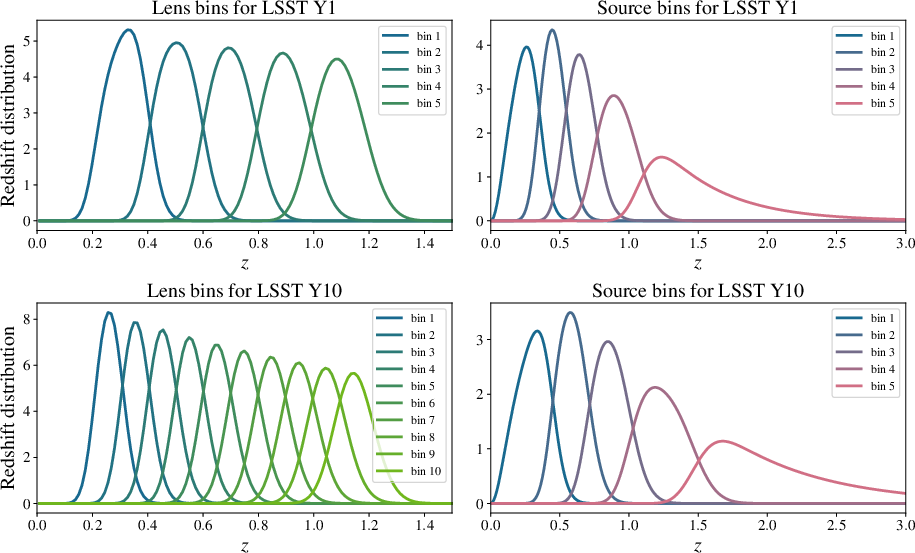
- Tomographic bins: Redshift-sliced samples used to exploit redshift information in angular analyses. "Redshift distributions of the tomographic bins"
- Window function: The redshift weighting kernel that projects 3D power into 2D angular power. "The window function for lensing tracers is given by:"
- Zennaro24 approach: A prescription for including baryonic effects in P_gm and P_gg within perturbative bias models. "Hereafter we refer to this approach as Zennaro24."
Collections
Sign up for free to add this paper to one or more collections.