- The paper introduces three models for r-band magnitudes that update the PATH framework using empirical, predictive, and naive approaches.
- It employs Bayesian methods to combine DM-based redshift probabilities and realistic image completeness for refined host galaxy association.
- The findings indicate FRB hosts are significantly fainter than expected from standard SFR or mass-weighted models, challenging conventional progenitor theories.
Updating the PATH Framework for FRB Host Galaxy Identification: Models, Results, and Implications
Introduction
The association of fast radio bursts (FRBs) with their host galaxies has become a critical aspect of both understanding FRB progenitors and utilizing FRBs as cosmological probes. Traditionally, the Probabilistic Association of Transients to their Hosts (PATH) framework has been the standard tool for host identification, providing Bayesian probabilities for candidate associations based on host offsets and magnitude-based priors. However, with an expanding sample of localizations—now in excess of one hundred—a revision of PATH’s prior structures is warranted to reflect modern empirical and physical understanding of host galaxies.
This work extends PATH by incorporating physically motivated priors for host galaxy magnitudes, parameterized via three distinct models for the r-band magnitude distribution at a given redshift, P(mr∣z). By integrating these distributions with P(z∣DM)—the probability of redshift given FRB dispersion measure—this approach brings model-driven rigor to host association and prior estimation. Fitting of these models leverages host candidates from 32 ASKAP/CRAFT ICS-mode FRBs, enabling robust statistical evaluations across data-driven (empirical), astrophysical (predictive), and agnostic (naive) modeling approaches.
Extension of the PATH Framework
The updated PATH methodology generalizes the form of priors to enable the use of P(mr∣z), where the host galaxy’s apparent magnitude is explicitly conditioned on its cosmological redshift. This eliminates the need for generic priors and, crucially, enables the DM of each FRB to inform the expected magnitude of its host via P(z∣DM). The framework further supports the calculation of the prior probability of the true host being undetected (P(U)), now appropriately DM- and image-depth-dependent rather than constant.
The resulting posterior probabilities account for:
- refined priors on host magnitudes derived from physical and empirical models,
- event-specific estimates of P(z∣DM), and
- realistic image completeness functions P(O∣mr) tailored to survey depths and filtering.
This structural change also clarifies subtle normalization questions that arise in prior construction, ensuring that the assignment of probability to detected versus undetected hosts is consistent with astrophysical expectations and observational selection.
Host Galaxy Magnitude Models
Three contrasting models for P(mr∣z) are developed:
1. Empirical Model ("Marnoch23")
Constructed as a non-parametric, redshift-dependent Gaussian model based on the observed mr(z) distribution of 23 FRB host galaxies, predominantly at z<0.5. K-corrections are data-driven, accounting for real SEDs and filter transformations. This model is highly descriptive, encapsulating the heterogeneity of observed host properties without attendant assumptions on progenitor physics.
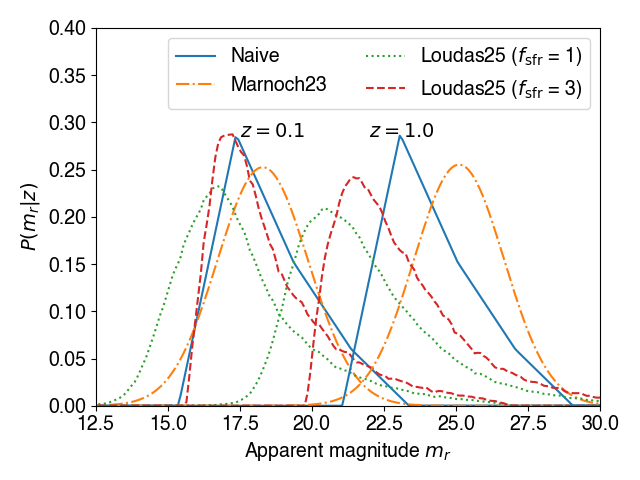
Figure 2: Apparent magnitude distributions, P(z∣DM)0, produced by the empirical Marnoch23 model, demonstrating strong empirical grounding for low-P(z∣DM)1 FRB hosts.
2. Predictive Physical Model ("Loudas25")
Simulates galaxies via the GALFRB code, drawing from a joint distribution in stellar mass and star formation rate (SFR), with P(z∣DM)2 modulated by a parameter P(z∣DM)3 that interpolates between weighting by total stellar mass and by SFR. Redshift evolution and realistic UV-IR SEDs inform the construction, allowing predictions for differing progenitor scenarios (prompt vs. delayed channel, metallicity preferences, etc.).
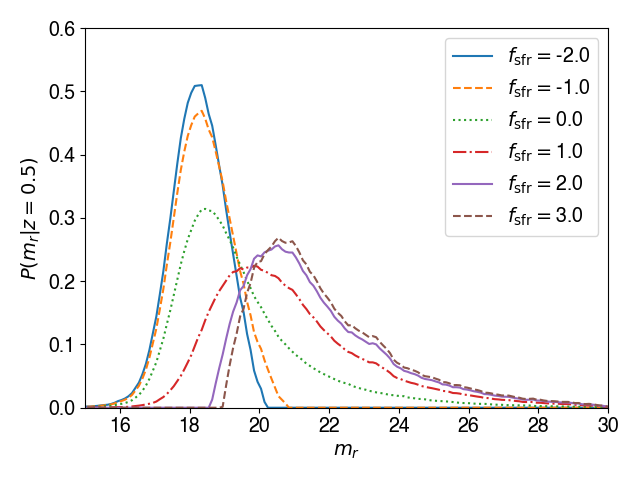
Figure 3: Probability distributions P(z∣DM)4 for various P(z∣DM)5 values using the Loudas25 model, showing the impact of star formation weighting on magnitude distributions.
3. Naive Model
Assumes an arbitrary, parameterized distribution of absolute magnitudes P(z∣DM)6, modulated by a simple P(z∣DM)7-corrected luminosity distance scaling. This maximally flexible model provides a prior-independent baseline, quantifying how much the data alone dictate the apparent magnitude distribution in the absence of any theoretical prejudice.
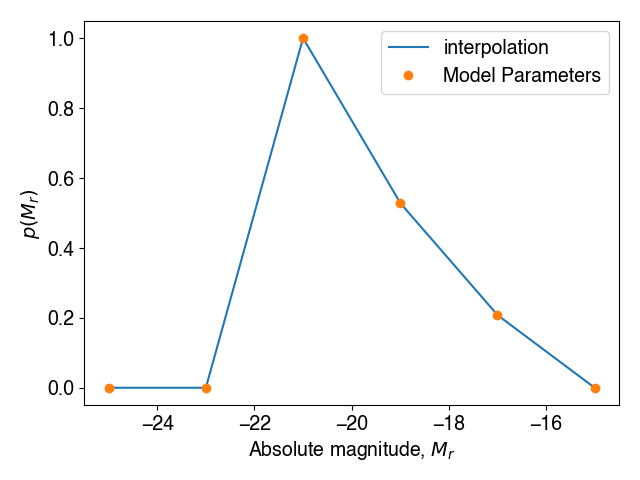
Figure 5: Fitted distribution of best-fit absolute magnitudes P(z∣DM)8 for the Naive model, using flexible binning and interpolation.
Likelihood Fitting and Discriminative Power
Each model is fit to the observed candidate host magnitudes and localization posteriors for the CRAFT/ICS FRBs. The Marnoch23 empirical model, with no free parameters, and the highly parameterized Naive model both provide excellent fits to the observed host magnitude distribution. The Loudas25 model's optimal fit requires P(z∣DM)9, signifying a host distribution even fainter than that predicted by pure SFR weighting, and strongly disfavors both SFR-only (P(mr∣z)0) and mass-only (P(mr∣z)1) models.
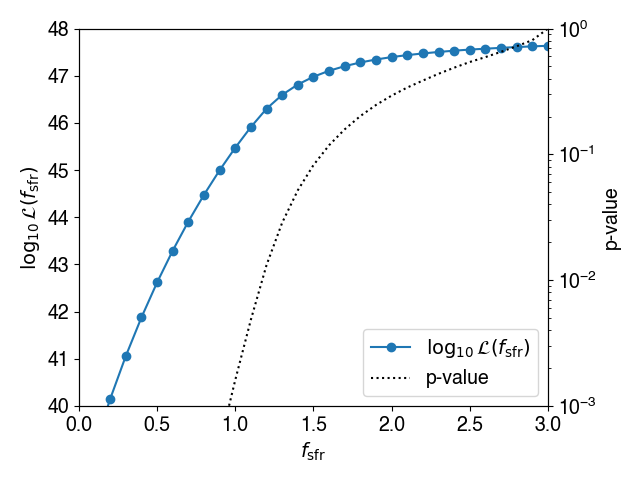
Figure 7: Fitted log-likelihood of the Loudas25 model as a function of P(mr∣z)2, highlighting a preference for P(mr∣z)3 (fainter hosts than SFR weighting).
Key quantitative results demonstrate:
- The host magnitude distribution is significantly fainter than that predicted by SFR weighting alone (p~0.12%), and mass weighting is decisively excluded (P(mr∣z)4).
- Model-agnostic likelihood and KS-like statistics marginally favor the Naive and Marnoch23 models.
- At low redshift (P(mr∣z)5), all models converge; at higher redshift, model predictions diverge, underscoring the critical need for more high-P(mr∣z)6 localizations.
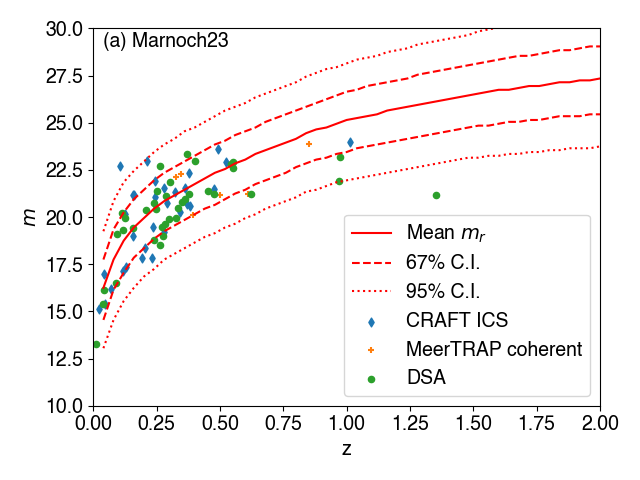
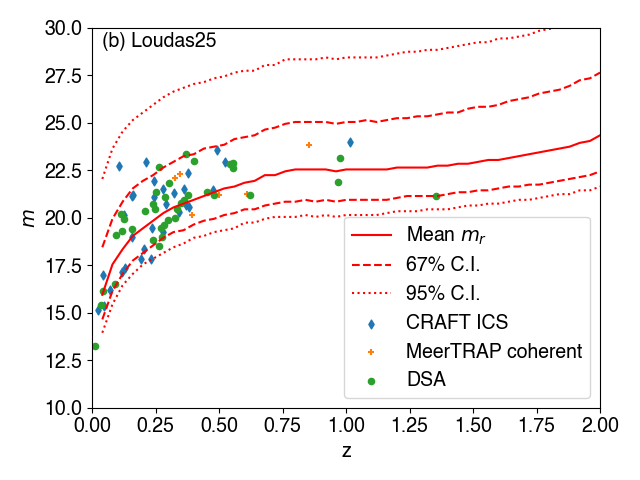
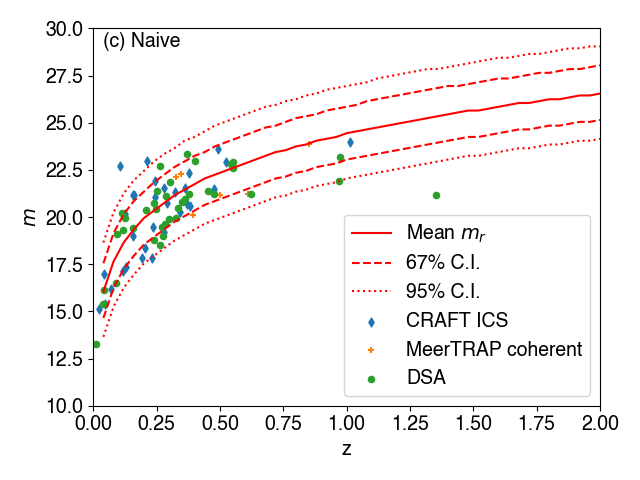
Figure 4: Mean and confidence intervals for FRB r-band host galaxy magnitude as a function of redshift for all models, with observed host galaxies overplotted.
Impact on Host Assignment and Priors
Integrating these magnitude models into PATH yields systematic increases in the posterior confidence for most probable host candidates compared to earlier analyses using ad hoc priors. In several cases previously considered 'non-firm', posterior probabilities for the most likely candidate rise above conventional firm association thresholds.
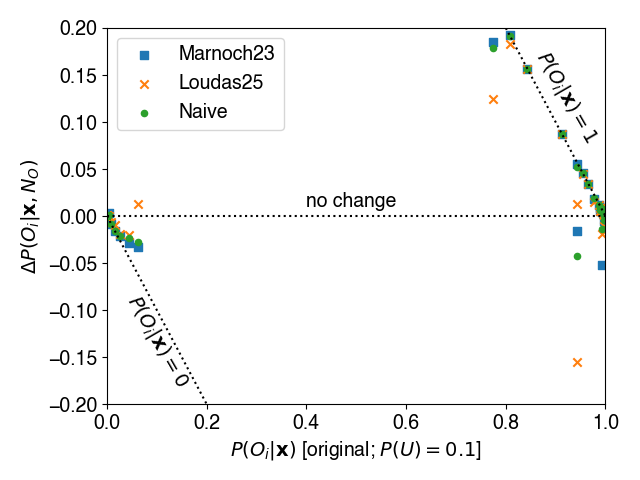
Figure 10: Change in posterior confidence for candidate hosts relative to previous priors, indicating consistent promotion of likely host candidates.
Additionally, the updated approach clarifies that the prior probability of a host being unobserved (P(mr∣z)7) is highly DM-dependent, especially when image depth and FRB dispersion span a broad dynamic range. Figure 11 illustrates this pronounced DM dependence, with deeper imaging (VLT/FORS2) substantially reducing P(mr∣z)8 even at moderate DM, while shallow imaging (Pan-STARRS) admits high probabilities of missed hosts.
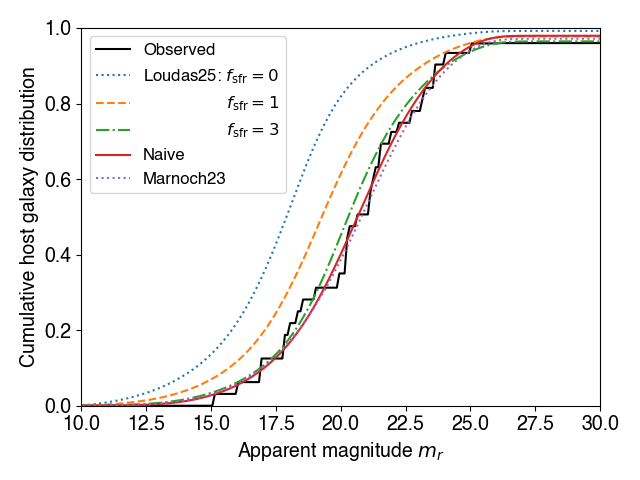
Figure 6: Cumulative observed and prior distributions in P(mr∣z)9 across models, revealing how the best-fit model aligns observed and expected distributions.
Implications and Future Directions
Theoretical Insights
The result that FRB host galaxies are fainter—i.e., less massive and/or less star-forming—than general SFR- or mass-weighted populations challenges simple progenitor models where FRBs directly track stellar explosions or mergers. This may suggest:
- Selection effects against FRBs in high-mass (more scattering, less detectability) hosts.
- Intrinsic preference for specific host conditions (e.g., metallicity, environment) not captured by SFR or mass alone.
Methodological Recommendations
For FRB samples with wide DM and depth variation, fixed unseen priors are inappropriate. Priors must be tailored per event, informed by the apparent-magnitude models presented here (preferably Marnoch23 by default), to achieve robust host associations.
Future Prospects
- Models incorporating multi-band photometry and explicit metallicity or delay-time weighting could disentangle environmental factors further.
- Extension to include redshift information in the inference loop offers the prospect of simultaneously constraining FRB population statistics and host demographics.
- Incorporating deep samples from DSA, MeerKAT, and future CHIME localizations at high redshift will be vital in testing model extrapolations.
Conclusion
This work presents a significant methodological advance in FRB host galaxy identification, embedding physically and empirically informed priors within the BAYESIAN PATH framework. The findings firmly establish that the true population of FRB host galaxies is fainter than naive extrapolations from SFR or mass weighting, with empirical data favoring a more complex, environment- or selection-biased scenario. The approach reaffirms and strengthens current host associations, delivers more principled estimates of missed hosts, and paves the way for next-generation joint analyses of progenitor channels, population evolution, and cosmological applications.