- The paper shows that large boson occupation numbers alone do not imply classical field behavior, emphasizing the need for a coherent state structure.
- It employs numerical sampling of random state vectors with varied coefficient distributions to quantify classicality using the ratio of fluctuations to field expectation.
- The study highlights significant implications for modeling ultra-light dark matter and Bose-Einstein condensates, suggesting robust state preparation or decoherence mechanisms are essential.
Identical Bosons, Large Occupation Numbers, and the Limits of Classical Field Descriptions
Introduction
This work rigorously addresses a foundational assumption common in both theoretical modeling and phenomenological analysis of systems with many identical bosons: the identification of regimes with large mean occupation number in a single mode with the validity of a classical field description. This assumption underlies, for instance, the application of classical field equations in the modeling of ultra-light dark matter (ULDM), Bose-Einstein condensates, and axion-like particle detection experiments. However, it is not self-evident that merely possessing a high mean occupation number is sufficient for classicality. The paper provides numerical and conceptual analysis, focusing on the statistical properties of arbitrary bosonic states and quantifies the degree of classicality via the criterion 2σφ<∣⟨φ⟩∣.
Structure of State Space and Classical/Quasi-Classical Criteria
The quantum state space for N identical bosons distributed over several modes is isomorphic to symmetric tensor powers of the single-particle Hilbert space. Importantly, each mode admits a basis of Fock states, and the state vector in a single mode can be expanded as ∣ψ⟩=∑ncn∣n⟩, with cn complex coefficients constrained by normalization. Classical field-like behavior is expected when quantum fluctuations are subdominant to the field expectation value, i.e., when σφ/∣⟨φ⟩∣ is small. Notably, in coherent states, this ratio decreases as the occupation number increases, scaling as 1/(2∣α∣), with ⟨N⟩=∣α∣2.
The crucial observation is that while coherent states with large occupation exhibit classical behavior, Fock states—even with large n—do not: for these, ∣⟨φ⟩∣=0, making the ratio undefined or dominated by fluctuations.
Statistical Analysis of Generic Bosonic States
The central analysis consists of generating high-dimensional random state vectors and evaluating their classicality properties based on the above criterion. Different ensembles are used for the coefficients cn: uniformly sampled on N0 (Case I), N1 (Case III), and states with Gaussian noise around a coherent state profile. The central goal is to statistically probe the prevalence (or rarity) of classical-like behavior in generic states with large mean occupation.
When the coefficients N2 are sampled with both signs (Case I), almost all states with large mean occupation have small N3 and large N4, making classicality statistically negligible. The ratio N5 is typically N6, and only in exceedingly rare circumstances does it approach the expected coherent state value of N7 for N8.
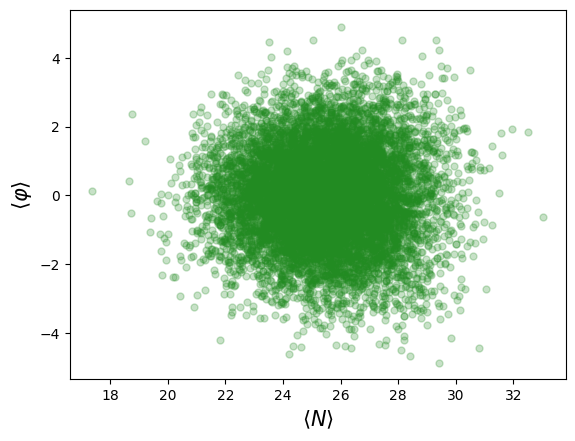
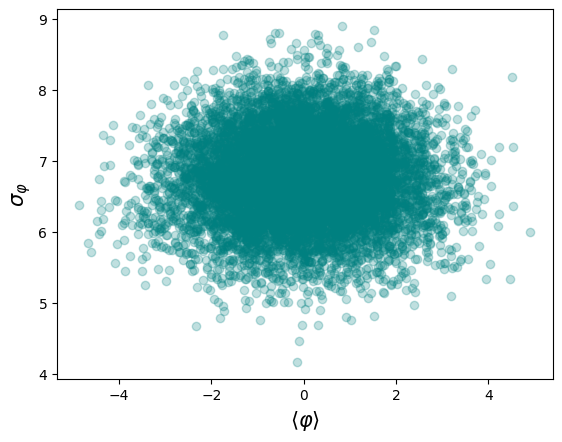
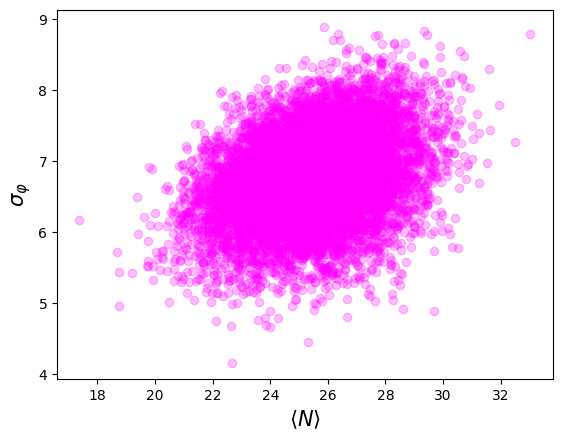
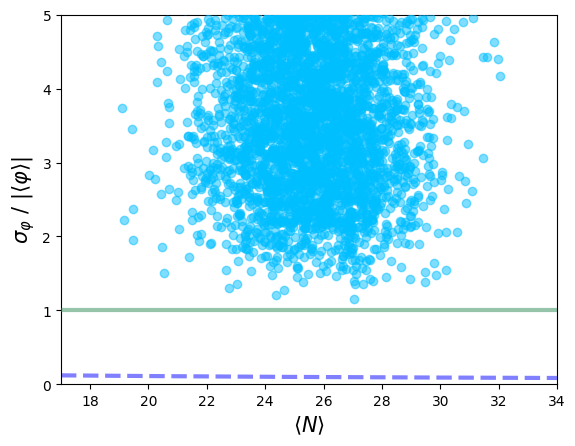
Figure 1: For random states with coefficients N9 uniformly distributed in ∣ψ⟩=∑ncn∣n⟩0, there is no significant correlation between large mean occupation number and classical field behavior; the parameter ∣ψ⟩=∑ncn∣n⟩1 is generically large.
Restricting to positive ∣ψ⟩=∑ncn∣n⟩2 (Case III) introduces weak correlations; classicality becomes more probable but still rare. The majority of such states, even with ∣ψ⟩=∑ncn∣n⟩3 large, do not approach the classical limit unless ∣ψ⟩=∑ncn∣n⟩4 are specifically correlated, such as in the coherent state case.
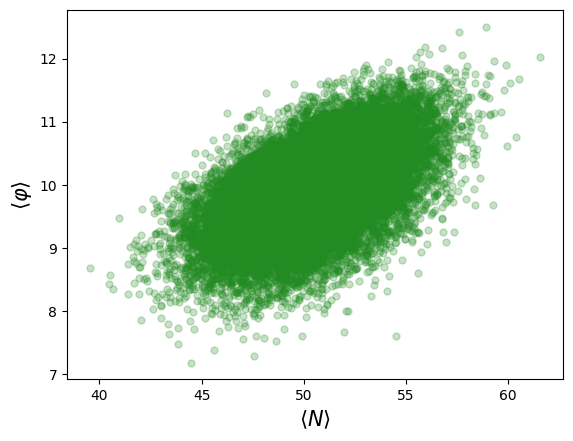
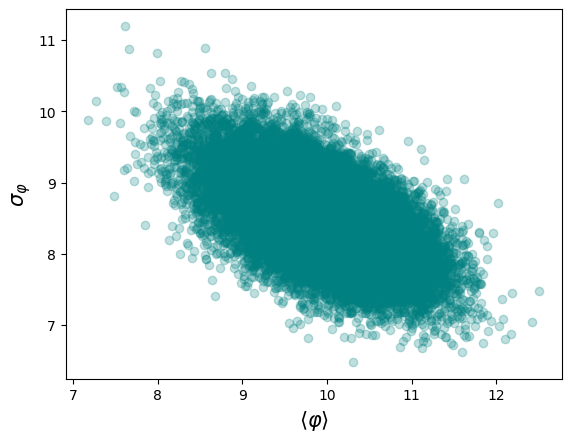
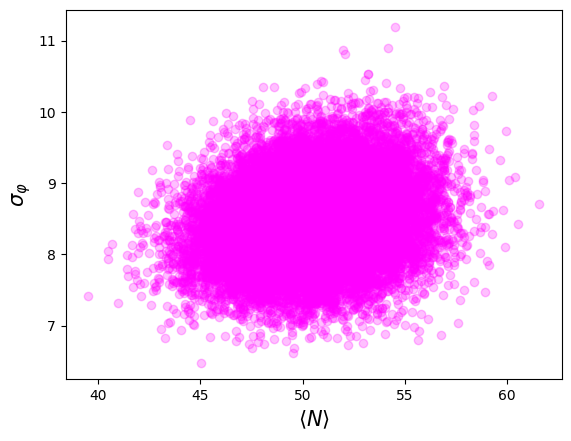
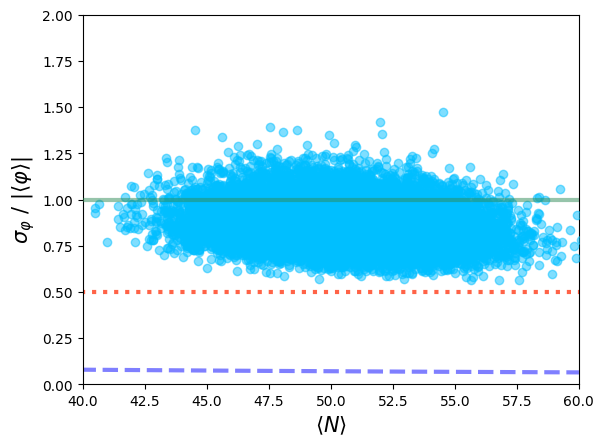
Figure 2: When coefficients ∣ψ⟩=∑ncn∣n⟩5 are uniformly distributed on ∣ψ⟩=∑ncn∣n⟩6, weak correlations between mean occupation and field expectation arise, but only a small fraction of states approach classicality.
Proximity to Coherent States and Onset of Classicality
A controlled interpolation is carried out between coherent states and random states by adding Gaussian fluctuations parameterized by ∣ψ⟩=∑ncn∣n⟩7 (the noise-to-signal ratio per coefficient) to the coherent state coefficients (Case IV). As ∣ψ⟩=∑ncn∣n⟩8 increases, the proportion of states satisfying the criterion for classicality rapidly diminishes. For small ∣ψ⟩=∑ncn∣n⟩9 (e.g., 0.1), nearly all states are classical; for cn0, a minority (cn1) remain classical, while for cn2, classicality is essentially absent in large samples, even at cn3.
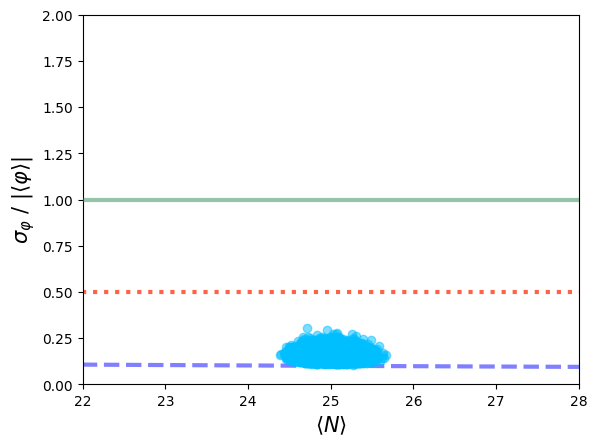
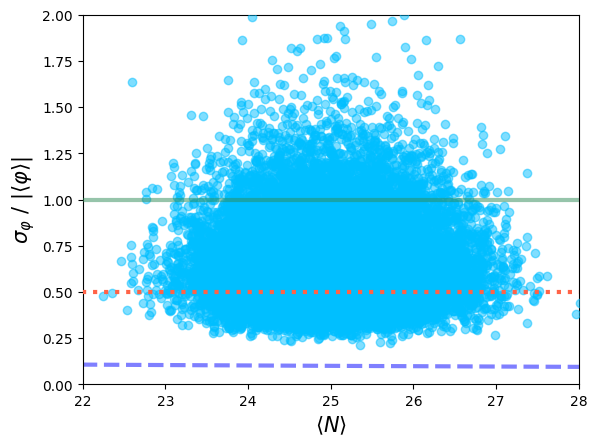
Figure 3: Classicality, as measured by cn4, is rapidly lost as state vectors deviate from the coherent state profile even at moderate or large mean occupation.
Implications and Theoretical Significance
Key Claim: Large occupation number alone is insufficient for the validity of a classical field description; proximity to a coherent state structure is necessary and, empirically, almost all random high-occupation states are non-classical.
The practical implication is severe for many modeling approaches in cosmology and condensed matter physics. For ULDM, predictions relying on classical field equations are justified only if there is credible mechanism for the initial conditions or dynamical evolution to populate the coherent state manifold or a proximate subset. Mechanisms such as decoherence or specific interactions may be necessary to dynamically select such states, but these require additional physical input and cannot be taken as granted solely by appealing to large occupation numbers.
On the theoretical side, this analysis demonstrates that the classical phase space—parameterized by a small subset (real amplitudes and phases per mode)—is a measure-zero manifold in the exponentially larger quantum Hilbert space. Thus, the default assumption for high-dimensional macroscopic bosonic systems should be non-classicality unless specific mechanisms are identified. This has immediate bearing on interpreting data from experiments sensitive to wave coherence, as well as on the interpretation of simulation results for quantum fluids and dark matter models.
Future Directions
Further investigation into the role of environment-induced decoherence as a mechanism for selecting quasi-classical pointer states is warranted, potentially extending the analysis beyond pure states and considering the decoherence timescales and interaction-driven localization in phase space. Extensions to multi-mode systems, finite temperature ensembles, and mixed states would improve the generality of these conclusions. The framework may also be quantitatively extended to non-Gaussian states or investigate possible exceptions in squeezed or correlated states.
Conclusion
This study establishes, through explicit numerical sampling and statistical arguments, that the oft-invoked classicality of highly occupied bosonic modes is not a generic property but demands the state closely resemble a coherent state. Classical field descriptions in such systems thus require either careful state preparation or robust dynamical mechanisms favoring the classical manifold; absent these, quantum fluctuations dominate most of state space regardless of occupation number. These insights necessitate caution in interpreting simulation and phenomenological results in the context of ultralight bosonic dark matter and related applications.