- The paper demonstrates that engine-driven, metal-poor Type Ic supernova SN 2026gzf exhibits a failed jet breakout with energy deposited in the stellar envelope and circumstellar material.
- It employs multiwavelength light-curve analysis and radiative transfer modeling to estimate ejecta mass (~7 M☉), kinetic energy (~2×10^52 erg), and nickel mass (~0.28 M☉).
- The study’s spectroscopic and environmental analysis rules out on-axis and most off-axis jets, supporting choked jet models in massive stars.
Observational Context and Motivation
The study targets the energetic end stages of massive stars leading to broad-lined type Ic supernovae (Ic-BL SNe), focusing on the role of relativistic jets and their electromagnetic manifestations. While associations between Ic-BL SNe and gamma-ray bursts (GRBs) are well-established, the lack of jet signatures in many Ic-BL SNe has led to divergent theoretical interpretations, including off-axis GRBs, choked jets, and intrinsic suppression mechanisms. SN 2026gzf provides a unique observational testbed due to its clean association with a soft X-ray shock-breakout (Einstein Probe EP260321a at z=0.0343), the absence of non-thermal emission, and early high-cadence multiwavelength coverage.
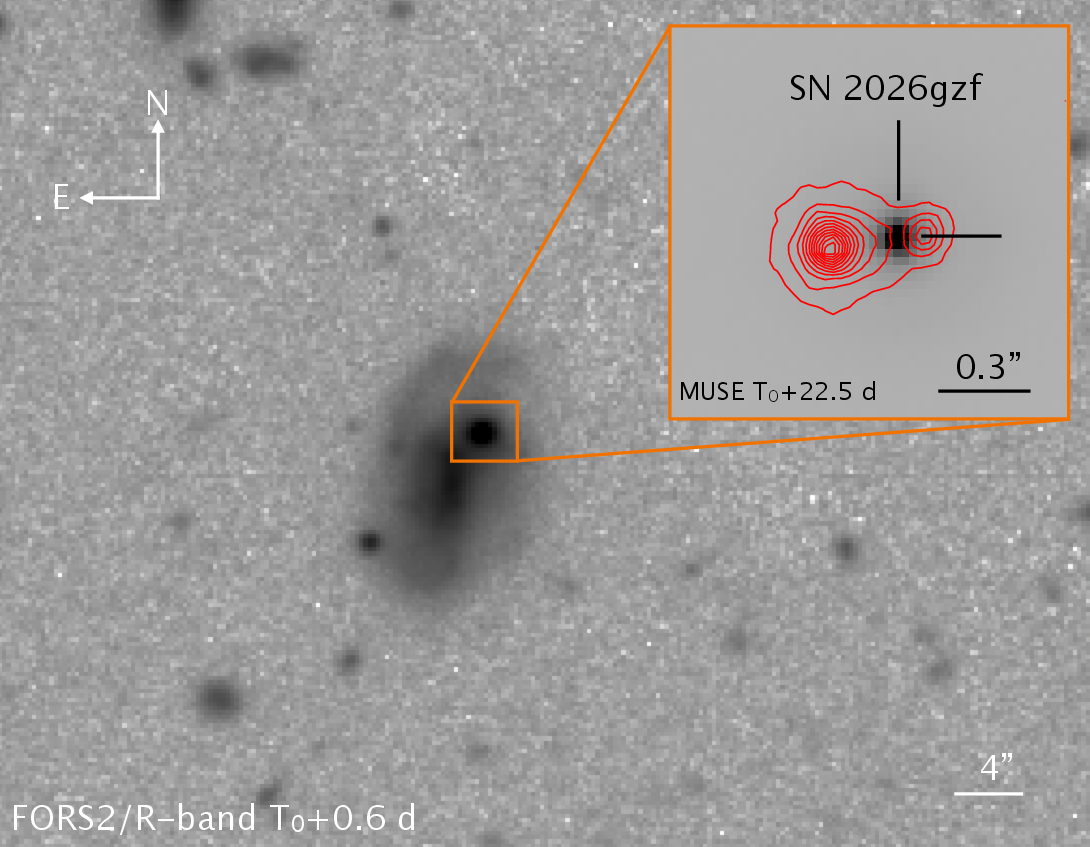
Figure 1: Identification and precise localization of SN 2026gzf within its host galaxy, highlighting the immediate star-forming environment via Hα emission mapping.
Multi-band Light Curves and Energy Source Decomposition
The optical/NIR light curve exhibits canonical 56Ni-powered evolution with an excess in the pre-peak rising phase, inconsistent with pure radioactive models. Rigorous modeling incorporating circumstellar material (CSM) interaction is required to fit the early excess, invoking a shell of ∼0.07 M⊙ at %%%%5∼6%%%%1013 cm. The derived SN properties from this hybrid model are: a total kinetic energy of %%%%8569α010%%%% erg, ejecta mass α17 Mα2, and α3Ni mass α40.28 Mα5—all firmly within the GRB-associated Ic-BL SN regime. Notably, the initial light curve decline is ascribed to shock-breakout cooling, but classical shocked cocoon or strong thermal precursors are undetectable.
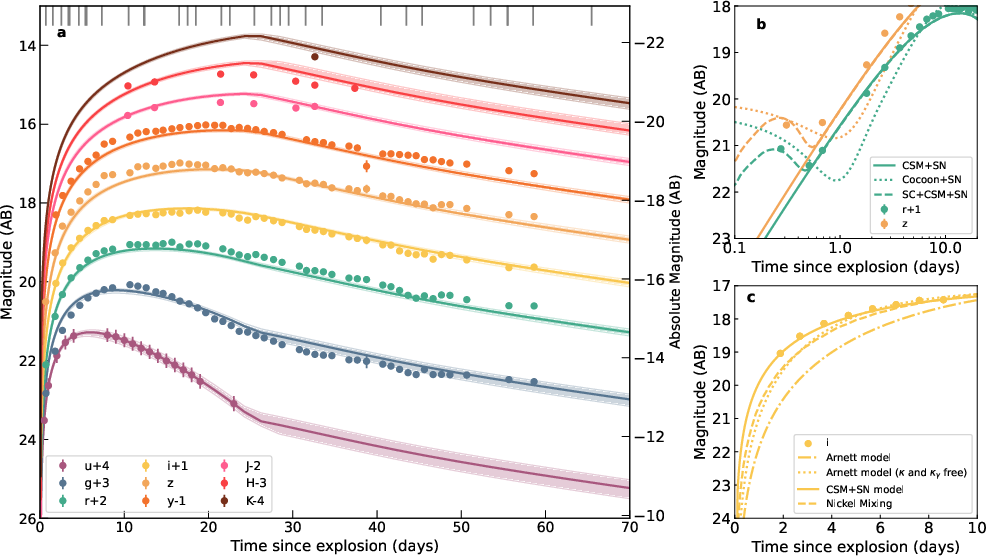
Figure 2: Multi-band light curves and best-fitting radiative transfer models delineate CSM interaction as crucial to explaining the rising-phase excess.
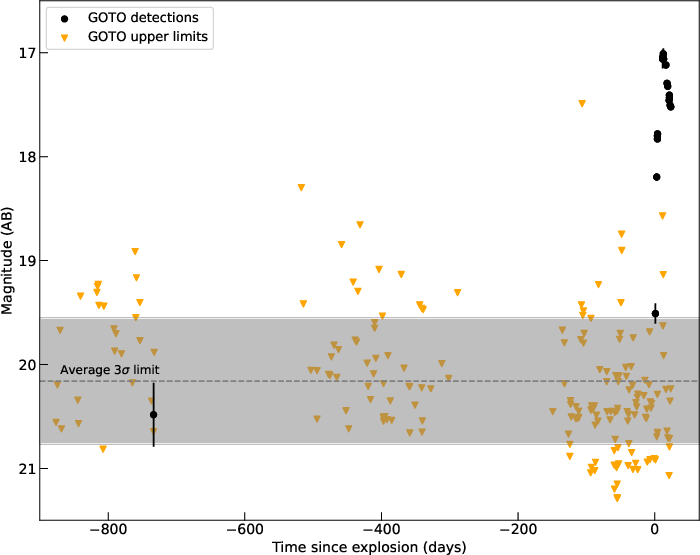
Figure 3: GOTO pre-explosion monitoring demonstrates deep non-detections prior to the event, ruling out precursor outbursts at α6.
Spectroscopic Signatures and Velocity Profile
Early spectroscopy at α7 d reveals a featureless, hot (α815,000 K) continuum, consistent with shock-cooling emission. Subsequent phases present canonical broad-lined features (Ca II, Mg II, Fe II, Si II) and blended He I/Na I at velocities α933,000 km/s, with a measurable power-law decline index of 560. The photospheric radii expand linearly at 5610.06 562, matching the characteristic velocities of engine-driven Ic-BL SNe.
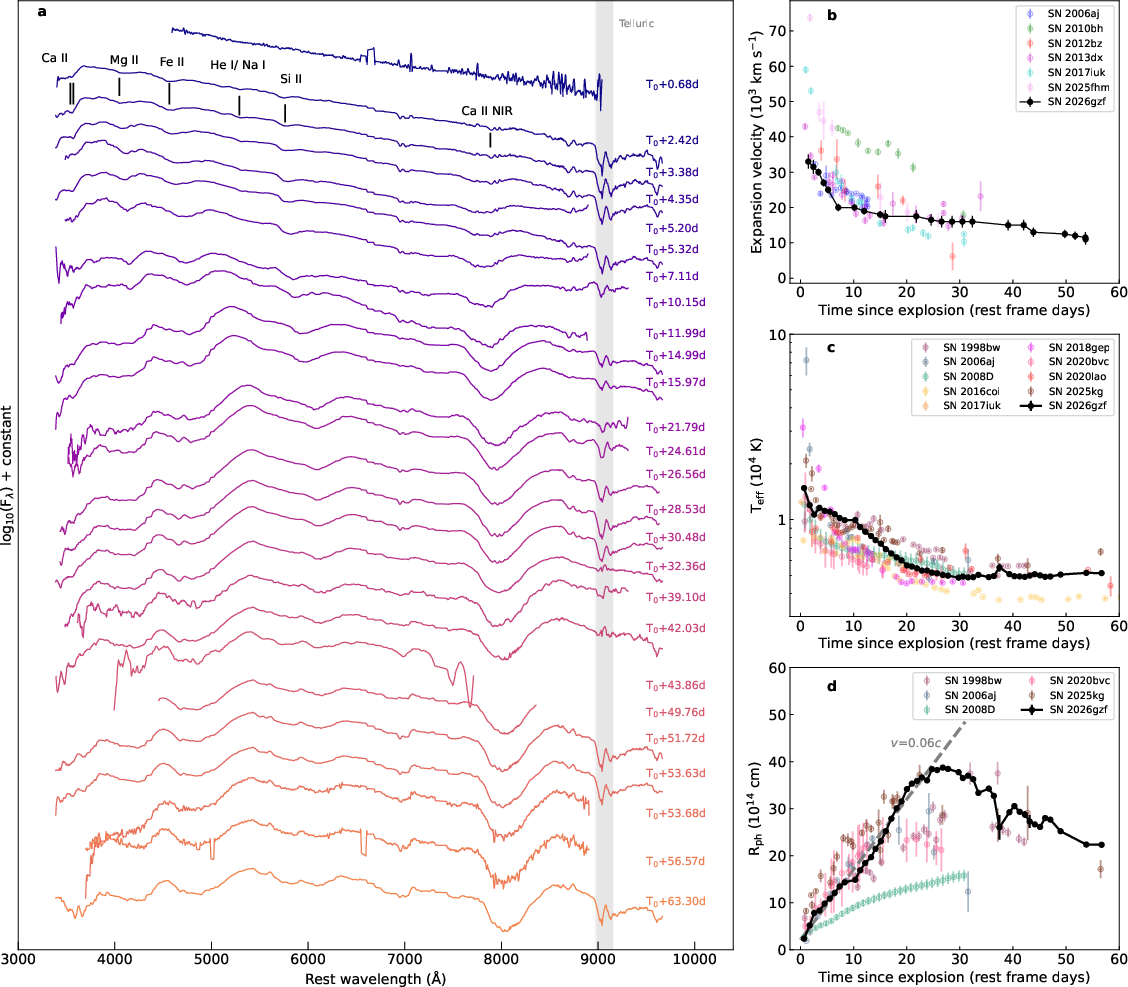
Figure 4: Temporal spectral evolution, velocity, temperature, and radius profiles compared to the GRB-SN population, demonstrating similar expansion but a lack of early high-velocity outliers.
Limits on Relativistic Jet Activity
Radio non-detections at two epochs through VLA up to 563 d place stringent upper limits on any jet afterglow. By comparing the derived 564–565 parameter space for jets in both ISM and wind-stratified circumstellar profiles, the data decisively exclude on-axis jets and rule out off-axis jets except for viewing angles 566 (in the faintest scenarios) or 567 (for standard jet energies and densities). Structured jet geometries would only strengthen these constraints.
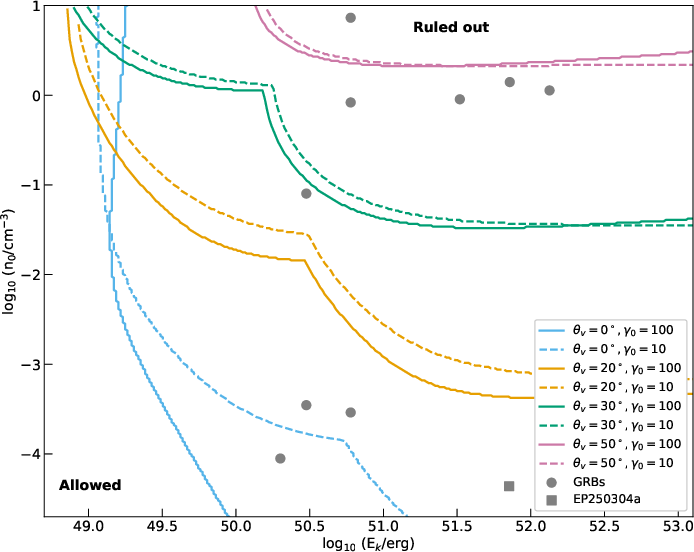
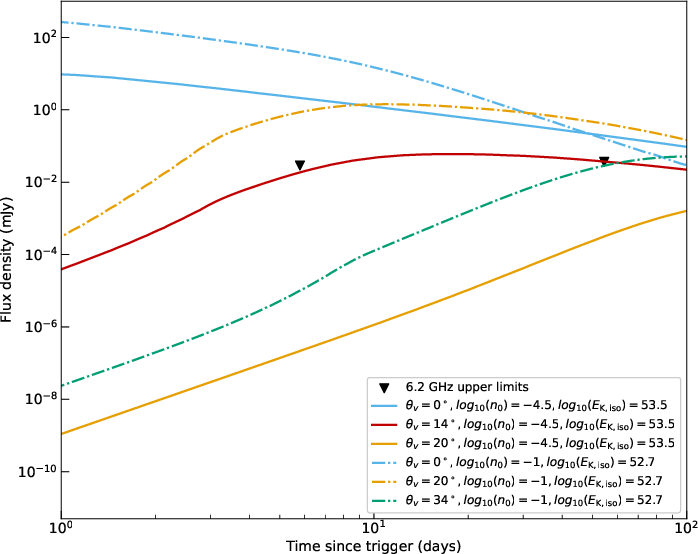
Figure 5: Jet kinetic energy versus circumburst density constraints, corroborating the non-detection of any relativistic afterglow and excluding a broad range of off-axis jet parameters.
Environmental Analysis and Progenitor Constraints
Integral field MUSE spectroscopy and resolved mapping reveal that SN 2026gzf exploded between two distinct H II regions in an especially blue, high-sSFR (56827 M569yr∼0(L/L*)∼1) pocket with essentially absent extinction. The metallicity at the explosion site, 12+log(O/H)∼2, is lower than any previously reported for a Ic-BL SN or GRB-SN association. The host is a low-mass (∼3), actively star-forming dwarf.
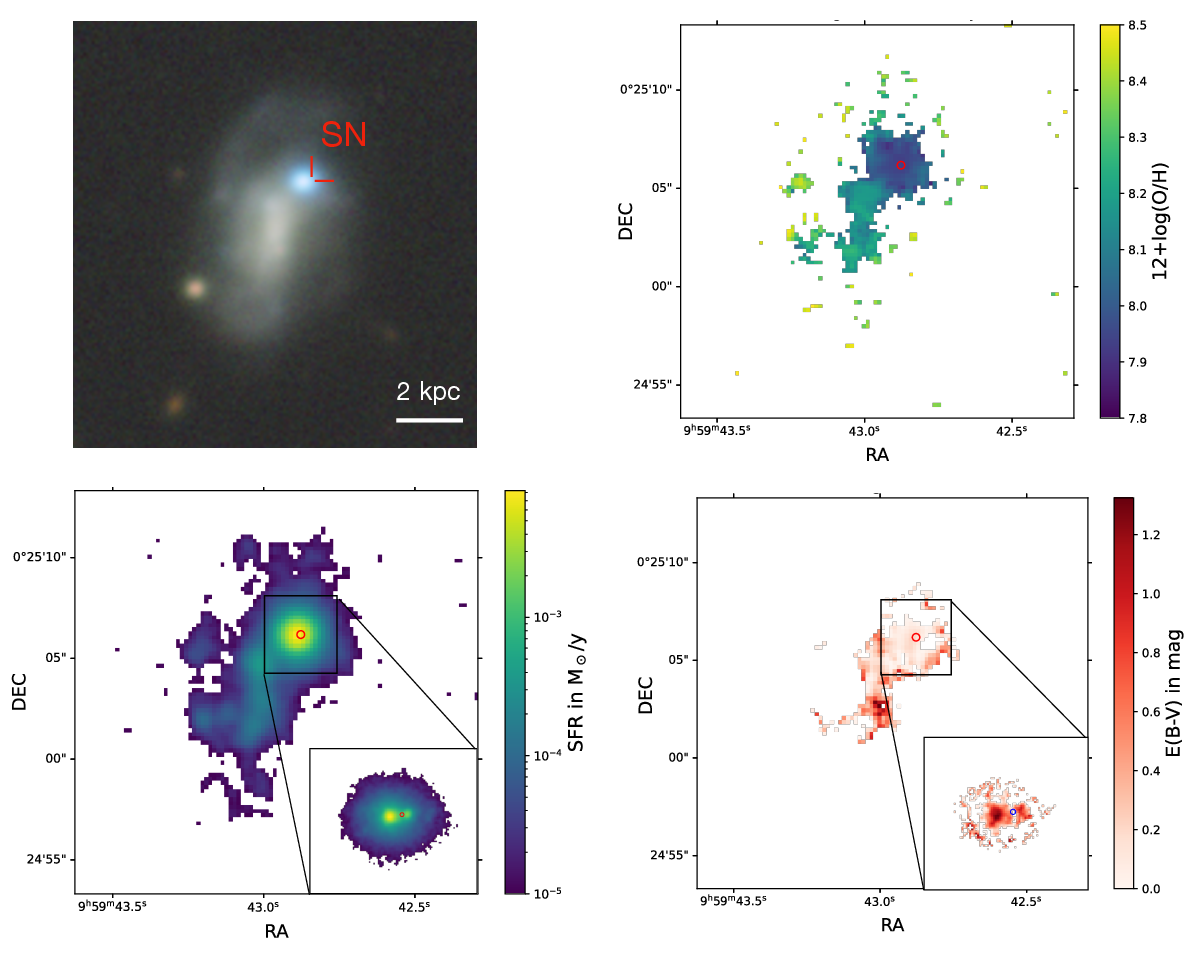
Figure 6: High-resolution color imaging and emission line mapping of the host galaxy pinpointing the SN location at the critical interface of star formation and metallicity minima.
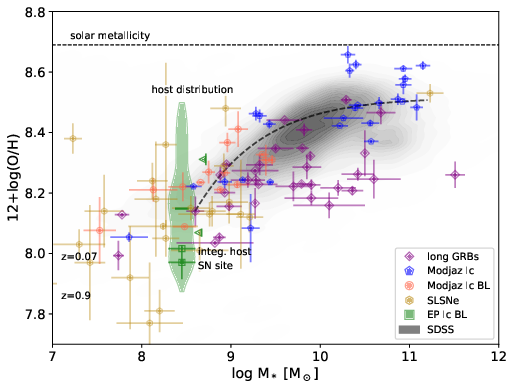
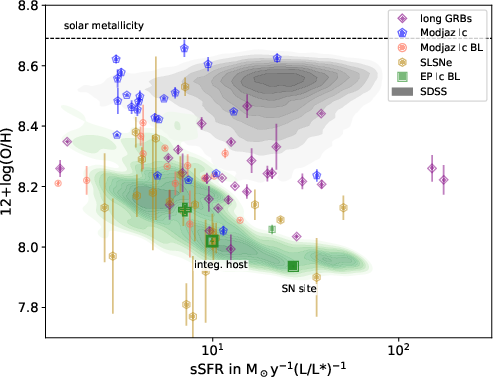
Figure 7: Host metallicity and sSFR distributions compared to Ic/Ic-BL, long-GRB, and SLSN populations, highlighting SN 2026gzf as a metallicity outlier.
Comparative Energetics and Progenitor Mass Inference
The kinetic energy, ejecta mass, and nickel mass are consistent with previously observed energetic Ic-BL SNe associated with jets, yet strong signatures of a relativistic jet are absent. Modeling constrains the zero-age main sequence (ZAMS) mass to ∼4–∼5 M∼6 under single-star evolution assumptions, closely approaching the theoretical direct-collapse regime. The derived mass-loss rate from the CSM is anomalously high (∼77.5 M∼8 yr∼9 for ⊙0 km s⊙1), exceeding that of H/He-free Wolf-Rayet steady winds by several orders of magnitude, suggesting late-stage eruptive episodes.
Lack of Shocked Cocoon and Implications for Jet Dynamics
A critical result is the absence of a luminous, lasting, early shocked cocoon emission that typifies SNe with successful jet breakout. The lack of both X-ray/radio afterglows and early optical excess—not explainable by CSM interaction or radioactive power—contradicts expectations from both off-axis and "hidden" GRB scenarios. Instead, the energetics and environment suggest a powerful choked jet that deposited energy into the stellar envelope and CSM without breaking out—an observationally confirmed "failed jet" case as predicted by models (e.g., [Hamidani et al. 2025]). The resultant engine energetics and high ejecta velocities naturally arise from this coupling, with the observed EP260321a X-ray thermal event matching choked-jet breakout predictions.
Broader Implications and Rates
The measured rate of such soft-X-ray shock-breakout-accompanied Ic-BL SNe derived from a single detection is ⊙2, statistically consistent with the local Ic-BL SN rate. This suggests that a significant fraction of engine-driven SNe may fail to launch observable relativistic outflows, with implications for the census of GRB progenitors and their energy coupling processes. The extreme low metallicity and high sSFR at the explosion site reinforce models favoring environments conducive to massive, rapidly evolving progenitors.
Conclusion
SN 2026gzf provides compelling empirical evidence for the failed jet scenario in engine-driven, metal-poor Ic-BL SNe. The absence of early shocked cocoon and relativistic afterglow signatures, combined with high kinetic energy and fast expansion in a highly stripped, low-metallicity progenitor, definitively distinguish this event from classical GRB-SN analogs. These results support theoretical models whereby central engines launch jets that may be choked in the stellar envelope/CSM, depositing energy efficiently without a successful breakout. This scenario fills a crucial gap between classical GRBs and non-relativistic Ic-BLs and constrains progenitor properties, circumstellar structure, and late-stage mass loss. The work sets a robust framework for interpreting future high-cadence, multiwavelength SN discoveries in the era of sensitive X-ray transients and large optical surveys.
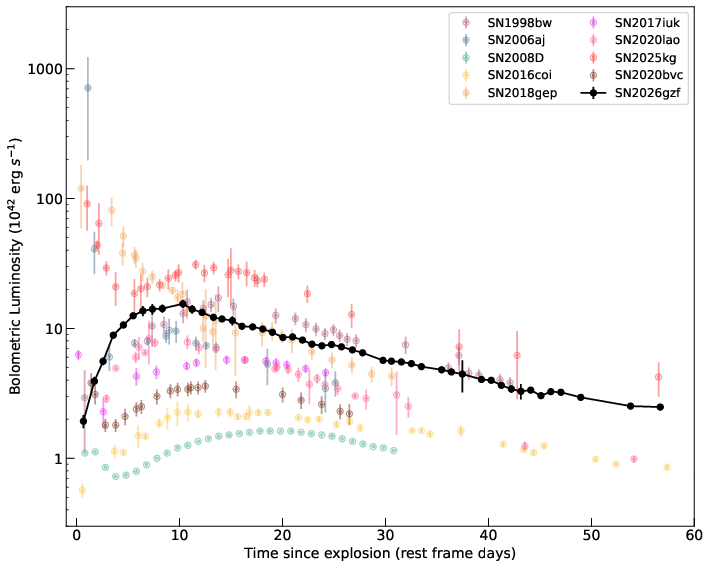
Figure 8: Bolometric luminosity comparison for SN 2026gzf and relevant SN subtypes demonstrates the absence of a prominent early cocoon phase.
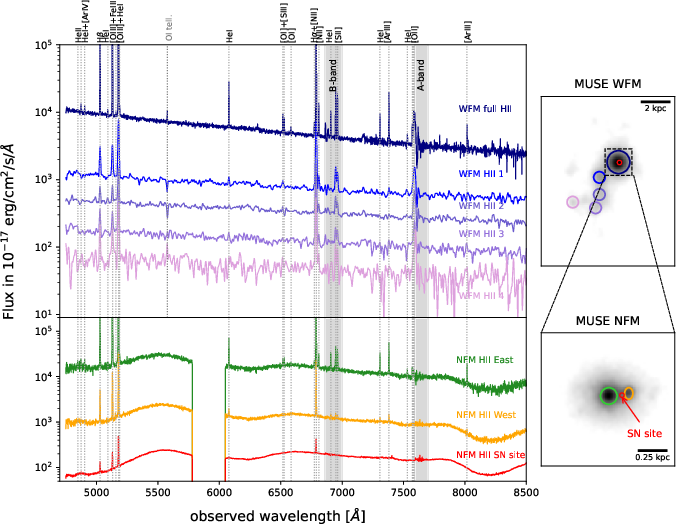
Figure 9: Resolved integrated spectra and H⊙3 maps across the host reveal a uniformly low metallicity and intense star-forming environment at the explosion site.

