- The paper’s main contribution is the formulation of a unified random matrix model that computes Weil-Petersson volumes for super-Riemann surfaces with both NS boundaries and R punctures.
- It employs spectral curve construction and topological recursion to derive explicit closed-form expressions for correlators and WP volumes.
- The results offer practical computational tools for super JT gravity and reveal universal structural relations in the geometry of supermoduli spaces.
Weil-Petersson Volumes for Super-Riemann Surfaces with NS Boundaries and R Punctures via Random Matrix Models
Overview
The paper "Ramond from Random: Weil-Petersson Volumes for Super-Riemann surfaces with NS Boundaries and R Punctures" (2606.09990) presents a unified random matrix model framework for computing Weil-Petersson (WP) volumes on moduli spaces of N=1 super-Riemann surfaces, generalizing the standard approach to simultaneously incorporate both Neveu-Schwarz (NS) boundaries and Ramond (R) punctures. The author formulates the spectral curve and topological recursion data for this problem and establishes explicit closed-form expressions for large classes of these volumes, highlighting deep interrelations and new structural properties within the intersection theory of super-moduli spaces relevant for the low-dimensional supersymmetric gravitational path integrals, notably super Jackiw-Teitelboim (JT) gravity.
String Equation, Matrix Model, and the Role of Ramond Punctures
Traditionally, WP volumes of moduli spaces with NS boundaries have been connected to matrix model integrable systems associated with the KdV and Brezin-Gross-Witten (BGW) hierarchies. This is captured via the so-called string equation:
uR2−2ℏ2RR′′+4ℏ2(R′)2=ℏ2Γ2,
where u(x) encodes the background geometry, R is a generating function for the Gel'fand–Dikii polynomials, and Γ is a deformation parameter counting R-puncture (Ramond) insertions.
For Γ=0, this equation describes the pure NS sector, previously mapped to super Schwartizan spectral data of N=1 JT gravity. Introducing Γ=0 within this framework directly incorporates R punctures, allowing both types of boundary/pointlike insertions to be treated on an equal footing. The key insight is that Γ, after appropriate scaling, naturally counts extended Ramond punctures or flux insertions, thus abstracting the topological data to a matrix model deformation parameter.
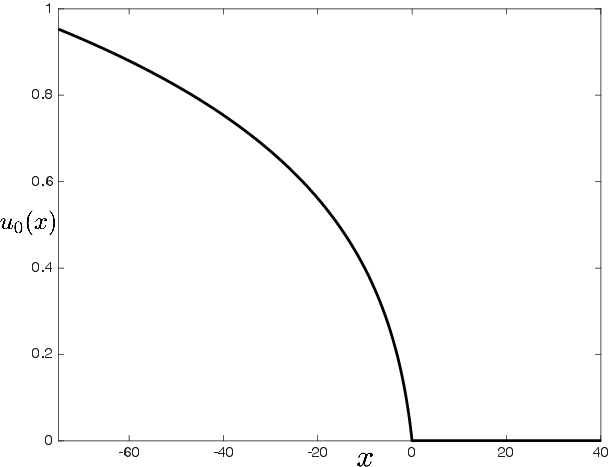
Figure 1: u0(x) for the purely NS case, solving the classical string equation without Ramond insertions. The support is restricted to uR2−2ℏ2RR′′+4ℏ2(R′)2=ℏ2Γ2,0.
This approach realizes both the NS and R sectors as deformation classes of the same integrable system, offering a more tractable computation of associated spectral correlators and intersection numbers than direct algebraic-geometric methods.
Explicit Construction: Spectral Curve and Topological Recursion
The construction proceeds by determining the leading piece uR2−2ℏ2RR′′+4ℏ2(R′)2=ℏ2Γ2,1 of uR2−2ℏ2RR′′+4ℏ2(R′)2=ℏ2Γ2,2 in the small uR2−2ℏ2RR′′+4ℏ2(R′)2=ℏ2Γ2,3 limit. For mixed NS/R boundaries, uR2−2ℏ2RR′′+4ℏ2(R′)2=ℏ2Γ2,4 solves a deformed nonlinear ODE:
uR2−2ℏ2RR′′+4ℏ2(R′)2=ℏ2Γ2,5
where uR2−2ℏ2RR′′+4ℏ2(R′)2=ℏ2Γ2,6 is a modified Bessel function and uR2−2ℏ2RR′′+4ℏ2(R′)2=ℏ2Γ2,7 is the scaled deformation parameter. This can be interpreted as backreacting the geometry to incorporate R-punctures at the level of the spectral curve data.
The resulting spectral density and, consequently, the spectral curve can be given compactly in terms of uR2−2ℏ2RR′′+4ℏ2(R′)2=ℏ2Γ2,8, enabling the application of topological recursion techniques directly even in the presence of Ramond punctures:
uR2−2ℏ2RR′′+4ℏ2(R′)2=ℏ2Γ2,9
where u(x)0 is a threshold energy determined dynamically in terms of u(x)1.
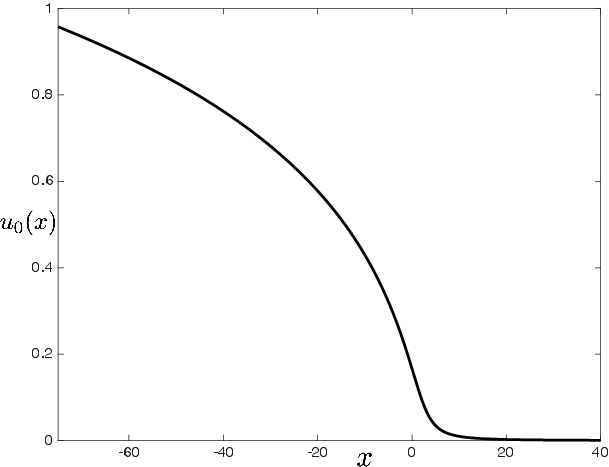
Figure 2: u(x)2 when both NS boundaries and R punctures are present, showing nonzero support in the u(x)3 region reflecting the R sector deformation.
The author demonstrates that topological recursion on this spectral curve, with suitable modification of the Bergman kernel when working in different coordinate conventions ("hard" or "soft" edge), precisely generates the full tower of u(x)4, the correlators encoding WP volumes (and thus intersection numbers) for arbitrary genus u(x)5, number of NS boundaries u(x)6, and number of R-punctures u(x)7.
A central achievement of the paper lies in closed-form expressions for the correlators u(x)8. These formulae are recursively accessible via the string equation solution for u(x)9, and can be immediately Laplace-transformed into WP volumes R0. Highlights include:
- General formulae for R1 with explicit polynomial dependence on R2 (or R3) with known coefficients for all relevant topological data.
- Systematic structural relations among sectors: for example, the genus jump relation R4, hinting at dualities between NS and R insertions.
- Prediction and classification of loci in parameter space where entire volume substructures vanish, generalizing perturbative selection rules.
This closed-form accessibility advances the explicit enumerative geometry of supermoduli spaces, generalizing and refining earlier results in the mathematical literature (e.g., Norbury's recursion for super WP volumes).
Theoretical and Practical Implications
The results supply an explicit, nonperturbative random matrix model for supermoduli spaces with mixed NS and R data. Significant implications include:
- Computability: The explicit spectral curve, with topological recursion data, enables full recursive construction of WP volumes without recourse to ad hoc combinatorial or geometric arguments. This places computations for super JT gravity and related models on the same algorithmic footing as ordinary JT gravity with or without boundary insertions.
- Universality: The framework suggests that inclusion of R punctures (and by extension, other types of boundary/defect insertions in supermoduli theory) can always be encoded within matrix model deformations, generalizable to higher R5 or more intricate compactifications.
- Structural Predictions: Novel predicted relations and vanishing loci in the super WP volume landscape await verification or geometric interpretation, likely informing further connections between intersection theory, supermoduli compactification, and duality phenomena.
- Gravity and Quantum Chaos: From the quantum gravity perspective, this matrix model directly realizes supersymmetric extensions of chaotic spectral statistics, including Ramond sector effects, with possible implications for black hole microstate counting and nonperturbative quantum geometry.
Future Directions
Potential avenues emerging from this work include:
- Extending the approach to higher R6 supergravities and analyzing corresponding matrix model hierarchies.
- Directly relating the spectral curve data to recursion relations in the style of Mirzakhani/Stanford-Witten/Norbury for WP volumes, possibly illuminating a geometric origin for the observed volume relations.
- Exploring modular and wall-crossing phenomena in the space of WP volumes as functions of R7.
- Applying the machinery to compute explicit gravitational amplitudes in super JT gravity with arbitrary boundary and defect insertions.
Conclusion
This paper establishes a comprehensive framework for calculating WP volumes in the presence of both NS boundaries and R punctures, employing a unified matrix model and topological recursion paradigm. The formalism delivers both explicit calculational tools and deep structural insights into the geometry of supermoduli spaces and their role in low-dimensional supersymmetric gravity. Its predictions and methodology set a new standard for rigorous analysis in the intersection of random matrix theory, supersymmetric geometry, and quantum gravity.